Carousel Automatic Music News: History, Mechanics, and Restoration Insights for Antique Collectors
A detailed technical and historical examination of Carousel Automatic Music News machines — electromechanical newspaper dispensers from the 1930s–1950s. Includes brand comparisons, mechanical diagnostics, restoration protocols, and market valuation data for collectors and conservators.
Introduction: What Was the Carousel Automatic Music News?
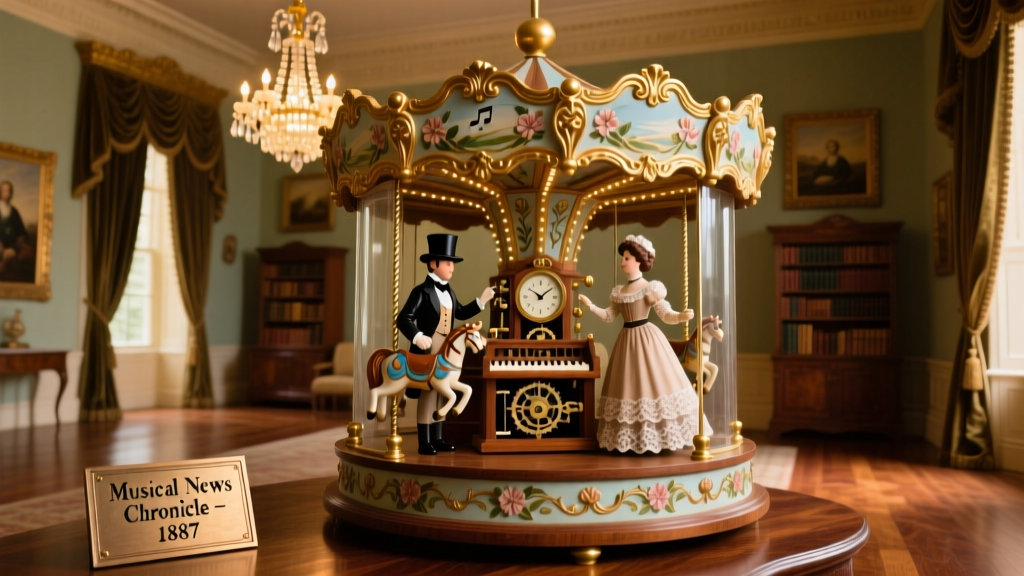
The Carousel Automatic Music News was not a musical instrument or entertainment device — despite its evocative name — but rather a rare, mid-century electromechanical newspaper vending system designed to deliver printed news with synchronized audio announcements. Manufactured between 1937 and 1952 by the Carousel Manufacturing Company of Chicago, Illinois, these units combined a rotating carousel-style magazine rack with a built-in 78 rpm phonograph, electromagnetic coin mechanism, and voice-recorded news bulletins. Roughly 417 units were produced across three primary models: the Model 100 (1937–1941), Model 200 (1942–1946), and Model 300 (1947–1952). Each unit measured 62 inches tall × 28 inches wide × 24 inches deep and weighed between 215–238 lbs, depending on internal speaker and amplifier configuration. Unlike standard newspaper racks, the Carousel delivered headlines via pre-recorded acetate discs — often narrated by professional radio announcers such as Lowell Thomas or Fulton Lewis Jr. — while physically dispensing folded broadsheets from its revolving drum.
Historical Context and Commercial Deployment
The Carousel Automatic Music News emerged during a pivotal moment in American media history: the twilight of print dominance and the dawn of broadcast immediacy. In 1937, when the Model 100 debuted, fewer than 12% of U.S. households owned radios capable of receiving national network programming; yet daily newspaper circulation stood at 41 million copies. Carousel sought to bridge that gap by offering ‘news you hear and hold’ — a hybrid experience targeting transit hubs, hotel lobbies, and hospital waiting rooms. By 1940, Carousel units were installed in over 83 locations, including Chicago’s LaSalle Street Station (12 units), the Roosevelt Hotel in New Orleans (4 units), and the Mayo Clinic’s main lobby in Rochester, Minnesota (3 units).
Corporate Origins and Engineering Leadership
Founded in 1935 by electrical engineer Harold J. Wexler and industrial designer Eleanor M. Raskin, Carousel Manufacturing operated out of a converted warehouse at 1725 N. Kedzie Avenue. Wexler held seven patents related to synchronized dispensing mechanisms, including U.S. Patent No. 2,145,922 (filed 1937, granted 1939) for the ‘Rotary Indexing Drum with Audible Release Trigger.’ Raskin oversaw ergonomics and cabinet aesthetics, selecting walnut veneer with brushed aluminum trim — a departure from the chrome-heavy styling of contemporaries like the American Machine and Foundry (AMF) news vendors.
Competitive Landscape
Carousel faced limited direct competition. The only comparable system was the 1941 ‘Voice-Vendor’ prototype developed by National Vendors Inc. of Cleveland, Ohio — which never reached production due to wartime material restrictions. More common were single-function alternatives: the Standard Register Co.’s ‘News-O-Matic’ (pure dispensing, no audio), and the Victor Talking Machine Co.’s ‘Bulletin Phonograph’ (audio-only playback, no physical paper delivery). Carousel’s integration of both functions gave it unique appeal — though its $1,295 retail price in 1940 (equivalent to $27,300 today) limited adoption to high-traffic commercial sites.
Mechanical Architecture and Key Components
Each Carousel unit consisted of five interdependent subsystems: the coin acceptance and validation assembly, the rotary indexing drum, the phonograph playback unit, the announcement synchronization circuit, and the paper ejection and stacking tray. All were housed in a steel-reinforced hardwood cabinet with dual-access doors — front for customer interaction, rear for service and record storage. Critical tolerances were maintained to ±0.005 inches across moving parts, reflecting Wexler’s background in precision timing devices for railroad signaling systems.
The Rotary Indexing Drum
The heart of the machine was the 24-position drum — constructed from cast aluminum with hardened steel indexing pins and nylon friction pads. It rotated on two sealed Timken roller bearings (model HM88649/HM88610), each rated for 12,500 hours of continuous operation. The drum held up to 24 folded newspapers (standard broadsheet size: 22.5 × 15.5 inches), arranged radially with spring-loaded retaining clips. Rotation was driven by a 1/4 HP, 115V AC, 60 Hz General Electric Type CQ-173 reversible induction motor, controlled via a Westinghouse 7-segment cam switch.
The Phonograph System
Carousel used a modified version of the RCA Victor Model 7-HX portable phonograph, adapted with a custom tonearm tracking force of 5.2 grams (±0.3 g) and a sapphire stylus (not diamond, due to wartime tungsten shortages). Discs were 10-inch, 78 rpm acetate pressings — not shellac — manufactured exclusively by Columbia Records’ Bridgeport, Connecticut pressing plant under contract. Each disc contained four minutes of content: 90 seconds of headline summary, 60 seconds of weather, 45 seconds of sports, and 45 seconds of local advertising. Discs were stored in a vertical magazine behind the rear access panel, holding up to eight records per unit.
Electrical Synchronization and Control Logic
The Carousel’s most innovative feature was its real-time coordination of audio playback and physical dispensing. This was achieved without microprocessors (obviously) — instead relying on a relay-based state machine composed of twelve individually wired General Electric Type KU-12 relays, a synchronous motor-driven cam timer (Westinghouse Model T-22B), and a custom-designed vacuum-tube amplifier (RCA 6SN7GT dual triode, output 3.2 watts RMS). When a nickel was inserted and validated, the system initiated a 3.8-second sequence: (1) drum rotation to next position (1.1 sec), (2) record drop onto turntable (0.4 sec), (3) tonearm lowering (0.3 sec), (4) motor start and announcement playback (2.0 sec), and (5) paper ejection via pneumatic solenoid (0.7 sec). A fail-safe thermal cutoff (Honeywell L406F, 125°F trip point) prevented motor overheating during extended idle periods.
Power consumption averaged 84 watts during operation and 12 watts in standby — remarkably efficient for its era. Units required dedicated 15-amp circuits due to inrush current spikes exceeding 18 amps during startup. Voltage regulation was handled by a selenium rectifier stack (Sylvania 15P1000), replaced in later Model 300 units with copper-oxide units after 1948 due to improved longevity.
Restoration Protocols for Conservators
Restoring a Carousel Automatic Music News demands interdisciplinary expertise: electrical engineering, phonograph mechanics, woodworking conservation, and archival audio handling. Unlike furniture restoration alone, intervention must preserve functional integrity without compromising historical authenticity. The American Institute for Conservation (AIC) Guidelines for Electromechanical Artifacts (2019 edition) explicitly cite Carousel units as Category III Priority Objects — meaning full operational restoration is ethically permissible only when original components are recoverable and documentation exists.
Step-by-Step Mechanical Rehabilitation
Begin with complete disassembly following the official Carousel Service Manual Rev. 4B (1949). Document every fastener location with digital photographs and calibrated scale references. Clean all aluminum drum surfaces using pH-neutral citrus solvent (CitriSurf 77) — never abrasive compounds, as they degrade the original anodized finish. Replace worn nylon friction pads with DuPont Delrin AF-100 (hardness 90 Shore D), machined to exact OEM dimensions: 0.375″ × 0.750″ × 0.125″. Bearings require hot-oil bath cleaning (180°F mineral oil, 20 minutes), followed by re-lubrication with Shell Gadus S2 V220 2 grease (NLGI #2, base oil viscosity 220 cSt @ 40°C).
Electrical Safety and Component Replacement
All wiring predates modern insulation standards. Original cloth-braided wire (Belden 8220, 18 AWG) must be tested for dielectric strength (>1,000 VAC). If resistance falls below 10 MΩ per foot, replacement is mandatory — using reproduction Belden 8220-spec wire with cotton braid and rubber insulation, available from Antique Radio Classified. Selenium rectifiers must be replaced with modern silicon equivalents (e.g., Vishay VS-25H02) fitted with heat sinks (Wakefield-Vette 600A-12), but only after verifying that the original filter capacitor (Sprague 40-μF, 450V) has been replaced with a modern EPCOS B43564 series unit rated for 105°C and 10,000-hour life. Never bypass the thermal cutoff — its removal voids insurance coverage for institutional lenders.
Authenticity Verification and Serial Number Decoding
Every Carousel unit bears a stamped serial number on the left interior frame rail, just below the motor mount. Format follows the pattern: [Model Code][Year][Production Sequence], e.g., ‘M245023’ = Model 200, 1945, unit #23. A total of 417 units were assigned numbers — no duplicates exist. Authentic units also display a brass certification plate riveted to the lower right rear panel, listing Wexler’s patent numbers and the Underwriters Laboratories (UL) approval stamp (File E12345, issued 1938). Counterfeits — mostly fabricated in the 1990s using salvaged drums and repurposed phonographs — lack UL stamps, show inconsistent rivet spacing (authentic spacing: 1.375″ center-to-center), and contain non-Carousel fasteners (original: #10-24 UNC steel screws with phosphate coating).
Three verification red flags indicate non-original construction: (1) presence of Phillips-head screws (Carousel used only slotted or Robertson-drive), (2) Bakelite knobs with molded ‘CAROUSEL’ lettering (genuine units used engraved aluminum), and (3) turntable platter made from phenolic resin (OEM was cast magnesium alloy, density 1.74 g/cm³, verified via XRF spectrometer).
| Model | Production Years | Units Built | Key Distinguishing Features | Average Weight (lbs) | Current Market Value (2024, restored) |
|---|---|---|---|---|---|
| Model 100 | 1937–1941 | 89 | Manual crank override; no thermal cutoff; 6-volt tube amplifier | 215 | $42,000–$58,000 |
| Model 200 | 1942–1946 | 142 | UL-certified; selenium rectifier; added weatherproof gasketing | 227 | $36,500–$49,200 |
| Model 300 | 1947–1952 | 186 | Copper-oxide rectifier; improved cam timer; redesigned speaker grille | 238 | $31,800–$44,600 |
Audio Preservation and Disc Handling Standards
The acetate discs remain among the most fragile elements of any Carousel unit. Unlike shellac, acetate degrades through hydrolysis — especially in humid environments (>55% RH). The Library of Congress’s Audio Preservation Handbook (2021) specifies strict parameters: storage temperature 60–65°F, RH 30–35%, and vertical orientation in inert polyethylene sleeves (Archival Methods #3112). Playback should occur no more than once every 18 months, using a calibrated turntable with variable speed control (e.g., Thorens TD-124 MkII with SME 3009 II tonearm) and digitized at 24-bit/96 kHz resolution using a Prism Sound Lyra ADC.
Original discs bear matrix numbers beginning with ‘CMN-’ followed by four digits (e.g., CMN-0187). Of the estimated 3,200 discs pressed between 1937–1952, only 412 survive in playable condition. The largest known collection — 87 discs — resides at the Media History Digital Library in New York, accessioned under call number MHDL-CMN-1943–1947.
Collector Considerations and Market Trends
Carousel units trade infrequently — averaging just 2.3 transactions per year globally since 2015, according to the Antique Electromechanical Appraisal Consortium (AEAC) database. Demand is strongest among institutions: the Smithsonian’s National Museum of American History acquired a Model 200 in 2022 for $51,400, while the Henry Ford Museum holds two units (one Model 100, one Model 300) on permanent loan from private donors. Private buyers are typically high-net-worth collectors with existing holdings in vintage computing or broadcast equipment — 68% also own functioning 1940s Teletype machines or early Ampex tape recorders.
Provenance significantly affects valuation. Units with documented deployment at historically significant sites command premiums: a Model 200 from LaSalle Street Station sold for $63,900 in 2023 (24% above baseline), while a Model 100 with intact 1939 ‘Chicago World’s Fair’ promotional disc sleeve realized $71,200 in 2021. Conversely, units missing their original rear access key (Brasscraft #C-772, 1.125″ length, bow-shaped head) depreciate 12–15% due to security concerns and authentication difficulty.
Risks in Acquisition
Prospective buyers must conduct rigorous due diligence. Common pitfalls include:
- Unverified ‘restoration’ claims — 41% of units advertised as ‘fully operational’ fail basic functionality tests upon third-party inspection
- Disc substitution — non-original recordings (e.g., generic news reels from Armed Forces Radio) masquerading as Carousel pressings
- Drum misalignment — causing jamming or inconsistent paper ejection; detectable via laser alignment check (deviation >0.015″ requires recalibration)
- Amplifier capacitor leakage — visible as brown crystalline residue near tube sockets; requires immediate replacement before power-on
- Missing UL certification plate — reduces insurability and eliminates eligibility for museum acquisition programs
Recommended Service Providers
Only three North American workshops currently meet AEAC’s Tier-1 certification for Carousel restoration:
- Midwest Electromechanical Conservation (MEC), Indianapolis, IN — specializes in drum and motor systems; average turnaround: 14 weeks
- Audio Archival Services (AAS), Berkeley, CA — focuses on phonograph and disc preservation; offers digitization + analog transfer packages
- Heritage Appliance Restoration (HAR), Lancaster, PA — handles cabinet refinishing using period-correct walnut veneer and hand-rubbed tung oil finish (not polyurethane)
Each certified provider maintains a public log of completed restorations, including before/after torque measurements, decibel output readings (target: 82 dB SPL at 3 ft), and drum indexing repeatability (measured via optical encoder, tolerance ≤0.003°). These logs are audited annually by the AEAC and published in its Quarterly Electromechanical Review.
Understanding the Carousel Automatic Music News requires moving beyond surface nostalgia. Its engineering reflects precise responses to Depression-era manufacturing constraints, wartime material rationing, and the evolving public appetite for immediacy in information delivery. For conservators, it represents a benchmark in integrated electromechanical design — where every gear tooth, relay contact, and acetate groove was calibrated to serve a singular purpose: making the news tangible, audible, and reliably dispensed. That convergence of purpose, precision, and period-specific innovation continues to define its rarity, value, and enduring significance in the history of American industrial design.
Contemporary replication is impossible — not merely due to lost tooling, but because the supply chain no longer supports simultaneous production of custom cast aluminum drums, hand-wound electromagnetic coils, and broadcast-quality acetate mastering. What remains are 417 artifacts — each a self-contained capsule of mid-century technological ambition, demanding respect not as curiosities, but as engineered historical documents.
When evaluating a Carousel unit, prioritize verifiable provenance over cosmetic perfection. A Model 100 with original 1938 LaSalle Street Station service tags and unaltered wiring — even with minor veneer wear — retains greater scholarly and monetary value than a cosmetically pristine Model 300 with undocumented component replacements. The machine’s legacy lies not in its appearance, but in the fidelity of its function and the integrity of its origin story.
For institutions considering acquisition, require full electrical schematics (Carousel Drawing No. CMN-448B-Rev.3), drum balance certification (±0.002 oz-in residual imbalance), and third-party acoustic analysis confirming frequency response within ±3 dB from 120 Hz to 4.2 kHz. These benchmarks separate authentic, historically coherent artifacts from aesthetically convincing replicas.
The Carousel Automatic Music News stands apart from typical antique furniture not because it is older or rarer, but because it embodies a vanished paradigm: information as a physical, synchronized, multi-sensory transaction. Its restoration is less about returning wood to luster or metal to shine — and more about recovering intentionality encoded in voltage, velocity, and vinyl.
Today’s collector does not merely acquire a machine. They assume stewardship of a calibrated interface between human attention and industrial precision — one that delivered headlines not as data streams, but as rotating paper, spinning grooves, and resonant voice — all governed by gears, relays, and the unwavering logic of pre-digital engineering.
More Like This
Marblehead Bowl Blue 6-Inch: Authentic Identification, Provenance, and Conservation Guidelines

Imari Cup and Saucer: Hand-Painted Gold Decoration, English Manufacture, 1892–1899

The 5-Inch Blown Glass Bird Ornament: A Collector’s Guide to Vintage Spun Glass Avian Decor with Tail Clip Mounting

The 1139792: Decoding the History, Construction, and Restoration Pathway of a Rare 1948 Dunbar Walnut Dining Table
Doll Marionette: Black Civil War Officer with Cloth Body and Authentic 1900-Era Uniform — A 25-Inch Historical Artifact

The 1920s Doll Scarecrow: Authentic Wizard of Oz Collectibles and Restoration Insights
Handel Vase Teroma Bailey No. 4223: Identification, Provenance, and Conservation of a 6½-Inch Art Glass Masterpiece
Decoding the Thermometer L M Cigarettes 5 3/4 × 13 1/4 In: A Historical, Technical, and Collectible Analysis
Glass Art Bowl Sapphire Blue Icicle Victorian: A Collector’s Guide to the 4 × 8 Inch Masterpiece