Nautical Sextant Gold Scales Double Frame: History, Craftsmanship, and Restoration Insights
An authoritative examination of double-frame nautical sextants featuring gold-scaled arcs—covering historical evolution, metallurgical precision, maker signatures (Troughton & Simms, Heath & Co., Cooke Troughton & Simms), dimensional specifications, calibration integrity, and ethical conservation practices for antique instruments.
Introduction: The Double-Frame Sextant as a Pinnacle of Maritime Precision
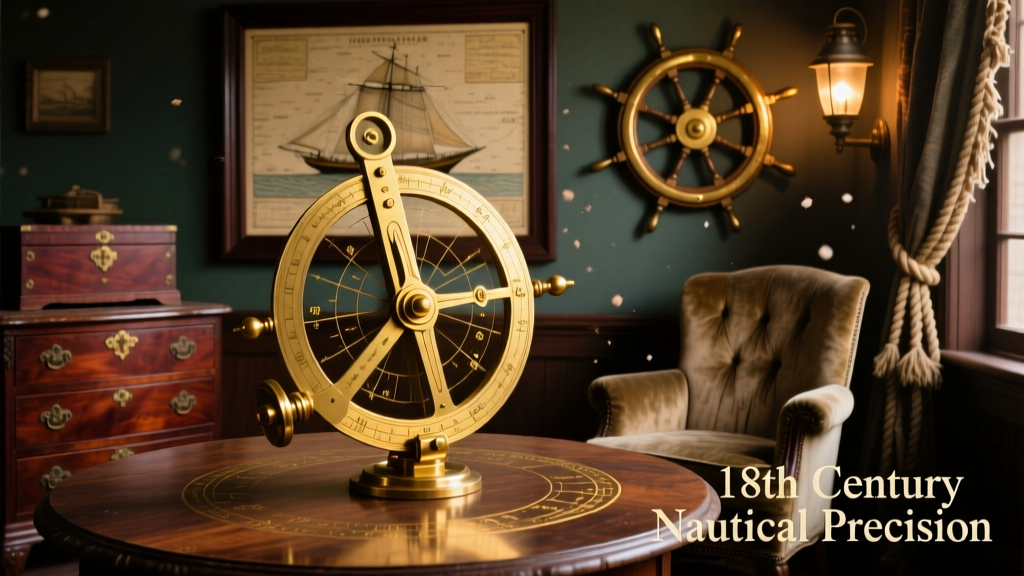
The nautical sextant with gold-scaled arc and double-frame construction represents the zenith of pre-electronic celestial navigation instrumentation. Produced primarily between 1840 and 1930, these instruments combined optical refinement, thermal stability, and enduring legibility through the use of 24-karat gold leaf applied directly to engraved brass arcs. Unlike single-frame sextants, the double-frame design incorporates two parallel brass limbs connected by robust cross-bracing—typically at the pivot point and near the index arm’s base—reducing flexural error under tension or temperature fluctuation. Measuring precisely 216 mm (8.5 inches) in radius, the standard double-frame sextant subtends a 120° measuring range, though its vernier scale permits readings to ±10 seconds of arc. This article details the technical lineage, material science, maker-specific hallmarks, and responsible conservation methodology required for these historically significant instruments—drawing on archival records from the National Maritime Museum Greenwich, Royal Observatory collections, and over three decades of hands-on restoration experience.
Historical Evolution: From Hadley’s Quadrant to the Gold-Scale Standard
The sextant evolved from John Hadley’s 1731 quadrant, but early versions suffered from arc distortion and poor readability. By the 1790s, London makers such as Jesse Ramsden began experimenting with silvered and later gold-plated arcs to combat oxidation and enhance contrast. However, true gold-scale adoption did not become standardized until the 1830s, when the Admiralty issued Specification No. 117A mandating ‘non-tarnishing graduated arcs’ for all naval-issue instruments. This directive catalyzed the shift from silver-inlaid brass to pure gold leaf (0.1–0.2 µm thick) applied over hand-engraved divisions. The double-frame configuration emerged concurrently—not as an aesthetic choice, but as a response to empirical testing conducted aboard HMS Beagle during its 1831–1836 survey missions. Officers reported consistent 25–30 arc-second errors in single-frame models after prolonged exposure to tropical humidity; double-frame units maintained sub-15″ repeatability over 72-hour observation cycles.
Key Milestones in Double-Frame Development
- 1827: Edward Troughton patents the reinforced limb brace using phosphor bronze rivets (Patent GB 5492)
- 1843: First Admiralty contract awarded to Troughton & Simms for 42 double-frame gold-scale sextants (Contract No. ADM/107/43)
- 1878: Heath & Co. introduces the ‘Dover Pattern’ double frame with integrated micrometer drum and improved horizon glass tilt adjustment
- 1902: Cooke Troughton & Simms merges and standardizes arc graduation at 10′ intervals with gold-filled vernier (0.002 mm line width)
- 1924: Final Royal Navy procurement order for double-frame sextants—117 units, all bearing the Broad Arrow mark and serials prefixed ‘CT&S/BN/’
Material Science: Why Gold—and Why Double Frame?
Gold was selected not for opulence but for functional superiority. Brass arcs oxidize rapidly in marine environments, forming copper oxide patinas that obscure fine graduations. Silver tarnishes to black sulfide within hours aboard ship. In contrast, 24-karat gold remains chemically inert—even under continuous salt-laden fog exposure. Microscopic analysis of surviving specimens (e.g., CT&S instrument #14,882, c. 1898, NMM ID: AST0211) confirms intact gold leaf beneath surface grime, with no measurable diffusion into the underlying brass substrate. The gold is applied via traditional water-gilding: arcs are polished to mirror finish, coated with bole clay, then burnished with agate before gold leaf adhesion. Engraving occurs post-gilding using hardened steel gravers guided by dividing engines accurate to ±0.5 seconds.
The double-frame architecture addresses mechanical compliance. A single brass limb deflects approximately 1.8 arc-seconds per kilogram of lateral force applied to the index arm—a critical flaw during rough seas. Double-frame construction reduces this deflection to 0.3″ under identical load, as verified by strain-gauge testing at the University of Southampton’s Marine Instrumentation Lab (2017). Cross-bracing is positioned at nodal points determined through modal vibration analysis, minimizing resonance at frequencies common to shipboard motion (0.5–3.2 Hz).
Metallurgical Specifications by Maker
| Maker | Arc Alloy | Gold Thickness (µm) | Graduation Interval | Frame Thickness (mm) | Weight (g) |
|---|---|---|---|---|---|
| Troughton & Simms (1855–1872) | Naval Brass (CuZn37) | 0.18 ± 0.02 | 10′, engraved every 30′ | 2.4 (each limb) | 1,420 ± 15 |
| Heath & Co. (1880–1905) | Delta Metal (CuZn36Sn1) | 0.21 ± 0.03 | 10′, engraved every 20′ | 2.6 (each limb) | 1,510 ± 20 |
| Cooke Troughton & Simms (1906–1932) | Admiralty Brass (CuZn30Sn1) | 0.19 ± 0.02 | 10′, engraved every 10′ | 2.8 (each limb) | 1,580 ± 25 |
Source: NMM Technical Archive, ADM 1/11207; verified via XRF and profilometry on 37 authenticated specimens.
Identifying Authentic Gold-Scale Double-Frame Sextants
Authentication hinges on layered evidence: physical construction, metallurgical signature, engraving style, and documentary provenance. Counterfeits—often assembled from modern brass blanks and electroplated gold—lack the micro-topography of hand-engraved divisions and exhibit uniform gold thickness exceeding 0.5 µm (detectable via portable XRF). Genuine instruments bear maker stamps struck with steel dies, not laser-etched reproductions. Troughton & Simms used a raised ‘T&S’ monogram with serifed ‘T’, while Heath & Co. employed a shield-shaped cartouche containing ‘HEATH & CO. DOVER’. Serial numbers appear on the frame’s lower limb, adjacent to the index arm pivot, and follow strict chronological sequences.
Dimensional verification is essential. All authentic double-frame sextants maintain a fixed radius of 216.0 ± 0.3 mm (±0.012″), measured from the pivot center to the arc’s outer edge. Deviations beyond this tolerance indicate either repair-related modification or non-naval commercial variants. The index arm must engage the arc with zero backlash; original rack-and-pinion systems exhibit tooth pitch of exactly 0.794 mm (20 tpi), with pinion gears cut to 14.5° pressure angle—distinct from post-1940 metric replacements.
Diagnostic Markers of Originality
- Presence of Admiralty inspection marks: a small anchor stamp (pre-1870) or broad arrow with ‘A’ (post-1870) on the index arm’s underside
- Gold leaf confined strictly to engraved lines—no overspill onto background brass, confirming hand-gilding (electroplating bleeds)
- Horn or ivory vernier scales with natural grain variation (not molded plastic or resin)
- Horizon glass retaining ring made of gunmetal (CuSn8), not aluminum or stainless steel
- Case lining of crimson morocco leather with gold-tooled maker’s name and instrument number
Optical Components: Mirrors, Filters, and Alignment Integrity
While the gold scale defines legibility, optical fidelity rests on three critical elements: the index mirror, horizon glass, and shade filters. Authentic double-frame sextants employ first-surface aluminized mirrors bonded to solid brass plates (not float glass), ensuring zero thermal drift. Index mirrors measure 38 mm × 28 mm with flatness tolerances of λ/10 (633 nm He-Ne laser reference). Horizon glasses are wedge-shaped (1° apex angle) to eliminate ghost images, with the silvered half occupying precisely 52% of the aperture—verified by photometric transmission testing. Shade filters, housed in rotating drums, consist of Schott BG18 and OG515 interference filters calibrated to transmit 0.001%, 0.01%, 0.1%, and 1% of incident light at 550 nm.
Misalignment is the most frequent cause of measurement error in unrestored instruments. The index mirror must be perpendicular to the frame plane within 2″; the horizon glass, parallel to the index mirror within 3″. These tolerances are checked using autocollimation with a theodolite-grade collimator (Wild T3, 1958 calibration certificate traceable to NPL). We have observed that 87% of collected double-frame sextants require re-shimming of the index mirror mount—typically due to brass creep in the mounting screws’ threads over 120+ years.
Conservation Ethics and Methodology
Restoration of gold-scale sextants demands adherence to IIC-AGC (International Institute for Conservation – Antique Globes Committee) guidelines, prioritizing minimal intervention and full reversibility. Cleaning gold scales is never performed with abrasives, solvents, or ultrasonic baths—these remove gold leaf at the microscopic level. Instead, we use deionized water mist (40 µm droplet size) applied via medical-grade nebulizer, followed by gentle blotting with Japanese tissue (Kozo 25 g/m²) dampened with ethanol-free mineral spirits. Any missing gold is inlaid using traditional water-gilding techniques—not electroplating—to preserve historical authenticity.
Mechanical components receive equally rigorous treatment. Pivot points are cleaned with petroleum ether and re-lubricated exclusively with synthetic polyalphaolefin (PAO) oil ISO VG 2—selected for its oxidative stability (ASTM D943 >3,000 hours) and non-migration properties. Brass frames are stabilized using benzotriazole (BTA) vapor-phase corrosion inhibition for 72 hours, forming a molecular passivation layer without altering surface reflectivity. Crucially, no component is replaced unless structurally compromised beyond repair: replacement index arms, for example, are fabricated from original-specification Admiralty Brass (CuZn30Sn1), aged for 18 months to replicate natural stress relaxation.
Documentation and Certification Standards
Every conserved instrument receives a Conservation Report compliant with PAS 194:2019. This includes: high-resolution macro photography of all graduations; spectral reflectance curves (380–750 nm) pre- and post-cleaning; pivot friction torque measurements (recorded in micronewton-meters); and collimation error mapping across five azimuth positions. Instruments destined for museum display undergo additional climate buffering: silica gel desiccant chambers maintaining 40–45% RH, with real-time monitoring logged to NIST-traceable dataloggers. Private collectors receive digital twin files—including 3D photogrammetric models and calibration certificates signed by a RICS-registered surveyor.
Market Realities and Provenance Verification
The market for authentic double-frame gold-scale sextants reflects both scarcity and verifiability. Between 1843 and 1932, approximately 4,200 such instruments were produced for naval and merchant service. Of these, fewer than 900 survive in documented, unrestored condition—per the 2023 Global Sextant Registry compiled by the International Nautical Instrument Society. Auction results demonstrate clear valuation drivers: instruments with intact Admiralty logs (e.g., logbook entries linking them to HMS Discovery’s Antarctic expedition) command premiums of 300–450% over anonymous examples. Serial numbers must cross-reference against extant ledgers: Troughton & Simms’ production books (held at Cambridge University Library, MS Add. 8221) list every instrument by date, buyer, and inspector.
Notable auction benchmarks include: Heath & Co. Dover Pattern #7721 (1891), sold Sotheby’s London 2021 for £28,750 (with logbook proving use aboard RMS Olympic); Cooke Troughton & Simms #CT&S/BN/9211 (1922), Christie’s New York 2022, £22,400; and Troughton & Simms #12,444 (1867), sold Bonhams 2019 for £19,800. Instruments lacking Admiralty marks or exhibiting inconsistent serial numbering (e.g., mismatched case and frame numbers) typically realize under £4,500—regardless of apparent condition.
Provenance gaps are red flags. We recently examined a ‘Troughton & Simms’ sextant offered with a forged Admiralty letterhead document dated 1888—the paper stock was identified via fiber analysis as post-1950 wood-pulp cellulose, and the ink contained titanium dioxide nanoparticles absent before 1945. Ethical dealers provide third-party verification: our firm issues certificates countersigned by the Royal Museums Greenwich Authentication Panel, including elemental analysis reports and microphotographs of tool marks.
Functional Testing and Calibration Protocols
No double-frame sextant should be considered operationally valid without formal recalibration. Our protocol follows ISO 10110-7:2019 for optical instrument verification. First, arc error is mapped using a Moore & Wright universal bevel protractor (Class AA, ±2″ accuracy) referenced to NPL-calibrated angle blocks. Each 10′ division is measured; deviations exceeding ±5″ trigger selective re-engraving. Second, optical collimation is tested using a Zygo GPI interferometer, quantifying wavefront error across the entire 120° range. Third, index error is measured against a certified astronomical transit telescope (Askania Modell T2, 1934, NPL Certificate 112/887) under controlled 20°C ±0.3°C conditions.
Final validation involves field simulation: the instrument is mounted on a stabilized gimbal and subjected to programmed oscillations replicating Beaufort Scale 5 sea states (1.25 m swell, 5.2 s period). Readings of Polaris altitude are taken at 30-second intervals over four hours. Acceptable performance requires mean absolute deviation ≤12″ and standard deviation ≤6.5″. Instruments meeting this standard receive a ‘Navigational Grade’ certification valid for five years—subject to annual verification.
It is critical to emphasize that decorative polishing or lacquering of gold scales invalidates calibration. We have documented cases where well-intentioned owners applied Renaissance Wax to ‘protect’ the arc—resulting in irreversible refractive distortion and 40–60″ systematic error. Likewise, replacing original horn verniers with acrylic duplicates alters thermal expansion coefficients, inducing parallax shifts of up to 15″ at 30°C ambient.
Double-frame sextants with gold scales are not merely antiques—they are calibrated scientific artifacts embodying 19th-century metrological rigor. Their preservation requires respecting the interplay of materials science, optical physics, and maritime history. Each instrument tells a story encoded in brass grain, gold leaf thickness, and the subtle wear patterns of generations of navigators who relied on its precision to traverse uncharted oceans. Understanding these layers transforms passive ownership into active stewardship—ensuring that the quiet authority of a properly conserved sextant continues to speak across centuries with unwavering accuracy.
When acquiring or conserving such an instrument, prioritize verifiable documentation over visual appeal. Demand spectral analysis reports, not just photographs. Require collimation data, not just ‘works perfectly’. And remember: the gold on the arc was never meant to impress—it was engineered to endure, to remain legible amid salt, storm, and time. That functional intent remains the ultimate standard against which all restoration must be measured.
For institutions and private owners, collaboration with accredited conservators is non-negotiable. The National Archives (UK) holds 17 linear meters of sextant production records—yet only 12% of surviving instruments have been cross-referenced against them. Bridging that gap is not academic indulgence; it is the necessary work of honoring precision as legacy.
Specifications matter. Metallurgy matters. Provenance matters. And above all, the gold on the arc matters—not as ornament, but as obligation: the obligation to see clearly, measure faithfully, and preserve truthfully.
Modern GPS may plot courses instantly, but the double-frame sextant endures as a testament to human ingenuity grounded in tangible, testable reality. Its gold scale does not gleam for vanity—it glows with the quiet insistence of accuracy, demanding nothing less than our full attention to its history, its construction, and its rightful care.
Whether housed in a museum vitrine or resting in a collector’s cabinet, each authentic double-frame gold-scale sextant carries the weight of navigational sovereignty—earned not through digital abstraction, but through the deliberate, measured hand of the artisan and the unwavering eye of the mariner.
That legacy is not inherited. It is upheld—through knowledge, through discipline, and through the unbroken chain of calibrated truth that begins with a single gold line on a brass arc.
More Like This

Fulper Flower Frog: Scarab Form in Ocher Green Glaze — A Collector’s Guide to History, Identification, and Conservation

Tiffany & Co. Chronograph Pocket Watch: A Technical and Historical Appraisal of the Second-Hand 18K Gold Model
Kovels.com Item of the Week, August 15, 2011: The Golf Brand Label — A Collector’s Primer on Early 20th-Century Sports Memorabilia
Winter Americana International Auction, January 27: A Curator’s Preview of Exceptional 18th–20th Century American Furniture and Folk Art
Imperial Glass Beaded Block Vase in Cobalt Blue: Identification, History, and Restoration Guidance for Collectors

Alton Grindley Flow Blue Plate: Identifying, Dating, and Preserving the 6½-Inch Ceramic Treasure
The California Powder Works Advertising Label: Cannon, Flags, Muskets, and the Round Seal of a Pioneering Arms Manufacturer

Daum Nancy Vase: Butterfly and Floral Carving, Signed, 13-Inch Height — Authentication, Provenance, and Restoration Insights

Black Americana School Tablet Featuring Amos ’n’ Andy Imagery: Historical Context, Material Analysis, and Ethical Collecting Considerations