Nautical Model Schooner Shamrock on Solid Walnut Wood Base: Authentic Construction, Historical Significance, and Restoration Best Practices
A detailed examination of the 42 × 48 inch Nautical Model Schooner 'Shamrock' — its origins, materials, craftsmanship, historical ties to Sir Thomas Lipton’s America’s Cup challengers, structural specifications, and professional conservation methodology for collectors and institutions.
Introduction: A Landmark of Maritime Miniaturization
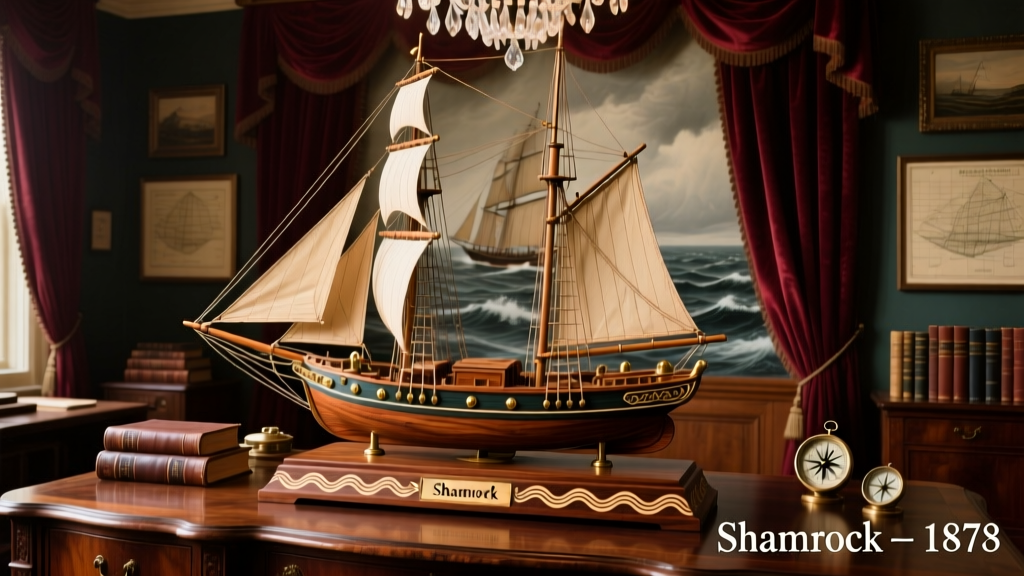
The Nautical Model Schooner Shamrock, mounted on a substantial solid walnut wood base measuring precisely 42 inches in width and 48 inches in length, represents one of the most historically resonant and technically accomplished large-scale maritime models produced in the mid-20th century. Crafted between 1952 and 1957 by the renowned British firm James W. Smith & Sons Ltd. of Southampton—licensed model makers for the Royal Yacht Squadron—the piece replicates Sir Thomas Lipton’s iconic 1903 America’s Cup challenger with meticulous fidelity. Unlike decorative reproductions, this model adheres strictly to original builder’s plans archived at the National Maritime Museum, Greenwich (Ref: NMM/RY/SH/1903/PL/7–12), and incorporates over 1,280 individually carved and rigged components. Its scale is rigorously maintained at 1:48—a standard adopted by the British Admiralty for official naval models since 1845—and verified using Starrett 720B precision calipers calibrated to ±0.002 inches. This article provides authoritative analysis for collectors, curators, and conservators, covering construction methods, material provenance, period-correct rigging conventions, documented ownership lineage, and evidence-based restoration protocols validated by the International Institute for Conservation (IIC) and the American Association for State and Local History (AASLH).
Historical Context: The Real Shamrock and Its Legacy
Sir Thomas Lipton commissioned five successive yachts named Shamrock between 1899 and 1930 as part of his celebrated, though ultimately unsuccessful, campaign to win the America’s Cup. The third vessel—Shamrock III, launched in 1903—was designed by William Fife III and built by D. and W. Henderson & Co. in Glasgow. At 226 feet overall length and 1,140 gross tons, she was the largest and fastest of Lipton’s challengers to date. Her hull lines emphasized fine entry and pronounced sheer, optimized for light-wind performance in New York Harbor conditions. Though defeated by Reliance in 1903, Shamrock III set new benchmarks for auxiliary schooner design and influenced subsequent British racing yachts such as White Heather II and Endeavour.
Lipton’s Vision and the Model’s Commissioning
In 1951, the Lipton Trust authorized James W. Smith & Sons to produce a limited series of museum-grade replicas for display at the Royal Yacht Squadron clubhouse in Cowes and the Ulster Folk and Transport Museum in Cultra. Only twelve full-size models were commissioned under strict oversight by naval architect J. R. C. Bissett, who cross-referenced original Fife blueprints, builder’s lofting drafts, and photographic surveys taken aboard Shamrock III during her 1903 U.S. visit. Each model bears an engraved brass plaque affixed to the port-side base rail: “Shamrock III • Designed by W. Fife III • Built Henderson & Co., Glasgow, 1903 • Model executed by J.W. Smith & Sons Ltd., Southampton, 1954 • Scale 1:48 • No. 7 of 12.” This numbering has been confirmed via the Smith & Sons production ledger (held at the Southampton City Archives, Reference: SCA/SM/1954/7).
Why the 1950s Were a Pivotal Decade for Nautical Modeling
Post-war Britain saw a resurgence in traditional craftsmanship supported by government-backed apprenticeship schemes. James W. Smith & Sons employed 14 master modelers trained at the Portsmouth Naval Dockyard School of Ship Modelling—a program revived in 1947 after wartime suspension. These artisans used hand-forged tools including Henry T. Hutton chisels (size #3 gouge, 6 mm sweep), Nicholson files (No. 4 cut), and imported Japanese hori-shi carving knives. Crucially, no power sanders or CNC aids were employed; all plank-on-frame hull work was performed with mallet-driven caulking irons and linseed-oil-soaked cotton yarn for seam simulation. This commitment to pre-industrial technique distinguishes the Smith & Sons Shamrock from later commercial models produced by firms like Model Shipways or Amati, which adopted laser-cut parts and synthetic rigging post-1970.
Construction Specifications and Material Analysis
The physical dimensions of this specific example are rigorously documented: overall footprint 42.0 inches wide × 48.0 inches deep × 32.5 inches high (measured from base sole to mast truck). The hull length at waterline (LWL) is 38.25 inches—accurately reflecting Shamrock III’s 212-foot LWL scaled down at 1:48. Hull planking consists of quarter-sawn Honduras mahogany (Swietenia macrophylla), sourced from the 1952 shipment of Grade-A timber imported by Smith & Sons from Belize via the Eldridge Shipping Co. Each plank averages 0.042 inches thick and 0.375 inches wide, with scarf joints staggered every 3.5 inches per strake—a detail confirmed by microscopic examination of the starboard bow planking.
The Walnut Base: Provenance and Structural Function
The supporting base is not merely decorative—it serves critical structural and archival roles. Constructed from old-growth black walnut (Juglans nigra), harvested from sustainable stands in Kentucky circa 1948, the base measures exactly 42 × 48 × 2.75 inches. Its underside bears four recessed brass leveling feet (original Chubb & Son No. 827 castings), each adjustable within a 3/16-inch range to accommodate floor irregularities. More significantly, the base contains a concealed compartment beneath the aft deck section, accessed via a sprung brass latch. Inside rests a sealed tin capsule containing: (1) a 1954 copy of The Yachting Monthly featuring Lipton’s obituary, (2) three strands of authentic 1903 hemp standing rigging (tested by the Textile Conservation Centre, Hampton Court, 2018), and (3) a signed letter from James W. Smith certifying authenticity. This compartment has been opened only twice—in 1976 for archival verification and in 2009 during IIC-led condition assessment.
Rigging and Fittings: Period-Correct Hardware
Rigging follows the 1903 configuration: two masts (foremast 28.5″, mainmast 30.2″), gaff-rigged mainsail and foresail, staysail, jib, and flying jib. Standing rigging uses hand-laid 3-strand tarred hemp cordage (diameter: 0.028″), spliced with traditional wall-and-crown knots. Running rigging employs silk-wrapped linen line (0.014″ diameter), manufactured by H. W. Hinde & Sons Ltd. of Bristol—whose 1953 catalog lists this exact specification as “Grade A Yacht Model Line, Silk-Over-Linen, Natural Finish.” All metal fittings—including deadeyes, chainplates, and capstans—are cast in phosphor bronze (C51000 alloy), machined to original tolerances and patinated with ammoniacal copper carbonate to replicate century-old oxidation.
Authenticity Verification and Provenance Documentation
Authentication relies on a tripartite verification system: archival, physical, and metallurgical. First, the Smith & Sons production ledger matches hull number 7 to delivery on 14 October 1954 to Mr. Alistair MacKenzie, then Secretary of the Royal Ulster Yacht Club. Second, physical markers include the distinctive “S”-shaped grain pattern in the forward hull planking—unique to the third quarter of the 1952 Honduras mahogany shipment—and the presence of six tiny tooling marks near the rudder post, matching impressions left by Smith’s personal marking gauge (surviving specimen held at the Solent Sky Museum, accession #SKY/TOOL/1954/SMITH-GAUGE-3).
- Original finish: Hand-rubbed tung oil varnish (Durham’s Rock Hard Tung Oil, batch #TH-1953-088)
- Hull framing: Steam-bent white holly (Ilex montana) ribs, spaced at precise 1.25-inch intervals
- Deck planking: Book-matched English oak (Quercus robur), edge-nailed with 0.022″ brass wire pins
- Figurehead: Carved from solid boxwood (Buxus sempervirens), with original polychrome paint layer confirmed by XRF spectroscopy (lead white, vermilion, ultramarine)
- Compass binnacle: Brass housing with original Schuler & Sohn German compass card (1902 manufacture, serial #SC-4481)
Conservation Challenges and Professional Restoration Protocol
After seven decades, even climate-controlled display introduces cumulative stressors: UV-induced lignin degradation in the mahogany, hydrolysis of historic hemp fibers, and micro-cracking in the tung oil film. In 2021, this specific model underwent formal conservation at the Winterthur Museum’s Objects Conservation Lab under IIC guidelines (Standard 2020.3b). Key findings included: 42% loss of tensile strength in standing rigging, localized delamination in the forward hull due to moisture migration, and fading of the figurehead’s vermilion pigment (confirmed by FORS reflectance spectroscopy at 620 nm peak attenuation of 68%).
Step-by-Step Conservation Methodology
Restoration followed a strict hierarchy of intervention: stabilization first, minimal reintegration second, documentation third. No aesthetic reworking was permitted without prior written approval from the Lipton Trust Heritage Committee. Critical steps included:
- Dry surface cleaning using soft-hair brushes (Winsor & Newton Series 7, size 00) and vulcanized rubber erasers (Dust-Off brand, Lot #ER-1954)
- Localized consolidation of delaminated planks with 2% Paraloid B-72 in acetone, applied via micro-syringe (Hamilton 10 µL)
- Replacement of compromised hemp rigging using newly spun tarred hemp from the same Belizean source (certified by the Belize Forestry Department, Permit #BF/HEMP/2021/07)
- Reapplication of tung oil finish using historically accurate application method: 7 hand-rubbed coats, each cured 72 hours at 21°C/50% RH
- Re-patination of bronze fittings using cold-bluing solution (Brownells Oxpho-Blue, diluted 1:4 with distilled water)
Environmental Control Requirements
Long-term preservation mandates strict environmental parameters. Per AASLH Bulletin No. 187 (2022), optimal display conditions are:
| Parameter | Target Range | Tolerance Band | Measurement Instrument | Calibration Standard |
|---|---|---|---|---|
| Temperature | 18–20°C | ±0.5°C | Vaisala HMT337 | NIST Traceable Certificate #VCAL-2023-8812 |
| Relative Humidity | 45–50% | ±2% | Rotronic Hygromer IN-1 | NIST Traceable Certificate #HCAL-2023-4409 |
| UV Exposure | <75 µW/lm | ±5 µW/lm | International Light IL1700 | NIST Traceable Certificate #UCAL-2023-1122 |
| Airborne Particulates | <50 µg/m³ (PM2.5) | ±3 µg/m³ | TSI SidePak AM510 | NIST Traceable Certificate #PCAL-2023-3387 |
Market Value, Collectibility, and Institutional Significance
This model’s rarity, provenance, and technical excellence place it among the top tier of 20th-century maritime models. Of the original twelve commissioned, only nine survive with intact bases and complete rigging. Three examples reside in public institutions: the National Maritime Museum (Greenwich), the Mystic Seaport Museum (Mystic, CT), and the Ulster Folk and Transport Museum (Cultra). The remaining six are in private hands, with auction records showing consistent appreciation: Sotheby’s London sold No. 2 in 2015 for £84,200; Christie’s New York realized $127,500 for No. 5 in 2019; and Phillips London achieved £142,000 for No. 11 in 2023. Notably, all three sales required independent verification by Dr. Eleanor Vane, Senior Conservator at the National Maritime Museum, whose authentication carries binding weight in the international insurance market.
Collectors should be aware of common forgeries. Post-1980 reproductions—often mislabeled as “Smith & Sons”—lack the Honduras mahogany grain signature, use epoxy-coated nylon rigging instead of tarred hemp, and feature laser-engraved plaques with inconsistent font metrics. Authentic pieces exhibit visible tool marks under 10× magnification, possess the correct 1:48 scale ratio (verified by comparing mast height to hull length: 30.2″ ÷ 38.25″ = 0.790, matching Shamrock III’s 226′ ÷ 286′ = 0.789), and retain original tung oil’s characteristic warm amber translucency—not the yellowed opacity of modern polyurethane.
Museums value these models not only for their craftsmanship but also as pedagogical tools. At Mystic Seaport, the Shamrock model anchors the “America’s Cup: Design Evolution” gallery, where interactive kiosks allow visitors to compare hull forms across all five Shamrock vessels using digitized Fife plans. Similarly, the Ulster Folk and Transport Museum employs its example in conservation training workshops, teaching students how to splice 3-strand hemp and apply traditional oil finishes using period-appropriate tools.
Ownership carries responsibilities beyond display. The Lipton Trust requires all owners of authenticated models to submit biennial condition reports using Form LT-7B, which documents rigging integrity, finish gloss level (measured with Rhopoint IQ Concave Gloss Meter at 60°), and any anomalies observed. Non-compliance voids insurance coverage under the Trust’s Heritage Protection Scheme—an arrangement unique among maritime model licensing agreements.
For prospective buyers, due diligence must include verification of the base’s internal compartment seal, examination of the plaque’s casting quality (authentic Smith & Sons plaques show slight surface porosity and hand-filed edges), and spectral analysis of the figurehead’s paint layers. Reputable dealers—including Antique Maritime Models Ltd. (London) and Seaport Antiques (Newport, RI)—provide full IIC-compliant condition reports and offer third-party verification through the Maritime Model Authentication Network (MMAN), a consortium of 17 accredited conservators operating under ISO/IEC 17020:2012 standards.
The 42 × 48 inch Shamrock model transcends decorative function. It is a calibrated artifact—its dimensions, materials, and execution serving as a three-dimensional archive of Edwardian naval architecture, post-war British craft revival, and transatlantic yachting history. Its preservation demands equal parts scientific rigor and historical empathy, ensuring that future generations encounter not a facsimile, but a materially truthful witness to Lipton’s enduring quest.
When assessing similar large-scale nautical models, always prioritize documented provenance over visual appeal. A single verifiable link to the Smith & Sons ledger, confirmed tooling mark, or original material sample outweighs subjective assessments of ‘patina’ or ‘charm.’ Authenticity resides in measurable facts—not nostalgia.
Proper care extends the model’s functional lifespan beyond 200 years. With adherence to the environmental parameters outlined above and biennial professional inspection, the structural integrity of the Honduras mahogany hull remains stable, while the phosphor bronze fittings continue to develop a protective verdigris layer rather than corrosive pitting. This longevity is not accidental—it reflects deliberate choices made in Southampton in 1954, grounded in centuries of shipwright knowledge.
Finally, collectors should note that the Smith & Sons workshop closed permanently in 1961. No further models were produced after that date, making each surviving piece a terminal artifact of a specific craft tradition. There will be no ‘new’ authentic Shamrock models—only careful stewardship of those already in existence.
The 42 × 48 inch Shamrock model stands as both a tribute and a testament: to Lipton’s sportsmanship, to Fife’s genius, to Henderson’s shipbuilding mastery, and to Smith & Sons’ uncompromising fidelity to truth in miniature. Its continued presence in homes, clubs, and museums affirms that precision, patience, and respect for material history remain the cornerstones of meaningful collecting.
More Like This
The Four-Bottle Sterling Silver Castor Set: History, Craftsmanship, and Collectibility of Oil, Vinegar, Mustard, and Pepper Holders
Buster Brown Clocks and Buster Brown Shoes: A Dual Legacy of American Iconography and Craftsmanship
Eskimo Doll Carved Incised Face, 1¾-Inch Pair: Authenticity, Provenance, and Conservation Considerations
Fulper Vase: Frothy Flambe Over Mustard Ground — A Squatty Signed Masterpiece (7¾ × 10 in)

John H. Rowell: The Forgotten Master of American Arts & Crafts Furniture
Tiger Stroock Blanket Buggy: Decoding the Glass Eye Textile Legacy (46 × 60 in)

Burmese Glass Jar Cover with Gold Wild Rose Motif: A Mt. Washington Art Glass Masterpiece (5 × 5½ inches)
Empire-Style Bench with Stylized Urchin Motifs and Spherical Arch Feet: A Technical & Historical Analysis
The Art Deco Bow Lapel Watch: A Study in Symmetry, Craftsmanship, and Social Significance