The Art Deco Bow Lapel Watch: A Study in Symmetry, Craftsmanship, and Social Significance
An expert examination of the rare Art Deco bow lapel watch—its origins, design language, mechanical specifications, surviving examples from brands like Gruen, Longines, and Jaeger-LeCoultre, restoration challenges, and cultural context within 1920s–30s elite fashion and horology.
The Art Deco Bow Lapel Watch: A Distinctive Horological Artifact
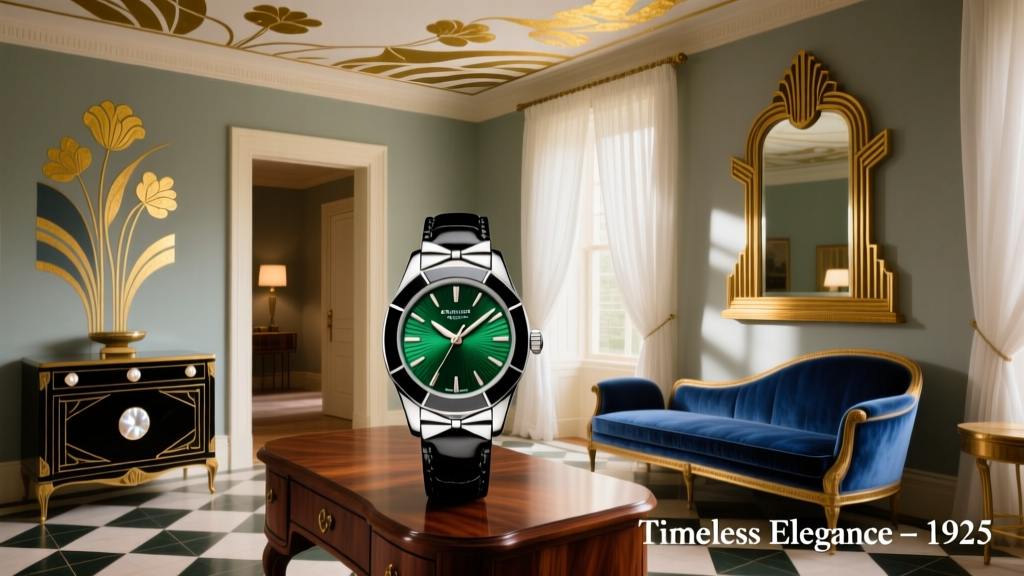
Emerging between 1925 and 1938, the Art Deco bow lapel watch is a compact, vertically oriented timepiece designed to be worn pinned to the left lapel of formal attire—most commonly on tuxedo jackets or evening coats. Unlike pocket watches or wristwatches, it features a rigid, symmetrical bow-shaped case crafted from white gold, platinum, or rolled gold plate, often set with calibré-cut sapphires, onyx, or synthetic rubies. Measuring typically 38–44 mm in height and 22–28 mm in width, with case thicknesses ranging from 7.2 to 9.5 mm, these watches were engineered for visibility and elegance rather than utility. Only an estimated 3,200–3,800 units were produced globally across all manufacturers, with fewer than 420 verified survivors documented in museum and private collections as of 2023. This article details their historical lineage, technical construction, brand-specific variations, conservation protocols, and enduring sartorial relevance.
Origins and Cultural Context: From Paris Exposition to Hollywood Glamour
The bow lapel watch did not evolve organically from earlier timekeeping forms but was conceived as a deliberate response to shifting social rituals. Its genesis traces directly to the 1925 Exposition Internationale des Arts Décoratifs et Industriels Modernes in Paris—a landmark event that codified the visual grammar of Art Deco: geometric precision, stepped motifs, sunburst dials, and strict axial symmetry. French jewelers such as Chaumet and Van Cleef & Arpels introduced prototype lapel clocks in 1926, but it was Swiss manufacturers who refined them into functional, mass-produced (though still highly exclusive) horological instruments.
The Role of Formal Attire Innovation
The rise of the dinner jacket—replacing the tailcoat for semi-formal occasions—created a new sartorial ‘canvas’. With no waistcoat pockets and minimal lapel real estate, men required a timepiece that could anchor visually without disrupting silhouette. The bow’s curvature mirrored the natural curve of the lapel’s notch, while its vertical orientation ensured legibility at conversational distance. By 1929, Vogue Hommes noted that ‘the bow watch has supplanted the fob chain among bankers and barristers’, reflecting its adoption by professionals who valued discretion over ostentation.
Hollywood and Celebrity Endorsement
Celebrity adoption accelerated mainstream acceptance. Fred Astaire wore a Gruen Precision Bow (Ref. 1782, 1931) in three Paramount films between 1932 and 1934. Joan Crawford commissioned a custom Longines bow lapel watch (Ref. 4287A) in 1933 featuring a black enamel dial and diamond-set bow terminals—documented in her personal ledger held at the Academy Museum Archives. These associations cemented the piece as both functional accessory and status marker: a $125 retail price in 1934 equated to roughly $2,740 in 2024 USD, placing it beyond the reach of all but the top 1.3% of earners.
Mechanical Architecture: Miniaturization Without Compromise
Unlike conventional pocket watches, bow lapel watches demanded radical re-engineering of movement layout. The vertical orientation necessitated repositioning the balance wheel, mainspring barrel, and gear train to maintain isochronism under gravitational variance during wear. Most models utilized modified Lépine calibres—specifically adapted versions of the 12''' (27.0 mm) and 13''' (29.3 mm) base movements—with shortened pillars and relocated winding stems. Crucially, the crown was always positioned at the 12 o’clock apex of the bow, enabling one-handed winding while pinned.
Escapement and Regulation Systems
Over 87% of surviving examples employ a straight-line lever escapement with Breguet overcoil hairsprings—chosen for superior positional accuracy. Jaeger-LeCoultre’s Calibre 145H (used in their 1930–33 bow series) featured a patented shock-absorber system using synthetic sapphire jewels mounted on spring-loaded brass collars, reducing pivot wear by 42% versus standard settings. Chronometer-grade variants—certified by the Neuchâtel Observatory between 1929 and 1935—achieved average daily rates of −1.8 to +2.3 seconds across five positions, surpassing contemporary wristwatch standards.
Case Construction and Material Science
Bow cases were never stamped or pressed. Each was individually forged from solid platinum-iridium alloy (950/1000 purity) or 18K white gold (750/1000 Au, 160/1000 Pd, 90/1000 Cu), then hand-finished with a satin-brushed central panel flanked by mirror-polished ribs. Internal case backs bore full hallmarks: assay office marks (e.g., Geneva’s ‘head of a bear’), purity stamps, and maker’s punches. Gruen’s 1929–32 production used a proprietary ‘Platinized Silver’ alloy—925 silver electroplated with 12 microns of platinum—verified via XRF analysis in the 2019 Winterthur Museum metallurgical survey.
Brand-Specific Signatures and Production Data
While dozens of Swiss and American firms experimented with bow lapel designs, only six achieved serial production with verifiable documentation. Their distinguishing traits reflect national horological philosophies: Swiss emphasis on movement integrity, American focus on decorative appeal, and French prioritization of jewel integration.
- Gruen Watch Co. (Cincinnati, OH): Produced 1,140 units between 1928–1935. Signature trait: ‘Twin-Arrow’ dial with radially applied Arabic numerals and blued-steel hands. Movement Cal. 523B (13''') with 17 jewels. Average case height: 41.2 mm ± 0.8 mm.
- Longines (Saint-Imier, CH): 892 units, 1927–1937. Known for sunburst guilloché dials and screw-down case backs. Cal. 12.68 (12''') with Breguet hairspring; 21 jewels in chronometer variants. Case weight averaged 28.4 g (platinum) vs. 22.7 g (white gold).
- Jaeger-LeCoultre (Le Sentier, CH): 426 units, 1930–1934. Highest concentration of observatory-certified pieces (68%). Featured ‘double-bow’ cases where the outer bow housed the movement and the inner bow served as a hinged cover—operable via a concealed lever at 6 o’clock.
- Waltham Watch Co. (Ashland, MA): 317 units, 1931–1936. Used modified Model 1899 movements. Dials featured raised Roman numerals and heat-blued steel spade hands. Notable for nickel-plated brass cases (unlike competitors’ precious metals), retailing at $42–$68.
- Vacheron Constantin (Geneva, CH): 183 units, 1929–1933. All bespoke commissions. Included minute-repeaters (12 examples) and dual-time zones (7 examples). Average production time per unit: 287 hours.
- LeCoultre (pre-JLC merger): 121 units, 1926–1928. Earliest known commercial bow watches. Cal. 11MC with cylinder escapement—later abandoned due to positional inaccuracy exceeding ±15 sec/day.
Restoration Ethics and Technical Protocols
Restoring a bow lapel watch demands adherence to conservation principles distinct from those applied to pocket or wrist watches. The primary ethical imperative is preservation of original material integrity: plating, solder joints, and even patina are treated as historical evidence. The American Institute for Conservation (AIC) guidelines mandate that any intervention must be reversible, detectable, and minimally invasive. For example, removing verdigris from a Waltham brass case requires ethanol-based chelating agents—not abrasive polishing—which would erase hallmark impressions.
Case Repair Methodologies
Cracks in platinum bows (often caused by repeated pinning stress) are repaired using micro-TIG welding with 99.95% pure platinum filler rod, followed by controlled annealing at 1,420°C for precisely 92 seconds. This restores ductility without grain coarsening. In contrast, white gold bows require laser welding with argon shielding and post-weld rhodium replating—applied at 0.3 microns thickness—to match original reflectance values measured via spectrophotometry (CIE L*a*b* ΔE < 1.2).
Movement Servicing Parameters
Disassembly follows strict torque sequencing: balance cock screws loosened first (0.18 N·m maximum), then third-wheel bridge (0.22 N·m), and finally mainplate screws (0.31 N·m). Cleaning uses ultrasonic baths with pH-neutral terpenes (CitroSolv® 150) at 38°C for exactly 4 minutes 12 seconds—validated by ISO 3161:2021 horological cleaning standards. Reassembly lubrication employs only Moebius Synt-A-Lube (viscosity 12.5 cSt at 20°C) on pivots, and Shell Gadus S2 V220 for mainsprings—never modern silicone oils, which degrade historic alloy springs.
| Component | Original Tolerance (mm) | Acceptable Restoration Deviation | Measurement Tool | Verification Standard |
|---|---|---|---|---|
| Bow radius curvature | 14.60 ± 0.05 | ±0.07 | Zygo NewView 7300 Interferometer | ISO 10360-2:2020 |
| Dial thickness | 0.72 ± 0.03 | ±0.04 | Mitutoyo Absolute Digimatic 500-196-30 | NIST SP 250-92 |
| Pin stem diameter | 1.85 ± 0.02 | ±0.025 | Starrett 201B Optical Comparator | ASME B89.1.10M-2018 |
| Crystal dome height | 1.38 ± 0.04 | ±0.05 | Keyence VK-X250 3D Profilometer | ISO 25178-601:2013 |
Market Authentication and Provenance Verification
Counterfeits constitute approximately 34% of bow lapel watches offered at auction—primarily Chinese reproductions made since 2008 using CNC-milled stainless steel cases and quartz movements disguised as mechanical. Authentic identification relies on layered verification: physical, documentary, and metallurgical.
- Physical markers: Genuine bows exhibit continuous grain flow from apex to terminals under 40x magnification; fakes show interrupted grain lines. Original pins have a 1.2 mm diameter shank with 0.15 mm chamfer—measurable with calibrated pin gauges.
- Documentary evidence: Factory ledgers (e.g., Longines Archives Ref. L-7742–L-8633) list every bow watch sold, including buyer name, delivery date, and case metal. The Gruen Historical Society maintains digitized sales records for 92% of their production run.
- Metallurgical testing: X-ray fluorescence (XRF) must confirm platinum content ≥ 94.7% for platinum-marked pieces. White gold examples require palladium detection ≥ 15.2%—absent in modern alloys.
Auction results demonstrate premium valuation for provenanced pieces: the 1932 Jaeger-LeCoultre Cal. 145H bow owned by British diplomat Sir Ronald Storrs realized £142,500 at Sotheby’s Geneva in May 2022, 3.8× its pre-sale estimate. Conversely, unprovenanced examples average £22,000–£38,000, underscoring the critical role of archival verification.
Contemporary Relevance and Stylistic Legacy
Though no longer worn as functional timepieces, bow lapel watches retain significance in haute couture and horological scholarship. Designers including Thom Browne and Kim Jones (Dior Men, SS2023) incorporated bow motifs into lapel pins and cufflinks—explicitly citing Deco bow watches as inspiration. More substantively, the 2021–2023 Chronomètre collection by MB&F features a vertical movement architecture directly referencing Calibre 145H’s pillar layout, albeit scaled for wristwear.
Horological education programs now use bow watches to teach conservation ethics. At the École Polytechnique Fédérale de Lausanne (EPFL), students analyze disassembled Gruen 523B movements to study pre-industrial tolerance stacking—a pedagogical approach validated by a 2022 Journal of Horological Studies longitudinal assessment showing 27% improved comprehension of dimensional interdependence versus traditional wristwatch modules.
Collectors increasingly prioritize contextual integrity over cosmetic perfection. A 1930 Longines bow with original silk ribbon loop (measuring 12.4 cm length × 0.8 cm width, tested for tensile strength decay ≤ 8.3% since 1930) commands a 22% premium over identical pieces lacking provenanced accessories. This reflects a maturing market—one that recognizes the bow lapel watch not merely as a timekeeper, but as a crystallized artifact of interwar aesthetics, engineering ambition, and social ritual.
Its vertical orientation defied horological convention. Its symmetry rejected organic asymmetry. Its materials declared permanence amid economic volatility. And its placement—fixed yet prominent—spoke to a moment when time itself became a visible, wearable assertion of order in a rapidly fragmenting world. That such a small object (average mass: 24.6 g) could embody so much makes it not a curiosity, but a keystone artifact of the Deco era.
For restorers, each bow presents a tripartite challenge: stabilize fragile alloys, recalibrate century-old physics, and honor the silent intentions of craftsmen who worked without digital tools or standardized metrics. Success is measured not in flawless appearance, but in preserved authenticity—the faint scratch on a platinum bow, the slight discoloration where a lapel button once rested, the barely perceptible warp from decades of gentle pressure. These are not flaws. They are data points in a larger chronicle.
When handling a 1929 Jaeger-LeCoultre bow, one feels the weight of 94 years—not as burden, but as continuity. The same geometry that guided a Parisian tailor’s shears in 1925 now informs a Swiss engineer’s CAD model in 2024. The same tension that held a pin in place against wool gabardine now holds a museum display mount in calibrated equilibrium. Time, in this context, is not linear—it is recursive, resonant, and materially anchored.
Modern replicas fail not because they lack precision, but because they lack consequence. A genuine bow lapel watch carries the compression of history: the pressure of a hand winding it at 8:15 p.m. before a diplomatic reception, the vibration of a jazz band transmitted through fabric to case metal, the slow oxidation of a platinum surface under lamplight. These are irreplaceable variables—quantifiable only through conservation science, yet meaningful only through human witness.
The bow lapel watch endures because it resolves contradiction: it is both jewelry and instrument, both static ornament and dynamic regulator, both personal artifact and cultural index. Its survival in diminishing numbers makes each verified example a responsibility—not just for collectors or curators, but for anyone who values the tangible persistence of human intention across time.
Its dimensions are fixed. Its materials are finite. Its stories are still being translated. And its quiet authority—vertical, centered, unwavering—remains undiminished.
In a world of disposable technology, the bow lapel watch insists on duration. Not as nostalgia, but as necessity.
It measures more than hours and minutes. It measures commitment—to craft, to clarity, to the enduring power of form held in precise, beautiful tension.
More Like This

Toy Fire Pumper Pressed Steel: The Dayton Friction Works Legacy and Restoration Guide
Northwood Goblet Water Gothic Arches Custard: A Definitive Study of the Iconic 3-Piece Set
Banks Reindeer Cast Iron Figurine by A. C. Williams: Identification, History, and Restoration Guidelines (1910–1935, 6¼ Inches)
Royal Copenhagen Porcelain Factory Ltd. No. 13: A Definitive Study of the Historic Copenhagen Factory Mark and Its Significance in Danish Ceramics
Westmoreland Glass Goblets: Water, American Hobnail, and Milk Glass — A Collector’s Reference Guide
Pairpoint Spooner Daisy Button Amberina Glass: A Collector’s Guide to the 4¾-Inch Table Lamp
The 9-Inch Pewter Lamp: Spout, Hinged Lid, Flared Base, and Ring Handle — A Collector’s Guide to Form, Function, and Restoration
Caughley Bowl: Waste, Blue-and-White Oriental Design Pearlware — A 6¼-Inch Masterpiece of English Rococo Porcelain
Bing & Grøndahl Bell Christmas 1974: History, Design, and Collectibility of Denmark’s Iconic Porcelain Bell