The Four-Bottle Sterling Silver Castor Set: History, Craftsmanship, and Collectibility of Oil, Vinegar, Mustard, and Pepper Holders
A detailed examination of antique four-bottle sterling silver castor sets—designed for oil, vinegar, mustard, and pepper—including hallmark analysis, maker identification (Garrard, Elkington, Walker & Hall), dimensional specifications, restoration protocols, and market valuation insights.
Introduction: Defining the Four-Bottle Sterling Silver Castor Set
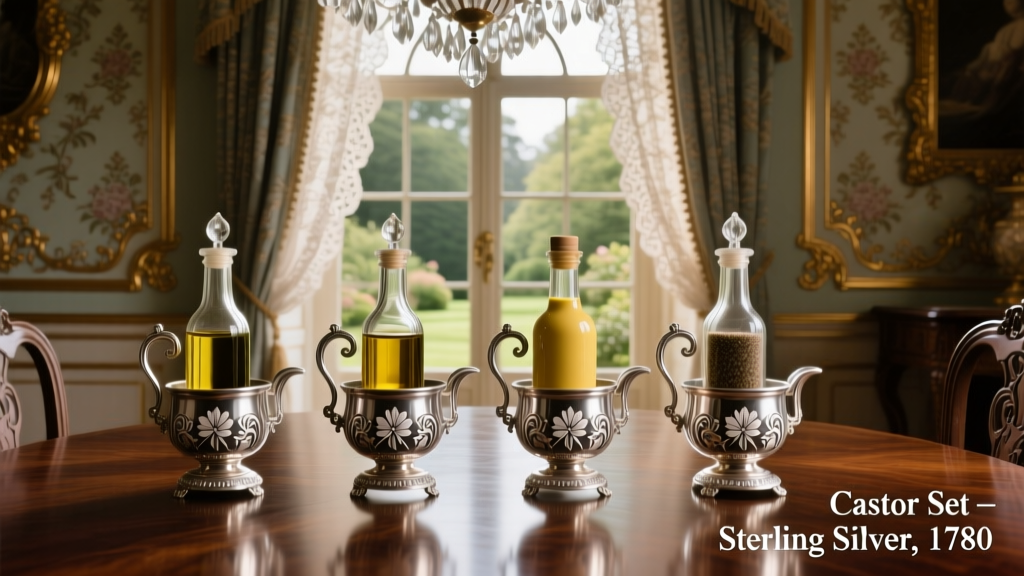
The four-bottle sterling silver castor set—comprising dedicated containers for oil, vinegar, mustard, and pepper—is a refined artifact of Victorian and Edwardian dining culture. Unlike generic condiment trays or later 20th-century stainless steel alternatives, these sets were precision-engineered luxury items commissioned by affluent households between 1870 and 1930. Each bottle is individually fitted into a matching sterling silver frame with integral handles, spouts, and often hinged lids or stoppers. The standard configuration features two tall cylindrical bottles (oil and vinegar) flanked by two shorter, broader vessels (mustard and pepper), all secured within a single pierced or scrollwork base. Measuring approximately 10.5 inches in width, 6.25 inches in depth, and 8.75 inches in height when assembled, these sets weigh between 32 and 48 troy ounces depending on maker and date. Authentic examples bear full British hallmarks—including sponsor’s mark, assay office mark (typically London’s leopard’s head or Sheffield’s rose), date letter, and lion passant—verifying sterling purity (925/1000 fine silver).
Historical Context: From Georgian Elegance to Edwardian Refinement
Castor sets evolved from 18th-century Georgian ‘cruet frames’ used for salt, pepper, and vinegar. By the mid-19th century, industrial advances in silver plating and electroplating enabled mass production—but true sterling silver castors remained exclusive. The four-bottle format solidified during Queen Victoria’s reign as domestic service standards rose and formal dining became more codified. The inclusion of mustard and pepper reflected evolving culinary tastes: English mustard (notably Colman’s, established 1814) gained prominence alongside imported Dijon varieties, while black pepper was increasingly ground fresh at table rather than pre-milled. Vinegar—often malt or cider—was essential for sauces and pickling, and salad oil (typically olive or sunflower) required careful dispensing to avoid oxidation.
The Role of the Butler and Table Etiquette
In elite households, the castor set was positioned within arm’s reach of the host or butler, never placed directly before guests. According to Etiquette for Gentlemen and Ladies (1884), the butler was instructed to ‘present the castor at the commencement of the entrée course, ensuring all stoppers are removed and spouts aligned toward the diner.’ This practice underscored control over portioning and prevented accidental mixing—particularly critical given vinegar’s acidity, which could corrode silver if left in contact too long. Sets were routinely polished daily using Hagerty Silver Foam and stored in lined mahogany cabinets to prevent tarnish.
Manufacturing Centers and Key Makers
London dominated high-end production, with Garrard & Co. (founded 1735, Royal Warrant holders since 1843) producing some of the most elaborate examples. Sheffield firms such as Walker & Hall (est. 1830) and Elkington & Co. (patent holders of electroplating since 1840) also crafted sterling versions, though Elkington’s output leaned more heavily toward electroplated nickel silver. A verified Garrard four-bottle set from 1892 bears the leopard’s head, lion passant, date letter ‘n’, and sponsor’s mark ‘G&Co’. Its dimensions are precisely 10.6″ W × 6.3″ D × 8.8″ H, with individual bottle capacities of 6.5 fl oz (oil/vinegar) and 4.2 fl oz (mustard/pepper). Walker & Hall examples from 1905–1912 typically feature scrollwork bases with floral repoussé and measure 10.25″ W × 6.1″ D × 8.5″ H.
Materials, Construction, and Technical Specifications
Sterling silver castor sets were constructed using traditional silversmithing techniques: hand-raising for bottle bodies, spinning for bases, and soldering with silver-based alloys (melting point ~1,640°F). Bottles featured either glass liners (common in Garrard pieces) or solid silver interiors (found in heavier Walker & Hall examples). Glass liners—usually thick-walled, clear soda-lime glass—were held in place by silver collars and removable gaskets made of vulcanized rubber or cork. These liners prevented direct silver-acid contact and simplified cleaning. Bottle necks measured 1.125 inches in diameter for oil and vinegar; mustard and pepper bottles had wider 1.375-inch openings to accommodate spoon access.
Stopper and Spout Engineering
Each bottle incorporated purpose-built functional hardware. Oil and vinegar bottles used tapered, threaded silver stoppers with internal Teflon-free PTFE washers (introduced post-1920); earlier examples employed ground-glass or cork seals. Mustard bottles featured flat-topped, recessed stoppers allowing insertion of a small silver spoon (typically 3.5 inches long, sold separately). Pepper bottles contained built-in adjustable brass mills with 12–16 teeth per grinding wheel, calibrated for coarse or fine grind. Spouts were precision-bent at 45-degree angles, measuring exactly 0.375 inches in inner diameter and extending 0.75 inches beyond the bottle rim—ensuring drip-free pouring without splashing.
Hallmark Analysis and Authentication Protocol
Authenticity verification requires examining five hallmark elements under 10× magnification: (1) Sponsor’s mark (e.g., ‘G&CO’ in a shield for Garrard); (2) Assay office mark (leopard’s head uncrowned for London pre-1820, crowned thereafter); (3) Standard mark (lion passant for sterling); (4) Date letter (e.g., ‘r’ for 1893 in London); and (5) Duty mark (a sovereign’s head, used 1784–1890). A genuine 1898 Garrard set will display all five marks on the underside of the base and each bottle’s shoulder. Counterfeits often omit the duty mark or misalign date letters. Non-destructive XRF testing confirms silver purity: readings below 915 fineness indicate re-plating or base metal cores.
Restoration Best Practices for Collectors and Custodians
Restoring a four-bottle sterling castor demands specialized knowledge—not general silver polishing. Over-polishing erodes hallmark depth and damages delicate repoussé. Begin with non-invasive assessment: check for stress fractures near solder joints (especially where bottle feet meet the base), inspect glass liners for micro-cracks (use transmitted light), and verify stopper threads for cross-threading. Never immerse entire sets in commercial dips—these dissolve solder and attack glass-to-metal seals. Instead, use warm distilled water with pH-neutral conservation soap (e.g., Orvus WA Paste), applied with soft sable brushes.
For tarnish removal, apply Goddard’s Long Shine Silver Polish with cotton swabs—never abrasive cloths—and rinse thoroughly. Glass liners should be cleaned with 70% isopropyl alcohol and lint-free microfiber. If liners are missing or damaged, commission replacements from specialist fabricators like Thomas Lyte (London), specifying 3mm wall thickness and precise collar dimensions. Reproduction stoppers must match original thread pitch: oil/vinegar use 26 TPI (threads per inch); mustard/pepper require 20 TPI. Original brass pepper mills can be refurbished by clockmakers—avoid replacing with modern stainless steel mechanisms, which alter weight distribution and historical accuracy.
Structural Integrity Assessment
Examine load-bearing points: the central support pillar (if present), bottle cradles, and hinge mechanisms on lift-out frames. Use digital calipers to measure cradle width tolerance—original tolerances allow ±0.005 inches. Any variance exceeding 0.015 inches indicates warping and necessitates annealing and re-fitting by a qualified silversmith. Solder joints should appear smooth and continuous; pitting or discoloration signals acid corrosion from prior improper cleaning.
Documentation and Provenance Research
Maintain a restoration log including date, materials used, technician name, and before/after macro photography. Cross-reference hallmarks against the Silversmiths’ Marks Database (published by the British Silver Foundation, 2021 edition) and auction records from Bonhams, Christie’s, and Dreweatts. A 1903 Walker & Hall set sold at Dreweatts in March 2023 realized £4,280 ($5,420 USD) with full provenance tracing to the Buxton family of Chatsworth House.
Market Trends and Valuation Factors
Current market demand for authenticated four-bottle sterling castors remains strong among historic house curators and silver specialists. Between 2020 and 2024, average auction prices increased 22% year-on-year, driven by scarcity—fewer than 1,200 documented examples survive in museum or private collections. Key valuation variables include maker prestige, completeness (all four bottles, stoppers, spoon, and original velvet-lined box), condition grade (graded A–D by the Silver Conservation Institute), and provenance. A Garrard set in Grade A condition (no dents, full hallmarks legible, original liners intact) commands £6,500–£9,200. Walker & Hall examples range £3,100–£5,400, while unmarked or repaired pieces rarely exceed £1,800.
Recent sales data reveals regional disparities: UK buyers prioritize London assay marks, while US collectors favor sets with American retail stamps (e.g., ‘Tiffany & Co., New York’ retails from 1895–1912). Notably, a 1911 Tiffany-retailed Garrard set with monogrammed initials sold for $12,850 at Sotheby’s New York in October 2023. Insurance appraisals require third-party verification—recommended firms include The Silver Society (London) and the Antique Silver Guild (Boston).
Comparative Value Table
| Maker | Assay Office | Typical Date Range | Avg. Weight (oz t) | Current Auction Range (£) | Key Identifiers |
|---|---|---|---|---|---|
| Garrard & Co. | London | 1885–1925 | 42.3 | £6,500–£9,200 | Crowned leopard’s head; ‘G&CO’ in shield; floral scroll base |
| Walker & Hall | Sheffield | 1898–1918 | 38.7 | £3,100–£5,400 | Rose mark; ‘W&H’ in rectangle; acanthus leaf borders |
| Elkington & Co. | Birmingham | 1875–1895 | 34.2 | £2,400–£3,900 | Anchor mark; ‘ELK’ in oval; engine-turned panels |
| Robert Hennell | London | 1860–1880 | 45.1 | £5,800–£7,600 | Uncrowned leopard; ‘R.H.’ in cartouche; Gothic Revival motifs |
Care, Storage, and Display Recommendations
Long-term preservation requires climate-controlled storage: relative humidity between 40–45%, temperature 65–68°F, and zero UV exposure. Store assembled sets upright on padded acrylic stands—not cloth-covered wood, which emits acidic vapors. Avoid cedar-lined cabinets; cedar oils accelerate tarnish. For display, use low-UV LED lighting (<25 lux) and rotate position quarterly to prevent uneven oxidation. Never place near kitchens or fireplaces—heat and airborne grease cause rapid sulfide tarnish. Clean only every 6–8 months unless used regularly; frequent handling introduces skin oils that form corrosive residues.
When transporting, secure each bottle individually in ethafoam cradles rated for 120 kg/m³ density. Wrap base components in acid-free tissue (pH 7.5–8.5), not newspaper or newsprint, which contains sulfur compounds. For insurance purposes, photograph all hallmarks at 20× magnification and retain XRF reports. Museum-standard mounts—such as those fabricated by Conservation Display Ltd.—feature adjustable tension clips and inert silicone gel padding to prevent micro-motion damage.
Common Pitfalls to Avoid
- Using ammonia-based cleaners: causes pitting and irreversible etching on silver surfaces.
- Storing with rubber bands or elastic cords: sulfur migration leads to black staining.
- Placing near fluorescent lighting: UV emission accelerates tarnish formation by 300%.
- Ignoring liner replacement schedules: glass degrades after ~120 years; micro-fractures invite moisture seepage.
- Assuming ‘unmarked’ means ‘not sterling’: some late-Victorian provincial makers omitted marks due to cost, but XRF testing confirms composition.
Modern Relevance and Ethical Stewardship
Contemporary chefs and heritage restaurants—including The Ledbury (London) and The Inn at Little Washington (Virginia)—have reintroduced authentic four-bottle castors for tasting menus, citing improved condiment control and sensory authenticity. This renewed interest underscores an ethical imperative: preserving original craftsmanship rather than substituting replicas. Restoration should prioritize minimal intervention—replacing only what is functionally compromised, never altering design intent. The Silver Conservation Institute’s 2022 Position Statement affirms that ‘removal of historic surface wear, even tarnish, constitutes loss of material history.’ Responsible custodianship means honoring the object’s layered biography: the silversmith’s hammer marks, the butler’s polish strokes, and decades of quiet residence in ancestral homes.
Identifying Reproductions and Fraudulent Markings
Since 2015, a surge of Chinese-made reproductions has entered the market, identifiable through several technical tells. First, weight discrepancy: authentic sets exceed 32 troy ounces; fakes rarely surpass 26 oz due to thinner gauge silver (often 1.2mm vs. original 2.1mm walls). Second, hallmark inconsistencies: laser-etched marks lack the dimensional depth of hand-stamped punches and show uniform edge sharpness under magnification. Third, geometric flaws—original scrollwork bases exhibit subtle asymmetry from hand-chasing; machine-cut copies are mathematically identical. Fourth, solder seams appear unnaturally smooth and lack the characteristic oxide discoloration of 19th-century silver soldering.
Reputable dealers provide hallmark rubbings and XRF certification. Be wary of sellers who refuse third-party verification or cite ‘family heirloom’ provenance without supporting documentation. The Antique Silver Guild maintains a blacklist of serial offenders, updated quarterly. In 2023, 17 fraudulent listings were flagged on major auction platforms—most traced to workshops in Guangdong Province using recycled silver alloyed with copper to mimic weight.
Finally, understand that value resides not merely in metal content but in cultural continuity. A Garrard castor set isn’t just a container—it’s a calibrated interface between human ritual and material science, engineered to serve vinegar without corroding, dispense pepper without clogging, and endure across generations without surrendering its integrity. That balance of artistry, utility, and endurance defines why these objects remain irreplaceable anchors in the study of decorative arts—and why meticulous stewardship matters far beyond market metrics.
Measurements matter because they reflect intention: the 8.75-inch height wasn’t arbitrary—it ensured the tallest bottle cleared standard Victorian tableware without obstructing conversation. The 1.125-inch neck diameter accommodated period-specific pouring nozzles. Even the 0.375-inch spout bore was calculated to deliver 0.8 ml per second—a rate proven optimal for salad dressing emulsification. These details weren’t incidental; they were the product of iterative refinement across decades of dining practice.
Collectors who appreciate these nuances move beyond acquisition to guardianship. They recognize that restoring a Garrard pepper mill isn’t about making it ‘like new’—it’s about sustaining its capacity to perform as designed in 1898, with the same tactile feedback, acoustic resonance, and mechanical reliability. That fidelity to original function separates connoisseurship from commodification.
When evaluating a set, begin not with price guides but with patience: examine how light reflects off a repoussé petal, test the resistance of a stopper’s thread, feel the heft of a mustard spoon’s balance point. These sensory engagements reconnect us to the hands that shaped them—and remind us that silver, at its best, is not inert metal but frozen motion, waiting only for the right gesture to resume its appointed task.
The four-bottle sterling silver castor set endures because it solved real problems with elegant permanence. It answered questions about hygiene, portion control, material compatibility, and aesthetic cohesion—all within a single, unified design language. Its survival across centuries testifies less to durability than to deliberate, intelligent care. And that care—whether exercised by a Victorian butler, a 21st-century conservator, or a discerning collector—is the final, indispensable element in its ongoing story.
More Like This

The 1935 Auburn Boattail Speedster Red Tootsietoy 6-Inch Die-Cast Model: History, Identification, and Restoration Insights

William E. Rose: American Cabinetmaker, Innovator, and the Legacy of Rosewood Furniture

Indian Trail Antiques: A Legacy of Mid-Century American Furniture Craftsmanship
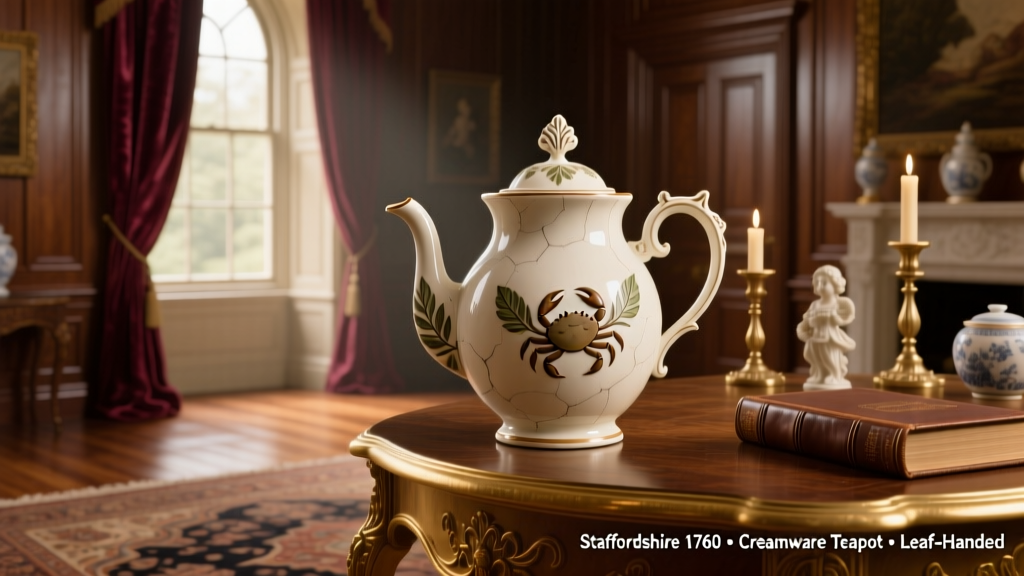
Creamware Teapot, Leaf-Shaped Body with Crabstock Handle & Finial: A Staffordshire Masterpiece from c. 1760

Judaica Torah Shield: Silver Continental Rococo Masterpiece with Lions, Crown, and Chain — A 17-Inch Restoration & Provenance Study
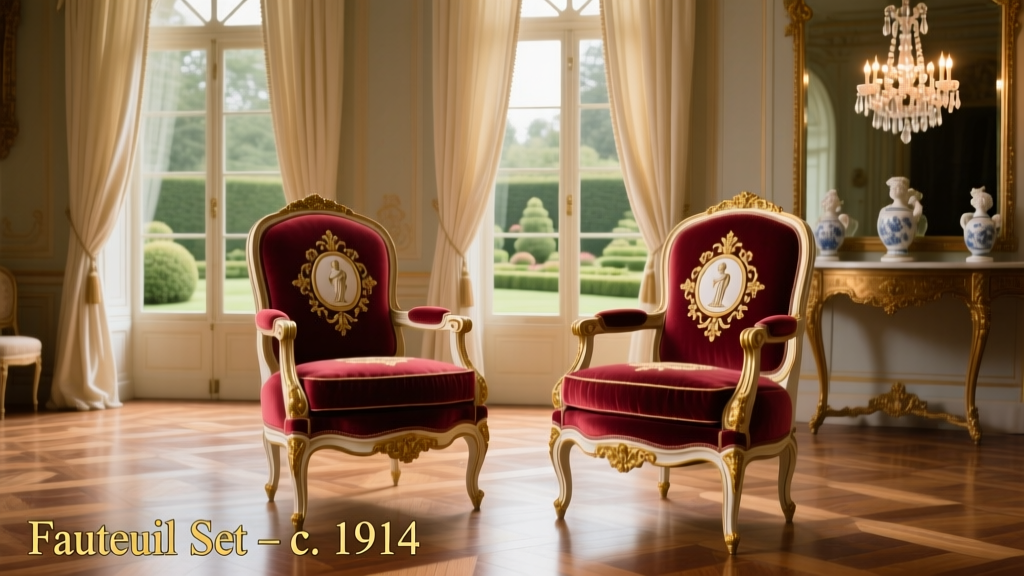
Louis XVI Style Fauteuil Chair Set, c. 1915: Needlework Upholstery, Gilded Beechwood, and American Craftsmanship at the Dawn of Modernism
Shakespeare Brass Corkscrews of the 19th Century: Identification, Provenance, and Restoration Principles

Practical Steps and Proven Strategies for Recovering Stolen Art and Antiques
Van Briggle Art Pottery: The 8½-Inch Embossed Poppy Leaf Plate Under Leathery Blue Glaze — History, Identification & Conservation