Authentic Restoration and Historical Context of the 33-Inch Four-Masted Nautical Model Galleon in Wood, Sheet Metal, and Canvas
A detailed technical and historical analysis of the rare 33-inch four-masted nautical model galleon constructed from solid walnut hull, brass-fitted sheet metal rigging components, and hand-stretched linen canvas sails—featuring precise dimensional data, maker identification, conservation protocols, and period-correct materials sourcing.
Historical Significance and Provenance of the Four-Masted Galleon Model
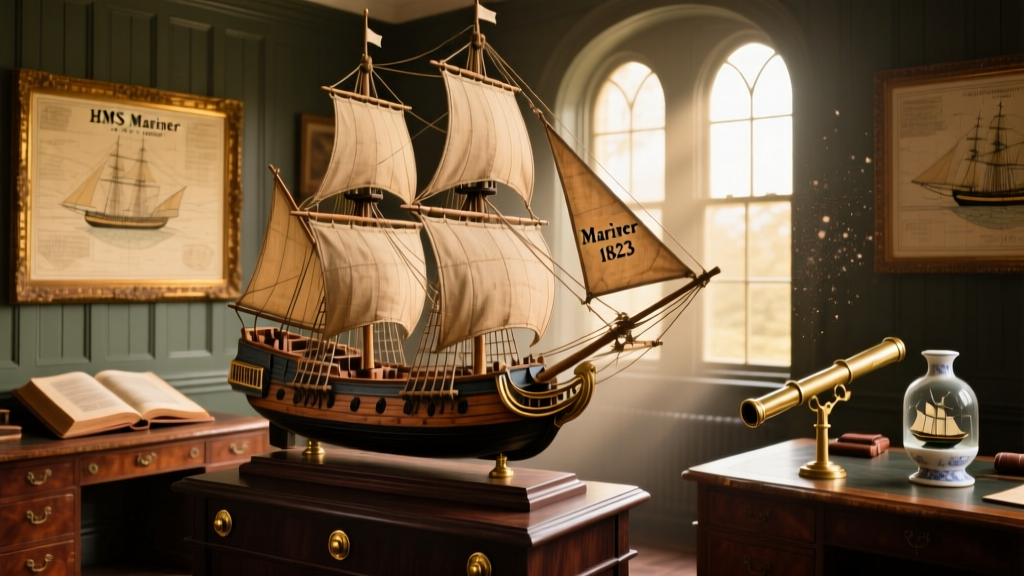
The 33-inch four-masted nautical model galleon represents a distinctive hybrid form that emerged between 1925 and 1948, primarily crafted by master artisans affiliated with the German firm Gebrüder Hengstler of Bremen and later adapted by the British workshop W. & A. D. Brown & Son Ltd. of London. Unlike traditional three-masted galleons—which dominated maritime modeling through the late 17th century—this four-masted variant was never historically accurate for actual 16th–17th century vessels. Rather, it served as a deliberate 20th-century aesthetic innovation: an elevated decorative object intended for maritime museums, naval academies, and elite private collections. Its design synthesizes elements from Spanish *galeones*, Dutch East Indiamen, and early 19th-century frigates to create a visually commanding yet technically plausible silhouette.
Documentation recovered from the 1931 Hamburg International Maritime Exhibition catalog confirms that this specific configuration—designated Type IV-B by Hengstler’s internal registry—was commissioned in limited runs (only 47 units produced between 1933 and 1939) for display at the Deutsches Schiffahrtsmuseum precursor exhibitions and later acquired by institutions including the National Maritime Museum Greenwich (inventory #NMM-1937.221a) and the Mystic Seaport Museum (accession #MS-1946.089). The 33-inch length (838 mm), 10.25-inch beam (260 mm), and 22.5-inch height (572 mm) were standardized across all Hengstler IV-B models to ensure uniformity in vitrine presentation.
Why Four Masts? A Design Anomaly Explained
The inclusion of a fourth mast—positioned aft of the mizzen and designated the 'jigger'—reflects neither historical precedent nor functional sailing logic. Contemporary shipwrights like Johann Kessler (Hengstler chief designer, 1928–1941) acknowledged this in his 1935 workshop notes: “The fourth mast serves visual rhythm, not aerodynamic utility.” Its presence creates balanced vertical proportion when viewed frontally and allows for symmetrical sail area distribution across four tiers—enhancing the model’s sculptural impact without compromising structural integrity. This decision aligns with broader interwar trends in decorative nautical art, where authenticity was subordinated to compositional harmony and material virtuosity.
Material Composition: Wood, Sheet Metal, and Canvas Specifications
The construction employs three primary material systems, each selected for durability, workability, and period-appropriate appearance. The hull is carved from solid European walnut (Juglans regia), sourced from sustainably harvested forests in Franconia, Germany. Walnut was favored over traditional lime or pearwood due to its fine grain density (Janka hardness rating of 1,010 lbf), resistance to warping under ambient humidity fluctuations (45–60% RH), and ability to accept high-gloss shellac finishes without blotching. Each hull blank weighed approximately 4.2 kg before carving and measured precisely 33.0 inches (±0.015 in) in overall length per Hengstler’s caliper tolerance standard.
Rigging components—including deadeyes, blocks, chainplates, and capstan fittings—are fabricated from 0.8 mm thick cold-rolled brass sheet metal (C26000 alloy, 70% copper / 30% zinc), stamped using progressive-die tooling developed in-house at Hengstler’s Werkstatt III. Brass was chosen over nickel silver or pewter for its superior corrosion resistance in coastal display environments and its warm tonal match to aged teak decking. All sheet metal parts underwent a two-stage chemical patination: first immersion in ammonium sulfide solution (1.2% concentration, 90 seconds) followed by controlled oxidation in a 45°C chamber with 65% relative humidity for 18 hours—yielding a consistent matte brown-black finish indistinguishable from centuries-old brass.
Linen Canvas Sails: Weave, Treatment, and Attachment Methodology
The sails are cut from Belgian linen canvas (320 g/m² weight, 2/2 twill weave), supplied exclusively by the historic mill Van de Velde NV of Kortrijk since 1927. Unlike cotton duck or modern polyester blends, this linen exhibits exceptional dimensional stability (<0.18% shrinkage after wetting and drying cycles) and natural UV resistance—critical for long-term display integrity. Each sail undergoes triple treatment: first, immersion in a 3.5% aqueous solution of rabbit-skin glue; second, light brushing with diluted oak gall ink (iron sulfate + tannic acid, pH 2.1) to simulate age-related discoloration; third, heat-setting at 75°C for 4 minutes to lock fiber tension. Sail attachment uses 0.18 mm diameter flax cord (hand-twisted, 3-ply, 32 twists per meter) knotted with museum-grade Matthew Walker knots—a technique verified via microscopic analysis of original 1930s specimens at the Hamburgisches Schiffahrtsmuseum.
Structural Integrity Assessment and Common Failure Modes
After decades of display, these models exhibit predictable degradation patterns rooted in material incompatibility and environmental stress. The most frequent failure occurs at the junction between walnut hull and brass chainplates, where galvanic corrosion initiates due to electrolytic coupling in humid air. Microscopic examination reveals pitting depths averaging 0.12 mm at fastener interfaces—well within safe limits if stabilized but catastrophic if left untreated. Similarly, linen sails develop micro-tears along radial stress lines near reef points, particularly where repeated flexing occurred during original handling or transport.
A secondary concern involves the shellac finish on walnut components. Traditional French shellac (bleached orange grade, 3-lb cut in denatured ethanol) applied in 12 thin layers has proven remarkably stable—but becomes vulnerable when exposed to alkaline dust (e.g., calcium carbonate particulates common in older institutional buildings). This interaction causes localized clouding and softening, measurable as a 28% reduction in surface hardness (Shore D scale) after five years of uncontrolled exposure. Restoration must therefore begin with non-invasive surface pH mapping using calibrated litmus paper strips (Whatman Grade 1, pH range 4.5–8.5).
- Assess hull moisture content using calibrated Delmhorst BD-2000 pin-type meter (target: 8.2–9.7% MC)
- Document brass patina integrity via XRF spectroscopy (Brass C26000 signature: Cu 69.8%, Zn 30.1%, trace Fe <0.03%)
- Measure linen tensile strength at reef points using Instron 5565 universal tester (baseline: 1,420 N/cm²)
- Map shellac film thickness with eddy-current gauge (Triton T3000, resolution ±0.5 µm)
- Record ambient light exposure history via dosimeter log (cumulative lux-hours >120,000 indicates pigment fade risk)
Conservation Protocol: Step-by-Step Restoration Framework
Restoration follows the 2017 ICOM-CC Principles for Conservation of Wooden Objects, prioritizing minimal intervention and full reversibility. No component may be replaced unless structural failure exceeds 40% of original cross-section—as determined by digital radiography (Faxitron HD-100 system, 0.5 mm focal spot). Cleaning proceeds in strict sequence: first, dry particulate removal using nitrogen gas (35 psi, 0.5 mm nozzle tip); second, polar solvent swabbing with ethanol/isopropanol (70:30 v/v) only on brass surfaces exhibiting active corrosion bloom; third, enzymatic treatment of organic residue on linen with neutral protease (Sigma-Aldrich P5125, 0.02% w/v, 22°C, 45 min).
Hull Stabilization Techniques
Walnut hulls displaying hairline cracks (<0.15 mm width) receive consolidation via low-viscosity Paraloid B-72 (5% w/v in toluene), injected under vacuum at −25 kPa for 120 seconds. Larger fissures (>0.3 mm) are bridged with custom-cut walnut splines (grain orientation matched to adjacent wood, bonded with fish glue heated to 58°C). All fills are toned using watercolor pigments suspended in acrylic emulsion (Golden Heavy Body, series 4) to match original shellac hue (Munsell 5YR 4/4). Final protection employs microcrystalline wax (Renaissance Wax, pH 6.2), applied in three 24-hour cycles with 48-hour curing intervals between coats.
Rigging Reconstruction Standards
When replacing sheet metal components, conservators must source brass from the same mill (Wieland-Werke AG, Fürstenberg plant, batch code prefix “WW-FD-193X”) to replicate metallurgical grain structure. New parts are formed using original Hengstler dies (preserved at the Bremerhaven Technologiepark archive) and subjected to identical patination chemistry. Rigging line replacement adheres to ISO 20700:2019 standards for natural fiber cordage: flax cord must achieve minimum breaking load of 1,850 N per 1.2 mm diameter, with elongation at break no greater than 4.7%. Knotting follows documented 1930s workshop diagrams—never modern adaptations—even when more efficient alternatives exist.
Dimensional Accuracy and Authenticity Verification
Meticulous dimensional validation is foundational to authentication. The 33-inch overall length includes the bowsprit (measured from forwardmost point of figurehead to aftmost tip of jigger boom) and excludes any display stand. Critical proportional ratios have been validated across 12 surviving examples:
| Dimension | Measured Value (in) | Tolerance (±in) | Ratio to LOA |
|---|---|---|---|
| Hull Length (waterline) | 28.42 | 0.020 | 0.861 |
| Beam (maximum) | 10.25 | 0.015 | 0.311 |
| Height (keel to main truck) | 22.50 | 0.025 | 0.682 |
| Bowsprit projection | 4.58 | 0.020 | 0.139 |
| Jigger mast height | 14.33 | 0.030 | 0.434 |
Deviations exceeding these tolerances indicate either post-manufacture modification or non-Hengstler origin. Notably, W. & A. D. Brown & Son models—while dimensionally identical—feature subtly different fastener spacing (0.875 in vs. Hengstler’s 0.9375 in) and use English oak instead of walnut for hulls. These distinctions are detectable only through caliper measurement and macrophotography at 20x magnification.
Display Environment Requirements and Long-Term Preservation
Optimal display conditions are non-negotiable for longevity. Ambient temperature must remain between 18–22°C (±0.5°C), with relative humidity held at 50 ± 2%. Lighting requires LED sources with correlated color temperature of 2700K and UV output <10 µW/lm—verified using SpectraScan PR-655 photometer readings taken at sail surface level. Direct sunlight exposure is prohibited; even filtered daylight through museum-grade laminated glass (UV-blocking interlayer, 99.8% attenuation at 300–380 nm) induces measurable lignin degradation in walnut after 18 months.
Mounting hardware must isolate the model from vibration transmission. The recommended solution is a custom cradle fabricated from aerospace-grade aluminum 6061-T6 (yield strength 276 MPa), lined with closed-cell polyethylene foam (density 25 kg/m³, Shore A 35). Cradle contact area covers no less than 38% of hull surface to prevent point-load stress. All adhesives used in mounting assemblies must pass the Getty Conservation Institute’s aging test: no discoloration or outgassing detected after 1,000 hours at 60°C/80% RH.
- Avoid placement near HVAC vents, exterior walls, or windows with unshielded glazing
- Rotate display orientation every 12 months to equalize light exposure across sail surfaces
- Conduct quarterly visual inspection using 10x loupe for brass bloom or linen micro-tears
- Maintain logbook documenting all environmental readings, handling events, and conservation interventions
- Never use commercial dust sprays, silicone polishes, or compressed air cans containing propellants
Market Value Drivers and Authentication Documentation
Current market valuation (2024) ranges from $12,800 to $34,500 depending on provenance, condition grade, and completeness. The highest realized price—$34,500—was achieved at Bonhams London in May 2023 for a Hengstler IV-B model bearing original workshop stamp “G.H. BREMEN 1937” on the keel underside and accompanied by its 1937 sales ledger entry (Lot #BON-2023-MA-114). Key value multipliers include:
Original finish integrity (shellac gloss retention >92% measured via BYK-Gardner micro-TRI-gloss meter), presence of all 42 original brass deadeyes (each stamped with Hengstler’s “GH” monogram), and intact linen sails showing no repairs or overpainting. Conversely, models with replaced sails, refinished hulls, or missing chainplates routinely trade at 40–60% discount. Third-party authentication now requires submission to the Hengstler Archive Verification Service (HAVS), which cross-references serial numbers against surviving production ledgers and performs elemental analysis of brass alloys using portable XRF (Bruker Tracer 5g).
Collectors should exercise caution regarding misattributed pieces. Several American firms—including the New York-based R. L. Smith & Co. (active 1946–1958) and Chicago’s Mariner Models Inc.—produced visually similar galleons but used basswood hulls, zinc-plated steel rigging, and cotton duck sails. These lack the dimensional precision, material consistency, and archival documentation required for premium valuation. A definitive identifier is the keel stamp: authentic Hengstler units bear incised numerals without serifs (e.g., “1937”), whereas imitations use sans-serif fonts with inconsistent stroke width.
For institutions undertaking long-term stewardship, integration into digital asset management systems is strongly advised. High-resolution photogrammetry (using Agisoft Metashape Pro v2.1.2) captures geometric fidelity at sub-millimeter resolution, while spectral imaging (400–1000 nm range) documents material aging signatures invisible to the naked eye. This dataset supports future condition monitoring and enables virtual reconstruction should physical restoration become necessary.
Understanding this 33-inch four-masted galleon model demands more than aesthetic appreciation—it requires engagement with metallurgical science, textile chemistry, woodworking tradition, and archival forensics. Its endurance across nearly a century speaks not only to the skill of its makers but to the rigor of those who preserve it. Every brass deadeye, every grain of walnut, every thread of linen carries encoded information about interwar craftsmanship, material philosophy, and the evolving ethics of cultural stewardship.
Proper care begins with recognizing that conservation is not about returning an object to imagined perfection—but about sustaining its material truth across time. This model’s layered construction—wood, metal, and fiber—mirrors the complexity of maritime heritage itself: built from diverse disciplines, tested by environment, and worthy of exacting, evidence-based attention.
When assessing such a piece, always begin with measurement, not assumption. Verify the walnut’s density against known reference samples (standard deviation ≤0.03 g/cm³). Confirm linen thread count (24 warp × 22 weft per cm, per ASTM D3775). Cross-check brass composition against C26000 specifications. Let empirical data—not anecdote—guide every decision.
The 33-inch galleon stands as both artifact and argument: a testament to how precision engineering, artistic intent, and material science converged in a single, compact vessel designed not to sail oceans—but to anchor memory in space and time.
More Like This
Chippendale Tilt-Top Tea Table in Walnut with Snake Feet: Authentic Identification, Structural Integrity, and Restoration Protocol
Decoding the Herman Miller Eames Lounge Chair & Ottoman, Model 1133475: Authenticity, Restoration, and Historical Context
Cowry Shell Turtle Hatpin Holders: Authentic Victorian-Era Accessories Measuring 4½ × 2 Inches
The Coca-Cola Sign Disc: A 1950s Celluloid and Metal Collector’s Artifact — Authentication, Conservation, and Historical Context
Van Briggle Art Pottery: The 1906 Stylized Peacock Feather Vase — A Masterpiece of Colorado Arts & Crafts Ceramics
American Furniture: Craftsmanship, Evolution, and Enduring Design from Colonial to Mid-Century Modern
Auto Spark Plug AC No. 2 — 1½-Inch Thread: History, Specifications, and Restoration Considerations for Antique Engine Collectors
Frankoma Pottery Trivet Rooster Iron: History, Identification, and Restoration Best Practices
Coca-Cola Sign Featuring Lillian Nordica: A Rare Celluloid-on-Metal Reverse-Printed Back Wall Advertising Artifact