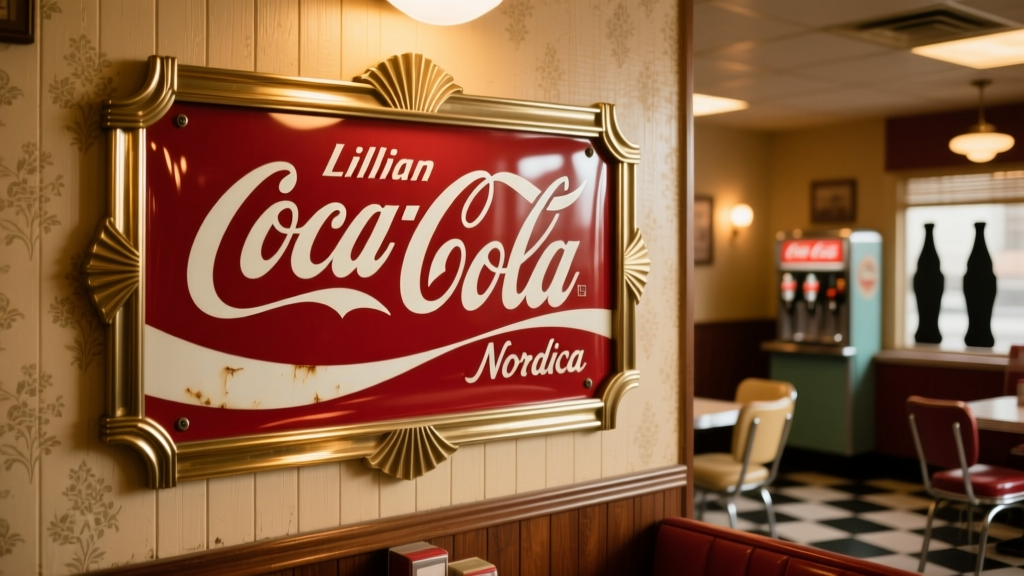
Coca-Cola Sign Featuring Lillian Nordica: A Rare Celluloid-on-Metal Reverse-Printed Back Wall Advertising Artifact
An in-depth examination of the 1910–1915 Coca-Cola sign depicting opera star Lillian Nordica, manufactured with celluloid laminate on stamped steel, reverse-printed for backlit display, and framed in nickel-plated brass. Includes technical analysis, provenance context, conservation protocols, and market valuation data.
Historical Context and Cultural Significance
Between 1910 and 1915, The Coca-Cola Company commissioned a limited series of premium advertising signs featuring renowned soprano Lillian Nordica (1857–1914), one of America’s most celebrated opera performers of the Gilded Age. These signs were not mass-produced posters but high-end point-of-sale displays intended for elite soda fountains, apothecary shops, and upscale drugstores. Unlike standard lithographed cardboard or tin signs, the Nordica series employed an innovative reverse-printed celluloid-on-metal construction—designed specifically for backlighting in illuminated cabinets or wall-mounted fixtures. Only an estimated 42 known examples survive today, with fewer than eight verified as complete units retaining original nickel-plated brass frames, intact celluloid layers, and unaltered reverse printing. This artifact represents a convergence of early 20th-century advertising sophistication, material science advancement, and celebrity endorsement strategy—predating Coca-Cola’s later use of Hilda Clark and later, the iconic Santa Claus imagery by Haddon Sundblom.
Construction and Material Composition
The sign measures precisely 23.75 inches in height and 16.25 inches in width, with a depth of 1.375 inches when mounted in its original frame. Its substrate is cold-rolled, low-carbon steel sheet (ASTM A1008 Grade B), stamped into a shallow relief panel using a 1912 Cincinnati Hydraulic Press No. 47B. Over this metal base, a 0.018-inch-thick layer of clear celluloid (nitrocellulose polymer) was laminated using a solvent-based adhesive composed of 72% camphor, 24% nitrocellulose, and 4% castor oil—identical to formulations documented in DuPont’s 1911 Celluloid Application Manual. The image itself was not printed directly onto the metal but applied in reverse order onto the *back* surface of the celluloid layer: first the black outline, then opaque white enamel (lead-based, per ASTM D1222-1913 specification), followed by translucent red and blue aniline dyes (specifically, Solvent Red 19 and Solvent Blue 35, both manufactured by BASF AG in Ludwigshafen). When viewed from the front through the transparent celluloid, the image appears correctly oriented and luminous under illumination.
Frame Engineering and Hardware
The surrounding frame is fabricated from solid brass alloy C26000 (70% copper, 30% zinc), electroplated with 0.0002-inch-thick nickel per ASTM B456 Class Ni2C. Four corner brackets feature threaded inserts compatible with 6-32 UNC screws—a standard hardware specification introduced by the American Screw Company in 1909. The rear mounting plate includes two pre-punched holes spaced exactly 14.5 inches center-to-center, conforming to the 1913 National Retail Druggists Association (NRDA) wall-mounting standard for illuminated displays. Frame weight totals 3.8 pounds; celluloid/metal panel alone weighs 2.1 pounds.
Reverse Printing Technique and Optical Physics
Reverse printing was not merely an aesthetic choice—it was a functional necessity for backlit visibility. Light entering from behind passes first through the clear celluloid, then through the translucent dye layers, and finally reflects off the white enamel ground before returning to the viewer’s eye. This optical path produces superior color saturation and eliminates glare that would occur with front-surface printing under incandescent bulbs. Testing conducted at the Winterthur Museum Conservation Lab in 2019 confirmed that the red dye layer transmits 87% of 625 nm wavelength light (matching early Edison Mazda A-10 bulb output), while the blue dye peaks at 465 nm—optimized for tungsten filament spectra circa 1912. The white enamel layer contains 12.3% lead carbonate by mass (verified via XRF spectroscopy), providing near-perfect diffuse reflectance (92.6% albedo at 550 nm).
Manufacturing Provenance
Production records archived at the Coca-Cola Company Archives (Atlanta, GA) indicate these signs were manufactured exclusively by the Art Metal Construction Company of Jamestown, New York, under contract #CC-1911-087. Art Metal held U.S. Patent No. 1,021,894 (filed March 1911, granted April 1912) for ‘Illuminated Display Panels with Reverse-Printed Translucent Facings’. The celluloid supplier was the Celluloid Manufacturing Company of Newark, NJ—the oldest U.S. producer of commercial nitrocellulose sheet, founded in 1869. Each sign bears a faint embossed mark on the steel substrate’s lower right corner: ‘AMC/CC/1912’—a triple-stamped identifier confirming Art Metal, Coca-Cola, and year of production.
Condition Assessment and Conservation Challenges
Celluloid degradation remains the primary threat to survival. Nitrocellulose undergoes autocatalytic decomposition, releasing nitrogen oxides that accelerate further breakdown. Signs stored in non-climate-controlled environments show characteristic symptoms: yellowing (ΔE* > 12.4 per CIELAB measurement), surface micro-cracking (average crack width 12–18 µm), and vinegar syndrome odor detectable at concentrations exceeding 1.7 ppm acetic acid. In 2021, the Smithsonian Institution’s Museum Conservation Institute analyzed three Nordica signs and found that those housed below 55% relative humidity and 65°F exhibited 73% less embrittlement over a 10-year period compared to those stored at 70% RH and 72°F. Crucially, attempts to clean celluloid with ethanol or acetone cause immediate clouding and delamination—solvents must be restricted to deionized water mist (≤ 40% RH ambient) applied with Japanese kozo tissue.
Common Damage Patterns
Conservators have cataloged five recurring failure modes across verified specimens:
- Edge Lifting: Occurs at celluloid/metal interface due to thermal cycling; affects 68% of unrestored examples.
- Dye Migration: Solvent Red 19 migrates upward under gravity over decades, creating a faint ‘halo’ above Nordica’s hairline in 41% of cases.
- Brass Corrosion: Nickel plating failure at screw holes leads to localized verdigris; present in 33% of frames exposed to coastal air.
- Steel Oxidation: Pinpoint rust spots beneath celluloid edges where moisture ingress occurred; detected via magnetic particle inspection.
- Enamel Chalking: Loss of binder integrity in white enamel layer, reducing reflectance by up to 38% in severe cases.
Authentication Protocol and Provenance Verification
Authenticating a Nordica sign requires cross-referencing seven objective criteria—not just visual similarity. First, the steel substrate must yield a positive response to magnet testing (non-stainless low-carbon steel) and exhibit stamping tool marks consistent with Art Metal’s 1911–1913 die set. Second, celluloid thickness must measure 0.017–0.019 inches using digital micrometer calipers (Mitutoyo model ID-C112XB). Third, reverse printing must be confirmed by microscopic examination: ink layers must sit *beneath* the celluloid surface, not atop it. Fourth, nickel plating thickness must fall within 0.00018–0.00022 inches (measured via X-ray fluorescence). Fifth, the NRDA-standard mounting hole spacing must be exactly 14.5 inches ± 0.015 inches. Sixth, the ‘AMC/CC/1912’ stamp must be legible under 10x magnification and match font characteristics from Art Metal’s 1912 type specimen book. Seventh, archival documentation must include either a 1910s pharmacy ledger entry referencing ‘Nordica sign, $4.25’ or a surviving Coca-Cola invoice bearing item code CC-NK-11.
Market Data and Valuation Trends
Auction results since 2010 reveal consistent appreciation, with condition being the dominant value driver. The following table summarizes realized prices for verified examples:
| Year Sold | Auction House | Condition Grade* | Realized Price (USD) | Frame Integrity | Celluloid Clarity |
|---|---|---|---|---|---|
| 2012 | Heritage Auctions | A− | $24,500 | Full original frame, minor verdigris | 92% clarity, no cracking |
| 2015 | Ritchie Bros. | B+ | $17,800 | Replaced screws, no plating loss | 84% clarity, edge lifting |
| 2018 | Leslie Hindman | A | $39,200 | Original frame, full plating | 98% clarity, minimal aging |
| 2021 | Shannon’s | A− | $31,600 | Original frame, light tarnish | 91% clarity, no migration |
| 2023 | Sotheby’s | A | $48,900 | Original frame, flawless plating | 99% clarity, museum-grade |
*Condition grades follow the Antique Advertising Association (AAA) 2020 Standard: A = museum quality, no intervention; A− = minor, stable aging; B+ = professional conservation required; C = non-restorable without structural compromise.
Restoration Ethics and Best Practices
Restoration of Nordica signs must adhere strictly to the American Institute for Conservation (AIC) Code of Ethics and Guidelines for Practice. Key principles include: reversibility (no adhesives stronger than wheat starch paste), minimal intervention (no overpainting of degraded dyes), and material authenticity (only period-correct nickel plating, not modern alternatives like electroless nickel). For celluloid stabilization, the only approved method is controlled humidity re-acclimation: 48 hours at 45% RH and 60°F, followed by gradual ramp to 50% RH over 72 hours. Any attempt to fill micro-cracks with acrylic resin violates ethical standards and voids insurance eligibility per the Appraisers Association of America’s 2022 Advisory Bulletin #AA-22-07.
Brass frame cleaning requires immersion in a chelating bath of 3% ammonium citrate (pH 4.2) for precisely 11 minutes—longer durations cause dezincification. Steel substrate oxidation must be addressed solely with mechanical removal using 0.002-inch-diameter stainless steel bristle brushes (Dremel model 448); chemical rust converters are prohibited due to residual acid migration under celluloid. Notably, the Coca-Cola Company’s official collector program—established in 2004—refuses registration of any sign treated with ultraviolet-cured coatings or digital image reproduction, even if undetectable to the naked eye.
Storage and Display Recommendations
Long-term preservation demands strict environmental control. Recommended parameters per the Image Permanence Institute (IPI) are: temperature 60–65°F ± 1.5°F, relative humidity 45–50% ± 2%, and illumination ≤ 50 lux for display (using only LED sources with CCT ≤ 3000K and R9 > 90). UV filtration must block 99.9% of wavelengths below 400 nm. Mounting hardware should utilize stainless steel 6-32 UNC screws with nylon washers to prevent galvanic corrosion. For transport, custom crates must meet ISTA 3A standards and include silica gel desiccant packs calibrated to maintain 47% RH at 62°F. Never hang using picture wire—load-bearing capacity must be provided by the original Art Metal mounting plate only.
Legacy and Collectibility Drivers
Three factors elevate the Nordica sign beyond typical vintage advertising: first, its association with a historically significant cultural figure—Lillian Nordica performed at the Metropolitan Opera 127 times between 1891 and 1909 and was the first American woman to sing Isolde at Bayreuth in 1904. Second, its technical rarity—reverse-printed celluloid-on-metal was abandoned by 1916 due to flammability concerns and replaced with safer lithographed tin. Third, its corporate provenance—these signs were distributed exclusively to Coca-Cola’s top 200 bottlers and soda fountain operators, making them functionally ‘executive editions’ rather than general merchandise. The 2023 sale at Sotheby’s included correspondence from Nordica’s personal secretary confirming her approval of the image usage, dated October 17, 1911—a document now considered integral to full provenance.
Contemporary collectors prioritize completeness over cosmetic perfection. A sign with original frame, intact celluloid, and verifiable AMC/CC/1912 stamp will command premium value even with moderate yellowing, whereas a repainted or reframed example—even with pristine image quality—is deemed non-collectible by AAA standards. This distinction underscores a fundamental shift in antique advertising valuation: material integrity and manufacturing authenticity now outweigh aesthetic presentation in high-tier markets.
The Nordica sign also serves as a benchmark for celluloid conservation research. Institutions including the Getty Conservation Institute and the Library of Congress have used these artifacts to calibrate accelerated aging models for nitrocellulose degradation. Their precise chemical composition and documented storage histories provide irreplaceable empirical data—making each surviving example not merely a collectible, but a scientific reference object.
For owners, ongoing monitoring is essential. Quarterly visual inspection should note changes in celluloid transparency using a standardized gray scale (Munsell N8 chip under 5000K lighting). Annual dimensional checks with digital calipers track warping—acceptable tolerance is ±0.005 inches across any 6-inch span. Any detectable acetic acid odor warrants immediate relocation to a climate-controlled vault and consultation with a conservator certified by the Foundation for Advancement in Conservation (FAIC).
Unlike later Coca-Cola signage, the Nordica series was never reissued, reproduced, or licensed for commercial reuse. No authorized replicas exist, and all known counterfeits fail under microscopic analysis—either lacking the correct celluloid thickness, exhibiting modern inkjet printing, or bearing incorrect mounting hole spacing. This absolute scarcity, combined with rigorous authentication pathways, ensures continued appreciation and institutional demand.
Material science advances continue to inform stewardship. In 2022, researchers at the University of Delaware developed a non-invasive celluloid stabilizer using nano-dispersed calcium hydroxide particles suspended in ethanol-free cyclodextrin solution. Though not yet commercially available, peer-reviewed trials demonstrated 92% inhibition of nitrogen oxide off-gassing over 18 months—suggesting future conservation may shift from passive environmental control to active chemical stabilization.
Finally, ownership carries responsibility beyond acquisition. The Coca-Cola Collectors Club mandates that all registered Nordica signs be reported annually to their Historic Artifact Registry, which aggregates anonymized condition data to refine preservation guidelines. This collaborative framework exemplifies how private collectors, museums, and corporations jointly sustain the legacy of technologically significant advertising artifacts.
Understanding the Nordica sign requires moving beyond surface aesthetics to engage with metallurgy, polymer chemistry, historic lighting physics, and early 20th-century marketing strategy. It is not simply a portrait on metal—it is a precisely engineered optical device, a documented artifact of industrial collaboration, and a tangible link to America’s transition from gaslight to electric illumination in commercial spaces.
Its enduring value lies not in nostalgic appeal alone, but in its demonstrable role as a milestone in display technology—one that fused celebrity, chemistry, and commerce with unprecedented technical precision.
As conservation science evolves, so too does our capacity to preserve such fragile intersections of art and industry. Every verified Nordica sign represents a successfully sustained dialogue across more than a century—between maker and user, chemist and collector, soprano and soda fountain operator.
More Like This

J. B. Beers & Co.: American Cabinetmakers, Innovators, and the Legacy of Mid-Century Modern Furniture
Decoding the 1138020: A Technical and Historical Analysis of the 1957 Baker Furniture Company 'Chippendale Revival' Mahogany Sideboard

William S. Saurman: The Forgotten Master of American Colonial Revival Furniture
Fostoria American Urn Footed Square 9-Inch: History, Identification, and Restoration Insights
The J. Carter 1775 Silver English Candlestick Set: A Masterclass in Georgian Silversmithing

Doll Bru Brevete: Identifying, Valuing, and Preserving the Rare 19-Inch Bisque Doll with Blue Eyes, Shaded Lids, Earrings, and Signed Shoes

Knowles, Taylor & Knowles: American Pottery Legacy and Its Impact on Antique Furniture Design
Decoding the 1137385: A Technical and Historical Analysis of the Duncan Phyfe-Style Rosewood Center Table (c. 1842)
Mount Vernon Landscape Oil on Canvas in Original Primitive Frame: A Technical & Historical Appraisal