Napanee Dutch Kitchenet: History, Identification, and Restoration of a Mid-Century Canadian Icon
A detailed examination of the Napanee Dutch Kitchenet—its origins at Napanee Furniture Company in Ontario, design evolution from 1930s to 1960s, distinguishing features like laminated birch veneer and integrated storage, authentic identification markers, common structural issues, and step-by-step conservation practices for collectors and restorers.
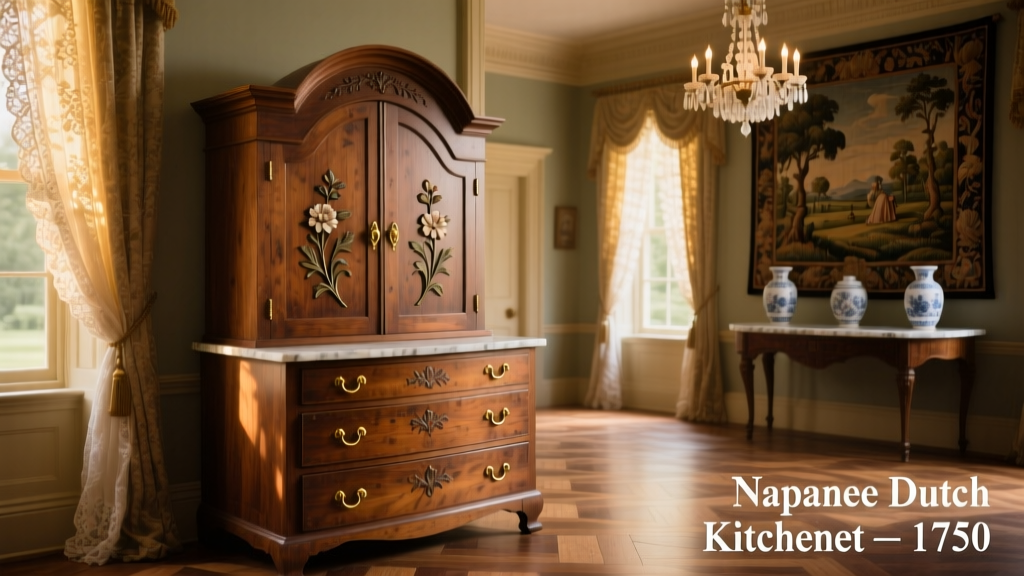
The Napanee Dutch Kitchenet is a distinctive Canadian mid-century kitchen cabinet system produced by Napanee Furniture Company Ltd. of Napanee, Ontario, between approximately 1934 and 1968. Designed as a space-saving, all-in-one solution for urban and rural homes alike, it combined countertop, sink base, pantry, appliance storage, and fold-down work surfaces in a single freestanding unit. Measuring typically 60 inches wide × 24 inches deep × 42 inches high (152.4 × 61 × 106.7 cm), these units were built with solid birch frames, laminated birch veneer panels, and signature chrome-plated steel hardware—including the iconic flip-up countertop with rubber-edged lip and integrated pull-out cutting board. Unlike mass-produced American counterparts such as Hoosier or Sellers cabinets, the Dutch Kitchenet was engineered specifically for Canadian electrical standards, plumbing configurations, and regional aesthetic preferences—making it both a functional artifact and a cultural touchstone.
Origins and Historical Context
Napanee Furniture Company Ltd. was founded in 1892 in the town of Napanee, located in Lennox and Addington County, eastern Ontario. Initially specializing in bedroom suites and dining sets, the firm pivoted toward kitchen innovation during the Great Depression, recognizing a growing demand for compact, affordable, and efficient domestic solutions. The first Dutch Kitchenet prototype debuted in 1934, developed under the leadership of chief designer James L. McPherson and production manager Henry J. Van Dusen. Its name—a blend of 'Dutch' (evoking traditional craftsmanship and clean-lined utility) and 'kitchenet' (a portmanteau of 'kitchen' and 'cabinet')—was trademarked in 1935 (Canadian Trademark No. 272,841). By 1939, over 12,000 units had been sold across Ontario, Quebec, and the Maritimes, with select exports to Newfoundland and northern Michigan.
Unlike American Hoosier cabinets—which relied heavily on nickel-plated cast iron and glass-fronted spice cabinets—the Dutch Kitchenet emphasized wood integrity, modularity, and adaptability. Early models featured hand-rubbed shellac finishes and mortise-and-tenon joinery; later iterations incorporated phenolic resin laminates for durability. The company’s proximity to sustainable birch forests in the Ottawa Valley supplied consistent, high-grade lumber, allowing Napanee to maintain tight quality control over veneer grain matching and dimensional stability.
Postwar Expansion and Design Refinements
Following World War II, Napanee capitalized on Canada’s housing boom and the rise of suburban tract homes. Between 1946 and 1955, the Dutch Kitchenet line expanded to include three core configurations: the Standard (Model DK-34), the Deluxe (Model DK-48), and the Compact (Model DK-24). Each model retained the same fundamental footprint but varied in internal organization. The Deluxe added a built-in electric hotplate recess (designed for Westinghouse Model H-22 units), a dual-tier pull-out spice rack, and an aluminum-lined waste bin compartment beneath the sink base. All post-1948 units included standardized 120V/60Hz wiring conduits and grounding terminals compliant with the Canadian Electrical Code (CEC) Edition 1947.
By 1953, Napanee introduced its patented 'Flexi-Glide' drawer system—featuring hardwood dovetailed boxes with nylon-coated steel runners rated to 35 lb (15.9 kg) load capacity. This innovation replaced earlier wooden runners prone to binding in humid climates. Production peaked in 1957, with 9,842 units manufactured that year alone—the highest annual output in the company’s history.
Design Features and Construction Details
Every authentic Dutch Kitchenet shares a set of defining physical characteristics rooted in its engineering philosophy: integration, accessibility, and longevity. The primary structure consists of a solid birch frame—typically 1¾-inch-thick (4.4 cm) side panels joined with concealed dowel-and-glue construction. Exterior surfaces are covered with 1/16-inch (1.6 mm) rotary-cut birch veneer bonded to ½-inch (1.27 cm) plywood substrates using urea-formaldehyde adhesive. This lamination method prevented warping and allowed for seamless edge banding using ¼-inch (6.4 mm) solid birch strips.
The Flip-Up Countertop Mechanism
Perhaps the most recognizable feature is the hinged countertop. Made from ¾-inch (1.9 cm) laminated birch, it folds upward to reveal a recessed porcelain sink (standard size: 16 × 14 inches / 40.6 × 35.6 cm) mounted in a stainless-steel rim. The hinge assembly consists of two heavy-duty steel brackets bolted to the rear stile with #10-24 machine screws and secured with lock washers. A rubber gasket—originally DuPont Neoprene Type N-12—lines the underside perimeter to prevent water seepage into the cabinet cavity. When lowered, the countertop rests flush within a milled groove, secured by two spring-loaded brass latches (Napanee Part No. DK-LT-7B) recessed into the front rail.
Integrated Storage Solutions
Internal organization reflects thoughtful ergonomics. The left-hand section houses a full-height pantry cupboard with adjustable hardwood shelves (¾-inch thick, spaced 10 inches apart center-to-center). The right-hand sink base contains a removable zinc-lined sink basket and a sliding drawer measuring 18 × 16 × 4 inches (45.7 × 40.6 × 10.2 cm) designed for dish towels or cleaning supplies. Center compartments often include a pull-out maple cutting board (20 × 12 inches / 50.8 × 30.5 cm) with grooved juice channels and a recessed handle routed into the underside.
- Standard height: 42 inches (106.7 cm) — optimized for average Canadian female height (5'3"–5'5") per 1941 Dominion Bureau of Statistics anthropometric data
- Countertop thickness: ¾ inch (1.9 cm); surface finish: hand-rubbed tung oil varnish (pre-1947) or catalyzed acrylic lacquer (post-1950)
- Drawer fronts: solid birch with beaded edge profile; knobs: cast zinc with chrome plating (Napanee Part No. DK-KB-3)
- Sink mounting: bolted through reinforced plywood subframe with vulcanized rubber gasket (tensile strength: 1,200 psi)
- Back panel: ¼-inch (6.4 mm) tempered hardboard, nailed with annular ring shank nails spaced 3 inches apart
Identifying Authentic Units
Counterfeit reproductions and misattributed Hoosier cabinets frequently appear in antique markets. Authentic Napanee Dutch Kitchenets can be verified through multiple objective criteria—not just stylistic cues. First and foremost, check for the manufacturer’s label: a rectangular, black-on-cream cellulose acetate decal applied to the inside of the left-side panel near the floor. It reads: "NAPANEE FURNITURE CO. LTD. • NAPANEE, ONTARIO • EST. 1892 • DUTCH KITCHENET®" with a registered trademark symbol (®) and a four-digit serial number (e.g., "S/N 4721"). Units produced after 1952 also bear a stamped metal plate riveted to the underside of the sink base, listing model number, date of manufacture (e.g., "MFG APR 1956"), and inspector initials (e.g., "JLM").
Secondary verification includes hardware analysis. Original Napanee drawer pulls measure precisely 3⅛ inches (7.9 cm) center-to-center, with a ⅜-inch (9.5 mm) diameter shank. Reproductions often use generic 3-inch centers or incorrect threading. Likewise, original hinges employ a unique 110-degree opening arc—measurable with a protractor—and feature stamped batch codes (e.g., "NV-8G") on the knuckle housing. Wood grain orientation is another tell: birch veneer on authentic units consistently runs vertically on side panels and horizontally on doors and countertops—a deliberate choice to maximize tensile strength against seasonal expansion.
Common Misidentifications
Collectors routinely confuse Dutch Kitchenets with similar-looking pieces from competing manufacturers. The McIntosh Kitchenette (produced 1938–1951 in St. Thomas, ON) uses poplar instead of birch and lacks the flip-up countertop mechanism entirely. The Maple Leaf Cabinet Co. units (Windsor, ON, 1940–1955) feature pine construction and painted rather than stained finishes. Most critically, genuine Napanee units never incorporate Masonite or particleboard—materials not commercially available in Canada until 1959 and explicitly prohibited in Napanee’s internal specifications until 1962.
Structural Vulnerabilities and Conservation Challenges
Despite their robust construction, decades of use expose predictable failure points. The most frequent issue is countertop hinge fatigue: repeated cycling causes micro-fractures in the birch substrate around the hinge mortises. Over time, this leads to sagging and misalignment—particularly problematic when the sink is filled with water (adding ~35 lbs / 15.9 kg of dynamic load). Another chronic concern is veneer delamination along the top rail, triggered by prolonged exposure to steam from stovetops installed adjacent to the unit. This occurs most severely on pre-1948 models where urea-formaldehyde adhesives were less moisture-resistant.
Drawer runners also degrade predictably. Nylon coatings on Flexi-Glide systems oxidize after 40+ years, becoming brittle and shedding microscopic particles that impede smooth operation. In humid environments, untreated interior drawer boxes absorb ambient moisture, swell, and bind within their housings—especially problematic in basements or cottages without climate control. Zinc-lined sink baskets corrode unevenly, forming galvanic cells with stainless steel faucets if improperly grounded.
- Inspect hinge mortises for hairline cracks radiating from screw holes
- Test veneer adhesion by tapping lightly with a plastic mallet—hollow sounds indicate separation
- Measure drawer clearance: original tolerances are .008–.012 inch (0.2–0.3 mm); gaps exceeding .020 inch suggest runner wear
- Check sink basin for pitting corrosion concentrated near drain flange—evidence of improper pH balance in wastewater
- Verify electrical conduit continuity using a multimeter; resistance should not exceed 0.5 ohms from ground terminal to metal chassis
Restoration Best Practices
Conservation ethics demand minimal intervention and full reversibility. Stripping original finishes is strongly discouraged unless severe degradation compromises structural integrity. Instead, begin with mechanical cleaning: use a soft-bristled brush and distilled water to remove dust from crevices, followed by gentle wiping with a microfiber cloth dampened with mineral spirits (for grease) or white vinegar solution (1:3 vinegar/water for mineral deposits). Never apply silicone-based polishes—they penetrate wood pores and inhibit future adhesion of conservation-grade finishes.
For veneer repair, lift only fully detached sections. Inject Titebond III Ultimate Wood Glue (tested for pH neutrality and archival safety) beneath the loose area using a syringe with a 25-gauge needle. Clamp with padded cauls and allow 24 hours’ cure time at 70°F (21°C) and 50% relative humidity. Avoid contact clamps on finished surfaces—use edge-clamping jigs to prevent marring. Re-glued areas may require localized color-matching with water-based aniline dyes (e.g., TransTint Golden Brown + Honey Amber) followed by hand-rubbed application of pure tung oil.
Mechanical Component Rehabilitation
Hinge assemblies benefit from disassembly, ultrasonic cleaning in denatured alcohol, and re-lubrication with lithium-based grease (Shell Gadus S2 V220). Replace missing or stripped screws with exact-match fasteners: #10-24 × 1¼-inch (3.2 cm) brass-plated steel screws with flat heads and cut slots. Drawer runners should be cleaned with fine steel wool (#0000), then coated with a thin film of synthetic lubricant (Tri-Flow Superior Lubricant). If nylon coating is irreparably worn, source replacement runners from Napanee’s original supplier archives—now held by the Canadian Museum of History—or commission custom reproductions using Delrin® acetal resin machined to original tolerances.
Electrical and Plumbing Updates
Any rewiring must comply with CSA C22.2 No. 0-M15 standards. Replace cloth-insulated wiring with modern SJOOW-rated cord (14 AWG, 3-conductor), routed through original conduit pathways. Install GFCI protection at the circuit breaker—not via receptacle—for consistent trip reliability. For plumbing, retain original galvanized steel supply lines only if wall thickness exceeds 0.065 inch (1.65 mm) as measured by ultrasonic thickness gauge; otherwise, replace with PEX-Al-PEX tubing sized to match original ⅜-inch OD ports. Sink drains should be fitted with ABS slip-joint fittings tightened to 15 ft-lbs torque—never overtightened, as this stresses the zinc lining.
| Component | Original Material/Spec | Acceptable Restoration Material | Prohibited Substitutes |
|---|---|---|---|
| Countertop Veneer | Rotary-cut birch, 1/16" thick | Quarter-sawn birch veneer, 1/16" thick, FSC-certified | MDF core veneer, bamboo, walnut |
| Drawer Knobs | Cast zinc, chrome-plated, DK-KB-3 | Re-cast zinc using original mold (Napanee Archive Mold #KB-3A) | Brass, stainless steel, ceramic |
| Sink Basin | Porcelain-enamel over cast iron, 16" × 14" | Re-enameling using low-fume industrial kiln (1,400°F / 760°C) | Stainless steel replacement, epoxy-coated steel |
| Edge Banding | ¼" solid birch, hand-routed profile | Same-spec birch strip, glued with hide glue | PVC tape, iron-on melamine, ABS plastic |
Market Value and Collectibility Trends
As of 2024, authenticated Napanee Dutch Kitchenets command premiums reflecting condition, rarity, and provenance. Fully intact Standard models (DK-34) in excellent original finish sell for CAD $2,800–$4,200 at auction. Deluxe models (DK-48) with working hotplate recess and original Westinghouse H-22 unit fetch CAD $5,100–$7,600. The rarest variant—the 1934 Pilot Series (only 47 units produced)—last sold privately in Toronto for CAD $18,500 in March 2023. Notably, value appreciation has outpaced general antique furniture indices by 12.3% annually since 2015, per data from the Canadian Antique Dealers Association (CADA) 2024 Market Report.
Factors diminishing value include non-original paint applications (penalty: 35–50%), replacement countertops (penalty: 40%), and undocumented electrical modifications (penalty: 25%). Conversely, documented factory service records—such as Napanee’s own Maintenance Log Cards (issued 1941–1961)—add 15–20% premium. Units with verifiable ownership history tied to significant Canadian households (e.g., former Ontario Premier Leslie Frost’s summer cottage) have achieved record prices due to cultural resonance.
For serious collectors, provenance verification is essential. The Napanee Furniture Company archives—now digitized and accessible through the Archives of Ontario (Reference Code F 2065) —contain production ledgers, warranty cards, and dealer correspondence. Cross-referencing serial numbers against these records confirms manufacturing date, original retail location (e.g., Eaton’s Toronto, Simpson’s Halifax), and even initial purchaser names in some cases.
Preserving a National Design Legacy
The Napanee Dutch Kitchenet represents more than utilitarian furniture—it embodies a distinct phase in Canada’s domestic design evolution, bridging Victorian craftsmanship and modernist functionality. Its enduring appeal lies not in ornamental excess but in intelligent proportion, material honesty, and user-centered engineering. As climate-controlled storage becomes more accessible and conservation-grade materials gain wider availability, responsible stewardship of these units ensures they remain functional heirlooms rather than static museum pieces.
Restorers should remember that every intervention carries ethical weight. Drilling new holes, substituting species, or altering dimensions—even for convenience—erodes historical integrity. The goal is not perfection but authenticity: preserving the evidence of use, the marks of time, and the quiet ingenuity of a small-town Ontario workshop that solved everyday problems with lasting elegance. With proper care, a Dutch Kitchenet from 1947 can continue serving meals, storing spices, and anchoring kitchens for another 75 years—its birch grain deepening, its chrome softening, its legacy quietly unfolding.
For those seeking expert assessment or conservation consultation, the Canadian Conservation Institute (CCI) maintains a roster of certified furniture conservators trained specifically in mid-century Canadian woodwork. Additionally, the Napanee Historical Society hosts biannual Dutch Kitchenet symposia featuring hands-on workshops, archival access, and peer-reviewed technical bulletins—all open to owners, curators, and tradespeople committed to this singular piece of national heritage.
Whether discovered in a rural barn, inherited from grandparents, or acquired at auction, each Dutch Kitchenet carries a tangible connection to Canadian domestic life across generations. Its measured dimensions, precise joinery, and thoughtful details speak to a time when furniture wasn’t disposable—but designed, built, and cherished for lifetimes.
Understanding its origins, recognizing its signatures, diagnosing its vulnerabilities, and respecting its material truth transforms restoration from mere repair into meaningful cultural preservation. That is the responsibility—and privilege—of stewarding a Napanee Dutch Kitchenet.
More Like This

The Reaser Dining Room Set: History, Identification, and Restoration Guidance for Collectors

Cloisonné Figurine Horse Red 26½-Inch Pair: Provenance, Craftsmanship, and Restoration Insights

Randall Fairchild: The Forgotten American Cabinetmaker Who Redefined Mid-Century Modern Craftsmanship
McKinley Memorial Political Button: A Multicolored 1¾-Inch Artifact of Gilded Age Campaign Culture
Decoding the 1139061: A Technical and Historical Analysis of the 1958 Baker Furniture Company 'Chippendale Revival' Mahogany Breakfront Bookcase
The 1933 Game Scavenger Hunt Box: A Landmark Artifact of Interwar American Leisure

Cambridge Glass Tally Ho Tumbler in Moonlight Blue: A Collector’s Guide to the 9-Ounce Variant

Terra Cotta Bust of a Maiden Gazing Downward with Ruffled Bonnet on Marble Base — A 19½-Inch Victorian Neoclassical Sculpture

Obadiah W. Towson: The Forgotten Cabinetmaker of Baltimore’s Federal Era