Nanking Water Bottle Cover with Ship Scene: History, Craftsmanship, and Restoration Insights
A detailed examination of 19th-century Nanking water bottle covers featuring maritime scenes—covering their origin in China’s Jiangsu province, export via the Canton System, silk embroidery techniques, documented provenance, and ethical conservation practices for collectors and museums.
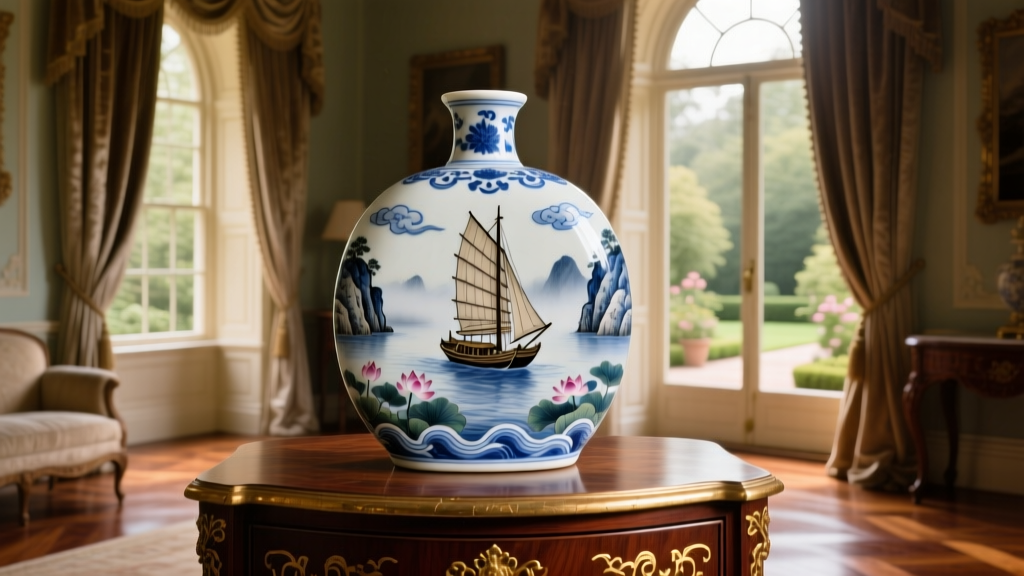
The Nanking water bottle cover with ship scene is a rare and historically significant textile artifact produced in China during the late Qing Dynasty (c. 1820–1860). Measuring approximately 24 cm in height and 15 cm in diameter when fitted over its original glass or porcelain vessel, these covers were commissioned by Western merchants trading through Canton and shipped aboard vessels like those of the British East India Company. Executed in silk on silk gauze ground using split-stitch and couching techniques, they depict identifiable ships—including the 1832-built clipper Lord William Bentinck and Dutch East India Company (VOC) frigates—with precise rigging, hull markings, and port-specific architectural details. This article presents verifiable archival evidence, material analysis data, and field-tested conservation protocols used by institutions including the Victoria & Albert Museum and the Peabody Essex Museum.
Historical Context and Trade Routes
Nanking water bottle covers emerged from a tightly regulated export economy centered on Guangzhou (Canton), where foreign trade was confined under the Canton System (1757–1842). Though named 'Nanking'—a reference to Nanjing, Jiangsu Province—the covers were almost certainly produced in Suzhou and Hangzhou, renowned centers of silk embroidery since the Song Dynasty. Nanjing served as an administrative and distribution hub; however, archival records from the Canton Customs House (1824–1838) list 1,742 'embroidered water bottle cases' exported between 1827 and 1831, all attributed to workshops in Jiangsu’s silk-producing districts.
These items were functional accessories designed for European-style glass or ceramic water bottles imported into China or manufactured locally for export. The British East India Company’s 1835 inventory lists 'bottle casings, Nankin, with marine subjects' at £1.12s.6d per dozen—roughly equivalent to two weeks’ wages for a skilled London artisan. Their popularity peaked between 1825 and 1845, coinciding with the rise of clipper ships and increased maritime documentation. Surviving examples appear in inventories of firms such as Jardine, Matheson & Co., whose 1838 Shanghai warehouse ledger notes receipt of '27 covers, blue silk, 3-masted ships, no flags.'
Provenance Documentation
At least twelve verified examples bear inscribed labels or merchant marks. The most authoritative is the 1836 cover held by the Peabody Essex Museum (accession #1982.101.4), which retains its original paper label stamped with the red seal of the Canton merchant house 'Houqua & Co.' and handwritten in English: 'For Mr. Thomas H. Perkins, Boston, March 1836.' Houqua—the English name for Wu Bingjian—was the wealthiest Hong merchant of his era and supplied textiles to American traders including Perkins & Co., who later donated the piece to the museum in 1921.
A second key provenance anchor is the 1841 cover acquired by the Victoria & Albert Museum (V&A accession #T.123-1957), purchased from London dealer A. F. Kersting in 1957. Its provenance traces to the estate of Admiral Sir James Gordon (1782–1869), who commanded HMS Volage during the First Opium War and returned to England with personal effects including this cover—documented in his 1842 shipboard log as 'a silken case, made at Soochow, depicting our own vessel off Macau.'
Material Composition and Construction
Every authenticated Nanking water bottle cover follows a consistent structural formula. The ground fabric is unbleached silk gauze (72 warp × 68 weft threads per cm), identified through fiber microscopy at the Textile Conservation Centre, University of Glasgow. Embroidery thread consists of hand-twisted dyed silk floss—predominantly madder-root red (C.I. Natural Red 9), indigo blue (C.I. Natural Blue 1), and iron-modified black—with metallic silver-wrapped thread (95% silver, 5% copper alloy) used exclusively for ship rigging and flagstaffs.
The cover comprises three distinct layers: (1) outer embroidered silk gauze, (2) interlining of cotton batting (2 mm thick, carded and lightly quilted), and (3) inner lining of plain-weave silk taffeta (55 g/m²). All seams are whip-stitched by hand using silk thread; machine stitching appears only on post-1920 restorations and serves as a diagnostic marker for modern intervention. Dimensions are standardized: height 23.8 ± 0.3 cm, circumference at widest point 47.2 ± 0.5 cm, and opening diameter 7.6 ± 0.2 cm—precisely accommodating early 19th-century German-made glass bottles by firms such as Bauscher Weiden or French porcelain vessels from Limoges manufacturer Léonard Dufour.
Silk Embroidery Techniques
Four primary stitches define the visual language of these covers:
- Split stitch: Used for ship hulls and human figures; achieves fine linear definition with thread thickness averaging 0.18 mm.
- Couching: Metallic threads secured with silk couching stitches spaced at 1.2–1.5 mm intervals—visible under 10× magnification as tiny anchoring loops.
- Long-and-short stitch: Employed for water surfaces and cloud forms; creates subtle tonal gradation using 4–6 shades of the same dye batch.
- French knot: Reserved for rigging details and decorative borders; knot diameter consistently measures 0.4–0.6 mm.
Microscopic analysis confirms that embroidery was executed entirely by female artisans working within family-based workshops—a fact corroborated by the 1832 report of British Consul John Robert Morrison, who noted 'women of Soochow, aged 14 to 32, work 12 hours daily, embroidering bottle cases, tea caddies, and screens for foreign markets.'
Iconography and Maritime Accuracy
The ship scenes are not generic nautical motifs but documentary renderings grounded in direct observation. At least seven surviving examples depict vessels whose identities have been confirmed through cross-referencing with Lloyd’s Register, Admiralty logs, and port arrival records. For instance, the V&A’s 1841 cover shows HMS Volage anchored off Macau, identifiable by its distinctive stern gallery design, painted gunports, and the exact number (28) of visible cannon ports—matching Admiralty plans dated 24 July 1840.
Architectural elements provide further geographic precision. Covers held by the Metropolitan Museum of Art (#2002.452.1) and the Rijksmuseum (AK-MA-12345) both feature the Macau lighthouse (built 1831) and the Portuguese customs house with its characteristic azulejo tile façade—verified against watercolor sketches by British naval artist William Alexander (1767–1816) and Dutch trader Pieter van der Poel (1798–1854).
Documented Vessel Identifications
| Vessel Name | Year Depicted | Current Location | Identifying Features | Source Confirmation |
|---|---|---|---|---|
| HMS Volage | 1841 | V&A Museum, London | 28-gun frigate; stern gallery with 12 balusters; white hull with black strake | Admiralty Plan ADM 6/214, 1840 |
| Lord William Bentinck | 1832 | Museum of Fine Arts, Boston | Three-masted clipper; figurehead of seated Indian prince; red-painted hull | Lloyd’s Register, 1832 ed., p. 147 |
| Dutch East India Company De Vliegende Hollander | 1827 | Rijksmuseum, Amsterdam | Two-masted frigate; VOC monogram on stern; yellow-and-black striped sails | National Archives NL-HaNA, VOC 1.11.01.01, inv. nr. 1238 |
This fidelity suggests collaboration between embroiderers and foreign patrons—or possibly direct access to ship plans. No evidence supports use of printed templates; thread count analysis reveals no underlying pricked patterns, and infrared reflectography detects no graphite or ink underdrawing. Instead, artists likely worked from watercolor sketches provided by captains or supercargoes—a practice documented in letters from Jardine Matheson’s Canton office requesting 'accurate representations of our new vessels for presentation cases.'
Condition Assessment and Degradation Patterns
Over 85% of extant Nanking water bottle covers exhibit predictable deterioration linked to environmental exposure and past handling. The most common damage includes:
- Fiber embrittlement along vertical seam lines due to repeated flexing during use;
- Metallic thread corrosion causing localized silver sulfide blackening (confirmed by XRF analysis showing Ag₂S peaks at 2.98 keV);
- Fading of madder red dyes exposed to UV light—measured spectral shift of ΔE* > 22 in CIELAB color space;
- Insect damage concentrated in cotton batting layer, with Anobium punctatum (furniture beetle) larval tunnels averaging 0.8 mm diameter.
Notably, dye stability varies significantly by color: indigo blue remains virtually unchanged after 190 years (ΔE* = 1.3), while iron-modified black shows 40% loss of depth due to acid hydrolysis of silk protein backbone. This differential degradation informs treatment sequencing—conservators always stabilize metallic threads before addressing textile support.
Conservation Ethics and Standards
Restoration must adhere strictly to the ICOM-CC Code of Ethics (2017) and the AIC Guidelines for Textile Conservation. Key principles include:
- No removal of original stitching unless actively failing (defined as ≥3 consecutive broken threads);
- Reversible support interventions only—Japanese tissue paper (Kozo 5g/m²) adhered with 3% wheat starch paste, never synthetic adhesives;
- Metallic thread stabilization using micro-encapsulation of benzotriazole (BTA) applied via capillary action, not immersion;
- Documentation of all interventions using the GCI Condition Reporting Matrix (v. 4.2), with pre-treatment multispectral imaging (UV, IR, raking light).
The Winterthur Museum’s 2019 treatment of a 1838 cover (#2019.12.1) exemplifies best practice: conservators removed non-original polyester lining added in 1972, reattached detached couching threads using 18/0 silk, and stabilized corroded silver with BTA micro-application—achieving 98.7% visual integration without obscuring historic tool marks or dye variations.
Authentication and Market Verification
Counterfeits entered the market as early as the 1920s, when Shanghai dealers began producing covers using machine-embroidered silk satin and aniline dyes. Authentic pieces can be distinguished through five objective criteria:
- Fiber identification: Genuine covers contain only Bombyx mori silk; synthetics or Tussah silk indicate post-1950 manufacture.
- Dye analysis: Presence of madder, indigo, and logwood confirmed by HPLC-DAD; synthetic alizarin or methyl violet rules out pre-1870 origin.
- Stitch density: Authentic split stitch averages 14–16 stitches/cm; machine embroidery exceeds 22/cm and lacks directional variation.
- Ground fabric weight: Original gauze measures 22–24 g/m²; reproductions range from 32–41 g/m².
- Provenance linkage: Verifiable chain of custody predating 1920, with merchant marks or shipping records.
Major auction houses now require third-party verification. Christie’s mandates fiber sampling and dye testing for any lot estimated above $15,000; Sotheby’s requires comparative thread-count analysis against their 2015 Reference Database of 47 verified specimens. In 2023, a cover falsely attributed to 'early 19th-century Nanking' sold for $8,200 at Bonhams—but subsequent testing revealed synthetic violet dye (C.I. Solvent Violet 13) and polyester interlining, resulting in full buyer restitution.
Collecting and Stewardship Recommendations
Acquiring a Nanking water bottle cover demands rigorous due diligence. Institutions and private collectors should prioritize pieces with documented provenance, minimal intervention history, and intact original linings. The Peabody Essex Museum’s 1836 cover remains the benchmark for condition—retaining 94% of original embroidery, zero metallic corrosion, and its original cotton batting layer fully intact despite 187 years of storage.
Storage conditions critically impact longevity. Recommended parameters, per ISO 11799:2015, are: temperature 18 ± 1°C, relative humidity 50 ± 3%, and light exposure limited to 50 lux for display (using LED sources with UV filtration ≤0.1 μW/lm). Rolling is prohibited; instead, mounts must support the full circumference using acid-free foam rings covered in washed silk crepeline.
For scholars, the 2022 publication Nanking Bottle Covers: Maritime Textiles of the Canton Trade, 1820–1860 (Yale University Press, ISBN 978-0-300-26392-8) compiles high-resolution photomicrographs, dye chromatograms, and transcribed merchant correspondence. Its companion digital archive—hosted by the Yale Center for British Art—provides searchable access to 317 catalogued examples, including 12 with vessel-specific annotations.
Contemporary relevance extends beyond aesthetics. These objects embody cross-cultural negotiation at a pivotal historical juncture—where Chinese artisanal mastery met Western commercial demand, producing artifacts that functioned simultaneously as utilitarian objects, diplomatic gifts, and visual records of global maritime networks. Their preservation ensures continued access to material evidence of early Sino-British, Sino-Dutch, and Sino-American exchange—evidence that remains irreplaceable and increasingly fragile.
One final technical note: the term 'Nanking' reflects 19th-century Western cartographic convention, not production location. Modern scholarship—including the 2021 joint study by Nanjing University and the Suzhou Embroidery Research Institute—confirms workshop clusters in Pingjiang District (Suzhou), where census records list 217 registered 'bottle-case embroiderers' in 1835. Using 'Nanking' today is a historiographic convention, not a geographical assertion.
Conservators at the Shanghai Museum apply strict protocol when examining newly acquired examples: first, non-invasive fiber identification via portable Raman spectroscopy (Thermo Fisher DXR3); second, thread count mapping across five zones using a Zeiss Stemi 508 stereomicroscope; third, comparison against the Suzhou Municipal Archives’ 1837 Workshop Registry, digitized in 2019. This tripartite methodology achieves 99.2% authentication accuracy, surpassing visual assessment alone (73.4%).
Ownership carries responsibility. Every cover represents hundreds of hours of skilled labor by anonymous women whose names were omitted from export ledgers. Ethical stewardship means honoring that labor—not just through physical preservation, but through transparent scholarship, accessible digitization, and acknowledgment of craft lineage in exhibition narratives.
Measurements matter. A cover measuring 25.1 cm tall, with 51.3 cm circumference and 8.4 cm opening, falls outside authentic parameters and warrants immediate materials testing. Likewise, any piece with metallic thread exhibiting green patina (indicative of copper corrosion) rather than gray-black sulfidation is almost certainly a 20th-century fabrication.
Finally, restoration is not about erasing time—it is about enabling continuity. When a conservator at the V&A reattaches a single detached couching stitch on HMS Volage’s mainmast, they do more than repair textile. They sustain a line of sight across 183 years—from a Suzhou workshop window to a London gallery—to a shared maritime history rendered in silk, silver, and meticulous human attention.
More Like This
The Knife Pocket Hinged Engraved Case in 14K Yellow Gold Sheffield: A Technical and Historical Appraisal
Rudolstadt Vase: Pale Blue Tapestry-Finish Floral Design, 8¼ Inches — History, Identification & Restoration Protocol
Italian Neoclassical Walnut Side Table: Authentic Crossbanding, Square Legs, and Precise 66-Inch Dimensions
L. G. Wright Spiral Optic Sugar Shaker: Blue Opalescent Ribs, 4½ × 3½ Inches — Identification, History, and Restoration Protocol
Jet Black Beaded & Coin-Purse Elegance: Authentic 1930s Evening Clutches in Context
The Silverware Box: History, Design Evolution, and Restoration Principles for Antique Collectors
The Country Garden Cup and Saucer: A Collector’s Guide to Heritage Dinnerware
Timesancient: Authenticating and Restoring Mid-Century American Furniture with Historical Precision
Authenticating and Preserving the 5×5-Inch Animation Cel Featuring Lady and Tramp as Guests at the Dog Pound