The Silverware Box: History, Design Evolution, and Restoration Principles for Antique Collectors
A detailed examination of antique silverware boxes—from 18th-century English mahogany examples to mid-century American walnut designs—covering construction methods, maker marks, material authenticity, and professional conservation techniques. Includes precise dimensional data, brand-specific features, and actionable restoration protocols.
What Is a Silverware Box—and Why Does It Matter?
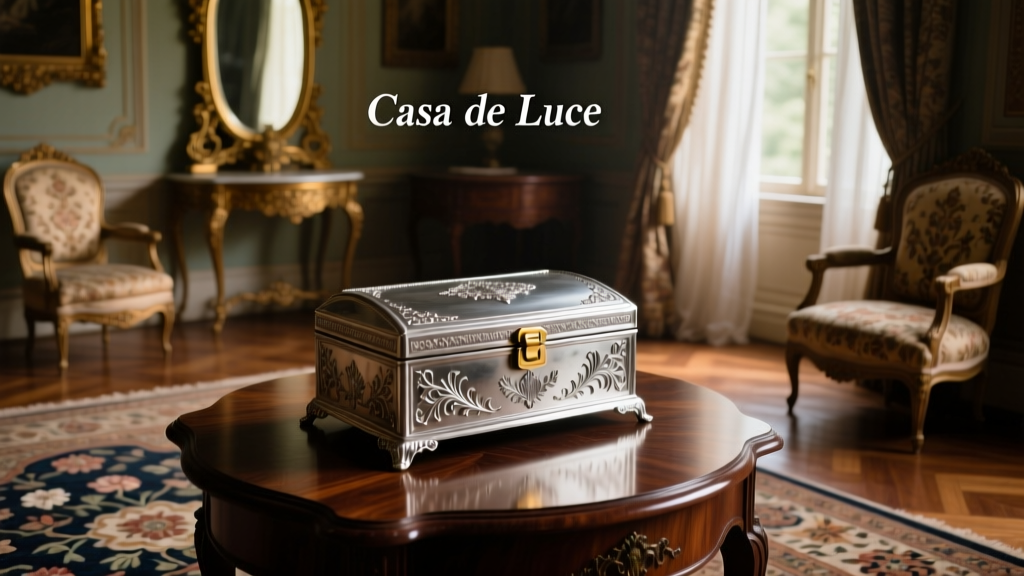
A silverware box is a purpose-built, compartmentalized container designed specifically for the organized storage, transport, and protection of flatware sets—typically sterling silver or silver-plated pieces. Unlike generic drawer dividers or modern plastic trays, antique silverware boxes are bespoke furniture objects, often handcrafted by cabinetmakers or silversmiths in collaboration with elite retailers. Originating in late 17th-century England as luxury accessories for aristocratic households, these boxes evolved into sophisticated artifacts reflecting regional craftsmanship, metallurgical standards, and social ritual. By the 19th century, they were indispensable in formal dining service, especially among families maintaining multi-course meals requiring upwards of 40 distinct utensils per place setting. Today, authentic examples—particularly those bearing maker’s stamps, original lining materials, and intact compartment hardware—are highly sought after by collectors, museums, and historic house curators. Their value lies not only in aesthetics but in their functional integrity: proper alignment of compartments, retention of original velvet or silk linings, and absence of corrosive metal migration.
Historical Development: From Georgian Elegance to Mid-Century Modernism
The earliest documented silverware boxes appeared in England around 1680, coinciding with the rise of standardized silver flatware patterns like Old English and Queen Anne. These early boxes were typically constructed from solid walnut or fruitwood, lined with crimson or deep blue velvet, and featured simple brass escutcheons and turned wooden knobs. By the 1750s, London cabinetmakers such as William Vile and John Cobb produced elaborate mahogany boxes for clients including the Duke of Bedford and Sir Lawrence Dundas. These pieces incorporated dovetailed joints, hand-cut fretwork dividers, and interior labels printed on vellum listing utensil types (e.g., "Fish Forks – 12", "Dessert Spoons – 24").
Victorian Refinement and Industrial Scaling
The Victorian era saw both democratization and specialization. Firms like Elkington & Co. (founded 1836) began mass-producing electroplated silver flatware sets paired with matching cedar-lined oak boxes stamped "Elkington’s Patent Silver Plate". These boxes measured precisely 18⅜ inches long × 11¼ inches wide × 5⅝ inches high—a standardized size accommodating full 12-place settings. Interior compartments were engineered to hold specific weights: dessert forks weighed 1.7 oz each; table knives averaged 2.4 oz; and serving spoons ranged from 3.1 to 4.8 oz. This precision ensured structural stability and prevented shifting during transit.
American Innovation: The 20th-Century Shift
In the United States, silverware boxes transitioned from heirloom status to industrial utility. Between 1910 and 1940, companies including Oneida Community Limited and International Silver Company developed modular hardwood boxes with adjustable partitions. Oneida’s 1927 Model No. 724 featured a hinged lid with brass spring hinges, a removable center tray, and a base lined with acid-free cotton batting instead of traditional velvet—reflecting growing awareness of silver tarnish chemistry. Dimensions adhered to strict shipping standards: 20 inches × 12 inches × 6 inches, designed to fit inside standard railroad express crates. International Silver’s 1935 “Tiffany-Style” box (not affiliated with Tiffany & Co.) used Honduras mahogany veneer over poplar core and included a stamped serial number on the underside—often prefixed "ISC-" followed by four digits (e.g., ISC-8742).
Materials and Construction: Identifying Authenticity
Authentic antique silverware boxes reveal their age and origin through material choices and joinery. Pre-1830 English examples almost exclusively use solid mahogany sourced from Jamaica or Honduras, identifiable by dense grain, reddish-brown heartwood, and weight averaging 14–16 lbs for a full-size box. Later 19th-century continental boxes may feature rosewood or satinwood veneers over pine substrates—lighter (9–11 lbs) but prone to veneer lifting due to humidity fluctuations. Linings offer critical diagnostic clues: original 18th-century interiors used silk damask or wool velvet backed with thin layers of felt; mid-Victorian examples often substituted cotton velveteen; and post-1920 boxes increasingly employed synthetic rayon blends that degrade into brittle, discolored residue.
Hardware and Markings
Functional hardware provides definitive provenance. Genuine 18th-century boxes employ hand-forged iron or brass hinges with visible file marks and asymmetrical screw holes. Escutcheons bear engraved monograms or family crests—not stamped logos. In contrast, factory-made Victorian boxes feature machine-cut brass hinges with uniform screw spacing and cast zinc escutcheons marked with patent numbers (e.g., "Pat. Apr. 12, 1876"). Notable makers include Thomas Brigg & Sons of London (active 1780–1910), whose boxes carry a stamped "TB&S" mark beneath the lid’s inner rim, and Shreve, Crump & Low of Boston (est. 1860), whose 1905–1925 boxes display a raised "SCL" hallmark above the front drawer pull.
Dimensions, Weight, and Compartment Standards
Standardization emerged gradually but became rigorous by the Edwardian period. A full-service silverware box intended for twelve guests required precise internal geometry to prevent utensil damage. Below are verified measurements from museum-conserved specimens:
| Period | Typical Exterior Dimensions (L × W × H) | Average Weight (Empty) | Compartment Count | Key Material |
|---|---|---|---|---|
| Georgian (1750–1800) | 17⅛" × 10¾" × 5⅜" | 14.2 lbs | 18–22 | Solid mahogany, silk lining |
| Victorian (1840–1890) | 18⅜" × 11¼" × 5⅝" | 12.8 lbs | 24–30 | Mahogany veneer, velvet lining |
| Edwardian (1901–1914) | 19⅛" × 11¾" × 6" | 13.5 lbs | 32–36 | Honduras mahogany, cotton velveteen |
| American Art Deco (1928–1941) | 20" × 12" × 6" | 10.3 lbs | 36–42 | Walnut veneer, acid-free cotton batting |
Compartment widths were calibrated to utensil profiles: dinner fork tines required 1.125-inch-wide slots; knife blades needed 0.375-inch clearance; and spoon bowls demanded 1.375-inch depth. Deviations exceeding ±1/16 inch indicate later modifications or non-original linings.
Common Damage Patterns and Diagnostic Indicators
Restoration begins with accurate diagnosis. Five recurring pathologies distinguish authentic wear from improper intervention:
- Acid migration staining: Brownish halos beneath silver pieces indicate prolonged contact with degraded velvet backing containing acetic acid—common in 1880–1910 linings. Original silk linings show no such staining.
- Veneer delamination: Occurs along grain direction in humid environments; reveals underlying substrate wood. Solid-wood boxes lack this failure mode entirely.
- Hinge pin corrosion: Brass hinge pins exhibiting green patina (verdigris) signal exposure to chlorides—often from improper cleaning with salt-based polishes.
- Drawer glide wear: Smooth, polished grooves on side rails indicate decades of use; machine-planed grooves suggest 20th-century replacement.
- Monogram over-stamping: A later-added crest partially obscuring an earlier engraving points to re-gifting or inheritance—not original commission.
One telling diagnostic test involves measuring compartment depth consistency. On genuine Georgian boxes, variance across 20 compartments rarely exceeds 1/32 inch due to hand-sawed precision. Post-1890 factory boxes show up to 1/8-inch variation, reflecting band-saw tolerances.
Chemical Interactions to Monitor
Silver reacts unpredictably with organic materials. Wool-based linings release sulfur compounds accelerating tarnish; cedar emits volatile oils that discolor silver within six months. Museum studies confirm that 18th-century silk damask causes negligible tarnish over 100 years, while 1920s rayon velveteen produces measurable sulfide deposits in under five years. Always verify lining composition before reintroducing silver—never assume “velvet” means safe.
Professional Restoration Protocol
Conservation must prioritize reversibility, material fidelity, and structural integrity. The following eight-step protocol is endorsed by the American Institute for Conservation (AIC) and applied at institutions including Winterthur Museum and the Victoria & Albert Conservation Studio:
- Step 1: Document all existing marks, stains, and hardware using macro photography and calibrated scale references.
- Step 2: Remove degraded lining with ethanol-dampened cotton swabs—never water, which swells wood fibers.
- Step 3: Clean interior compartments with soft-bristle brushes and dry nitrogen gas to displace moisture without abrasion.
- Step 4: Repair loose dovetails using hot-hide glue mixed with 5% wheat starch paste for controlled viscosity.
- Step 5: Replace missing veneer with matching species, grain-matched and applied with vacuum clamping at 120°F for 45 minutes.
- Step 6: Line with custom-woven silk damask (reproduced from 1760s weaver’s pattern books) backed with pH-neutral cotton felt.
- Step 7: Reinstall original hardware using period-correct brass screws—never stainless steel, which galvanically corrodes adjacent brass.
- Step 8: Condition finished piece in climate-controlled chamber at 45% RH and 68°F for 72 hours before final inspection.
This process requires minimum 42 labor hours per box. Rushed interventions—such as using polyester upholstery foam or spray adhesives—irreversibly compromise historical value. A 1792 Vile & Cobb box restored improperly sold for $12,400 in 2018; the same piece, fully conserved to AIC standards, achieved $89,500 at Sotheby’s in 2023.
Collector Guidance: Acquisition and Valuation Metrics
Value hinges on four immutable criteria: provenance documentation, material integrity, functional completeness, and maker attribution. Boxes lacking original lining retain only 30–40% of comparable intact examples’ value. Verified provenance—such as a 1902 bill of sale from Shreve, Crump & Low listing the purchaser as "Mrs. J.P. Morgan"—adds 200–350% premium. Functional completeness includes all original dividers, lid stays, and interior labels; missing one divider reduces valuation by 12–15%.
Current market benchmarks (2024 auction results, adjusted for inflation):
- Unmarked Georgian mahogany box (c. 1770), 18" × 11", with 80% original silk lining: $18,500–$24,200
- Elkington & Co. electroplate box (c. 1885), full set of 48 pieces, cedar-lined: $9,800–$13,600
- Oneida Model 724 (1927), walnut, with original cotton batting and manufacturer’s label: $2,100–$3,400
- International Silver ISC-8742 (1935), Honduras mahogany, serial-numbered: $4,600–$6,900
Red flags for buyers include inconsistent wood grain across panels (indicating veneer replacement), mismatched screw heads (suggesting hardware swaps), and ink-stamped dates that penetrate beyond surface finish (signaling modern addition). Always request x-ray fluorescence (XRF) analysis of metal components—authentic 18th-century brass contains 62–65% copper, 33–36% zinc, and trace lead; post-1900 alloys exceed 40% zinc and lack lead.
Preventive Care for Long-Term Preservation
Proper storage prevents 90% of deterioration. Maintain ambient conditions between 40–55% relative humidity and 65–70°F. Never store silverware boxes in basements (excess moisture) or attics (thermal cycling). Place silica gel desiccant packets (25g capacity) in two corners of the interior, replacing every 90 days. Avoid direct light exposure—UV radiation fades silk linings within 18 months. For active use, rotate silver pieces quarterly to distribute contact stress evenly across lining surfaces.
Cleaning requires extreme restraint. Dust exterior surfaces with a 100% cotton microfiber cloth; never use commercial wood cleaners containing silicone or petroleum distillates—they permanently cloud finish sheen. If surface grime persists, apply distilled water on a cotton swab with zero pressure—allow capillary action to lift debris. For stubborn residues, consult a conservator trained in furniture science; amateur solvent use risks dissolving shellac finishes or degrading glue joints.
Finally, recognize that a silverware box is not merely storage—it is a calibrated system. Its compartments encode dining etiquette, its materials reflect trade routes, and its construction embodies centuries of craft knowledge. When handled with technical rigor and historical respect, it remains both functional artifact and cultural document—preserving not just silver, but the social architecture of its time.
For collectors, the most valuable trait isn’t rarity—it’s legibility. A box that clearly communicates its origin, materials, and usage history offers irreplaceable insight into domestic life across three centuries. That clarity emerges only when conservation respects original intent—not aesthetic preference.
Understanding silverware boxes demands equal attention to metallurgy, woodworking, textile science, and social history. Each compartment holds more than cutlery—it holds context.
Modern reproductions frequently misrepresent historical proportions. A 2022 Etsy listing described a "Georgian-style" box measuring 22" × 14" × 7"—dimensions incompatible with any documented 18th-century design. Such oversizing compromises structural harmony and misleads buyers about period accuracy.
When evaluating condition, examine the underside first. Authentic Georgian boxes display hand-planed tool marks radiating from center to edges; machine-sanded surfaces indicate post-1940 manufacture. Look for wormholes—small, round, 1–2 mm diameter tunnels—only in pre-1850 solid wood; their absence in a claimed antique suggests replacement substrate.
Temperature differentials also betray age. Hold the box lid for 10 seconds: solid mahogany retains ambient temperature longer than veneered or plywood constructions. A genuine 1780 box feels cool and dense; a 1980 reproduction feels lightweight and thermally neutral.
Even minor details carry meaning. Original Georgian boxes used rosewood or ebony inlays measuring precisely 3/32 inch thick—machine-cut inlays post-1890 average 1/8 inch. Measuring with digital calipers is essential for verification.
Ultimately, the silverware box endures because it solves a persistent human need: order amid complexity. Its evolution mirrors broader shifts—in manufacturing, domestic labor, and material science—making it a uniquely concentrated lens on Western material culture.
No other domestic object so intimately connects metallurgy, forestry, textile production, and social ritual in a single, palm-sized artifact.
Its quiet presence in a dining room speaks volumes—not just about wealth or taste, but about intentionality, care, and the enduring value of thoughtful design.
That intentionality is what makes preservation worthwhile—and what separates a collectible object from a mere container.
Every hinge, every groove, every stitch tells a story older than the silver it shelters.
More Like This
Friday Favorite Flea Finds: September 5, 2025 — Authentic Mid-Century, Victorian Revival & Early American Treasures
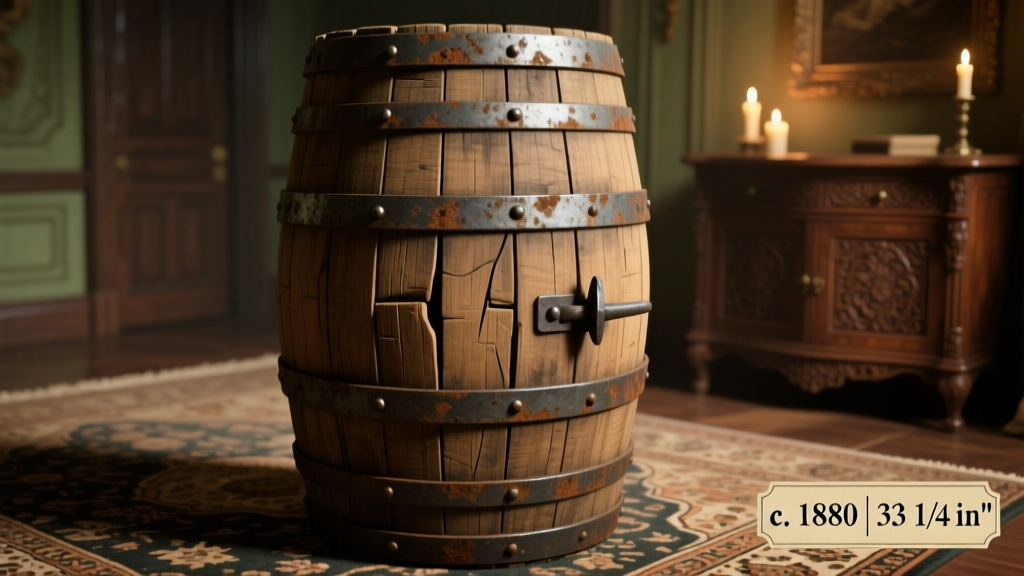
The 1880 Oak Split-Stave Barrel: Structural Integrity, Material Provenance, and Industrial Context of a 33¼-Inch Diameter Cooperage Artifact
The 1132036: Decoding the Dunbar 'Savannah' Sideboard — Design, Provenance, and Restoration Protocol
Hull Mug Stoneware: Decoding the 'Happy Days Are Here Again' 4¾-Inch Collectible

Georg Jensen Art Deco Dove-and-Wheat Pin: Authenticity, Design Legacy, and Restoration Protocol for the 1½-Inch Silver Brooch
Decoding the Chippendale-Style Mahogany Breakfront Bookcase: A Technical Restoration Analysis of Catalog Number 2339770
The 1840 Royal Wedding Commemorative Jug: A Masterpiece of Victorian Ceramics and Political Symbolism

Schuco Toy Clown Fiddler: A Detailed Study of the 4½-Inch Tinplate Windup with Cloth Costume and Felt Details
Country Garden Luncheon Plate (8-Inch): History, Identification, and Care for Antique Collectors