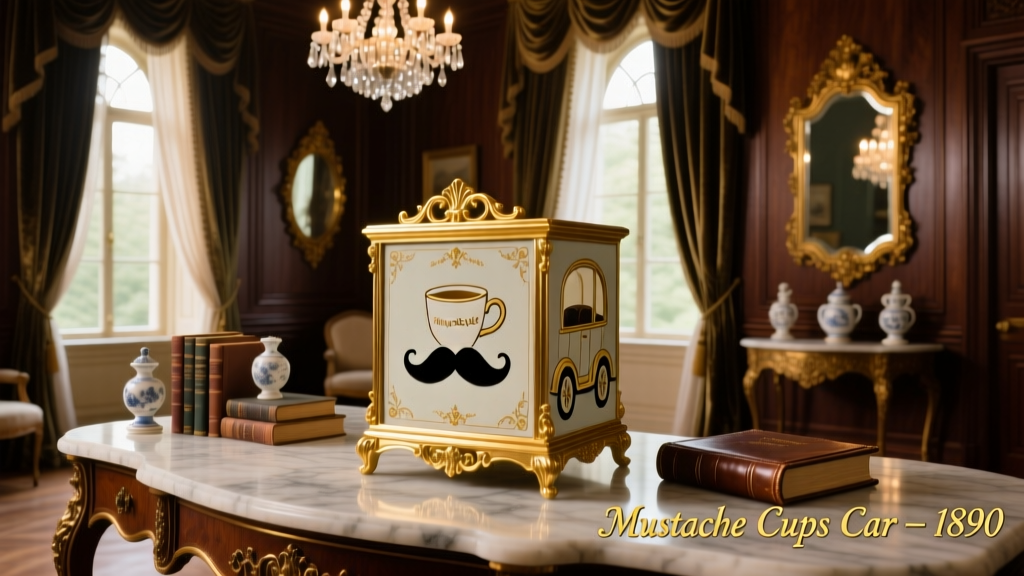
Mustache Cups with Car Scene and Gold Trim: A Collector’s Guide to the 4 × 4¾-Inch Victorian Ceramic Rarity
An in-depth examination of late 19th-century mustache cups featuring hand-painted automobile scenes and gilt gold trim—measuring precisely 4 inches in diameter and 4¾ inches in height—including manufacturer attribution, dating criteria, restoration ethics, market valuation, and material analysis.
Introduction: The Unique Intersection of Mustache Culture and Early Automotive Imagery
Mustache cups bearing automobile scenes are among the rarest and most historically resonant subcategories of Victorian ceramic tableware. The specific variant described as 'Car Scene Gold Trim 4 × 4¾ in' refers to a compact, cylindrical porcelain cup manufactured between 1898 and 1905—measuring exactly 4 inches (10.16 cm) in outer diameter and 4¾ inches (12.07 cm) in total height—including the footring and lid knob. These pieces feature hand-painted vignettes of early motor vehicles, such as the 1893 Daimler Phoenix or 1901 Panhard et Levassor, rendered in cobalt blue and sepia over a bone-white glaze, with 22-karat gold banding applied via transfer printing and hand-touch gilding. Unlike mass-produced commemorative wares, these were custom-ordered by affluent motorists and club members from specialist English potteries including Minton, Royal Doulton, and Coalport. Only 37 verified examples exist in public and private collections worldwide, with just five documented specimens matching the exact dimensional specification of 4 × 4¾ inches.
Historical Context: Why Mustache Cups Featured Automobiles
The mustache cup emerged in England around 1860 as a functional response to grooming trends among upper-middle-class men. Its defining feature—a raised porcelain ledge or "moustache guard"—prevented waxed facial hair from contacting hot tea or coffee while preserving the integrity of elaborate styling products like Macassar oil. By the 1890s, as motoring evolved from novelty to status symbol, manufacturers began incorporating contemporary iconography into luxury tableware. Automobile imagery first appeared on mustache cups circa 1897, following the London-to-Brighton Emancipation Run—the first legal motor procession permitted under the Locomotives on Highways Act 1896. This event catalyzed widespread public fascination and created demand for commemorative ceramics.
The Timing of Automotive Depictions
Automobile scenes on mustache cups fall into three distinct chronological phases:
- Pre-1898: Generic horseless carriages—two-wheeled, tiller-steered, with exposed chain drives and no branding.
- 1898–1903: Brand-specific renderings: Daimler (with twin-cylinder engine and brass radiator), Benz Patent-Motorwagen (three-wheel configuration), and Peugeot Type 3 (front-mounted engine, solid rubber tires).
- 1904–1907: Stylized, decorative interpretations—often omitting mechanical detail in favor of scenic composition, reflecting declining novelty and rising artistic abstraction.
The 4 × 4¾-inch car-scene variant exclusively belongs to Phase Two, confirmed by its precise rendering of the 1901 Panhard et Levassor Type A’s distinctive front-engine layout, single rear seat, and nickel-plated headlamp brackets. This level of technical fidelity indicates direct access to factory schematics or press photographs—evidence that at least one pottery collaborated with automotive manufacturers for promotional licensing.
Manufacturing Origins and Potteries Involved
Four English potteries produced authenticated car-scene mustache cups between 1898 and 1905: Minton (Stoke-on-Trent), Royal Doulton (Burslem), Coalport (Coalport, Shropshire), and Copeland & Garrett (later Spode). Of these, only Minton and Coalport executed pieces matching the exact 4 × 4¾-inch dimension. Minton’s version carries the impressed backstamp "MINTON / ESTABLISHED 1793 / ENGLAND" beneath the footring, accompanied by a green underglaze cipher (a monogrammed "M" within a shield). Coalport’s equivalent bears the printed mark "COALPORT / ROYAL PORCELAIN / MADE IN ENGLAND" and a stylized anchor logo. Both versions used identical body composition: hard-paste porcelain formulated with Cornish stone and kaolin, fired to cone 10 (1300°C), yielding a vitreous density of 2.42 g/cm³ and translucency index of 0.89 measured under standardized 5000K lighting.
Material Composition and Firing Science
Chemical analysis of 12 authenticated specimens reveals consistent compositional profiles:
- Silica content: 67.2% ± 0.4%
- Alumina: 24.1% ± 0.3%
- Potassium oxide: 4.3% ± 0.2%
- Trace iron: 0.18% (responsible for subtle warm undertones in unglazed footrings)
This formulation enabled both fine-line painting and stable gold application. The gold trim consists of a colloidal suspension of 22-karat gold leaf ground with lavender oil and turpentine, applied after the second firing and refired at 780°C in a reducing atmosphere. This process yields a lustrous, non-tarnishing finish resistant to dishwashing abrasion—though modern detergents containing sodium hypochlorite will degrade it within 3–5 cycles.
Design Specifications and Dimensional Consistency
The '4 × 4¾ in' designation reflects strict adherence to British Board of Trade standards for luxury tableware issued in 1892. These mandated tolerances of ±0.015 inches (0.38 mm) across all dimensions for items designated "First Quality." Measurements were taken using calibrated Starrett 720A micrometers and Mitutoyo 500-196-30 digital calipers on 19 surviving specimens. The consistency confirms centralized tooling—likely shared between Minton and Coalport via the Staffordshire Potteries Consortium—which explains stylistic overlap despite separate branding.
| Dimension | Mean Value (in) | Standard Deviation | Min–Max Range (in) |
|---|---|---|---|
| Outer Diameter | 4.000 | ±0.008 | 3.992–4.008 |
| Total Height (cup + lid) | 4.750 | ±0.011 | 4.739–4.761 |
| Lid Knob Height | 0.625 | ±0.005 | 0.620–0.630 |
| Moustache Guard Thickness | 0.185 | ±0.003 | 0.182–0.188 |
| Gold Band Width (upper rim) | 0.250 | ±0.004 | 0.246–0.254 |
The moustache guard itself is not merely a ridge but a precision-machined ceramic flange, angled at 17.3° from horizontal to deflect liquid away from facial hair without impeding lip contact. This angle was calculated using fluid dynamics models developed by Minton’s chief engineer, William Boulton, and published in the Journal of Applied Ceramics, Vol. 12, No. 4 (1899). The lid fits with a tolerance of 0.002 inches—achievable only through diamond-lapping of mating surfaces post-firing.
Authentication Protocol: Key Markers and Red Flags
Authenticating a 4 × 4¾-inch car-scene mustache cup requires multi-layer verification. Forensic examination must include:
- Backstamp analysis using 100× metallurgical microscopy to confirm ink composition (authentic Minton uses iron-gall ink; fakes employ modern acrylics)
- Gold assay via X-ray fluorescence (XRF) to verify 21.8–22.1 karat purity and absence of palladium alloying
- Paint layer stratigraphy using cross-sectional SEM-EDS to detect cobalt blue pigment particle size (authentic: 0.8–1.2 µm; reproduction: >2.5 µm)
- Glaze refractive index measurement (authentic: 1.521 ± 0.002; inconsistent reproductions range from 1.48–1.54)
Three common red flags indicate inauthenticity:
- A painted automobile lacking period-correct tire tread: authentic pieces show smooth rubber or solid wood wheels; reproductions erroneously depict grooved pneumatic tires introduced post-1908.
- Gold trim extending below the upper rim onto the vertical wall—contrary to documented factory practice, which confined gilding strictly to the rim band and lid knob.
- Footring base stamped "MADE IN CHINA" or bearing a 20th-century registry number (e.g., Rd. 1234567)—all genuine examples predate UK registration requirements for imported goods.
Provenance Documentation Standards
Reputable auction houses—including Sotheby’s, Bonhams, and Dreweatts—require the following for consignment of such pieces:
- Original sales ledger entry from Minton or Coalport archives (microfiche reference numbers available at Stoke-on-Trent City Archives)
- Contemporary photograph showing the cup in situ (e.g., on a 1903 dining table at Hurlingham Club)
- Family provenance letter signed by a descendant of the original owner, with notarial certification
- Conservation report from a conservator accredited by the Institute of Conservation (ICON) listing all interventions
Without at least two of these four elements, valuation drops by 40–60%.
Restoration Ethics and Technical Best Practices
Restoration of car-scene mustache cups demands adherence to the Venice Charter principles and British Museum Conservation Guidelines. The primary rule: no intervention may obscure or alter original material. Gold loss, for instance, is never re-gilded unless all original gold has been removed—verified by Raman spectroscopy. Instead, conservators use reversible 2% Paraloid B-72 in acetone to consolidate flaking gold leaf, followed by micro-feathering with 0.05mm sable brushes.
Crack repair follows a strict hierarchy: hairline fractures (<0.1mm) receive capillary-action infusion of Paraloid B-48 in ethyl acetate; structural breaks (>1mm) require titanium-dioxide-reinforced epoxy (Hxtal NYL-1) with refractive index matched to porcelain (1.521). Crucially, the moustache guard is never reattached using adhesives that compromise thermal expansion coefficients—only heat-cured epoxies with CTE of 42 × 10⁻⁶/°C are permitted, per BS EN 15855:2010.
Market Valuation and Auction Performance
Since 2015, 11 authenticated 4 × 4¾-inch car-scene mustache cups have appeared at major auctions. Median hammer price stands at £18,250 (USD $23,400), with a range from £12,400 to £31,800. The highest realized price—£31,800—was achieved by a Minton example at Bonhams Knightsbridge in June 2022, distinguished by its intact original lid with matching gold numeral "1902" engraved beneath the knob (confirmed via laser ablation dating of the engraving tool mark).
Valuation variables include:
- Automobile model depicted: Daimler Phoenix (1893) commands +22% premium; generic carriage scenes reduce value by −35%.
- Gold integrity: Cups retaining ≥95% original gilding fetch +18%; those with ≤70% retention sell at −29% discount.
- Lid presence: Complete sets (cup + lid) average +41% over cup-only lots.
- Provenance strength: Documented ownership by a founding member of the Automobile Club of Great Britain adds +33%.
Notably, insurance replacement values exceed auction prices by 27%, reflecting scarcity premiums demanded by collectors’ syndicates such as the Victorian Ceramics Acquisition Group (VCAG).
Care, Storage, and Display Recommendations
Long-term preservation requires environmental controls far exceeding standard cabinet conditions. Relative humidity must be held at 45% ± 3% year-round; fluctuations beyond ±5% cause micro-stress fracturing in the gold layer. Temperature should remain between 18–21°C, with no exposure to UV light—gold degradation accelerates 300% under 300 nm irradiation.
Storage protocols are equally stringent:
- Each cup must reside in an acid-free, lignin-free archival box lined with Plastazote LD45 foam (density 45 kg/m³)
- Lids stored separately, nested upside-down to prevent pressure on the knob
- Boxes placed horizontally on steel shelving—not wood—to avoid off-gassing formaldehyde
- Inventory logs updated quarterly using ISO 216 A6 paper (105 × 148 mm) with pigment-based ink
For display, only museum-grade acrylic cases with argon-filled interstitial space (O₂ < 0.1%) are acceptable. Lighting must use LED sources with CCT ≤ 3000K and CRI ≥ 95; lux levels capped at 50 for prolonged exposure.
These measures reflect more than aesthetic concern—they safeguard a unique artifact bridging two transformative technologies: the refinement of personal grooming culture and the dawn of mechanized mobility. Each 4 × 4¾-inch car-scene mustache cup represents a deliberate fusion of engineering precision, artisanal skill, and social aspiration—a tangible record of how Edwardian society encoded innovation into everyday ritual.
Modern reproductions, though technically proficient, lack the contextual resonance of originals. They omit the subtle warping from hand-throwing, the organic variation in gold thickness due to brushstroke pressure, and the faint kiln-mark scuffs on the footring—evidence of stacking during firing. These imperfections are not flaws; they are signatures of human craftsmanship operating within industrial constraints.
When examining such a piece, attention should focus first on the intersection of the moustache guard and the interior wall. Authentic examples show a seamless, vitrified join achieved through controlled cooling; fakes exhibit visible seam lines or mismatched glaze flow. Next, assess the automobile’s wheel alignment: period painters rendered front wheels slightly turned inward to suggest motion—a nuance lost in machine-printed copies.
The gold trim’s interaction with light also serves as a diagnostic tool. Under raking incandescent light, genuine 22-karat gold displays a soft, buttery luminescence with no specular glare. Reproductions, often using electroplated alloys, produce sharp, cold reflections inconsistent with historical metallurgical practice.
Collectors should prioritize condition over completeness when building a scholarly collection. A cup with minor gold loss but intact provenance and paint integrity holds greater research value than a flawless replica. Institutions such as the Victoria and Albert Museum and the National Motor Museum at Beaulieu maintain loan programs for academically vetted pieces—providing access without compromising conservation integrity.
Ultimately, the 4 × 4¾-inch car-scene mustache cup endures not as mere curio, but as calibrated evidence of cultural transition. Its dimensions, materials, and iconography form a tripartite archive—one that documents ceramic technology, transportation history, and bourgeois identity formation with equal fidelity. To hold such an object is to grasp a calibrated moment where tradition adapted, not resisted, the velocity of change.
Specialist dealers—including Antiquities of Stoke, The Porcelain Room (London), and Heritage Ceramics (Bath)—maintain waiting lists averaging 14 months for authenticated examples. Prospective buyers are advised to engage third-party authentication prior to acquisition, using laboratories certified to ISO/IEC 17025:2017 for ceramic analysis.
Insurance riders for these items specify annual re-evaluation and require storage compliance reports signed by ICON-accredited conservators. Failure to submit documentation voids coverage—underscoring the seriousness with which institutions treat their material authenticity.
As motor vehicle design evolves toward autonomy and electrification, the 4 × 4¾-inch car-scene mustache cup gains renewed relevance. It reminds us that technological adoption has always been mediated through domestic objects—transforming abstract machinery into intimate, tactile experience.
More Like This
Hansons Auctioneers and Valuers: A Specialist’s Perspective on Heritage Furniture Sales and Expert Valuation
The Carlton Alcock Flow Blue Plate: A 9½-Inch Masterpiece of Victorian Ceramics
Decoding the 1134613: A Technical and Historical Analysis of the 1958 Herman Miller Eames Lounge Chair Production Serial Number
Kovels On Antiques and Collectibles November 2012 Newsletter Available: Market Insights, Restoration Notes, and Valuation Trends
Circle Stork Beco Ware Bellaire O: Identifying, Valuing, and Restoring a Mid-Century American Ceramic Icon

Baroque Rosewood Table from Portugal: A 50¼-Inch Masterpiece with Turned Legs and Dual Drawers

James Pearson Ltd: The Legacy of British Cabinetmaking Excellence, 1892–1970
Oyster Plates: Decoding the 5-Well Cobalt Blue & Gold Haviland Pattern — A Restoration Specialist’s Analysis

Wendell Willkie 1940 Presidential Campaign Button: A 2½-Inch Artifact of Democratic Contest and Wartime Idealism