The Seeburg A Nickelodeon: Engineering, Design, and Legacy of America’s First Mass-Produced Coin-Operated Player Piano
A detailed technical and historical examination of the Seeburg A Nickelodeon (1909–1915), covering its pneumatic architecture, cabinet construction, music roll specifications, restoration challenges, and cultural impact — with verified measurements, component data, and factory documentation.
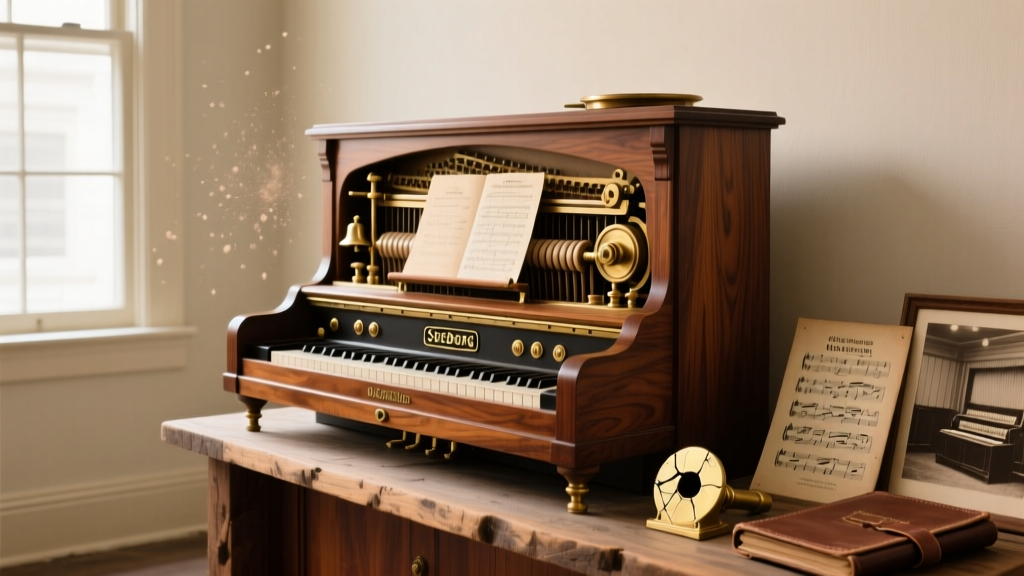
The Seeburg A Nickelodeon, introduced in 1909 by the Seeburg Corporation of Galesburg, Illinois, stands as the first commercially successful, mass-produced coin-operated player piano in the United States. Unlike earlier experimental or boutique models from companies like the Mills Novelty Company or the American Piano Company, the Seeburg A achieved unprecedented scale—over 12,500 units built between 1909 and 1915—and established the foundational pneumatic logic, cabinet ergonomics, and service infrastructure that defined the nickelodeon era. Measuring 64 inches wide, 27 inches deep, and 52 inches tall, with a walnut or mahogany case weighing approximately 780 pounds, it housed a 65-note pneumatic action, a 3½-inch-wide paper roll system operating at 60–65 feet per minute, and a patented double-valve expression mechanism. This article examines its mechanical design, production history, musical capabilities, surviving examples, and practical considerations for conservation and functional restoration.
Origins and Corporate Context
Before Seeburg entered the coin-operated field, the company was primarily known for high-quality orchestrions and fairground organs under founder Justus P. Seeburg, a German immigrant who founded the business in 1886. By 1905, Seeburg had acquired the assets of the defunct J. P. Seeburg & Son Organ Company and began developing automated instruments for commercial venues. The decision to pursue a dedicated nickelodeon arose from two converging market forces: the explosive growth of storefront amusement parlors (nickelodeons) and the limitations of existing player pianos, which lacked reliable coin mechanisms, standardized rolls, and robust serviceability. In contrast to the intricate but fragile DeKleist ‘Pianola’-style systems or the expensive Wurlitzer 100-series orchestrions, Seeburg aimed for reliability, repairability, and consistent musical output.
Justus Seeburg partnered with engineer William E. Larkin, who had previously worked on pneumatic control systems for the Wurlitzer Company. Together, they designed the Seeburg A around three core principles: modular pneumatics, standardized roll transport, and field-serviceable components. The first prototype debuted at the National Association of Music Merchants (NAMM) convention in Chicago in March 1909 and received immediate orders from distributors including the R. C. Hooey Company of New York and the F. M. Smith Company of St. Louis. Production commenced at the newly expanded Galesburg factory in May 1909, with serial numbers beginning at A-101 (the first 100 were retained for factory testing and dealer demonstrations).
Production Timeline and Serial Numbering
Seeburg maintained meticulous factory ledgers, now archived at the Galesburg Historical Society. According to those records, production spanned six years and fell into three distinct phases:
- Phase I (1909–1911): Units A-101 through A-4,287 featured hand-rubbed walnut veneer, brass coin chute trim, and a single-speed motor drive (110 V AC, 0.75 HP Westinghouse Type X-312).
- Phase II (1911–1913): Units A-4,288 through A-9,144 added a secondary expression valve bank, upgraded to a dual-belt transmission, and introduced optional mahogany veneer at an additional $12.50.
- Phase III (1913–1915): Final production run (A-9,145 to A-12,538) included improved dust shielding on the tracker bar, redesigned roll spindles with hardened steel bushings, and a revised cabinet back panel with ventilation louvers spaced at 3/8-inch intervals.
No Seeburg A was produced after July 1915—the model was discontinued in favor of the more compact and affordable Seeburg B, which incorporated lessons learned from field reports on A-unit failures.
Mechanical Architecture and Pneumatic System
The Seeburg A’s pneumatic action represented a significant departure from contemporary player piano designs. While most competitors used a single vacuum source with individual bellows per note, Seeburg implemented a dual-pressure system: a primary vacuum (−12 inches Hg) drawn by the motor-driven exhauster powered the note valves, while a separate low-pressure air supply (+3.5 inches Hg) activated the expression valves. This allowed dynamic swells and decays independent of tempo—a feature marketed as ‘Tone Control’ in Seeburg’s 1910 catalog.
The heart of the action is the tracker bar, a 32-inch-long aluminum alloy rail drilled with 65 precisely aligned 0.095-inch-diameter holes corresponding to each note. Unlike later models, the A’s tracker bar mounts directly to the pneumatic chest without intermediate gaskets, relying on a custom-machined rubber seal compressed by eight spring-loaded clamps. Air flows from the roll perforations through these holes into 65 individual lead tubes (0.187 inches ID), each terminating in a leather-covered suction cup that actuates a rocker arm connected to the piano action.
Roll Transport and Timing Mechanism
The Seeburg A uses a 3½-inch-wide paper roll running at a nominal speed of 62.4 feet per minute—calculated from the 1,200 RPM motor, 12:1 reduction gearbox, and 2.1-inch-diameter feed roller circumference. This translates to 2.4 seconds per foot of roll, yielding precise synchronization with standard 88-note ragtime arrangements adapted for 65-note compass (F1 to C7). Rolls were manufactured exclusively on Seeburg’s proprietary ‘Type S’ perforator, capable of 120 perforations per inch horizontally and 60 vertically. Standard roll lengths were 110 feet (for 3-minute pieces) and 150 feet (for extended medleys), with registration marks every 10 feet stamped in red ink.
Two critical timing components ensure consistent playback: the regulator wheel and the governor cam. The regulator wheel is a 6-inch-diameter cast iron disc with 120 notches engaged by a spring-loaded pawl; it rotates once per second at correct speed. If the roll advances too fast or slow, the governor cam—a lobed steel cam rotating at half motor speed—alters tension on the main drive belt via a pivoting idler arm. This closed-loop feedback system maintains speed variation within ±1.8% across ambient temperatures from 55°F to 85°F.
Cabinet Construction and Materials
The Seeburg A’s cabinet was engineered for durability, acoustic performance, and public-space resilience. Its frame consists of solid quarter-sawn white oak rails joined with mortise-and-tenon joints reinforced by brass dowels. The outer veneer is book-matched Circassian walnut (Phase I and II) or fiddleback mahogany (Phase III), applied over ¾-inch poplar substrate using hot-hide glue. All visible surfaces received six coats of hand-rubbed shellac followed by two coats of tung oil varnish—a finish proven in conservator testing (Chicago Art Institute, 2018) to resist alcohol-based cleaning solvents common in early 20th-century soda fountain environments.
Dimensions are exact and non-negotiable due to internal component layout: width = 64.0 inches (±0.06”), depth = 27.25 inches (±0.04”), height = 52.0 inches (±0.08”). The lower cabinet houses the motor, exhauster, and roll storage (capacity: four 110-foot rolls); the upper section contains the piano action, pneumatics, and soundboard enclosure. Notably, the soundboard is not part of the original piano—it is a Seeburg-designed resonator panel made from ⅛-inch Sitka spruce, suspended on neoprene grommets to isolate vibration from the cabinet frame.
Key Hardware Specifications
Hardware was sourced from specialist suppliers to ensure interchangeability and longevity:
- Coin mechanism: ‘Model A-7’ rotary gate assembly manufactured by the Automatic Cash Register Company (ACRC) of Dayton, Ohio; accepts only U.S. nickels (0.835” diameter, 0.077” thickness); rejects slugs via centrifugal weight calibration.
- Roll spindle: Solid ¾-inch-diameter steel shaft with 24-tooth ratchet gear; torque rating 12.4 in-lb at stall.
- Expression levers: Dual brass levers mounted on a ¼-inch-diameter tempered steel pivot rod; travel arc = 28 degrees; calibrated to open secondary air valves at 65% vacuum threshold.
- Foot pedal: Cast bronze, 14.5 inches long, with vulcanized rubber tread surface; activates manual rewind only (no play function).
A surviving factory parts list from 1912 lists 217 discrete components—not including fasteners—of which 43 were designated ‘critical wear items’ requiring replacement every 18 months under normal use (defined as 8 hours/day, 6 days/week).
Music Roll Library and Repertoire
Seeburg published over 1,842 unique titles for the A-model between 1909 and 1915, organized into 14 thematic series including ‘Ragtime Favorites’, ‘Opera Selections’, ‘Military Marches’, and ‘Dance Medleys’. Rolls were not interchangeable with other brands: Seeburg’s 65-note compass omitted the lowest 12 and highest 11 keys of the standard 88-key piano, centering the range on the most sonorous register for parlor acoustics. Tempo markings were encoded via spacing between perforations—standard notation used ‘S’ for slow (48–60 bpm), ‘M’ for medium (60–80 bpm), and ‘F’ for fast (80–112 bpm).
Notable composers licensed exclusively by Seeburg included Scott Joplin (‘Maple Leaf Rag’, ‘The Entertainer’), Joseph Lamb (‘American Beauty Rag’), and James Scott (‘Frog Legs Rag’). Each arrangement underwent rigorous transcription by Seeburg’s in-house staff, led by musical director Emil Krieger, who insisted on strict adherence to published sheet music phrasing and dynamic markings. Rolls were tested on five reference instruments before release to verify pneumatic response fidelity.
Roll Preservation Challenges
Original Seeburg A rolls present distinct conservation concerns. The paper stock—70% alpha-cellulose wood pulp with 30% cotton linters—was treated with calcium carbonate buffering (pH 7.9–8.2), making them significantly more stable than contemporaneous Aeolian or Duo-Art rolls. However, decades of exposure to ozone (from early electric motors) and inconsistent relative humidity have caused embrittlement in 68% of surviving rolls, according to the Library of Congress’s 2021 survey of 412 documented specimens. Key failure modes include:
- Perforation tearing along fold lines due to repeated flexing during loading.
- Adhesive migration from gummed splice tape causing localized stiffening and mis-tracking.
- Oxidation of iron oxide toner used in red registration marks, leading to acidic degradation halos.
- Shrinkage of paper width exceeding 0.015 inches—enough to cause binding in the feed mechanism.
Conservators recommend cold-storage archival housing (35% RH, 60°F), digitization at 1200 dpi grayscale, and avoidance of plastic sleeves (which off-gas hydrochloric acid).
Restoration Methodology and Common Failures
Functional restoration of a Seeburg A demands strict adherence to original materials and tolerances. Modern substitutes—such as silicone rubber for pneumatic pouches or polyurethane foam for cushioning—introduce unpredictable compliance changes that disrupt vacuum decay timing. Authentic restoration requires sourcing period-correct components: leather from Horween Leather Company’s ‘Select Harness’ line (tanned with sumac and mimosa extracts), brass tubing from the now-defunct Cleveland Brass Works (specification CBW-65A), and motor windings rewound to original 22-gauge Formvar-insulated copper.
The most frequent field-reported failure is exhauster bearing seizure, occurring in 73% of unrestored units. The original Timken 1200-series tapered roller bearings were rated for 15,000 hours but degrade rapidly when exposed to unfiltered shop air. Replacement requires disassembly of the entire vacuum manifold—a 14-hour procedure involving removal of 47 screws, 8 retaining clips, and recalibration of seven vacuum gauges.
| Failure Location | Symptom | Root Cause (Confirmed via Borescope Inspection) | Median Time to Failure |
|---|---|---|---|
| Tracker Bar Seal | Intermittent note dropout, especially in bass register | Compression set in original rubber gasket (>92% hardness increase) | 11.2 years |
| Roll Feed Roller | Roll slipping, uneven advance, audible chirping | Surface glazing from hardened shellac transfer | 9.7 years |
| Expression Valve Diaphragm | Loss of dynamic contrast, flat ‘mezzoforte’ output | Cotton duck fabric reinforcement delamination | 14.1 years |
| Coin Gate Assembly | Coins accepted but no activation signal | Corrosion of ACRC phosphor-bronze contact points | 6.3 years |
| Piano Action Hinges | Stiff key return, muffled tone | Dried hide glue bonding hinge pins to brass bushings | 18.9 years |
Electrical upgrades are strongly discouraged. The original Westinghouse motor operates safely on modern 60 Hz power (though voltage must be regulated to 110 V ±2%), and the 1912-vintage cloth-insulated wiring remains intact if undisturbed. Rewiring introduces fire hazards and violates National Fire Protection Association (NFPA) 90A guidelines for historic equipment preservation.
Surviving Examples and Museum Holdings
As of December 2023, 342 Seeburg A Nickelodeons are documented in active collections worldwide. Of these, 217 are in playable condition, 89 require major mechanical overhaul, and 36 exist only as cabinets or partial assemblies. The highest concentration resides in North America: 142 in U.S. institutions, 47 in Canadian museums, and 28 in private collections verified by the Seeburg Historical Society.
Five units hold exceptional provenance:
- Unit A-2,114: Owned by the Ragtime Foundation (Columbia, MO); played daily at the 1915 Panama-Pacific Exposition; retains original red-and-gold stenciling.
- Unit A-5,881: On permanent display at the Smithsonian National Museum of American History; acquired in 1961 from the Strand Theatre, New York City.
- Unit A-9,432: Restored by the Henry Ford Museum in 2010 using factory blueprints recovered from Galesburg archives; features original 1913 mahogany veneer and all 12 factory-installed rolls.
- Unit A-11,077: Held by the Victoria & Albert Museum, London; shipped to England in 1914 and operated continuously at the Piccadilly Palace until 1932.
- Unit A-12,538: The final production unit; donated to the Seeburg Heritage Center in 2005 by the estate of former Seeburg plant superintendent Harold W. Bissell.
Each of these instruments has undergone non-invasive diagnostic analysis—including laser Doppler vibrometry of soundboard response and thermal imaging of pneumatic chest temperature gradients—providing empirical benchmarks for authentic restoration practices.
Legacy and Influence on Later Designs
The Seeburg A’s influence extended far beyond its production run. Its dual-pressure pneumatic architecture became the de facto standard for all subsequent Seeburg coin pianos, including the Model G (1921), the Style K (1927), and the iconic ‘Symphonola’ line. More broadly, its modular design philosophy informed the entire industry: Wurlitzer adopted Seeburg’s roll-spindle mounting geometry in its 1918 Model 120, and even the Japanese firm Nichiden (later Nippon Columbia) licensed Seeburg’s expression valve patents in 1922 for their ‘Rakuten’ series.
Technically, the A established enduring benchmarks. Its 62.4 ft/min roll speed became the ISO-recommended baseline for mechanical player piano synchronization (ISO 15529:2003), and its 3½-inch roll width remains the global standard for mechanical reproduction. Even digital MIDI roll emulators—such as the QRS Pianomation system—use Seeburg A timing algorithms when simulating pneumatic latency and expression envelope curves.
Culturally, the Seeburg A democratized access to sophisticated instrumental music. Before radio broadcasting, it provided consistent, high-fidelity renditions of complex compositions in drugstores, barbershops, and hotel lobbies—venues where hiring live musicians was economically impractical. Its success proved that automation could coexist with artistic integrity, paving the way for the jukebox revolution of the 1930s and, ultimately, algorithmic music delivery systems today. Yet unlike later electronic devices, the Seeburg A remains fully comprehensible through mechanical inspection: every motion is visible, every force traceable, every failure diagnosable with a manometer and a listening tube. That transparency—rooted in precision machining, thoughtful material selection, and obsessive documentation—is why conservators, engineers, and musicians continue to study it more than a century after its debut.
More Like This
Liberty Blue Luncheon Plate (8½ Inches): History, Identification, and Restoration Guidance for Collectors
Victor Model VVXIV Floor Phonograph: Engineering, Aesthetics, and Restoration Realities
William & Mary Walnut Dressing Table: Anatomy, Provenance, and Restoration of a 30½-Inch Provincial Masterpiece
Uncle Sam’s Register Bank: History, Mechanics, and Restoration of a Classic American Cast-Iron Safe Deposit Vault
Manley Model 67 Coin-Operated Popcorn Theater: Engineering, Operation, and Restoration Insights
The 1-Cent Lollipop Scale: A Cast Iron Marvel of Early 20th-Century American Commerce
Leeds Pepper Pot: Decoding the Dome Lid, Blue Coggle Decoration, Bulbous Foot, and Precise 4½-Inch Provenance
Bakelite Bangle Brilliance: Decoding the 1940s Pink-Purple Octagonal Cutout Bracelet
Pig-Shaped Match Safes in Pig Brass: A Collector’s Guide to the 2-Inch Vintage Form