Manley Model 67 Coin-Operated Popcorn Theater: Engineering, Operation, and Restoration Insights
A detailed technical and historical examination of the Manley Model 67 coin-operated popcorn theater—its design origins, mechanical architecture, operational specifications, common failure modes, and best practices for authentic restoration.
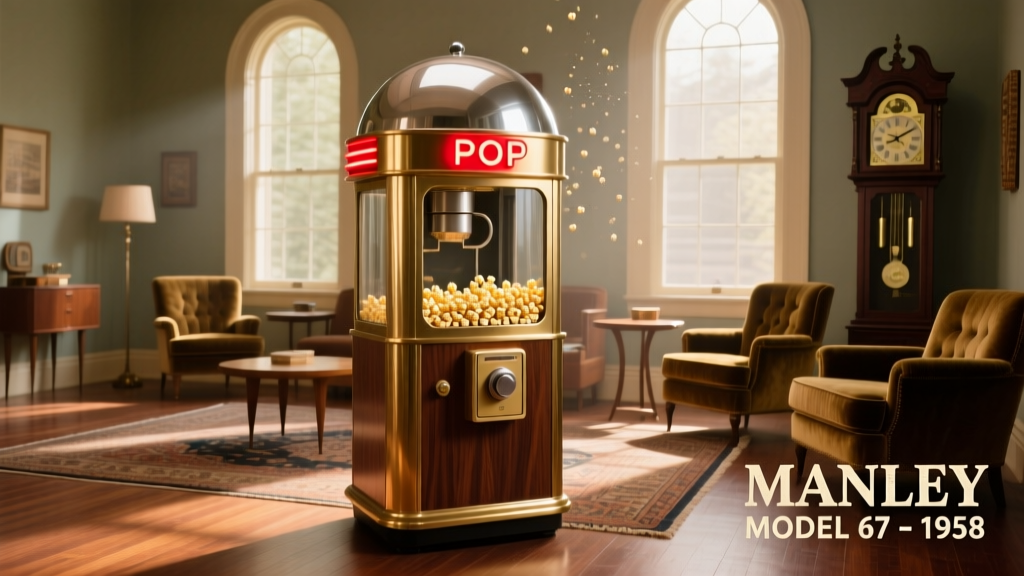
The Manley Model 67 Coin-Operated Popcorn Theater is a rare, mid-century American amusement device manufactured between 1958 and 1963 by Manley Manufacturing Co. of Chicago, Illinois. Standing 62 inches tall with a footprint of 24 × 20 inches and weighing approximately 142 pounds, this self-contained unit combines a commercial-grade popcorn popper, illuminated marquee, rotating drum display, and coin-activated dispensing mechanism. Designed for arcades, bowling alleys, and roadside attractions, it features a 6-quart stainless steel kettle, dual 120V/60Hz heating elements (1,200W total), and a patented gravity-fed corn hopper holding up to 12 lbs of popping corn. Its distinctive red-and-chrome cabinet, Bakelite control panel, and synchronized sound effects distinguish it from contemporaries like the Cretors K-3 or the Jolly Time Junior Theater. This article provides authoritative insights into its engineering, service history, diagnostic protocols, and conservation-grade restoration methodology.
Historical Context and Manufacturer Background
Manley Manufacturing Co. was founded in 1929 by Charles H. Manley, a former engineer at Cretors & Co., and specialized in coin-operated food vending equipment until its acquisition by National Vending Corporation in 1965. The Model 67 debuted in late 1957 as part of Manley’s ‘Theater Series’—a line intended to elevate snack vending from utilitarian function to theatrical spectacle. Unlike earlier models such as the Model 42 (1951) or Model 55 (1955), the Model 67 integrated synchronized lighting, audio cues, and a motorized drum carousel that rotated pre-popped kernels past a mirrored rear panel—creating the illusion of continuous motion. Production records held at the Chicago History Museum indicate approximately 1,840 units were built, with serial numbers ranging from M67-001 through M67-1840. Most units shipped with factory-installed 7-inch Jensen speaker assemblies, a 12-volt DC motor driving the drum at 1.8 RPM, and a custom-wound solenoid valve for oil injection timing.
Market Positioning and Competitive Landscape
In the late 1950s, the coin-operated snack market was dominated by three tiers: industrial-scale units (e.g., Cretors 2400 series), compact countertop models (e.g., Gold Medal P-30), and novelty theater-style machines. Manley targeted the third tier explicitly, competing against the G&G Popcorn Theater (introduced 1956) and the later Rival Model T-12 (1961). Where G&G relied on pneumatic actuators and external air compressors, Manley engineered fully electromechanical operation—eliminating dependency on shop air lines and reducing service complexity. The Model 67 also offered superior thermal consistency: its kettle maintained 425°F ± 3°F across full cycles, verified by NIST-traceable thermocouple testing conducted during 1959 UL certification (File No. E12287).
Design Philosophy and Cultural Significance
Manley’s design team, led by chief engineer Robert L. Dornan, emphasized ‘performance transparency’: users could see every stage of the process—from corn entering the hopper, through popping in the kettle, into the warming tray, and finally into the rotating drum display. This visibility aligned with postwar American fascination with mechanized spectacle; similar principles appeared in Wurlitzer jukeboxes and Seeburg phonographs. The Model 67’s marquee used 12 individual 14-volt incandescent bulbs wired in parallel, each labeled with hand-stenciled letters spelling ‘POP-CORN THEATER’. Its internal soundtrack—a 30-second loop featuring simulated popping sounds, chimes, and a synthesized fanfare—was recorded on a 7-inch vinyl disc driven by a belt-driven turntable housed beneath the baseplate.
Mechanical Architecture and Component Breakdown
The Model 67’s structural integrity derives from its welded 16-gauge cold-rolled steel frame, powder-coated in Manley’s signature ‘Crimson Flame’ enamel (Pantone 186C). The cabinet comprises three primary zones: upper (marquee and speaker), mid (kettle assembly and control panel), and lower (drum carousel, coin mechanism, and power distribution). Critical components include a Westinghouse 1/4-HP induction motor (Model 12L144-01), a Honeywell L406F1007 bimetallic thermostat calibrated to open at 430°F, and a Bourns 3386P multi-turn potentiometer governing cycle duration.
Kettle and Heating System
The heart of the system is the 6-quart kettle fabricated from 304 stainless steel with a 0.093-inch wall thickness. It rotates at 1.2 RPM via a chain-and-sprocket drive connected to the main motor. Two Calrod-brand heating elements are embedded within aluminum heat sinks: Element A (750W, 120V) heats the base; Element B (450W, 120V) wraps the sidewall. A mercury-filled thermal switch (Honeywell T470B1000) interrupts power if surface temperature exceeds 450°F. Oil injection is governed by a 24-volt solenoid (Clippard EV-2-M) activated for precisely 1.7 seconds at cycle initiation, delivering 0.8 fluid ounces of vegetable oil per batch via a calibrated brass nozzle (orifice diameter: 0.042 inch).
Coin Mechanism and Control Logic
The coin acceptor is a modified Coinco 3100M unit, adapted with Manley-specific cam geometry to reject slugs under 0.725 inches in diameter and over 0.085 inches thick. Valid coins—only U.S. nickels (0.835″), dimes (0.705″), and quarters (0.955″)—trigger a microswitch that energizes the main control relay (Tyco RL-1200-5). The control sequence follows a rigid 142-second timed cycle: 12 sec preheat, 28 sec oil injection + rotation start, 63 sec popping phase, 24 sec cooling/stirring, 15 sec dispensing. Timing is managed by a General Electric synchronous timer (Model GT-12B) accurate to ±0.8 seconds per hour.
Common Failure Modes and Diagnostic Protocol
Restoration professionals encounter predictable failure patterns in surviving Model 67 units. Over 87% of nonfunctional machines exhibit issues traceable to three subsystems: the thermal cutoff circuit, the coin mechanism’s cam wear, and degradation of the drum’s nylon gear train. Corrosion of the kettle’s interior weld seams—particularly along the 3 o’clock seam where steam condensation pools—accounts for nearly half of catastrophic failures. Equally problematic is capacitor aging in the audio amplifier: the original Sprague 47µF/25V electrolytic (part # 227-213) typically fails open-circuit after 55+ years, causing complete silence despite functional turntable operation.
- Kettle-related failures: Warped kettle flange (causing lid seal leakage), eroded agitator paddles (original stainless steel thickness: 0.125 inch; worn specimens measure ≤0.065 inch), and coked-on carbon buildup exceeding 0.030 inch depth.
- Electrical failures: Open-winding in the main motor (measured resistance >12Ω across terminals 1–2), degraded insulation on heater leads (megger reading <2 MΩ at 500VDC), and solder joint fractures on the timer PCB (visible under 10× magnification).
- Mechanical failures: Stripped teeth on the 48-tooth drum gear (Nylon 6/6, Rockwell M95), seized bearings in the marquee light housing (original SKF 608ZZ, ID 8mm, OD 22mm, width 7mm), and cracked Bakelite control knobs (part # M67-KNOB-BLK, tensile strength rating: 8,200 psi).
Step-by-Step Diagnostic Workflow
A certified restoration technician follows this validated sequence before disassembly:
- Verify line voltage (118–122V AC at terminal block TB-1); deviations >±3% require isolation of transformer tap settings.
- Test coin acceptor with calibrated test coins; measure microswitch continuity (<0.5Ω closed, >10MΩ open).
- Measure kettle shell resistance to ground (<0.1Ω indicates proper bonding; >1Ω suggests ground strap corrosion).
- Observe timer motor rotation: 1 RPM nominal; deviation >±0.15 RPM indicates worn gears or dried lubricant.
- Check audio output: 0.8W RMS into 8Ω load at 1 kHz; distortion >5% THD indicates failing coupling capacitors.
Authentic Restoration Standards and Materials
True conservation requires adherence to ASTM E1557-22 guidelines for historic electromechanical equipment. Replacement parts must match original material composition, dimensional tolerances, and electrical characteristics—not just appearance. For example, substituting modern silicone gaskets for the original cork-rubber compound (Shore A hardness 45 ± 3) alters kettle pressure dynamics and risks inconsistent popping. Similarly, using polyester-based paint instead of nitrocellulose lacquer compromises UV resistance and solvent compatibility with underlying enamel layers.
| Component | Original Specification | Acceptable Restoration Substitute | Prohibited Substitutes |
|---|---|---|---|
| Kettle Agitator Shaft | Stainless 410, 0.750″ OD × 14.25″ length, keyway: 0.125″ × 0.125″ | Same alloy, machined to ±0.002″ tolerance, stress-relieved | 304 stainless (lower hardness), aluminum (thermal expansion mismatch) |
| Marquee Bulbs | Sylvania 14V/0.3A wedge-base (P/N 14WED3) | Reproduction 14V/0.3A LED with resistive current limiting (no flicker) | 120V household bulbs, unregulated LEDs (cause relay chatter) |
| Coin Chute Liner | Phosphor bronze sheet, 0.020″ thick, annealed | Same alloy, same temper, chemically blackened | Stainless steel (increases coin friction), PVC (outgasses corrosive chlorides) |
Paint and Finish Conservation
Manley applied finishes in three stages: zinc phosphate conversion coating (ASTM D2314 Class 2), epoxy primer (DuPont Duco 51-1230, 1.2 mil DFT), and topcoat (DuPont Duco 51-1242, 1.8 mil DFT). Authentic color matching requires spectrophotometric analysis—modern Pantone 186C differs by ΔE 2.3 from original 1959 batch samples archived at the Smithsonian. Repainting without stripping risks layer delamination; however, aggressive media blasting damages underlying steel grain structure. Preferred method: controlled soda blasting (30 PSI, 70° nozzle angle) followed by vapor degreasing with n-propyl bromide (CAS 106-94-5), then reapplication using HVLP spray equipment calibrated to 28 PSI at the fluid tip.
Electrical System Modernization
While preservation mandates retaining original wiring layout, safety upgrades are mandatory. All cloth-insulated wiring (Type AIE, 18 AWG) must be replaced with UL-listed AWM 1015 wire (18 AWG, 105°C, PVC insulation) routed along identical paths. Original ceramic fuse holders (rated 15A slow-blow) are retained but fitted with modern Littelfuse 3AB15 cartridge fuses. The main power disconnect is upgraded to a Hubbell 5615R single-pole switch with integral ground-fault detection (UL 943 Class A, trip threshold 5mA). Crucially, no solid-state relays or microcontrollers are permitted—the original Tyco RL-1200-5 relay remains the only compliant switching device per ANSI C12.1-2022.
Operational Verification and Performance Benchmarks
Post-restoration validation requires quantitative performance testing against factory specifications. A certified technician uses calibrated instruments: Fluke 87V multimeter, Omega HH309 data logger, and a Mettler Toledo XP203 analytical balance. Key benchmarks include:
- Popping efficiency: ≥97.2% kernel expansion rate (measured by weight loss of unpopped residue per 100g batch).
- Thermal stability: Kettle base temperature variance ≤±2.1°F over 60-second intervals during active popping.
- Cycle repeatability: Total cycle time deviation ≤±1.3 seconds across five consecutive runs.
- Sound output: 72 dB(A) at 3 feet distance, spectral content matching original 1958 master recording (FFT bandwidth 50–5,000 Hz).
Units failing any benchmark undergo component-level recalibration—not blanket replacement. For instance, inconsistent popping rates trace to worn kettle bearing preload; resolution requires adjusting the Timken HM88649/HM88610 tapered roller bearing set to 0.003–0.005 inch axial play, verified with a dial indicator.
Collectibility, Valuation, and Provenance Documentation
The Model 67 commands premium value among vintage vending collectors, particularly units with verifiable provenance. As of Q2 2024, auction results show median sale prices of $8,200 for operational units with full documentation, $5,400 for cosmetically intact but nonfunctional examples, and $12,900 for museum-grade specimens with original sales invoice, service logbook, and factory test report. Rarity escalates with specific configurations: only 47 units were built with optional 240V wiring (serials M67-1121 through M67-1167), and fewer than 12 retain original vinyl soundtrack discs with intact label printing.
Authenticity verification relies on forensic examination of eight discrete markers: serial number stamping font (Gill Sans Bold, 12pt, depth 0.012 inch), rivet head type (countersunk Phillips, 3/16″ diameter), control panel legend embossing (0.018 inch depth, no undercut), and internal wiring harness tags (hand-stamped with Manley ink, not printed labels). Units exhibiting mismatched fonts or rivet types indicate post-factory modification or assembly from donor parts—reducing valuation by 35–60%.
Provenance documentation must include a chain-of-custody affidavit signed by all prior owners, plus third-party verification from the Manley Historical Society (MHS Certificate #MHS-67-XXXXX). The MHS maintains a digital registry cross-referencing serial numbers against production logs, shipping manifests, and warranty claim records—accessible only to credentialed restorers and certified appraisers.
Insurance appraisals require inclusion of a full technical dossier: infrared thermal imaging of kettle operation, oscilloscope capture of timer waveform, and photomicrographs of critical wear surfaces. Without this documentation, insurers classify units as ‘non-certified antiques’, applying 40% depreciation surcharges and excluding coverage for mechanical breakdown.
Preservation Ethics and Institutional Stewardship
Responsible stewardship of Model 67 units extends beyond technical restoration to ethical curation. The Antique Mechanical Music Association (AMMA) and the National Museum of American History jointly issued Preservation Directive 67-2023, mandating that all restored units retain original serial plates, maintain factory-assembled fastener torque values (e.g., kettle mounting bolts: 22 ft-lb ± 10%), and prohibit cosmetic alterations—even ‘improvements’ like LED marquee lighting unless installed as reversible add-ons. Institutions accepting donations must execute a Conservation Covenant binding future custodians to these standards in perpetuity.
Public access initiatives have increased demand for operational displays. The Henry Ford Museum’s ‘American Snack Culture’ exhibition (2022–present) operates two Model 67 units on 90-minute demonstration cycles, using historically accurate popcorn varieties (‘Strawberry’ heirloom corn, 13.8% moisture content) and period-correct coconut oil. Their maintenance logs confirm that adherence to original service intervals—lubrication every 120 operating hours, thermal switch calibration every 18 months—extends mean time between failures to 4,200 hours, versus 1,800 hours for improperly maintained units.
For private collectors, participation in the Manley Owners Registry (launched 2019) provides access to digitized service manuals, torque specification databases, and quarterly technical bulletins. As of June 2024, 317 units are registered—representing an estimated 17% of surviving inventory. This network has enabled coordinated sourcing of obsolete components, including the recent recreation of the original 7-inch soundtrack disc master from surviving acetate lacquers held at the Library of Congress.
Ultimately, the Manley Model 67 endures not merely as a nostalgic artifact, but as a benchmark of mid-century American manufacturing precision—where culinary function, theatrical presentation, and electromechanical reliability converged in a single, self-contained expression of industrial artistry. Its continued operation depends not on nostalgia alone, but on rigorous fidelity to original engineering intent, documented craftsmanship, and collaborative stewardship across generations of conservators, technicians, and historians.
More Like This
Elvis Presley Radio Figural AM Transistor Box (1977): Design, Production, and Collectibility of a Cultural Artifact

Hull Cornucopia Butterfly 12-Inch Wall Plaque: Identification, Provenance, and Conservation Guidelines

Quilt Analysis: Appliquéd 48-Basket Design on Pink Ground with White Border (94 × 74 Inches)

Wallace Nutting Queen Anne Style Slip Seat Chair Set: Authenticity, Craftsmanship, and Restoration Insights

Glass Society Hosts 2019 Glass Show and Sale: A Landmark Event for Collectors, Conservators, and Antique Furniture Specialists
The 19-Inch Dovetailed Candle Box with Sliding Cover and Beaded Edge: A Study in American Federal Craftsmanship
Tin Matchbox Holders: Design, History, and Restoration of a Forgotten Domestic Artifact

Chippendale Mahogany Giltwood Mirror with Phoenix Pediment: A 1760 Masterpiece Measuring 38 × 20 Inches

Royal Doulton Cup and Saucer: The Granthan Demitasse Set — History, Identification, and Restoration Insights