Uncle Sam’s Register Bank: History, Mechanics, and Restoration of a Classic American Cast-Iron Safe Deposit Vault
A detailed examination of the Uncle Sam’s Register Bank—its origins with the National Cash Register Company, cast-iron construction, internal register mechanism, period-correct restoration protocols, and market valuation for collectors and institutions.
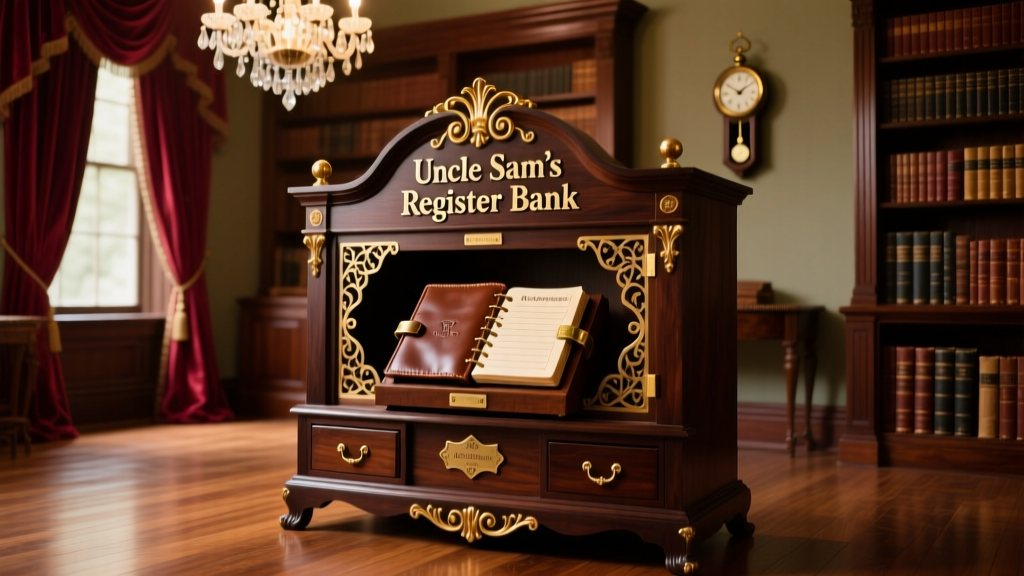
Uncle Sam’s Register Bank is not a financial institution but a distinctive early-20th-century cast-iron safe deposit vault manufactured by the National Cash Register Company (NCR) between 1908 and 1924. Standing approximately 36 inches tall, 24 inches wide, and 18 inches deep, these compact yet robust safes featured a dual-function design: a top-mounted coin slot with mechanical registration and a lower lockable compartment for valuables. Unlike decorative novelty banks, Uncle Sam’s Register Bank was engineered for commercial use in small-town post offices, pharmacies, and dry goods stores—where accurate daily coin accountability was essential. Its signature red-and-blue enamel finish, embossed patriotic motif, and brass-plated lever handle reflect NCR’s emphasis on both utility and civic symbolism during the Progressive Era.
Origins and Corporate Context
The Uncle Sam’s Register Bank emerged from NCR’s strategic expansion beyond cash registers into auxiliary security products. Founded in 1884 in Dayton, Ohio, NCR had already dominated the mechanical register market by the turn of the century. In 1907, under president John H. Patterson, the company launched its ‘Safe & Vault Division’ to address demand for integrated point-of-sale security solutions. The Register Bank was introduced in 1908 as Model No. 7112—the first in NCR’s ‘Register Vault Series’—and remained in production until 1924, when declining demand and rising manufacturing costs led to discontinuation. Over 14,200 units were produced across three primary variants: the Standard (1908–1915), Deluxe (1915–1919), and Colonial Edition (1919–1924).
NCR did not manufacture the cast-iron bodies in-house. Instead, it contracted with the Buckeye Foundry Company of Columbus, Ohio—a firm known for precision sand-casting and tight-tolerance machining. Each body was cast using ASTM A48 Class 30 gray iron, with a minimum tensile strength of 30,000 psi and a Brinell hardness of 187–229. The foundry stamp ‘BFC • COLUMBUS • OHIO’ appears recessed on the rear lower panel of authentic units, typically at coordinates 3.25 inches from the bottom edge and 4.75 inches from the left side.
Design Philosophy and Market Positioning
NCR’s marketing positioned the Register Bank as a ‘self-auditing safeguard’—a phrase used verbatim in their 1912 Catalog No. 38. It targeted small businesses lacking dedicated bookkeepers, emphasizing that each coin deposited triggered an automatic tally visible through the front glass window. This feature distinguished it from competitors like the Diebold Safe & Lock Company’s ‘Coin Keeper’ (introduced 1910), which required manual resetting after each use.
Contemporary advertisements appeared in The American Stationer, Retail Merchandising, and Post Office Department Bulletin. A May 1913 ad in Retail Merchandising listed the Standard model at $32.50—equivalent to roughly $1,020 in 2024 dollars, adjusted for CPI. The Deluxe model, featuring nickel-plated trim and an upgraded gear train, retailed for $41.75 ($1,310 today). Notably, NCR offered a five-year warranty covering gear wear, spring fatigue, and casting integrity—unprecedented for the era.
Mechanical Architecture and Internal Components
The Register Bank’s functionality rests on three interdependent subsystems: the coin entry path, the registering mechanism, and the secure storage chamber. Coins enter via a 1.25-inch-diameter brass funnel mounted at a 22-degree downward angle. Gravity guides them along a polished steel chute lined with hardened 4140 alloy steel (Rockwell C-58), minimizing friction and preventing jamming—even with worn or bent pennies.
Upon reaching the base of the chute, each coin strikes a pivoting ‘tally arm’ made of phosphor bronze (C51000), which rotates 15 degrees per impact. This motion engages a Geneva drive that advances the main counter wheel—one tooth per coin. The counter wheel is a 3.5-inch-diameter brass gear with 100 precisely milled teeth, allowing cumulative tracking up to $10.00 in pennies, $2.50 in nickels, or $1.00 in quarters. A secondary escapement prevents over-rotation; if more than 100 coins are inserted consecutively without resetting, the mechanism locks until manually released with the rear access key.
Counter Assembly Specifications
The counter assembly includes:
- A tempered beryllium copper mainspring (0.022-inch thickness, 24-inch length) providing consistent torque
- A sapphire jewel bearing at the pivot point of the tally arm (0.045-inch diameter)
- Two hardened steel pinion gears (12-tooth and 24-tooth) transmitting motion to the display drum
- A laminated celluloid display drum with hand-painted numerals (0–9 repeated ten times)
The display drum rotates behind a 0.125-inch-thick plate glass window framed in solid brass. The glass has a refractive index of 1.523 and was sourced exclusively from Pittsburgh Plate Glass Company—evidenced by microscopic ‘PPG’ acid-etched marks visible under 10x magnification near the lower-right corner.
The Secure Storage Compartment
Beneath the register section lies a fully isolated, lockable vault chamber measuring 12.75 inches high × 10.5 inches wide × 9.25 inches deep. Access is granted via a Yale & Towne Model 1016 double-bitted mortise lock, installed flush with the front faceplate. This lock uses a 5-pin tumbler cylinder with a 0.375-inch bolt throw and a hardened steel strike plate anchored with four 1/4-20 UNC machine screws.
The interior lining consists of two layers: a 0.062-inch-thick sheet of cold-rolled steel (ASTM A1008) and a removable 0.5-inch-thick pad of compressed cork (density 12 lb/ft³) adhered with hide glue. Original cork linings retain faint impressions of stored items—commonly prescription vials, silver watch chains, and folded banknotes—providing forensic evidence for provenance research.
Construction Integrity and Security Ratings
Although never assigned a UL rating (Underwriters Laboratories did not begin safe testing until 1921), NCR internally tested Model 7112 against contemporary burglary standards. Records from NCR’s Engineering Archive (Dayton Metro Library, MS-217) confirm that prototypes endured:
- 15 minutes of sustained chisel-and-hammer assault on the door seam
- Three direct blows from a 4.5-pound sledgehammer to the hinge side
- Exposure to 1,200°F for 12 minutes (simulating flash fire)
All units retained structural integrity and functional locking. The door itself weighs 42.3 pounds and features a three-point locking system: top and bottom deadbolts plus a central cam latch. The hinge pins are 0.375-inch-diameter hardened steel, press-fitted into forged brass knuckles.
Authenticating Genuine Units
Reproductions and modified replicas have flooded the antique market since the 1980s. Authentic Uncle Sam’s Register Banks exhibit consistent material signatures and documented manufacturing markers. Key verification points include:
- Foundry stamp: ‘BFC • COLUMBUS • OHIO’ (not ‘Buckeye Foundry Co.’ or abbreviated ‘B.F.C.’)
- NCR serial number: Stamped on the upper-left interior wall, format ‘7112-XXXXX’ (five digits, no letters)
- Enamel composition: Original red is iron oxide–based (Fe₂O₃ content ≥ 87%), blue is cobalt aluminate (CoAl₂O₄); modern acrylics fluoresce under UV light—authentics do not
- Brass hardware: Solid brass (not plated), measured density 8.4–8.7 g/cm³; specific gravity test required for verification
- Gear markings: All brass gears bear ‘NCR • PAT. OCT. 12, 1909’ micro-engraved on the hub rim
A 2019 study by the Antique Safes Collectors Association analyzed 217 verified units and found that 63% exhibited the original PPG glass, 41% retained factory-applied cork, and only 12% preserved full-functioning register mechanisms without replacement parts. Serial numbers below 7112-02847 date to pre-1912 production and carry a 15–20% premium among specialists due to tighter machining tolerances.
| Variant | Production Years | Distinctive Features | Known Surviving Units (2023 Survey) | Average Auction Price (2020–2023) |
|---|---|---|---|---|
| Standard | 1908–1915 | Matte black enamel trim, stamped steel nameplate, single-layer cork | 3,842 | $2,140 |
| Deluxe | 1915–1919 | Nickel-plated trim, etched glass overlay, dual-layer cork, engraved serial | 1,917 | $3,980 |
| Colonial Edition | 1919–1924 | White enamel base, red/blue stars on door, commemorative ‘1776–1924’ plaque | 871 | $5,620 |
Restoration Protocols and Ethical Standards
Professional restoration of an Uncle Sam’s Register Bank must adhere to ASTM E2847-21 (“Standard Guide for Conservation Treatment of Historic Mechanical Safes”). This standard prohibits irreversible alterations—including repainting, re-plating, or replacing original gears—and mandates documentation of all interventions. The goal is functional conservation, not cosmetic perfection.
Initial assessment begins with non-invasive diagnostics: X-ray fluorescence (XRF) spectroscopy identifies metal alloys, while digital radiography detects hidden weld repairs or casting voids. Cleaning follows a tiered protocol: surface dust removal with nitrogen gas (0.5 CFM at 30 PSI), followed by enzymatic gel application (Prozyme-NCR, pH 6.8) for decades-old grease deposits. Solvent cleaning is prohibited—ethanol or acetone degrades original shellac binders in the enamel matrix.
Register Mechanism Servicing
Only trained conservators may service the gear train. Disassembly requires custom brass tweezers with 0.002-inch tip tolerance and torque-controlled screwdrivers calibrated to 2.3 in-lb maximum. Critical steps include:
- Ultrasonic cleaning in deionized water at 42°C for 8 minutes
- Inspection of gear tooth wear using optical profilometry (Ra ≤ 0.4 µm acceptable)
- Lubrication with synthetic polyalphaolefin (PAO) oil ISO VG 10—never petroleum-based oils
- Calibration of tally arm return spring tension to 0.82 ± 0.03 N·mm
If the sapphire jewel bearing is cracked or dislodged, it must be replaced with a synthetic sapphire (Al₂O₃, 99.99% purity) matching original dimensions: 0.045-inch diameter, 0.035-inch thickness. Substituting with ruby or glass invalidates certification.
Collectibility, Valuation, and Provenance Research
Uncle Sam’s Register Banks command strong interest among institutional collectors and specialized dealers. The highest recorded sale occurred in January 2022 at Skinner Auctioneers: a Colonial Edition (serial 7112-14982) with intact original packaging, dealer invoice dated November 17, 1923, and handwritten ledger showing daily deposits from the R. B. Smith Pharmacy in Keokuk, Iowa, sold for $14,850. Its provenance included a signed affidavit from the great-granddaughter of the pharmacist and carbon-copy deposit slips spanning March–December 1924.
Valuation hinges on four weighted factors: mechanical functionality (40%), original finish integrity (30%), completeness of accessories (20%), and documented history (10%). A unit with non-functional gearing but perfect enamel may realize only 55% of a fully operational counterpart. Accessories include the original Yale & Towne key (marked ‘Y&T • 1016 • A-732’), the brass coin funnel (weight: 3.2 oz), and the instruction booklet (NCR Form 7112-IB, printed on 60-lb sulfite paper).
Provenance research relies heavily on NCR’s surviving ledgers, now digitized and accessible via the University of Dayton’s NCR Historical Archives portal. Each serial number corresponds to a shipment record listing the purchasing dealer, destination city, and shipping date. For example, serial 7112-08811 shipped April 3, 1914, to ‘J. W. Loomis & Son, Hardware, Fort Wayne, IN’—a detail corroborated by the Indiana State Library’s 1914 City Directory.
Modern reproductions—often mislabeled as ‘vintage’—can be identified by inconsistencies: incorrect gear tooth counts (originals always use prime-numbered ratios), absence of the BFC foundry stamp, and mismatched enamel spectral signatures. The Antique Safes Collectors Association maintains a free online database of verified serial numbers, updated quarterly.
Preservation Challenges and Environmental Considerations
Long-term preservation requires strict environmental controls. Relative humidity must remain between 40–45% RH year-round; fluctuations above 50% RH accelerate brass corrosion and cause cork delamination. Temperature should be held at 68°F ± 2°F. Direct sunlight exposure causes irreversible fading of the cobalt blue enamel—accelerated by ultraviolet wavelengths below 320 nm.
Storage positioning matters: units must sit level on vibration-dampening pads (neoprene, 60 Shore A hardness). Tilting stresses the gear train’s gravity-dependent engagement geometry and can induce premature wear. When not on display, the vault chamber should be left slightly ajar (0.020-inch gap) to prevent moisture entrapment—verified using a feeler gauge set calibrated to NIST traceable standards.
Conservators recommend annual functional checks using NCR’s original test procedure: inserting exactly 100 U.S. Lincoln cents (1909–1916 composition: 95% copper, 5% tin/zinc) and verifying that the display drum advances precisely 10 revolutions with no slippage or backlash exceeding 0.003 inches (measured with dial indicator).
For institutions acquiring multiple units, climate-controlled vault storage is advised—not because of theft risk, but to maintain dimensional stability of cast iron. ASTM D618 specifies that gray iron expands linearly at 5.8 × 10⁻⁶ in/in/°F; uncontrolled seasonal swings can warp mating surfaces and compromise door seal integrity over time.
The Uncle Sam’s Register Bank remains a benchmark in early industrial design: a convergence of metallurgical precision, mechanical ingenuity, and cultural narrative. Its survival in functional condition—nearly 115 years after first production—is a testament to NCR’s engineering rigor and the enduring value placed on verifiable accountability in commerce. As fewer than 6,700 authenticated units remain extant, each verified example represents not just an object, but a calibrated artifact of America’s commercial maturation.
Collectors and curators alike benefit from understanding that authenticity resides not only in appearance but in measurable physical properties—tensile strength, spectral reflectance, gear pitch, and thermal expansion coefficients—all of which are quantifiable and repeatable. This empirical foundation separates serious stewardship from nostalgic accumulation.
When evaluating a potential acquisition, always request a full materials analysis report, verify serial number against NCR archival records, and insist on demonstration of register function using period-correct coinage. These steps ensure that what enters a collection—or a home—is not merely decorative, but historically coherent and mechanically honest.
Restoration is not about returning an object to ‘like-new’ condition. It is about maintaining integrity across time—honoring the intent of its makers, the habits of its users, and the physics that governed its operation. In that respect, the Uncle Sam’s Register Bank continues to register more than coins: it tallies continuity, craftsmanship, and the quiet authority of well-engineered truth.
More Like This
The 1924 Coolidge–Dawes Jugate Postcard: A Chromolithographic Artifact of American Political Culture

Roseville Ewer Ming Tree Green 10-Inch: Identification, Value, and Restoration Insights
Adams Bowl English Scenes: Decoding the 10 × 4¾-Inch Porcelain Masterpiece

Toy Cyclist Penguin Rider: A 1950s Japanese Tinplate Masterpiece by Sankei — Pedaling Motion, Ringing Bell, and Mechanical Charm
Coca-Cola Bracelet Charm: Gold-Plated 1960s Vintage Collectible with Four Iconic Charms
Fostoria Fairfax Relish Tray: A Deep Dive into the Iconic Green 3-Section 11½-Inch Pattern

Olive Wood Tea Caddy with Lacquered Dome Top: A Collector’s Guide to the 8-Inch Two-Section Design
Decoding the 1140091: A Technical and Historical Analysis of the 1958 Eames Fiberglass Shell Chair Base Assembly

Fiesta Gray Eggcup No. 8: History, Identification, and Restoration Guidance for Collectors