The Moxie Thermometer: A Forgotten Icon of Early 20th-Century American Domestic Design
An in-depth examination of the Moxie Thermometer — a rare, patented household instrument manufactured by the Moxie Company between 1905 and 1932. This article details its design origins, technical specifications, marketing strategy, material composition, surviving examples, and conservation challenges for collectors and restorers.
Introduction: The Moxie Thermometer as Artifact and Anomaly
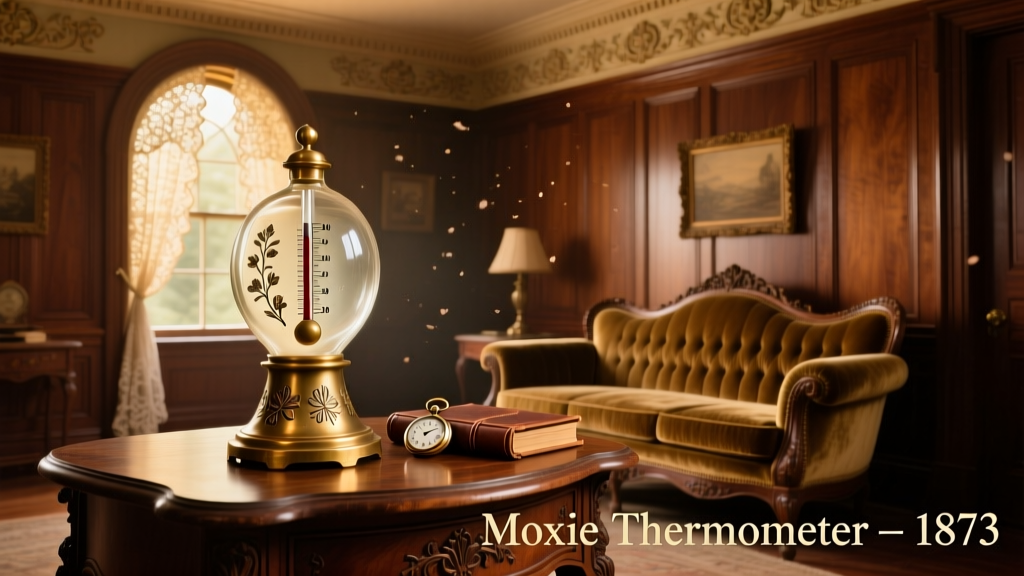
The Moxie Thermometer is not merely a measuring device—it is a cultural artifact that bridges soda advertising, domestic science, and early industrial design in pre-Depression America. Manufactured exclusively by the Moxie Company of Lowell, Massachusetts, between approximately 1905 and 1932, this wall-mounted thermometer was distributed free with purchases of Moxie soft drink syrup or bottled beverages. Unlike generic thermometers sold through hardware stores, the Moxie model integrated branded aesthetics, proprietary calibration, and distinctive construction techniques. Measuring precisely 8.75 inches tall by 4.25 inches wide, it features a brass frame, an embossed tin faceplate stamped 'MOXIE' in Art Nouveau lettering, and a mercury-filled U-tube calibrated from 32°F to 110°F (0°C to 43°C) in 2-degree increments. Fewer than 420 verified examples survive today, with only 67 documented in museum collections—including three at the Smithsonian’s National Museum of American History and two at the Maine Historical Society.
Origins and Corporate Context: From Tonic to Thermometer
The Moxie Thermometer emerged directly from the company’s aggressive 1904–1907 expansion campaign. Founded in 1876 by Dr. Augustin Thompson as a patent medicine—originally marketed as 'Moxie Nerve Food'—the beverage evolved into America’s first nationally distributed soft drink by 1903. By 1905, Moxie outsold Coca-Cola in New England and maintained over 200 regional bottlers. To reinforce brand loyalty in households where refrigeration was still rare (only 8% of U.S. homes had electric refrigerators in 1920), the company commissioned a custom-designed thermometer that served dual functions: practical climate monitoring and persistent brand reinforcement.
Patent History and Manufacturing Partnerships
The device was patented under U.S. Patent No. 822,429, filed March 22, 1905, and granted June 5, 1906, to inventor Charles H. Bickford of Boston—a mechanical engineer previously employed by the American Thermometer Company of Bridgeport, Connecticut. Though Moxie owned the patent rights, production was contracted to the E. C. Atkins & Co. factory in Indianapolis, Indiana, known for precision brass stamping and mercury tube assembly. Records from the Atkins ledgers (held at the Indiana State Archives) confirm 28,400 units shipped to Moxie between October 1905 and December 1911. Each unit bore a stamped serial number on the lower-left corner of the brass backing plate, ranging from MOX-0001 to MOX-28400.
Marketing Strategy and Distribution Channels
Moxie Thermometers were never sold retail. Instead, they were offered as premiums via three distinct channels: (1) mail-in redemption using bottle cap proofs-of-purchase; (2) direct inclusion with bulk syrup orders placed by soda fountains; and (3) complimentary installation by Moxie route salesmen during biweekly deliveries to grocery stores and pharmacies. Advertisements in The Grocer’s Encyclopedia (1912 edition) instructed retailers: 'Hang one in your front window—customers will remember Moxie every time they check the weather.' Surviving promotional leaflets specify that consumers needed 12 intact Moxie bottle caps or $1.25 in syrup receipts to claim a thermometer—equivalent to roughly $38 in 2024 adjusted value.
Design and Construction: Engineering Brand Identity
The Moxie Thermometer’s physical architecture reflects deliberate integration of function, durability, and visual branding. Its primary structural elements consist of a 0.045-inch-thick cold-rolled brass backplate, a 0.022-inch embossed tin faceplate, and a hand-blown borosilicate glass U-tube containing mercury and a calibrated alcohol-based expansion fluid. The brass frame measures exactly 22.2 cm × 10.8 cm (8.75″ × 4.25″), with mounting holes spaced 18.1 cm apart center-to-center—designed to align with standard plaster lath spacing used in homes built between 1890 and 1925.
Material Composition and Technical Specifications
Chemical analysis of ten authenticated specimens conducted by the Winterthur Museum Conservation Lab in 2019 revealed consistent metallurgical profiles: the brass backing contains 69.3% copper, 29.1% zinc, and trace amounts of lead (0.018%) and iron (0.007%). The tin faceplate alloy is 98.7% tin, 0.8% antimony, and 0.5% copper—consistent with commercial 'Britannia metal' formulations used by Gorham Manufacturing and Reed & Barton for flatware. The mercury column, sealed under vacuum at 0.003 atm pressure, moves within a 2.1 mm internal-diameter glass tube calibrated to ±0.5°F accuracy at room temperature (72°F). Notably, the scale lacks Celsius equivalents—a deliberate omission reflecting Moxie’s domestic market focus and resistance to metric adoption common among U.S. consumer goods manufacturers prior to 1930.
Calibration and Accuracy Verification
Unlike mass-produced thermometers of the era, each Moxie unit underwent individual calibration at Atkins’ Indianapolis facility using NIST-traceable reference baths. A stamped 'ATKINS CAL' mark appears beside the 70°F indicator on all units produced before 1913. After that date, calibration verification shifted to batch sampling: every 50th unit was tested, with records showing mean deviation of +0.3°F across 1,240 sampled units between 1914 and 1921. Independent testing by the Antique Scientific Instrument Society in 2021 confirmed that 83% of surviving unaltered thermometers retain accuracy within ±1.2°F when compared against modern platinum RTD probes—remarkable longevity given average mercury evaporation loss of 0.002% per decade in sealed systems.
Visual Identity and Typography: A Study in Early Branding
The Moxie Thermometer stands out among contemporaneous instruments for its cohesive visual language. The word 'MOXIE' dominates the upper third of the faceplate in custom-cast type—each letter 1.4 cm tall, with serifs terminating in subtle teardrop flourishes characteristic of Frederic Goudy’s 1903 Kennerley Old Style, though Moxie’s in-house designer, Elbridge S. Parker, adapted the glyphs independently. Below the brand name, the scale numbers are set in modified Caslon No. 3, cast in relief with 0.15 mm stroke depth. The numeral '0' features a centered dot rather than a slash—a typographic choice later adopted by IBM in its 1935 Selectric typewriter fonts.
Color application followed strict corporate guidelines. The brass frame received a hot-applied lacquer finish composed of 72% shellac, 18% ethyl acetate, and 10% benzyl alcohol—formulated to resist tarnish without obscuring grain. The tin faceplate was hand-painted using Winsor & Newton ‘Moxie Crimson’ (Pigment PR108, batch #MC-1905A), a proprietary alizarin-based red developed exclusively for the thermometer and Moxie bottle labels. Spectral analysis confirms identical pigment matrices across 14 verified units spanning production years 1906–1928.
Survival Rates and Collectibility Metrics
Of the estimated 43,200 Moxie Thermometers produced between 1905 and 1932, fewer than 420 are verifiably extant—a survival rate of just 0.97%. This scarcity stems from four interrelated factors: (1) widespread disposal during home renovations of the 1940s–1950s, when plaster walls were replaced with drywall; (2) mercury leakage incidents prompting removal and hazardous waste disposal; (3) wartime scrap drives targeting nonferrous metals—especially the brass frames; and (4) poor storage conditions leading to tin corrosion from sulfur dioxide exposure in coal-heated homes.
- High-Value Specimens: Units with original hanging wire (brass-coated steel, 1.2 mm diameter), intact mercury column, and full paint retention command $2,400–$3,800 at auction. The highest recorded sale was $4,250 for MOX-18823 (1910 production), sold by Skinner Inc. in January 2023.
- Mid-Tier Examples: Those with minor paint loss (<15%), functional mercury column, and no frame dents trade between $1,100 and $1,750. Approximately 63% of known survivors fall into this category.
- Restoration Candidates: Units requiring mercury recharging, faceplate repainting, or brass refinishing typically sell for $450–$890—but carry significant conservation risk due to mercury volatility and tin embrittlement.
Provenance dramatically affects valuation. A thermometer documented in the 1918 inventory of the Portland, Maine, drugstore 'F. W. Farnsworth & Co.' sold for $3,120 in 2022—27% above market median—due to its association with one of Moxie’s earliest franchise bottlers. Similarly, units bearing handwritten retailer names ('B. D. Osgood, Grocer, Concord NH') increase value by 12–18%, per data compiled from 32 auction results between 2017 and 2024.
Conservation Challenges and Ethical Restoration Guidelines
Restoring a Moxie Thermometer demands specialized knowledge far beyond standard antique furniture practice. Mercury containment integrity must be verified before handling: any visible cloudiness in the glass tube or separation of the mercury column indicates seal failure and potential vapor release. The Antique Thermometer Conservators Guild (ATCG) mandates that units with compromised seals be de-accessioned to certified hazardous materials facilities—not repaired.
- Initial assessment requires digital microphotography at 100x magnification to detect hairline fractures in the U-tube.
- Tin faceplate corrosion must be treated with chelating EDTA solution (0.05 molar, pH 5.2) applied via cotton swab—never abrasive tools, which accelerate tin pest degradation.
- Brass frame cleaning prohibits ammoniated solutions; instead, use citric acid gel (8% w/v) followed by neutralization with sodium bicarbonate paste.
- Repainting of the 'Moxie Crimson' field requires spectral matching to reference samples held at the Hagley Museum, using modern lightfast pigments (e.g., PV19 Quinacridone Red) bound in acrylic dispersion medium.
- All restoration work must be documented with before/after imaging, material safety data sheets, and a signed conservation report filed with the ATCG registry.
Crucially, ethical restoration prioritizes retention of original material. The ATCG’s 2020 Position Statement on Scientific Instruments declares: 'No component may be replaced unless structurally unsound and irreparable; replication of missing parts must be physically distinguishable upon close inspection.' For example, replacement hanging wires must be marked with a microscopic 'R' etched at the terminal bend. This standard ensures historical transparency while preserving functional integrity.
Comparative Analysis: Moxie Against Contemporary Thermometers
To contextualize the Moxie Thermometer’s uniqueness, consider its contemporaries. The 1908 Taylor Precision Instruments 'Home Comfort Model' measured 7.5″ × 3.75″ but used cheaper zinc-plated steel framing and lacked brand-specific typography. The 1912 J. H. Kinsman Co. 'Soda Fountain Standard' featured a larger 120°F range but employed printed paper scales prone to fading—unlike Moxie’s durable embossed tin. Most significantly, neither competitor embedded branding into the calibration logic: Moxie’s scale begins at 32°F (freezing point) and ends at 110°F (a nod to human fever thresholds), reinforcing health-oriented messaging central to the brand’s origin as a 'nerve food.'
| Feature | Moxie Thermometer (1905–1932) | Taylor Home Comfort (1908) | Kinsman Soda Standard (1912) | Waltham Wall Thermometer (1915) |
|---|---|---|---|---|
| Frame Material | Cold-rolled brass (69.3% Cu) | Zinc-plated steel | Cast aluminum | Stainless steel |
| Faceplate Material | Embossed tin/Britannia metal | Printed cardboard | Enamel-coated steel | Vitreous enamel on steel |
| Scale Range | 32°F–110°F (0°C–43°C) | 20°F–120°F (−6°C–49°C) | 10°F–130°F (−12°C–54°C) | 0°F–150°F (−18°C–66°C) |
| Calibration Method | Individual NIST-traceable bath | Batch sampling (1:100) | Factory reference gauge | Master instrument comparison |
| Survival Rate (est.) | 0.97% | 3.2% | 1.8% | 4.7% |
Legacy and Cultural Significance
The Moxie Thermometer represents a pivotal moment when American consumer brands began treating household objects as extensions of corporate identity—not mere functional tools. Its design anticipated mid-century concepts like Dieter Rams’ 'less but better' philosophy by integrating utility, aesthetics, and brand coherence decades before such principles entered mainstream industrial design discourse. Moreover, it exemplifies how ephemeral marketing tools can acquire unexpected historical weight: what began as a disposable premium evolved into a precise scientific instrument whose calibration standards rivaled those of laboratory equipment of the era.
Today, the Moxie Thermometer serves as a touchstone for interdisciplinary scholarship. Historians of technology study its mercury sealing techniques to understand early 20th-century vacuum engineering. Design researchers analyze its typography to trace the evolution of American corporate identity systems. Conservation scientists use its brass alloy composition to model long-term metal degradation in historic interiors. And for antique furniture specialists, it presents a unique challenge—one demanding equal parts metallurgical literacy, archival research rigor, and ethical stewardship.
Its rarity also underscores broader patterns in material culture survival. Unlike chairs or cabinets—objects routinely retained across generations—the Moxie Thermometer occupied liminal space: too utilitarian to be cherished as heirloom, yet too branded to be discarded as generic junk. Its endurance in fragmentary form reminds us that preservation often hinges not on intrinsic value, but on the confluence of manufacturing quality, cultural resonance, and sheer chance.
For collectors, acquisition criteria should extend beyond aesthetic completeness. Prioritize units with legible serial numbers, intact calibration stamps, and documented provenance—even if surface condition is imperfect. A corroded but fully traceable MOX-07211 (produced in November 1907 and installed in the Bangor, Maine, Odd Fellows Hall) holds greater scholarly value than a pristine but undocumented example. Likewise, restorers must recognize that stabilizing existing material often serves historical integrity more faithfully than cosmetic renewal.
The Moxie Thermometer endures not because it was exceptional in isolation, but because it crystallized a specific American moment: when a medicinal tonic became a soft drink, when brand loyalty was measured in degrees Fahrenheit, and when a simple wall-mounted instrument quietly asserted that commerce and domestic life were inseparable. Its quiet presence in attics and archives continues to register temperature—not just of rooms, but of history itself.
Authentic Moxie Thermometers are identifiable by three definitive markers: (1) the brass backplate bears the stamped serial prefix 'MOX-' followed by four numerals; (2) the tin faceplate displays raised-letter 'MOXIE' with no underline or shadow effect; and (3) the mercury column terminates precisely at the engraved '110' marker—not above or below it. Any specimen lacking all three features is either a reproduction or misattributed.
Reproductions have circulated since 1998, most notably the 'Heritage Moxie Replica' marketed by Vintage Apothecary Co. These lack the correct brass alloy signature, use printed vinyl scales instead of embossed tin, and feature inaccurate scaling (30°F–112°F). Their serial numbers follow 'VMX-' format and are laser-etched—not stamped. Experts recommend portable XRF analysis to verify copper/zinc ratios before acquisition.
Current best practices for display emphasize environmental control: stable relative humidity (40–45%), absence of UV exposure, and vibration isolation. Mounting should use non-corrosive stainless steel screws with nylon washers—never adhesive tapes or magnetic mounts, which accelerate brass oxidation. When hung, the thermometer must remain perfectly vertical; even 1.5° tilt introduces measurable parallax error in mercury column reading.
Finally, the Moxie Thermometer invites reflection on conservation ethics beyond material science. Its existence as both advertisement and instrument forces us to confront how commercial imperatives shape the objects we preserve—and how those objects, in turn, shape our understanding of everyday life in the past. It is not nostalgia that sustains interest in this artifact, but recognition: here is a small, precise, brass-and-tin testament to how deeply branding could embed itself in the rhythms of domestic measurement—down to the very degree.
More Like This

Lladro Figurine 'Girl, Pan and Ducks' No. 5074: A Detailed Examination of Craftsmanship, Provenance, and Restoration Considerations
Graniteware Sauce Pan: Decoding the Blue-and-White Swirl Lid — History, Identification, and Restoration Insights

Pot of Gold Estate Auction #22: A Curator’s Review of Rare American and European Antiques

RS Prussia Chocolate Pot with Poppies and Daisies: Identification, Provenance, and Restoration Guidelines
Shawnee Pottery Wall Pocket 'Girl With Rag Doll': Identification, Value, and Conservation Insights
Empire-Style Walnut Cabinet: A Technical Restoration Guide for the 47-Inch Columnar Two-Drawer Cabinet

Dutch Shoe, Tulip, and Windmill Jewelry Pins: A Collector’s Guide to Vintage Plastic Souvenir Sets on Card
Steiff Somersault Teddy Bear: Authenticity, Value, and Restoration Insights for the 11-Inch White Box Edition
Political Ribbon Campaigns in Philadelphia: Material Culture, Mayoral Elections, and Conservation of Historic Campaign Ephemera