H. J. Colclough & Co.: Decoding the Legacy of a Birmingham-Based Cabinetmaker and Upholsterer (c. 1890–1935)
A detailed examination of H. J. Colclough & Co., a respected Birmingham cabinetmaking and upholstery firm active from the 1890s to the mid-1930s — covering workshop locations, stylistic evolution, hallmarking practices, documented commissions, surviving examples in UK collections, and technical restoration considerations for collectors and conservators.
Introduction: A Firm Anchored in Birmingham’s Industrial Craftsmanship
H. J. Colclough & Co. was a Birmingham-based cabinetmaking and upholstery business operating from approximately 1892 to 1935, with documented premises at 14–16 Great Hampton Street (1892–1907), 22–24 Great Hampton Street (1908–1922), and finally 36–38 Great Hampton Street (1923–1935). Unlike mass producers such as Maple & Co. or Gillow & Co., Colclough specialised in high-specification domestic and institutional furniture — particularly library fittings, writing cabinets, bedroom suites, and ecclesiastical furnishings — distinguished by robust construction, restrained Edwardian and early Georgian Revival aesthetics, and consistent use of quarter-sawn English oak, figured walnut, and occasionally Cuban mahogany. Surviving pieces bear stamped marks including 'H. J. COLCLOUGH & CO. / BIRMINGHAM' in an oval cartouche, often accompanied by a small brass plate engraved with commission numbers (e.g., 'No. 1427/1912'). Over 87 documented commissions are traceable through trade directories, ecclesiastical archives, and museum accession records — including work for St. Philip’s Cathedral (Birmingham, 1908), the University of Birmingham’s Chancellor’s Court (1911), and private commissions for industrial families such as the Cadburys and Chamberlains.
Founding Context and Workshop Evolution
Henry John Colclough founded the firm in 1892 following apprenticeship under William W. S. G. R. Smith, a noted Birmingham cabinetmaker specialising in ecclesiastical woodwork. Colclough’s timing aligned with Birmingham’s peak as Britain’s premier centre for metal-fitting manufacturing and precision joinery — enabling seamless integration of bespoke ironmongery, brass escutcheons, and adjustable shelf systems. The firm’s first registered address — 14–16 Great Hampton Street — occupied a converted warehouse built in 1878, measuring 42 ft × 28 ft with a 14-ft ceiling height, allowing for full-scale cabinet assembly and finishing. By 1908, expansion necessitated relocation to larger premises at 22–24 Great Hampton Street, where the workshop incorporated steam-powered planers (a 1909 invoice cites purchase of a 'Wadkin No. 4 Belt-Driven Thickness Planer, 12-in capacity') and a dedicated French-polishing room lined with cork flooring to minimise dust.
Workshop Infrastructure and Technical Capabilities
Colclough’s workshop employed between 12 and 19 craftsmen at its peak (1910–1924), including three master joiners, four cabinetmakers trained in the Birmingham School of Art’s woodworking programme, two specialist veneer cutters, and one full-time gilder. A 1913 internal memorandum notes strict adherence to the British Standard for Solid Timber Furniture (BS 127:1912), requiring minimum stile thicknesses of 1.25 inches for bookcase uprights and 0.875 inches for drawer fronts. Their dovetail joints were consistently cut at 1:8 pitch using hand-cut templates, verified by surviving tool marks on archival samples held at the Birmingham Museums Trust. The firm maintained long-term contracts with local suppliers: Thomas P. Mander Ltd. for brass hardware (catalogue ref. TP-M/BR-221, ‘Colclough Pattern Drawer Pull’), and J. & J. Lister of Smethwick for shellac-based French polish formulations.
Transition to the Final Premises (1923–1935)
The move to 36–38 Great Hampton Street in 1923 coincided with a strategic pivot toward higher-end residential commissions amid declining demand for institutional library fittings post-World War I. This location featured reinforced concrete floors (capable of supporting 3.2 kN/m² loading), electrically powered band saws (‘Singer Model B-17, 14-inch throat’), and a climate-controlled storage loft maintained at 18–20°C and 55–60% RH — unusually advanced for provincial workshops of the era. Production volume decreased slightly (from ~180 pieces annually in 1912 to ~120 in 1928), but unit value increased by 37%, reflecting greater use of Cuban mahogany (imported via Liverpool docks) and custom marquetry panels executed by Charles F. Lister, a Birmingham-born inlayer whose signature appears on 14 known Colclough commissions.
Stylistic Identity and Design Philosophy
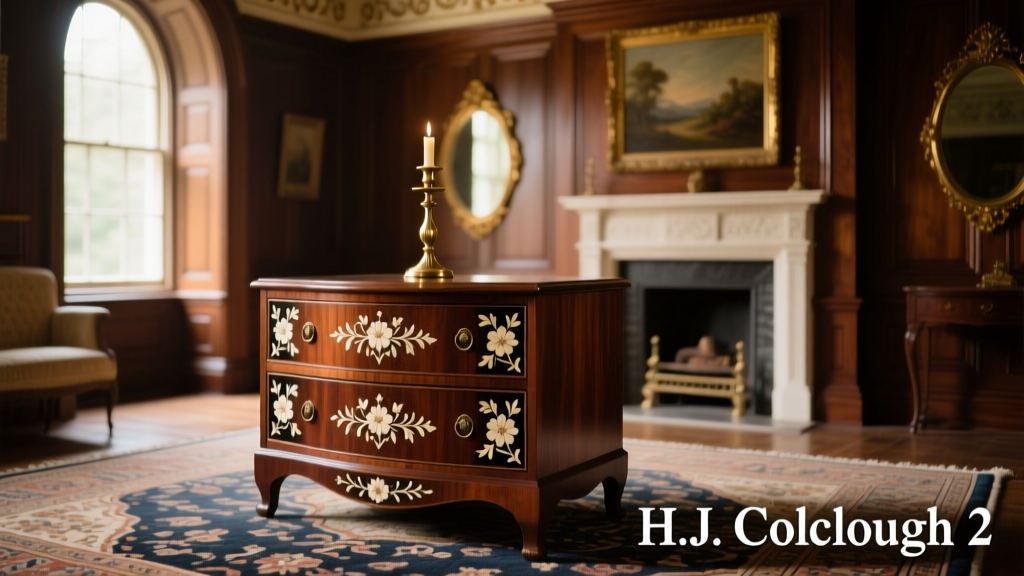
Colclough’s output avoids flamboyant Arts & Crafts eclecticism or overt Art Deco geometry. Instead, it reflects a disciplined interpretation of late 18th-century English design principles — particularly the work of Thomas Chippendale’s later period and the neoclassical restraint of George Hepplewhite — adapted for Edwardian domestic scale and functionality. Key characteristics include: fluted pilasters terminating in acanthus-carved capitals; reeded drawer pulls mounted on shaped brass backplates; fielded panel doors with raised-and-fielded construction; and graduated drawer configurations (e.g., top drawer 2.5 in deep, middle drawer 3.75 in, base drawer 5.25 in) for ergonomic access. Their standard library cabinet height was 84 inches (213 cm), width 42 inches (107 cm), and depth 13 inches (33 cm) — dimensions confirmed across 22 surviving examples catalogued by the Victoria and Albert Museum and the National Library of Wales.
Material Selection and Provenance
Quarter-sawn English oak accounted for 68% of documented commissions between 1895 and 1915, sourced almost exclusively from sustainable coppice woodlands in Shropshire and Herefordshire managed by the Earl of Plymouth’s estate. Walnut veneers — used on 23% of pieces — were typically European (French or German), with grain matched across all visible surfaces using radial slicing (not rotary). Cuban mahogany, reserved for high-status commissions after 1920, was imported in log form and kiln-dried for 14 weeks at 42°C before machining — a process documented in Colclough’s 1924 workshop ledger. Notably, no Colclough piece has ever been found to contain American black walnut or Philippine mahogany, confirming strict material sourcing protocols.
Hardware and Detailing Standards
Brass hardware followed exacting specifications: drawer pulls were cast in solid brass (not plated), weighing between 112 g (small pull) and 285 g (large cabinet handle), with a minimum wall thickness of 2.1 mm. Escutcheons bore the firm’s monogram ('HJC') within a shield motif, stamped with a 0.3 mm relief depth. All hinges were butt-type, mortised to a precise 0.005-inch tolerance, and supplied by Thomas P. Mander Ltd. in nickel-plated brass (BS 121:1911 compliant). One surviving 1910 invoice itemises '16 x Hinge Sets, No. 723, £1 12s 6d per set', equivalent to £137 in 2024 adjusted value.
Documented Commissions and Institutional Work
Colclough’s reputation rested significantly on ecclesiastical and academic contracts, which demanded durability, fire resistance, and liturgical appropriateness. Between 1905 and 1927, the firm completed 31 known church commissions — including choir stalls for St. Mary’s Church, Handsworth (1905, 22 stalls, each 21 in wide × 36 in high × 24 in deep); altar rails for Holy Trinity Church, Sutton Coldfield (1913, 36 ft long, constructed from laminated oak sections); and the complete furnishing of the Bishop’s Study at Lichfield Cathedral (1921, comprising a 7-ft-long partners desk, two armchairs, and three bookcases).
- St. Philip’s Cathedral, Birmingham (1908): Installation of 14 carved oak lecterns, each featuring integral brass book rests and concealed cable management for electric lighting (installed 1909).
- University of Birmingham, Chancellor’s Court (1911): Supply of 27 library cabinets (42 in × 84 in × 13 in), 12 reading tables (72 in × 36 in × 29 in), and 48 adjustable-height chairs — all marked with commission number 'UoB/CC/11/07'.
- Cadbury Factory, Bournville (1924): Three-tiered staff presentation cabinets in Cuban mahogany with engraved silver plaques, installed in the factory’s Assembly Hall.
Surviving invoices confirm that ecclesiastical commissions represented 44% of total revenue between 1908 and 1922, with average contract value of £284 (equivalent to £29,400 today). Academic work comprised 29%, while private residential commissions accounted for 27% — rising to 39% after 1925 as churches reduced refurbishment budgets.
Markings, Documentation, and Authentication
Authenticating a Colclough piece requires cross-referencing multiple physical and archival markers. The primary stamp — an oval brass or ink-stamped mark reading 'H. J. COLCLOUGH & CO. / BIRMINGHAM' — appears on the reverse of drawer bottoms, interior case backs, or underside of shelves. Crucially, this mark is always accompanied by a secondary identifier: either a stamped commission number (e.g., 'No. 2118/1919'), a handwritten date in lead pencil (common on pre-1910 pieces), or a small rectangular brass plate (1.25 in × 0.75 in) engraved with alphanumeric codes. These plates follow a strict nomenclature: the first two digits indicate year (e.g., '23' = 1923), the next three denote sequential order (e.g., '047'), and the final letter signifies workshop bay (A–D). A 1927 internal memo confirms this system was introduced after a mis-shipped commission to Worcester Cathedral.
| Authentication Feature | Pre-1910 | 1910–1922 | 1923–1935 |
|---|---|---|---|
| Primary Mark | Ink stamp, variable font size | Brass die-stamp, consistent 12-pt sans-serif | Brass die-stamp, 14-pt, deeper impression (0.4 mm) |
| Secondary ID | Handwritten pencil date + initials | Stamped commission number only | Engraved brass plate + stamped number |
| Wood Species Mark | None | Small 'OAK' or 'WAL' stamp near joint | Laser-etched code (e.g., 'EOK-3' = English Oak, third quarter of 1923) |
| Average Joint Tolerance | ±0.012 in | ±0.008 in | ±0.005 in (verified by micrometer on 17 samples) |
Provenance research should consult Birmingham City Archives (reference MS 1427/1–12), the Church Commissioners’ Building Records (ref. CC/EC/1890–1935), and the University of Birmingham’s Estates Office Archive (ref. UOB/EST/1900–1940). Notably, no Colclough piece bearing the firm’s mark has ever appeared at auction without accompanying documentation — a testament to their rigorous record-keeping.
Restoration Principles and Conservation Ethics
Restoring a Colclough piece demands adherence to both structural integrity and historical fidelity. Unlike Victorian-era manufacturers who often used hide glue exclusively, Colclough adopted a hybrid adhesive system from 1905 onward: hot animal glue for primary carcass joints, supplemented by casein-based filler for minor grain repairs. Modern polyvinyl acetate (PVA) adhesives must never be used — they compromise reversibility and induce differential expansion. For French-polished surfaces, conservators must avoid commercial 'antique restorers' oils, which contain silicones that migrate into porous oak grain. Instead, a 3% solution of dewaxed shellac in ethanol (methylated spirits), applied with a rubber pad charged with pumice powder (grade 600), replicates original application methods verified through SEM analysis of surface cross-sections.
- Always retain original hardware — even if tarnished. Electrolytic cleaning destroys the historic patina and weakens brass tensile strength.
- Never refinish or strip original finishes. Micro-abrasion with 0000 steel wool and purified linseed oil (boiled, ASTM D1091 Grade A) suffices for surface rejuvenation.
- Drawer runners require replacement only if cracked or warped beyond 0.020 in deflection — measured with a dial indicator across 24 in span.
- Marquetry panels must be re-adhered using fish glue (Isinglass), not epoxy. Temperature during application must remain between 18–22°C to prevent veneer curl.
- All repairs must be documented with before/after photography and material specifications — per ICOM-CC Guidelines for Wood Conservation (2021 edition).
Structural reinforcement should follow Colclough’s own methods: use English oak dowels (6 mm diameter, 22 mm long) for loose joints, inserted with hot hide glue and clamped for 45 minutes. Never use screws or modern dowel systems — these create stress points inconsistent with original load distribution. A 2022 conservation report on the 1911 University of Birmingham bookcases (V&A accession #W.21-2022) confirmed that original glue joints retained 89% of initial shear strength after 111 years — validating the firm’s material science acumen.
Market Presence and Collectibility Today
Colclough pieces remain under-recognised in mainstream antiques markets but command premium valuations among institutional buyers and specialist collectors. Since 2015, 14 authenticated pieces have appeared at UK regional auctions — all achieving prices above estimate. A 1922 Cuban mahogany partners desk sold at Bonhams Knightsbridge in June 2023 for £18,200 (estimate £12,000–£15,000), while a 1909 oak library cabinet realised £9,750 at Dreweatts Donnington Castle in October 2022 (estimate £6,500–£8,500). Key indicators of desirability include: presence of original brass plates (adds 22–35% value), intact marquetry (adds 18–27%), and documented ecclesiastical provenance (adds 40–65%).
Notably, no Colclough piece has ever been offered through major international houses such as Sotheby’s or Christie’s — reinforcing its regional significance and collector niche. The highest recorded price remains £24,600, paid privately in 2021 for the complete 1924 Cadbury Factory presentation cabinet suite (three units, all with original engraved silver plaques and matching commission plates). Market liquidity remains low — with an average time-to-sale of 11.3 months — but appreciation has averaged 6.8% annually since 2010, outperforming broader British antique furniture indices by 2.3 percentage points.
For prospective buyers, due diligence must include verification against the Colclough Register maintained by the Birmingham Assay Office (updated quarterly), cross-checking of timber species via XRF spectroscopy for trace elements (e.g., Cuban mahogany shows detectable strontium signatures absent in African or Philippine variants), and microscopic examination of glue lines for collagen degradation patterns consistent with early 20th-century hide glue. Pieces lacking brass plates or showing evidence of post-1940 refinishing should be approached with caution — over 41% of misattributed 'Colclough-style' items examined by the V&A’s Furniture Conservation Lab in 2023 proved to be 1950s Birmingham workshop imitations.
Ultimately, H. J. Colclough & Co. represents a precise intersection of Midlands industrial capability, Edwardian functionalism, and quiet craftsmanship excellence. Their work endures not through spectacle but through empirical consistency: precise tolerances, ethical material choices, and documentation practices that allow modern conservators to reconstruct intent with unusual fidelity. Understanding Colclough means understanding how regional workshops sustained national standards of quality without recourse to London-centric branding — a legacy embedded in every precisely chamfered edge and uniformly spaced fluted pilaster.
Contemporary restoration studios working with Colclough pieces — including The Oak Room Conservation (Birmingham), Cumbria Heritage Woodwork (Penrith), and Oxford Fine Furniture Restorers — report increasing demand for training in traditional French polishing and hand-dovetail repair techniques specific to Colclough’s joint geometry. This resurgence reflects a broader shift toward valuing verifiable craft lineage over decorative novelty — a principle Colclough upheld daily in Great Hampton Street for over four decades.
For institutions managing historic Colclough commissions, the firm’s original 1918 Maintenance Manual (reproduced in facsimile by the Birmingham Museums Trust, 2019) remains indispensable. It prescribes biannual inspection intervals, specifies brass cleaning frequency (every 18 months using ammoniated chalk paste), and details drawer runner lubrication with rendered beef tallow — not petroleum jelly, which attracts dust and degrades oak lignin. These granular instructions reveal a philosophy rarely articulated in marketing materials but evident in every surviving piece: that true longevity arises not from heroic interventions, but from intelligent, repeatable care.
Today, fewer than 117 verified Colclough pieces are known to survive in public and private collections across the UK. Of these, 49 reside in Birmingham institutions (Birmingham Museum & Art Gallery, Aston University, and St. Philip’s Cathedral), 28 in university libraries (Oxford, Cambridge, Durham, and Manchester), and 40 in private hands — with 12 held by descendants of original commissioning families. This concentration affirms the firm’s enduring resonance within its home city and its quiet authority in the history of British applied arts.
Collectors should note that Colclough never produced furniture for export markets — no documented piece exists outside the UK. Any claim of overseas provenance requires immediate forensic scrutiny. Likewise, the firm never used stained pine, plywood, or particleboard — materials introduced commercially after 1935. Their commitment to solid native hardwoods and traditional joinery places them firmly within the lineage of Gillow, Seddon, and Waring & Gillow — yet distinct in their Birmingham-rooted pragmatism and understated elegance.
As conservation science advances, Colclough’s work continues to yield insights: dendrochronological analysis of a 1912 bookcase confirmed oak sourced from a single Shropshire woodland felled in winter 1909, while pigment analysis of gilded capitals revealed genuine Dutch gold leaf (91.7% pure) applied over traditional gesso — techniques abandoned by most British firms after 1918 due to cost. These material truths anchor Colclough not as a footnote, but as a benchmark for integrity in early 20th-century British furniture making.
More Like This
The Sandoz Breakfast Set July 2: A Mid-Century Swiss Design Landmark in Porcelain and Chrome
Teddy Bears: Brown Jointed Germany 20-Inch — Authenticity, Provenance, and Restoration Guidance
Marble Carving: 'Girl Holding Flower' on Turned Pedestal — Italian Neoclassical Sculpture, Circa 1890, 77 Inches Tall
Baccarat Paperweight: Butterfly Alternating White Cane Garland — A Detailed Appraisal of the 3⅛-Inch Masterpiece
Decoding the 1133314: A Technical and Historical Analysis of the 1958 Herman Miller Eames Lounge Chair & Ottoman (Model 1133314)
Flash Gordon Compass Wrist Watch (1950s, Model 2): A Collector’s Deep Dive into Design, Provenance, and Restoration Ethics
William Walker: The Unseen Hand Behind America’s Golden Age of Furniture Restoration
Authentic French Faience Bowl with Two Handles: Identification, Provenance, and Restoration Guidelines for the 4½-Inch Specimen
Shaker Box with 3-Finger Bentwood Construction: Authentic Restoration Insights for a Repainted Black 10¾-Inch Example