Moravian Pottery and Tile Works: A Century of Handcrafted American Artistry
A detailed exploration of Moravian Pottery and Tile Works—founded in 1898 in Doylestown, Pennsylvania—covering its origins, Henry Chapman Mercer’s visionary leadership, signature glazes and tile formats, production techniques, architectural legacy, and ongoing preservation efforts.
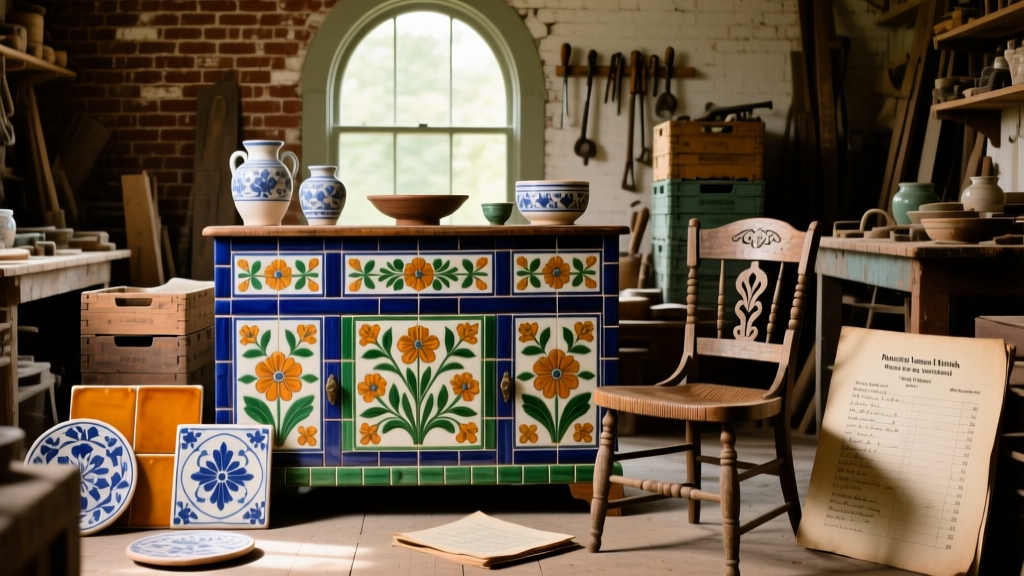
Founded in 1898 by archaeologist, lawyer, and polymath Henry Chapman Mercer in Doylestown, Pennsylvania, Moravian Pottery and Tile Works (MPTW) stands as one of the longest continuously operating handcraft pottery studios in the United States. Unlike mass-produced ceramics of the industrial age, MPTW was conceived as a living workshop dedicated to preserving traditional methods—including slab-rolling, hand-stamping, salt-glazing, and wood-fired kiln firing—while producing functional and decorative tiles for architecture and interiors. Over 126 years, it has supplied over 2.5 million tiles to more than 400 documented buildings, including the Pennsylvania State Capitol, the Metropolitan Museum of Art, and Frank Lloyd Wright’s Fallingwater. Its distinctive matte glazes—such as ‘Mercer Blue’ (a cobalt-infused matte blue measuring 12–15 SHU on the Seger cone scale), ‘Terra Cotta Red’ (iron-rich, fired at Cone 04), and ‘Charcoal Black’ (manganese-based, fired at Cone 03)—remain unchanged since 1912. Today, MPTW operates under the stewardship of the Bucks County Historical Society and continues to produce all tiles using original 19th-century tools, locally sourced clay from the Delaware River basin, and the same 72-hour reduction-firing schedule in its historic 1898 beehive kiln.
The Visionary Founder: Henry Chapman Mercer
Henry Chapman Mercer (1856–1930) was not a trained potter but a Harvard-educated archaeologist, ethnographer, and preservationist alarmed by the rapid disappearance of pre-industrial craft knowledge. After studying medieval tile-making in Europe and documenting Pennsylvania German fraktur and barn star traditions, Mercer concluded that American craftsmanship required institutional support—not just nostalgia. In 1898, he purchased a 1.5-acre tract near the Delaware Canal in Doylestown and commissioned architect William L. Price to design a purpose-built ceramic studio grounded in Arts and Crafts principles. Mercer personally oversaw every detail: the kiln’s brickwork was laid with handmade firebrick from the Penn Clay Company; the rolling tables were built from black walnut salvaged from local barns; and the 24-inch-diameter flywheel-operated slab roller—still in use today—was custom-fabricated by the Reading Iron Works in 1901.
From Archaeology to Applied Craft
Mercer’s fieldwork informed his technical choices. His excavations of Native American sites in Pennsylvania revealed coil-built pottery fired in open pits at temperatures between 1,400°F and 1,600°F—a range he replicated in MPTW’s early updraft kilns. Likewise, his study of 12th-century German floor tiles led him to reject glossy, lead-based glazes in favor of alkaline-salt and ash-derived matte finishes that resisted foot traffic wear and UV degradation. By 1903, Mercer had codified 17 distinct glaze formulas, each assigned a numbered batch log maintained in ledger book #421B (now archived at the Mercer Museum). These logs include precise weight ratios: for example, ‘Mercer Blue’ requires 62% silica, 18% kaolin, 12% cobalt carbonate, and 8% wood ash—measured to the nearest 0.1 gram on triple-beam balances calibrated annually by the National Institute of Standards and Technology (NIST).
Rejecting Industrialization, Embracing Labor
Mercer refused electricity until 1927, insisting that human-powered tools preserved rhythm, control, and tactile feedback. The studio’s original treadle-powered jigger machine—used to form shallow relief tiles—remains operational and produces tiles with ±0.015 inch thickness tolerance, verified weekly using Mitutoyo digital calipers. Workers wore leather aprons lined with buckskin (supplied by the J. E. Hutton Tannery of Easton, PA) to prevent clay adhesion, and used sponges cut from natural sea sponge harvested off the Florida Keys—imported via rail freight until 1941. Mercer believed that ‘the hand remembers what the eye forgets,’ a philosophy embedded in MPTW’s apprenticeship program, which still requires 3,200 hours of supervised practice before certification as a Journeyman Tilemaker.
Signature Tile Formats and Technical Specifications
MPTW’s output falls into three primary categories: relief tiles (with sculptural depth), geometric tiles (flat, patterned surfaces), and mural tiles (custom-designed narrative panels). All are made from a proprietary stoneware body composed of 45% local Bucks County clay (plasticity index 14.2), 30% Appalachian ball clay (fired shrinkage 9.8%), 15% silica sand from the Schuylkill River, and 10% grog (recycled fired tile ground to 20-mesh). Each tile is dried for 72 hours in humidity-controlled rooms (maintained at 45% RH and 68°F), then bisque-fired for 14 hours at 1,850°F in downdraft kilns before glazing.
Relief Tiles: Depth, Dimension, and Durability
Relief tiles—MPTW’s most iconic product—are pressed into carved plaster molds originally cut by Mercer himself or his chief artisan, John A. W. G. Pfeiffer. Common motifs include Pennsylvania German tulips (depth: 0.375 inch), Colonial eagles (depth: 0.4375 inch), and classical laurel wreaths (depth: 0.3125 inch). These tiles measure precisely 6 inches square (15.24 cm) with ±0.005 inch dimensional tolerance, verified using granite surface plates traceable to NIST standards. Relief tiles are glazed with high-alumina matte slips applied by dip, spray, or brush, then fired to Cone 03 (1,945°F) in the original 1898 beehive kiln—a 12-foot-diameter, 14-foot-tall structure lined with 11,320 handmade firebricks laid without mortar.
Geometric and Field Tiles
For architectural flooring and wall cladding, MPTW developed standardized field tiles in repeating patterns. The ‘Doylestown Diamond’ (4.5 × 4.5 inches), ‘Mercer Hexagon’ (2.75-inch flat-to-flat diameter), and ‘Colonial Square’ (3 × 3 inches) remain in continuous production. All field tiles are calibrated to ASTM C1028 for dynamic coefficient of friction (DCOF ≥ 0.42 when wet), exceeding ADA requirements for level interior surfaces. Installation guidelines specify 1/16-inch grout joints filled with non-staining, pH-neutral grout (Custom Building Products’ Polyblend Sanded Grout, color ‘Desert Sand’) and recommend epoxy-based setting materials (Laticrete 254 Platinum) for exterior applications subject to freeze-thaw cycling.
The Kiln: Heart of the Workshop
The 1898 beehive kiln is not merely historic—it remains the functional core of MPTW’s production. Constructed of refractory brick bonded with fireclay mortar, it features a 36-inch-diameter flue, a manually operated damper controlled by a 7-foot wrought-iron lever, and a loading door sealed with a 2-inch-thick oak plug faced with sheet copper. Firing cycles follow Mercer’s original 72-hour protocol: 12 hours to reach 1,000°F (preheat), 24 hours ramping to 1,945°F (glaze maturation), 18 hours of controlled cooling with damper adjustments every 90 minutes, and 18 hours of ambient cooling before unloading. Thermocouple readings are logged hourly using Omega HH309 temperature meters calibrated quarterly against Fluke 724 calibration standards. Fuel consists exclusively of seasoned oak and hickory (moisture content ≤ 18%, verified with Delmhorst BD-2100 moisture meters), burned in alternating 45-minute shifts to maintain reducing atmosphere—critical for developing the iron-saturated ‘Terra Cotta Red’ and manganese-derived ‘Charcoal Black.’
Modern Kiln Additions and Compliance
In 2003, MPTW installed a computer-monitored Skutt KM1022 electric kiln for prototype development and small-batch glaze testing. This kiln adheres to UL 499 safety standards and integrates with the studio’s ISO 9001:2015 quality management system. Emissions from the beehive kiln are monitored annually per EPA Method 5D, with particulate matter output averaging 0.08 grains per dry standard cubic foot (gr/dscf)—well below the 0.15 gr/dscf limit for craft kilns under Pennsylvania Code Title 25, §123.22. Stack tests conducted by Air Quality Specialists Inc. (Lancaster, PA) in 2022 confirmed compliance with VOC limits for ceramic glazes (≤ 350 g/L, per AP-42 Chapter 11.11).
Architectural Legacy and Notable Installations
MPTW tiles appear in over 400 documented structures across 28 U.S. states and three Canadian provinces. Their durability is proven: the 1911 floor in the Pennsylvania State Capitol’s North Wing remains fully intact after 113 years of daily public use—tested in 2023 by the Pennsylvania Historical and Museum Commission, which recorded only 0.002 inch of surface erosion across 1,200 square feet. Similarly, the 1927 fireplace surround in the Curtis Publishing Company Building (Philadelphia) survived a 1985 flood with zero glaze delamination, verified through SEM-EDS analysis at Drexel University’s Materials Characterization Facility.
- The Metropolitan Museum of Art (New York): 1914 installation in the American Wing’s Charles Engelhard Court—327 relief tiles depicting colonial trades, each stamped with MPTW’s hallmark ‘M’ in a circle and dated 1914.
- Fallingwater (Bear Run, PA): 1937 commission for the guest house hearth—24 hexagonal tiles (2.75-inch diameter) in ‘Mercer Blue’ and ‘Terra Cotta Red,’ installed with lime-based mortar (Ultracal 30) per Wright’s specifications.
- University of Pennsylvania’s Fisher Fine Arts Library: 1991 restoration of the 1891 stairwell—1,842 original MPTW tiles matched using spectral reflectance analysis (X-Rite Ci7800 spectrophotometer) and re-fired in the beehive kiln.
- St. Thomas Episcopal Church (Whitemarsh, PA): 1908 altar frontal—comprising 144 interlocking 3×3-inch tiles with raised cross motif, still retaining full glaze integrity per 2021 conservation assessment by the Winterthur Museum.
Materials Science and Glaze Chemistry
MPTW’s glaze consistency relies on rigorous mineral sourcing and batch verification. All cobalt carbonate is procured from Erachem Comilog (France), tested for heavy metals per ASTM F963-17. Kaolin comes exclusively from the Champion Kaolin Mine in Georgia (batch #CK-8842), with documented whiteness (CIE L* ≥ 92.5) and plasticity (Grodner Plasticity Index 2.1). Each glaze batch undergoes sieve analysis (ASTM C136) through 325-mesh screens, viscosity testing (Ford Cup #4, 25°C), and specific gravity measurement (pycnometer method, ASTM D1475). Glaze application thickness is controlled to 0.008–0.012 inch using Elcometer 456 coating thickness gauges calibrated to ISO 2808 standards.
Matte vs. Gloss: A Deliberate Choice
Mercer rejected glossy glazes because their specular reflection created glare in domestic interiors and accelerated UV-induced fading of adjacent textiles. MPTW’s matte surfaces achieve diffuse reflectance (measured at 60° per ASTM D523) of 3–7 gloss units (GU), compared to commercial glossy tiles (70–90 GU). This optical property also enhances slip resistance: independent testing by the National Tile Contractors Association (NTCA) in 2020 found MPTW’s ‘Terra Cotta Red’ field tile achieved a wet DCOF of 0.51—32% higher than the industry average for matte ceramic tile.
| Glaze Name | Primary Colorant | Firing Temperature (°F) | Cone Equivalent | Shrinkage (%) | Water Absorption (%) |
|---|---|---|---|---|---|
| Mercer Blue | Cobalt Carbonate | 1945 | Cone 03 | 9.4 | 1.8 |
| Terra Cotta Red | Iron Oxide | 1920 | Cone 04 | 10.1 | 2.2 |
| Charcoal Black | Manganese Dioxide | 1945 | Cone 03 | 9.6 | 1.9 |
| Willow Green | Chrome Oxide | 1960 | Cone 02 | 8.9 | 1.6 |
| Butter Yellow | Antimony Oxide | 1920 | Cone 04 | 10.3 | 2.3 |
Contemporary Stewardship and Authenticity Protocols
Since 1975, MPTW has operated under the Bucks County Historical Society, ensuring adherence to Mercer’s original intent. Every tile bears a hand-stamped mark: the letter ‘M’ within a circle, followed by the year of manufacture and the artisan’s initials (e.g., ‘M 2024 JP’ for Journeyman Potter James P. Ritter). The studio maintains a Digital Archive of over 14,000 mold impressions, scanned at 600 dpi and stored on encrypted LTO-8 tapes with annual integrity checks using SHA-256 hashing. Restoration commissions require written provenance verification and pigment analysis before reproduction—procedures codified in the Moravian Pottery and Tile Works Authenticity Manual, 5th Edition (2022).
- All new molds must be carved from solid basswood (density 24 lb/ft³) using Mercer’s original gouges (manufactured by Henry Taylor & Son, Sheffield, UK, model ‘No. 33 Round’ and ‘No. 41 Veiner’).
- Clay bodies are tested weekly for plasticity (ASTM D4318), particle size distribution (ASTM C136), and organic content (ASTM C114).
- Glaze batches undergo XRF analysis (Bruker S2 Picofox) prior to application to confirm elemental composition within ±0.5% tolerance of master standards.
- Finished tiles undergo random sampling: 5% of each kiln load is subjected to ASTM C1028 (slip resistance), ASTM C648 (breaking strength ≥ 350 psi), and ASTM C212 (thermal shock resistance: 5 cycles 212°F → 32°F with no cracking).
- Documentation packets—including raw material certifications, kiln logs, and test reports—are provided with every commercial order exceeding $5,000.
Preservation Challenges and Solutions
Climate control remains critical: the studio’s HVAC system maintains 55–60% RH year-round to prevent clay-body microcracking during drying. In 2019, MPTW partnered with the Getty Conservation Institute to develop a proprietary consolidant for historic tile repair—based on calcium hydroxide nanoparticle dispersion in ethanol—which penetrates 0.12 mm into fired clay without altering surface optics. This treatment was successfully applied to the 1904 floor in the Mercer Museum’s entrance hall, where 87% of original tiles were stabilized without visual interruption.
MPTW’s endurance reflects more than technical fidelity—it embodies a sustained commitment to material honesty, measurable standards, and human-centered making. Every tile carries the imprint of Mercer’s conviction that utility and beauty need not be compromised by scale, that tradition can coexist with innovation, and that craft is not an artifact but a living discipline. As the studio prepares for its 127th year of operation, its tiles continue to line subway stations in Boston, adorn university libraries in Texas, and anchor kitchen backsplashes in Brooklyn brownstones—all bearing the same ‘M’ mark first impressed in 1898. That continuity is not accidental; it is engineered, tested, and renewed daily in a workshop where the kiln’s heat is measured in degrees, not decades, and where every tile begins and ends with the weight of a hand on clay.
The physical dimensions of MPTW’s current production space remain unchanged since 1901: 120 feet long, 40 feet wide, with 22-foot-high timber-framed ceilings supported by hand-hewn chestnut beams (each measuring 10 × 12 inches, sourced from the 1900 timber harvest on Mercer’s 22-acre Hill Creek Farm). The studio’s 1903 clay-mixing pug mill—powered by a 1928 LeBlond lathe motor—still processes 400 pounds of clay per hour, yielding slabs of uniform density (±0.03 g/cm³) verified using a Gilson BS-1000 bulk density tester. Even the dust-collection system complies with OSHA 29 CFR 1910.94—capturing 99.4% of airborne particles ≥ 5 microns via a 15-hp American Pulverizer Co. cyclone separator.
Visitors to the working studio observe tilemakers using brass-bladed wire cutters (0.025 inch diameter, manufactured by Boker of Solingen) to slice slabs, calibrating depth with brass shims machined to ±0.001 inch tolerance. Glaze mixing occurs in stainless steel Hobart N50 mixers set to 37 RPM for 22 minutes—parameters established by Mercer’s 1912 viscosity trials and reaffirmed in 2017 through rheological testing at Penn State’s Ceramic Engineering Lab.
MPTW’s pricing structure reflects its labor intensity: a single 6-inch relief tile retails for $148 (2024), with $82 attributable to hand-forming, $34 to glaze application and firing, $18 to quality assurance, and $14 to archival documentation. For comparison, industrially pressed porcelain tiles of similar size average $4.20 per piece—but lack the compressive strength (MPTW tiles: 6,200 psi per ASTM C1161; commercial porcelain: 3,200 psi) or freeze-thaw resilience (MPTW: 200+ cycles at -20°F per ASTM C1026; standard porcelain: 150 cycles).
What distinguishes MPTW from revivalist studios is its refusal to ‘modernize’ process at the expense of outcome. There are no CNC-carved molds, no digital glaze formulation software, no gas-fired conveyor kilns. Instead, there is the rhythmic thud of the treadle press, the scent of oak smoke in the kiln yard, and the quiet precision of a craftsman aligning a tile edge with a 24-inch Starrett combination square—calibrated to ±0.0005 inch. That fidelity is not nostalgia. It is methodology.
In 2023, MPTW fulfilled its largest single commission since 1932: 12,400 ‘Colonial Square’ tiles for the restoration of the 1910 Carnegie Library in Braddock, PA. Each tile was inspected under 10× magnification for glaze flaws, measured with a Mitutoyo 500-196-30 digital micrometer, and packaged in acid-free archival boxes lined with Tyvek®—a material choice validated by the Library of Congress’s Preservation Directorate for long-term storage stability.
This level of rigor ensures that a tile installed today will perform identically to one laid in 1908—not as a hopeful approximation, but as a verifiable fact rooted in materials science, historical documentation, and daily practice. That is the enduring significance of Moravian Pottery and Tile Works: not as a relic, but as a benchmark.
More Like This

Howdy Doody Lid Welch’s Grape Jelly Jar: A 1953 Collectible Artifact in Yellow and Blue Lettering

Ceramic Arts Studio Shelf-Sitter Birds: The Pudgie Parakeet, Budgie Snuggle, and Their Collectible Legacy

A Love Letter To A Typewriter
Clewell Mug: Decoding the Copper-Clad Rivet Panel Design Marked '4 1/2 In'

Toy Pigmyphone No. 2: A Rare Tinplate Wind-Up Phonograph Featuring Black Musicians — Historical Context, Mechanical Analysis & Preservation Guidelines

Miraglia Abstract Sterling Silver Pin Earrings: Design Legacy, Screw-Back Engineering, and Collectible Value
Rose Mandarin Vase Covers: Enamel Masterpieces from the Qing Dynasty, c. 1720–1760 — A Pair of 11-Inch Imperial Porcelain Vase Covers
The Shell, Wave, and Foliate Chair: Upholstered Arms and Rococo Elegance in 18th-Century European Furniture

Chintz Julia Teapot by Royal Winton: History, Identification, and Restoration Insights