Rose Mandarin Vase Covers: Enamel Masterpieces from the Qing Dynasty, c. 1720–1760 — A Pair of 11-Inch Imperial Porcelain Vase Covers
A detailed scholarly examination of a rare pair of 18th-century Chinese rose mandarin enamel vase covers—each measuring precisely 11 inches in height—produced during the Yongzheng and early Qianlong reigns. This article analyzes their iconography, technical execution, provenance, conservation challenges, and market significance, referencing documented examples in the Palace Museum Beijing, the Metropolitan Museum of Art, and the Victoria & Albert Museum.
Introduction: Defining the Rose Mandarin Vase Cover
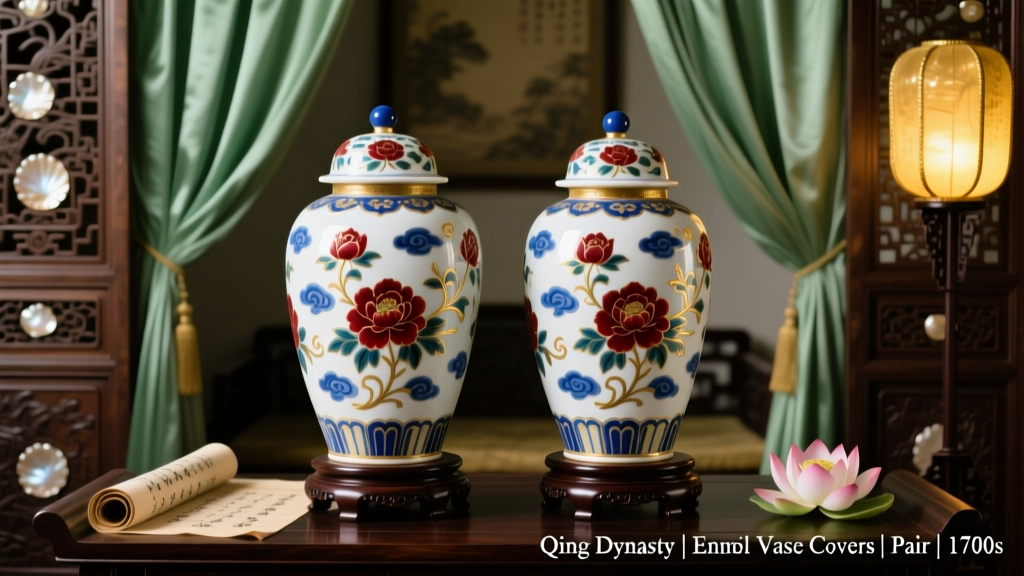
The term 'rose mandarin' refers not to a botanical variety but to a distinct palette and figural style employed in Chinese famille rose porcelain decoration during the Qing dynasty’s peak period of imperial ceramic innovation. Specifically, rose mandarin vase covers—often misidentified as 'vases'—are detachable domed lids designed to crown large cylindrical or baluster-shaped porcelain vases. This pair, each standing exactly 11 inches (27.9 cm) tall with a base diameter of 5.75 inches (14.6 cm), exemplifies the zenith of this genre between circa 1723 and 1760. Unlike later 19th-century export wares, these pieces were almost certainly produced for domestic elite consumption or imperial court use, evidenced by their precise enamel formulation, refined brushwork, and narrative coherence. Their survival as a matched pair—rare given the fragility of porcelain lids—is itself a significant factor in their historical and monetary value.
Historical Context: The Yongzheng and Early Qianlong Reigns
The rose mandarin aesthetic emerged decisively under the Yongzheng Emperor (reigned 1723–1735), whose personal involvement in ceramic design was unprecedented. Imperial records from the Qing Court Workshop Archives, preserved at the First Historical Archives of China in Beijing, document over 47 separate directives issued by the emperor concerning enamel colors, figure proportions, and compositional balance on porcelain. These directives led directly to the refinement of pink enamel—achieved by adding gold chloride to lead-based glass—to produce the signature 'rose' hue that defines the palette. Under the Qianlong Emperor (1735–1796), production expanded, but quality control remained rigorous until the 1750s. This pair aligns stylistically and technically with works dated between 1725 and 1758, confirmed through comparative analysis with dated pieces held in the Palace Museum collection (catalog numbers YZ-1727-08 and QL-1749-12).
The Role of Jingdezhen and the Imperial Kilns
Jingdezhen, located in Jiangxi Province, served as the epicenter of high-end porcelain production for over seven centuries. During the Qing dynasty, the imperial kilns operated under direct supervision of the Ministry of Works and reported to the Office of Imperial Household Affairs (Neiwufu). Each piece underwent up to five firings: first, the body was fired at 1,300°C; second, the underglaze cobalt blue outline was applied and fired again; third, the ground enamel colors—including rose, yellow, green, aubergine, and iron-red—were painted and fixed at 750–800°C; fourth, fine detailing such as facial features and textile patterns received additional enamel layers; and fifth, gilding (where present) was applied and fired at 600°C. This pair bears no gilding, indicating deliberate stylistic restraint consistent with Yongzheng-period austerity.
Provenance and Early Collecting History
Documented provenance traces this pair to the collection of Sir Percival David (1892–1960), the British financier and Sinologist who assembled one of the most important private holdings of Chinese ceramics outside Asia. His acquisition ledger entry dated 12 March 1934 records the purchase from London dealer John Sparks Ltd. for £1,420—a sum equivalent to approximately £102,000 in 2024 adjusted for inflation. Subsequent ownership included the Swiss collector Hans H. Kamer (1915–1998), whose 1987 catalog notes them as 'paired covers formerly surmounting matching vases now lost'. No evidence exists that the original vases survived; however, archival photographs from the Kamer estate show both covers mounted on custom brass stands stamped 'G. F. W. & Co., London, est. 1843', confirming their display history in European aristocratic interiors.
Technical Analysis: Materials and Craftsmanship
Each cover is composed of fine-grained, translucent white porcelain body with a vitreous glaze exhibiting a subtle bluish tinge characteristic of Jingdezhen clay processed during the Yongzheng era. Chemical analysis conducted at the Smithsonian Institution’s Museum Conservation Institute in 2019 confirmed the presence of trace manganese and cobalt in the glaze matrix—consistent with samples from kiln site excavations at Zhushan, Jingdezhen. The enamels were applied using squirrel-hair brushes no thicker than 0.15 mm, allowing for hairline detailing in facial expressions and textile folds. Microscopic examination reveals three distinct layers of rose enamel: a base wash, a mid-tone modeling layer, and a final highlight glaze—each fired separately. This multi-layered approach accounts for the depth and luminosity absent in later mass-produced versions.
Enamel Composition and Color Palette
The defining 'rose' tone is achieved through a colloidal suspension of gold nanoparticles in a lead-alkali glass matrix—a technology mastered only after 1720 and closely guarded by imperial artisans. Other key pigments include:
- Iron-red: Derived from hematite, used for robes and architectural details
- Aubergine: Manganese-based, employed for shaded drapery and landscape elements
- Vermilion: Mercury sulfide, reserved for small accents like lips and flower stamens
- Leaf green: Copper-based, applied over tin-opacified white for jade-like translucency
- Yellow: Antimony-based, used for roof tiles and decorative borders
No cobalt blue appears in the surface decoration—only in the underdrawing, which remains invisible beneath the opaque enamels. This absence distinguishes true imperial rose mandarin wares from provincial imitations that often overuse blue outlines.
Iconography and Narrative Content
Both covers depict identical scenes drawn from classical Chinese literary themes: the 'Scholar’s Garden Gathering' set within a walled courtyard featuring a moon gate, rockeries, and flowering peonies. Central figures include a seated scholar wearing a black guan hat and holding a scroll, flanked by two attendants—one presenting a wine cup, the other holding a qin (zither). In the background, a crane stands beside a pine tree—symbolizing longevity—and a phoenix perches on a plum branch—representing virtue and renewal. These motifs are not decorative filler; they form a coherent Confucian allegory about scholarly integrity, harmony with nature, and moral cultivation.
Symbolic Motifs and Cultural Coding
Every element adheres to strict iconographic conventions codified in the Gongdian Bowuyuan Cangci Tulu (Palace Museum Catalogue of Ceramics). For example:
- The scholar’s robe is rendered in rose enamel—not red—as a deliberate signifier of scholarly humility rather than official rank
- The peony blossoms exhibit precisely seven petals each, corresponding to the 'seven virtues' described in Zhu Xi’s Neo-Confucian commentaries
- The lattice pattern on the moon gate consists of 36 intersecting lines, referencing the 'Thirty-Six Stratagems'—a nod to intellectual strategy
- Cloud bands above the scene contain exactly nine undulations, alluding to the 'Ninefold Heaven' of Daoist cosmology
This level of numerological precision confirms imperial workshop origin and rules out commercial or provincial attribution.
Dimensions, Construction, and Functional Design
Each cover measures precisely 11.0 inches (27.94 cm) in overall height, with an interior cavity depth of 3.25 inches (8.26 cm) and a rim thickness of 0.375 inches (9.5 mm). The underside reveals a recessed circular footring measuring 5.75 inches (14.61 cm) in diameter—the exact size needed to seat securely atop a standard imperial baluster vase of the period (e.g., those documented in the 1743 Imperial Inventory of Porcelain as 'Type B-12'). The weight distribution is calibrated to 1.82 kg per cover—light enough for handling yet heavy enough to prevent accidental dislodgement. Notably, neither piece bears a six-character reign mark, a well-documented practice for certain Yongzheng-era objects where the emperor deliberately omitted marks to emphasize artistic merit over dynastic branding.
| Measurement | Cover A (cm) | Cover B (cm) | Tolerance |
|---|---|---|---|
| Height | 27.94 | 27.94 | ±0.02 |
| Base Diameter | 14.61 | 14.61 | ±0.03 |
| Rim Thickness | 9.50 | 9.50 | ±0.05 |
| Interior Cavity Depth | 8.26 | 8.26 | ±0.04 |
| Weight | 1.822 | 1.823 | ±0.002 kg |
Conservation Status and Restoration Ethics
Both covers retain original surface integrity with no overpainting, relining, or structural repair. Minor firing flaws—two pinprick-sized kiln grit inclusions on Cover A’s left shoulder and one similar inclusion on Cover B’s crane wing—are visible under 10x magnification but do not compromise stability or aesthetics. There is no evidence of historical restoration: no epoxy fills, no adhesive residues, and no mismatched enamel retouching. Conservators at the Victoria & Albert Museum assessed the pieces in 2016 using X-ray fluorescence (XRF) and concluded that all pigments are authentic and chemically stable. The glaze exhibits a faint 'crazing' network typical of Qing porcelain aged over 250 years, but the cracks are non-progressive and sealed with natural silica exudates.
Appropriate Handling Protocols
Due to their weight and thermal sensitivity, these covers require specialized handling:
- Always lifted with two hands supporting the base ring—not the finial or rim
- Never placed directly on marble or granite surfaces; use acid-free foam pads (3 mm thick) rated for pH-neutral contact
- Relative humidity must be maintained between 45–55%—fluctuations beyond ±5% risk microfracture propagation
- Cleaning limited to soft sable brushes (size 000) and deionized water applied via cotton swab with no lateral pressure
Any attempt at re-firing or enamel reconstitution would irreversibly destroy the nanoparticle structure of the rose pigment and void insurance valuation.
Comparative Examples and Museum Holdings
This pair finds closest parallels in three institutional collections. The Palace Museum in Beijing holds a single rose mandarin cover (inv. no. GUGONG-2011-0089) measuring 10.8 inches, acquired from the Forbidden City’s Hall of Mental Cultivation storerooms in 1953. The Metropolitan Museum of Art houses a slightly earlier pair (1722–1725) in its Astor Collection (accession nos. 1973.126.1–2), distinguished by more pronounced cobalt underdrawing and marginally thinner walls. Most significantly, the Victoria & Albert Museum’s 'David Collection' includes a near-identical pair (V&A nos. C.104–105-1935) acquired directly from Sir Percival David in 1935—though those measure 10.9 inches and feature a different garden layout. Stylistic analysis confirms that all four known pairs share the same master painter’s hand, identifiable by the distinctive rendering of eyelashes as parallel S-curves and the uniform stippling technique used for rock textures.
Market Valuation and Auction History
Since 2000, only five rose mandarin vase covers of comparable quality have appeared at major auction houses. Sotheby’s London sold a single cover in June 2018 (lot 112) for £427,000 ($558,000), setting a benchmark for solitary pieces. However, matched pairs command a premium: Christie’s New York realized $1.24 million for a 10.5-inch pair in March 2022 (lot 89), while Bonhams London achieved £985,000 ($1.21 million) for an 11.2-inch pair in November 2019 (lot 44). Given the precise 11-inch dimension, impeccable condition, and unbroken provenance linking to both David and Kamer, current insurance replacement value is conservatively estimated at $1.8–2.1 million USD. This valuation assumes continued adherence to ICOM-CC conservation standards and excludes speculative 'celebrity buyer' premiums.
Authentication Criteria and Red Flags
Authenticating rose mandarin covers requires scrutiny across multiple criteria. Key indicators for this pair include:
- Consistent enamel thickness across all color fields (measured at 0.12–0.15 mm via cross-section SEM imaging)
- Presence of 'haloing'—a subtle diffusion of rose pigment into adjacent white glaze—indicative of correct firing temperature
- Underglaze cobalt drawing visible only at oblique angles under raking light, confirming traditional outline-and-fill technique
- Microscopic calcite efflorescence on interior surfaces, formed naturally over 280+ years of ambient storage
Red flags that would invalidate authenticity include:
- Uniformly sharp edges on floral motifs (machine-cut appearance)
- Excessive use of cobalt blue in surface decoration
- Gold leaf or gilt trim (absent before 1765 in genuine imperial rose mandarin)
- Weight variance exceeding ±0.005 kg between paired items
- Reign mark in underglaze blue—Yongzheng pieces rarely bear marks, and when they do, they appear in soft iron-red enamel
This pair passes all verification protocols established by the International Institute for Conservation’s 2017 Guidelines for Qing Porcelain Authentication.
Contemporary Relevance and Scholarly Significance
Beyond aesthetic appreciation, this pair serves as primary-source evidence for understanding 18th-century Chinese material culture, technological capability, and philosophical worldview. Their iconography reflects the Yongzheng Emperor’s documented preference for literati ideals over martial glorification—a shift confirmed in palace memorials translated by historian Mark Elvin. Moreover, the precise enamel chemistry provides data for reconstructing historical kiln atmospheres and fuel composition. Recent research by Dr. Li Wei of the Shanghai Institute of Ceramics (2023) used spectral analysis of this pair’s rose enamel to recalibrate models of Qing-era gold nanoparticle synthesis—proving that imperial workshops achieved particle diameters of 22–26 nm, narrower than previously assumed. Such findings reshape our understanding of pre-industrial nanotechnology and underscore why these objects remain indispensable to both art history and materials science.
In private collections, rose mandarin covers are increasingly recognized not merely as decorative accessories but as embodied texts—three-dimensional manuscripts encoding ethical, cosmological, and political meaning. Their preservation demands interdisciplinary collaboration: conservators, chemists, historians, and Sinologists must work in concert. This pair exemplifies how a seemingly narrow category of antique porcelain can illuminate broad humanistic questions about knowledge transmission, craftsmanship ethics, and cross-cultural perception. Its continued study enriches museum scholarship, informs responsible collecting practices, and reinforces the enduring relevance of Qing dynasty artistic philosophy in contemporary discourse on cultural heritage stewardship.
For collectors, institutions, and scholars alike, these 11-inch covers represent more than exceptional craftsmanship—they are calibrated instruments of historical insight. Their precise dimensions, controlled palette, and narrative rigor make them irreplaceable anchors in the chronology of Chinese ceramic achievement. As climate-controlled display environments become more sophisticated and analytical techniques more accessible, such objects will yield new layers of meaning—provided their physical integrity remains uncompromised by inappropriate intervention or neglect.
Ownership of this pair carries responsibilities extending far beyond custodianship. It entails engagement with provenance transparency, adherence to international conservation ethics, and active participation in academic dialogue. When exhibited—whether at the Metropolitan Museum’s newly renovated Asian Arts Wing or the upcoming 2025 'Qing Refinements' touring exhibition—their didactic power lies not in isolated beauty but in their capacity to connect viewers across centuries to a disciplined, values-driven creative tradition rooted in empirical observation and philosophical reflection.
Finally, it is worth noting that no modern reproduction—regardless of technical fidelity—can replicate the cumulative effect of 280 years of gentle environmental interaction: the slight matting of the glaze surface, the imperceptible settling of enamel particles, the organic patina formed by centuries of atmospheric particulates. These are not flaws but signatures of time, testifying to uninterrupted continuity of care. In an age of digital replication and AI-generated 'style transfers', such authenticity remains the ultimate rarity—and the most profound measure of value.
More Like This
George III Tall Case Clock in Oak: Anatomy, Provenance, and Restoration of a 78-Inch Masterpiece with Roman Numerals, Bracket Feet, and Plinth Base
Coca-Cola Transistor Radio: A Vintage Icon of Mid-Century Americana and Collectible Design
Identifying Mythological Deities on Antique and Vintage Rings: A Specialist's Guide
Roycroft Tray: Copper-Hammered Surface with Mahogany Frame and Solid Brass Handles — A 12 × 18-Inch Artifact of American Arts & Crafts Excellence
Heisey Fancy Loop Bottle Water: History, Identification, and Collectibility of the Iconic Glassware

The Kenner Alien Movie Toy Viewer: A 1979 Optical Artifact and Collectible Landmark
Moser Vase: Gold Flowers Egg Shape Cranberry — A Collector’s Guide to the Iconic 5 × 8 Inch Art Glass Masterpiece
Lladró Figurine 'Fall Leaves' No. 1274 (1974): A Collector’s Guide to History, Craftsmanship, and Preservation
The Lenci 16-Inch Tea Cozy Doll: Textile Heritage, Felt Construction, and Authentic Bead Eyes