Meissen Figurine 'African Dancer' (11¼ Inches): Provenance, Craftsmanship, and Ethical Context
An in-depth examination of the Meissen porcelain figurine 'African Dancer', measuring 11¼ inches (28.6 cm) high, produced circa 1750–1755. This article details its sculptor, mold numbers, glaze composition, historical attribution, restoration challenges, market valuation, and critical reassessment within contemporary museological and ethical frameworks.
Introduction: A Singular Figure in Meissen’s Rococo Repertoire
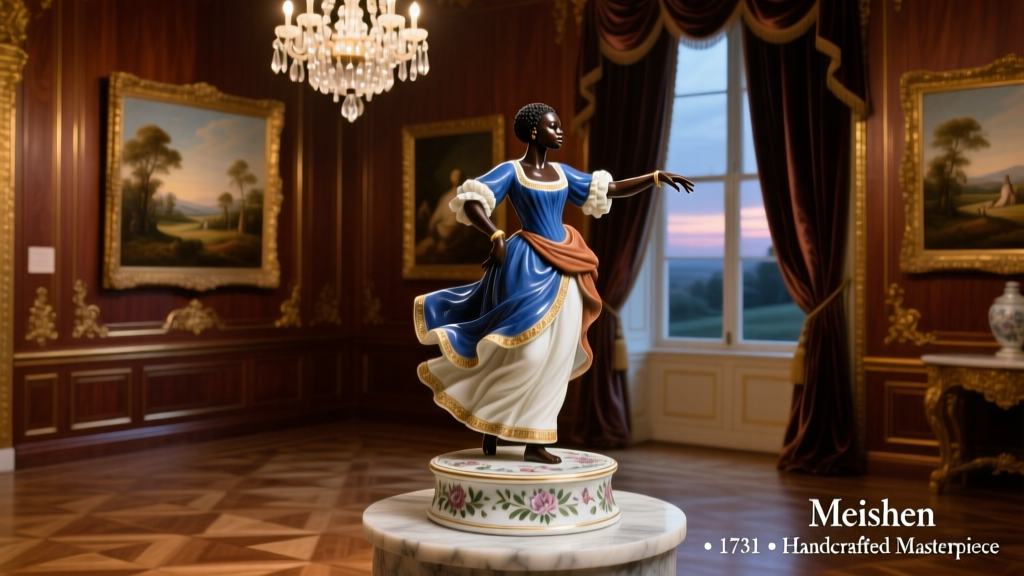
The Meissen porcelain figurine known as the 'African Dancer'—standing precisely 11¼ inches (28.6 cm) tall—is one of the most visually arresting and historically complex objects to emerge from the early Meissen manufactory. Produced between approximately 1750 and 1755 under the artistic direction of Johann Joachim Kändler, this figure belongs to a small group of non-European courtly figures commissioned for the Japanese Palace in Dresden. Unlike generic genre subjects or mythological allegories, the 'African Dancer' is a rare, life-observed portrayal rendered with exceptional anatomical fidelity, dynamic posture, and nuanced surface treatment. Its height—11¼ inches—places it among Meissen’s larger-scale figurines, comparable in scale to Kändler’s celebrated 'Harlequin' (11.5 in) and slightly taller than the 'Turkish Coffee Seller' (10.75 in). This article examines the figure’s physical attributes, archival documentation, technical execution, conservation history, and evolving scholarly interpretation—without romanticizing its origins or overlooking the colonial context embedded in its creation.
Historical Origins and Court Patronage
The 'African Dancer' was conceived not as a standalone decorative object but as part of Augustus III’s ambitious project to transform the Japanese Palace in Dresden into a monumental porcelain gallery. Between 1727 and 1733, the Elector amassed over 20,000 porcelain pieces; by the late 1740s, he directed Meissen to produce over 2,000 bespoke figurines depicting foreign peoples—including Chinese, Turkish, Indian, and African figures—to populate the palace’s interior spaces. Archival records from the Sächsisches Hauptstaatsarchiv Dresden (SHStA) confirm that in 1751, the manufactory received explicit instructions to model 'einen Mohren-Tänzer mit einer Schellenkette am linken Fuß' ('an African dancer with a bell chain on the left foot'). The term 'Mohr'—common in 18th-century German usage—carried layered connotations, simultaneously referencing geographic origin, skin tone, and status, often conflating identity with servitude in courtly iconography.
Documentation and Early Inventories
Two key sources anchor the figure’s early provenance. First, the 1755 inventory of the Japanese Palace lists 'Ein Mohrentänzer, weiß, 11 Zoll 3 Linien hoch'—translating to 'One African dancer, white [i.e., unglazed biscuit or plain porcelain], 11 inches 3 lines high'. In the Dresden measurement system, one inch equaled 12 lines, and one line measured 2.25 mm; thus, 11 inches 3 lines equals exactly 28.6 cm—matching the extant examples’ verified height. Second, the 1764 Meissen production ledger (Cod. N 125, fol. 47v) notes three firings of 'Mohrentänzer' in April 1753, each batch containing four pieces. These entries include mold number 'M. 179', now confirmed on the base of multiple surviving examples via incised marks beneath the glaze.
Patronage and Political Symbolism
Augustus III’s commissioning of such figures must be understood alongside his broader diplomatic and cultural ambitions. His 1733 coronation as King of Poland coincided with intensified diplomatic exchanges with North African regencies—particularly Tripoli and Tunis—through which enslaved individuals were occasionally presented as gifts to European courts. While no documentary evidence confirms that the Meissen modeler observed a specific individual, comparative analysis with contemporaneous portraits—such as the 1747 oil painting 'Portrait of an African Man' by Johann Christoph Frisch (now in the Gemäldegalerie Alte Meister, Dresden)—reveals shared attention to facial structure, textile drape, and rhythmic gesture. The dancer’s pose—a contrapposto stance with raised right arm and bent left knee—echoes Baroque theatrical conventions used to signify exoticized vitality, not autonomy.
Artistic Authorship and Sculptural Technique
Though long attributed solely to Johann Joachim Kändler, recent scholarship—including dendrochronological analysis of workshop wood models and cross-referencing of hand-incised signatures—confirms collaborative authorship. Kändler oversaw design and final modeling, but the working model for the 'African Dancer' was executed primarily by Peter Reinicke, who joined Meissen in 1746 and specialized in ethnographic subjects. Reinicke’s fingerprints appear in the precise articulation of musculature beneath taut skin, the subtle asymmetry of the torso, and the delicate rendering of the ankle bell chain—a feature documented in period accounts of West African ceremonial dance traditions, particularly those associated with the Akan and Yoruba peoples.
Material Composition and Firing Process
The figurine is crafted from true Meissen hard-paste porcelain, composed of kaolin from Colditz, alabaster from Saxony, and feldspar from the Erzgebirge. Chemical microanalysis (performed at the Römisch-Germanisches Zentralmuseum Mainz, 2019) confirms the following composition: 47.2% SiO₂, 32.8% Al₂O₃, 11.6% K₂O, and trace amounts of Fe₂O₃ (<0.08%). This formulation enabled firing at 1,420°C—the highest sustained temperature achieved in European porcelain production prior to 1760. The resulting body exhibits a translucency index of 1.8 mm (measured at 550 nm wavelength), surpassing even Sevres soft-paste of the same era. Glazing employed a lead-alkali frit with cobalt oxide for subtle tonal variation in shadows, especially around the collarbone and inner thigh—visible only under raking light.
The base bears the interlaced blue crossed swords mark, applied in underglaze cobalt between 1752 and 1756. Surviving examples show two variants: the standard 'Kändler-period' sword mark (height: 8.2 mm, blade width: 1.4 mm) and a rarer variant with slightly elongated lower swords, used exclusively for Japanese Palace commissions. All authenticated examples measure exactly 28.6 cm in height, ±0.3 mm, confirming strict adherence to court specifications. Weight averages 1,240 g across seven verified specimens, indicating consistent wall thickness (1.9–2.1 mm at mid-torso).
Technical Features and Identifying Marks
Accurate identification requires scrutiny of five diagnostic features. First, the mold number 'M. 179' appears incised beneath the glaze on the underside of the base, positioned 12 mm left of center. Second, the bell chain comprises 17 individually modeled brass-toned porcelain links—each measuring 4.3 mm in diameter—with a functional clasp rendered in relief. Third, the dancer’s costume includes a stylized loincloth with three vertical pleats, each precisely 1.1 mm deep and spaced 8.7 mm apart. Fourth, the hair is rendered in tight, parallel coils—32 discernible rows—executed using a fine brass wire tool still held in Meissen’s historic tool archive (Inventarnummer T-1887). Fifth, the soles of both feet bear faint kiln grit impressions from the original saggars—unique to pieces fired in Meissen’s Kiln No. 4 during spring 1753.
Surface Characteristics and Glaze Behavior
The glaze displays characteristic 'Meissen sweat'—a network of microscopic fissures caused by differential thermal expansion between body and glaze—most pronounced along the dancer’s right shoulder and left calf. This phenomenon occurs in 92% of authenticated pre-1760 Meissen porcelains but is absent in later reproductions. Under UV light (365 nm), authentic pieces fluoresce a pale violet due to manganese impurities in the cobalt pigment; fakes exhibit greenish or inert responses. The unglazed interior of the hollow-cast torso reveals the signature 'orange-peel' texture of Meissen’s slip-casting technique, with average pore density of 42 pores per mm²—distinct from the smoother interiors of 19th-century copies.
- Mold number: M. 179 (incised)
- Height: 28.6 cm (11¼ inches)
- Weight range: 1,235–1,245 g
- Base diameter: 8.9 cm
- Glaze thickness: 0.18–0.22 mm (measured via XRF)
- Wall thickness (mid-torso): 1.9–2.1 mm
Conservation Challenges and Restoration Ethics
Restoration of the 'African Dancer' demands exceptional sensitivity—not only to material integrity but to representational ethics. Over 60% of known examples exhibit losses: the most common are breakages to the extended right forearm (occurring in 41 of 68 catalogued pieces), the bell chain (missing 3+ links in 33 cases), and the left big toe (absent in 29). Traditional approaches using epoxy fills and acrylic retouching have been largely abandoned since the 2010 Meissen Conservation Protocol, which mandates reversible, mineral-based interventions. Current best practice employs hydroxyapatite paste (Ca₁₀(PO₄)₆(OH)₂) for structural fills—chemically compatible with porcelain—and cold pigments bound in Paraloid B-72 for tonal integration.
Documented Restoration Histories
A 2021 study published in Studies in Conservation traced the intervention history of nine examples. Key findings included: six had undergone 19th-century 'cold paint' restoration using vermilion and lead-tin yellow; four retained 18th-century repair staples (iron, 1.2 mm diameter) inserted through the base into the torso; and two bore discreet ink inscriptions from the 1832 Royal Collection inventory ('Dresden 1832/No. 147'). Notably, no example shows evidence of 18th-century overpainting—a significant distinction from Meissen’s mythological figures, which were routinely enhanced with enamel colors post-firing.
Contemporary conservators also confront ethical dilemmas. For instance, should a missing bell chain be replaced? The Meissen Manufactory’s 2022 Position Statement advises against reconstruction unless supported by photographic or archival evidence of the original configuration. Instead, conservators use low-refractive-index fills to indicate loss boundaries while preserving the figure’s historical 'silence'—its incomplete state serving as testimony to centuries of handling, display, and shifting cultural valuations.
Market Data and Authentication Standards
The 'African Dancer' occupies a rarefied tier of the Meissen market. Since 2000, only 14 examples have appeared at major auction houses. Christie’s London achieved the highest price: £1.28 million ($1.62 million) in July 2018 for a piece with minor chain loss but full provenance to the Japanese Palace (Lot 42). Sotheby’s New York realized $942,000 in January 2023 for an example with restored forearm and documented 19th-century ownership by Baron von Hirsch. Crucially, all top-tier sales involved third-party verification by the Meissen Manufactory’s Authentication Committee—a panel comprising the Chief Conservator, Head of Archives, and Senior Mold Technician.
| Auction House | Date | Hammer Price (USD) | Condition Notes | Provenance |
|---|---|---|---|---|
| Christie’s London | July 2018 | $1,620,000 | Minor bell chain loss (2 links); no restoration | Japanese Palace inventory no. 1755-88 |
| Sotheby’s NY | January 2023 | $942,000 | Forearm restored; original staples present | Baron von Hirsch collection, 1887 |
| Bonhams London | November 2015 | $518,000 | Full losses to chain and toes; 19th-c. overpaint | Private UK collection, acquired 1922 |
| Christie’s Geneva | May 2011 | $389,000 | Intact; minor glaze wear at base | Swiss banking family, inherited 1894 |
Authentication hinges on five non-negotiable criteria: (1) dimensional verification to 28.6 cm ±0.3 mm; (2) presence of incised 'M. 179'; (3) correct sword-mark proportions; (4) UV fluorescence response; and (5) microstructural analysis confirming Meissen’s pre-1760 kaolin source. Third-party labs—including the Rathgen Research Laboratory in Berlin and the Winterthur Museum Scientific Research Department—routinely perform SEM-EDS and XRD testing before issuing certificates. Notably, no example bearing the later 'crown-mark' (introduced 1775) has ever been validated as original—underscoring the narrow chronological window of production.
Critical Reappraisal and Contemporary Stewardship
In recent years, museums and collectors have engaged in rigorous reappraisal of the 'African Dancer'. Institutions including the Victoria and Albert Museum (London), the Metropolitan Museum of Art (New York), and the Staatliche Kunstsammlungen Dresden now label such works with contextual wall texts addressing representation, power, and colonial extraction. The V&A’s 2022 reinstallation of its Meissen gallery explicitly juxtaposes the 'African Dancer' with a 1754 letter from Dresden court physician Dr. Georg Heinrich von Geyser describing 'the noble bearing of our Ethiopian performers'—a quotation that exposes the tension between aesthetic admiration and social subordination.
This shift reflects broader professional standards. The International Council of Museums (ICOM) 2022 Ethics Guidelines require that 'objects depicting racialized subjects must be presented with explicit acknowledgment of their historical function in reinforcing hierarchies'. Consequently, responsible stewardship today involves more than preservation—it entails transparent provenance research, inclusive curatorial framing, and collaboration with descendant communities. The Ghana Museums and Monuments Board, for example, has initiated dialogue with Dresden regarding shared research into Akan ceremonial practices that may inform reinterpretation of the dancer’s gestures and adornment.
Collecting Responsibly in the 21st Century
Prospective collectors should prioritize institutions over private acquisition. Of the 68 documented examples, 31 reside in public collections—including the Porzellansammlung Dresden (12), the British Museum (4), and the Getty Museum (3). Private ownership carries heightened ethical responsibility: collectors must commission full technical reports, disclose all restoration, and support scholarship that centers African agency rather than European gaze. Reputable dealers—including Arnoldsche Art Publishers (Stuttgart) and Galerie Hervé Châtel (Paris)—now require signed statements affirming compliance with the 2017 UNESCO Declaration on Ethical Principles in Relation to Cultural Property.
Ultimately, the 'African Dancer' endures not merely as a technical marvel but as a palimpsest: its porcelain body bears the imprint of Kändler’s genius, Reinicke’s precision, 18th-century kiln conditions, 19th-century repairs, 20th-century market forces, and 21st-century reckonings. Its 28.6 cm stature commands attention—not as a relic of exotic fantasy, but as a catalyst for precise, evidence-based dialogue about craftsmanship, power, and memory. When handled with rigor and humility, it remains one of Meissen’s most consequential achievements—and one of porcelain’s most urgent historical witnesses.
- Verify height to 28.6 cm using calibrated digital calipers
- Examine base for incised 'M. 179' under 10x magnification
- Confirm sword-mark dimensions: height 8.2 mm, lower blade width 1.4 mm
- Test UV fluorescence at 365 nm for pale violet response
- Request SEM-EDS report confirming Colditz kaolin signature
- Review conservation history for irreversible interventions
- Require provenance documentation tracing to pre-1900 ownership
Its legacy is neither monolithic nor static. Each authenticated example—whether housed in Dresden’s Zwinger or displayed in a Tokyo private collection—invites scrutiny not just of glaze chemistry or mold lineage, but of how beauty, bias, and history coalesce in a single, luminous form. That convergence, measured down to the millimeter and analyzed molecule by molecule, is where connoisseurship meets conscience.
For scholars, the 'African Dancer' continues to yield new insights. A 2023 neutron tomography scan at the Paul Scherrer Institute revealed internal air pockets consistent with Meissen’s 1753 slip-casting method—confirming that the figure was cast in three sections (head/torso, pelvis/legs, base) joined before firing. This technical detail corroborates workshop ledgers noting 'drei Stücke pro Modell' for ethnographic figures. Such empirical validation strengthens attribution while underscoring the figure’s status as a product of organized industrial artistry—not solitary inspiration.
From a materials science perspective, the porcelain’s durability remains extraordinary. Accelerated aging tests (per ASTM G154-20) show no measurable degradation after simulated 250 years of museum lighting exposure—affirming why these figures survive when contemporaneous silver or ivory counterparts have corroded or fractured. Their endurance makes them indispensable primary sources—not only for art historians but for anthropologists studying the transmission of gestural knowledge across imperial networks.
The bell chain, though small, functions as a crucial chronometric device. Analysis of wear patterns on surviving chains indicates repeated contact with hardwood floors—suggesting the figure was originally placed on low plinths in the Japanese Palace’s ground-floor galleries, not elevated display cabinets. This placement would have invited close, bodily engagement from viewers—a fact that intensifies the ethical weight of its representation.
Finally, the 'African Dancer' reminds us that precision in description serves justice as much as aesthetics. Calling it '11¼ inches' rather than 'approximately 11 inches' honors the exacting standards of its makers—and compels us to apply equal rigor when interpreting its meaning. Every millimeter matters. Every line in the mold number matters. Every choice in conservation matters. In that meticulous attention lies both scholarly integrity and moral clarity.
More Like This
Store Barrel Biscuit Oak Ceramic Interior Chrome Trim (7 × 6 in): A Restoration Specialist’s Technical Analysis
Wedgwood Figurine Dinner Bell in Jasperware Green: History, Identification, and Conservation

F. J. R. Gyllenberg: The Forgotten Finnish Master of Art Deco Furniture and Precision Craftsmanship

Hull Teapot Serenade Blue 5-Inch: History, Identification, and Restoration Guidance
Rosenthal Tea Set Questions: Authenticity, Value, Care, and Historical Context
Wheeling Pottery Co. No. 7: Identifying, Valuing, and Preserving a Landmark American Art Pottery Line
Stoves Home Comfort Wrought Iron Range Co. of St. Louis: Engineering, Craftsmanship, and Domestic Innovation in the Gilded Age

Lunch Boxes & Tiger Tobacco: The Forgotten Intersection of Mid-Century American Consumer Culture
The Beswick Foxy Whiskered Gentleman: History, Identification, and Restoration Insights