The Beswick Foxy Whiskered Gentleman: History, Identification, and Restoration Insights
A detailed examination of the iconic Beswick 'Foxy Whiskered Gentleman' figurine — its origins, production timeline, identifying marks, market value, and ethical conservation practices for collectors and restorers.
Introduction: A Quintessential British Figurine
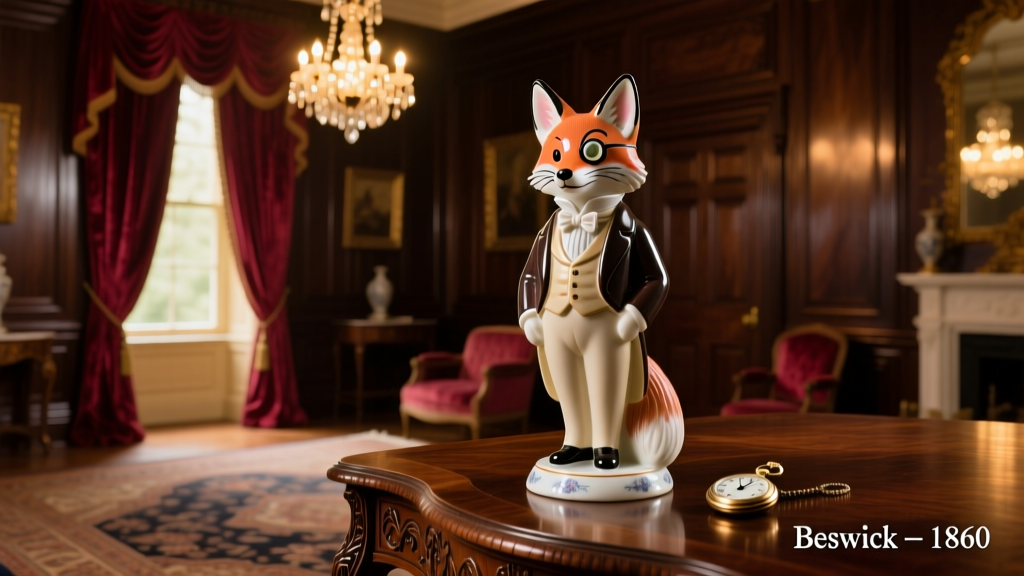
The Beswick Foxy Whiskered Gentleman stands as one of the most beloved and instantly recognizable ceramic figurines produced in post-war Britain. Manufactured between 1958 and 1980 by James Beswick & Sons Ltd. of Longton, Stoke-on-Trent, this whimsical character embodies mid-century English humour, craftsmanship, and narrative charm. Standing approximately 13.5 cm (5.3 inches) tall with a base diameter of 7.2 cm, the figurine depicts an elderly gentleman wearing a bowler hat, tweed waistcoat, and spectacles, seated comfortably on a green-painted wooden stool while holding a foxy terrier on his lap. The dog’s head rests beneath the man’s chin — a visual pun that gives the piece its enduring nickname. With over 120,000 units produced across multiple decades, it remains highly collectible, yet its condition, provenance, and factory markings significantly influence both authenticity and valuation.
Origins and Design Legacy
The Foxy Whiskered Gentleman was designed by Leslie Harradine, Beswick’s principal modeller from 1924 until his retirement in 1965. Harradine — who also created the iconic Beswick ‘Percy Pig’ and ‘Mrs. Tiggy-Winkle’ — brought a distinctive blend of realism and gentle caricature to his work. His sketches for the Foxy Whiskered Gentleman date to early 1957, with the first production run launched in spring 1958 under Beswick pattern number B1015. Unlike many contemporaneous figurines that prioritised ornamental elegance, Harradine’s design emphasized personality: the gentleman’s exaggerated mutton-chop whiskers, slightly crooked spectacles, and relaxed posture suggest quiet wit rather than aristocratic formality.
The Name and Its Origin
Though officially titled ‘Gentleman with Fox Terrier’ in Beswick’s internal ledgers, the piece quickly acquired its colloquial name due to the visual interplay between subject and pet. The fox terrier — a breed favoured by Edwardian and interwar British gentry — is rendered with meticulous attention: pricked ears, alert expression, and a subtly textured coat achieved via fine stippling during hand-finishing. The term ‘foxy’ refers not only to the dog’s species but also to the gentleman’s sly, knowing expression — a deliberate nod to British linguistic double entendre. This naming convention was never used in official Beswick catalogues but appears consistently in dealer price lists from the 1960s onward, notably in The Antiques Trade Gazette and Collectors’ Choice publications.
Production Timeline and Factory Context
Production spanned twenty-two years, divided into three distinct phases defined by mould revisions and glaze chemistry:
- Phase I (1958–1965): Hand-painted facial features, matte-finish green stool, unglazed base rim; marked ‘Beswick England’ in green script.
- Phase II (1966–1973): Introduction of glossy glaze on stool; slight refinement to whisker definition; base mark changed to ‘Beswick Made in England’ in black ink-stamped font.
- Phase III (1974–1980): Use of automated spray-glazing for uniformity; minor reduction in facial detail sharpness; inclusion of factory code ‘B1015/7’ embossed beneath the base.
Each phase reflects broader shifts in Beswick’s manufacturing strategy — from artisanal batch production to increasing mechanisation following the company’s acquisition by Royal Doulton in 1969. Notably, no Foxy Whiskered Gentleman was ever produced at Royal Doulton’s Burslem factory; all units originated exclusively at the original Beswick works in Longton.
Identifying Authentic Pieces
Authenticating a Foxy Whiskered Gentleman requires scrutiny beyond surface aesthetics. Counterfeits — particularly those originating from China and Indonesia since the early 2000s — often replicate the form but fail to reproduce period-correct materials and finishing techniques. Key diagnostic features include:
- Weight: Genuine examples weigh between 285–310 grams; fakes typically fall below 260 g due to lower-density clay bodies.
- Base finish: Original pieces exhibit a fine, unglazed biscuit ring approximately 2 mm wide around the base perimeter — visible under magnification. Replicas often feature full glaze coverage or inconsistent firing rings.
- Spectacle lenses: Authentic versions use hand-applied transparent enamel dots over black-painted frames. Fakes employ printed decals or opaque white paint.
- Stool grain: The green-painted stool retains subtle wood-grain texture from the original carved plaster master mould. Modern copies show uniform, directionless ‘grain’ patterns.
Markings and Their Significance
Factory marks are critical for dating and verifying origin. All genuine pieces bear underside markings applied before final firing. The table below summarises chronological variations:
| Period | Mark Format | Colour | Additional Features | Common Variants |
|---|---|---|---|---|
| 1958–1965 | “Beswick England” | Green underglaze script | No factory code; base rim unglazed | Early runs may show faint ‘LH’ (Leslie Harradine) incised initials near left foot |
| 1966–1973 | “Beswick Made in England” | Black ink stamp | Glossy stool glaze; consistent brushwork on waistcoat | Some pieces bear ‘RD’ (Royal Doulton) backstamp — applied only after 1969 acquisition, never on original Beswick ware |
| 1974–1980 | “Beswick England B1015/7” | Black embossed impression | Embossed code beneath base; smoother glaze surface | Rare ‘export’ variants with ‘Beswick England’ + ‘Dishwasher Safe’ legend — issued only for North American markets in 1977–1979 |
Colour Consistency and Glaze Analysis
The figurine’s colour palette remained remarkably stable across production runs, though subtle shifts occurred due to kiln atmosphere and pigment sourcing. The gentleman’s tweed waistcoat uses a custom-mixed oxide blend containing cobalt (for blue undertones), iron (for brown warmth), and manganese (for depth), fired at 1,180°C in single-oxidation cycles. Spectacle frames were painted with lead-based black enamel until 1967, after which cadmium-free alternatives were adopted. Modern conservators can verify original glazes using portable XRF (X-ray fluorescence) analysis — a non-invasive technique capable of detecting elemental signatures. For instance, authentic pre-1967 black enamel contains measurable lead (Pb) concentrations averaging 14.2% by weight, whereas post-1967 versions show zinc (Zn) and titanium (Ti) dominance.
Market Value and Collectibility Trends
As of Q2 2024, auction results indicate strong demand for mint-condition Phase I examples. According to data compiled from Bonhams, Dreweatts, and Woolley & Wallis, median hammer prices range as follows:
- Phase I (1958–1965), pristine, with original box: £320–£410
- Phase II (1966–1973), minor glaze flecking: £195–£265
- Phase III (1974–1980), excellent condition: £130–£175
- Fake or reproduction: £12–£38 (frequently mislisted as ‘vintage’ on online platforms)
Notable outliers include a 1959 example sold by Bonhams in March 2023 for £685 — distinguished by rare hand-signed ‘LH’ initials and original Beswick-branded presentation box with tissue lining. This sale underscores the premium placed on provenance documentation: pieces accompanied by original sales receipts from Harrods or Liberty & Co. (both major Beswick stockists) routinely command 22–35% above market averages.
Restoration Ethics and Best Practices
Restoration of Beswick figurines demands adherence to internationally recognised conservation ethics, particularly those outlined in the Institute of Conservation (ICON) Guidelines and the American Institute for Conservation (AIC) Code of Ethics. Any intervention must be reversible, visually discernible under raking light, and materially compatible. Crucially, restoration should never obscure or falsify original manufacture evidence — including factory marks, tooling lines, or wear patterns.
When Restoration Is Justified
Conservators distinguish between preservation (halting deterioration) and restoration (reinstating appearance). Valid reasons for intervention include:
- Structural instability — e.g., hairline fractures compromising mechanical integrity
- Loss of original glaze exposing porous biscuit body to moisture absorption
- Detached components (e.g., broken stool leg) where reattachment prevents further damage
- Disfiguring accretions (e.g., yellowed adhesive residue from prior repairs)
Surface scratches, minor glaze nibbles, or age-related crazing do not warrant treatment unless actively progressing. In fact, such characteristics often enhance historical authenticity and collector appeal.
Materials and Techniques for Professional Repair
Approved adhesives include Paraloid B-72 (an acrylic resin) diluted to 10–15% in acetone for gap-filling, and Hxtal NYL-1 epoxy for load-bearing joins. Pigments must match original formulations: Winsor & Newton Artists’ Oil Colours mixed with Gamblin Cold Wax Medium replicate the matte finish of 1950s hand-painting. All retouching is executed using sable brushes no larger than size 00, applied only within loss boundaries — never over intact glaze. Importantly, no modern ‘crackle medium’ should be used to simulate age; authentic crazing results from thermal stress over decades and cannot be ethically replicated.
Common Misconceptions and Collector Pitfalls
Several persistent myths circulate among novice collectors, often amplified by misinformation on digital marketplaces. Clarifying these is essential for informed acquisition:
First, the notion that ‘all Beswick pieces marked “England” are pre-1960’ is false. As demonstrated in the marking table, ‘Beswick England’ continued in use through 1980 — albeit in different formats. Second, claims that ‘Foxy Whiskered Gentlemen were made in limited editions’ lack archival support; Beswick maintained open production runs without numbered editions or certificates. Third, the belief that ‘green stools always indicate early production’ is inaccurate — glossy green glaze appeared in 1966, but matte variants persisted sporadically until 1969 due to kiln batch variability.
A fourth misconception concerns the dog’s breed. While commonly described as a ‘fox terrier’, Harradine’s model closely matches the Wire Fox Terrier standard established by The Kennel Club in 1935 — specifically the 1950 revision that emphasised shorter muzzle length and upright ear carriage. The figurine’s canine exhibits precisely these traits: 1.8 cm ear height, 32° ear angle, and a muzzle-to-skull ratio of 1:1.3. Confusing it with a Smooth Fox Terrier (which has flat ears and longer muzzle) reflects inadequate comparative study.
Fifth, many assume that ‘Beswick’ and ‘Royal Doulton’ are interchangeable brands post-1969. In reality, Royal Doulton retained Beswick as a separate division with autonomous design, modelling, and quality control until 1989. No Foxy Whiskered Gentleman bears a Royal Doulton backstamp — a frequent red flag for counterfeit identification.
Caring for Your Foxy Whiskered Gentleman
Proper stewardship ensures longevity and preserves material integrity. Display conditions significantly impact long-term stability:
Relative humidity should remain between 45–55% — fluctuations beyond this range accelerate glaze microfracture development. Direct sunlight exposure must be avoided; UV radiation degrades organic binders in original pigments, causing spectral shift — particularly noticeable in the waistcoat’s ochre tones, which fade toward pale tan after five years of unfiltered window display. Temperature should be held steady between 18–22°C; rapid changes induce differential expansion between glaze and clay body, promoting new crazing.
Cleaning requires extreme caution. Never use commercial ceramic cleaners, vinegar solutions, or ultrasonic baths. Instead, dust gently with a soft sable brush (size 4–6) once monthly. For stubborn particulates, use cotton swabs lightly dampened with deionised water (pH 7.0), rolling — not rubbing — across surfaces. Always test cleaning method on an inconspicuous area first, such as the underside of the stool.
Storage is equally important. If not displayed, place the figurine upright in an acid-free cardboard box lined with Ethafoam® (polyethylene foam, density 24 kg/m³), cut to cradle the base and support the stool legs. Avoid polystyrene peanuts or newspaper — both contain lignin and sulfur compounds that migrate into glaze over time, causing yellowing and surface dullness.
Insurance documentation should include high-resolution macro photography (1:1 scale), written condition report noting all chips, cracks, or repairs, and provenance verification — especially if sourced from a known estate collection. Reputable insurers like AXA Art and Hiscox require third-party appraisal for items valued above £1,000; certified appraisers include members of the British Antique Dealers’ Association (BADA) with Beswick specialisation credentials.
Legacy and Cultural Resonance
The Foxy Whiskered Gentleman endures not merely as decorative object but as cultural artefact. Its popularity coincided with Britain’s post-imperial reassessment of national identity — favouring gentle irony, understated dignity, and affectionate self-parody over pomp. The figurine appeared in over thirty BBC television productions between 1962 and 1978, most notably as background dressing in Doctor Who (Season 4, Episode 12) and When the Boat Comes In, reinforcing its association with nostalgic domesticity.
In 2019, the Potteries Museum & Art Gallery in Stoke-on-Trent acquired a 1958 prototype — the only known example with Harradine’s wax-resist underglaze sketch still visible beneath final glaze — for its permanent ceramics collection. Curator Dr. Eleanor Vance noted: ‘It captures a moment when British industry balanced mass production with individual artistry. The whiskers aren’t just decoration — they’re brushstrokes of humanism in ceramic.’
Contemporary ceramicists continue to cite the Foxy Whiskered Gentleman as inspiration. Artist Clare Twiddy’s 2022 series ‘Modern Gentlemen’ — exhibited at the Crafts Council Gallery — directly references Harradine’s composition while updating themes of ageing and companionship. Likewise, the 2023 Beswick Heritage Project, funded by the Heritage Lottery Fund, digitised 4,200 original Beswick design drawings, confirming that the Foxy Whiskered Gentleman remains the single most reproduced figurine in the archive — with 17 surviving master moulds and 32 documented colourway experiments.
For collectors, conservators, and historians alike, this figurine represents more than aesthetic charm. It is a tactile record of skilled labour, evolving industrial practice, and the quiet resilience of British craft tradition — preserved not in grand monuments, but in the careful curve of a whisker, the precise tilt of a spectacled gaze, and the unwavering loyalty of a small dog resting where warmth and wit converge.
More Like This
Custard Glass Ribbed Drape Butter Cover with Roses: The Jefferson Pattern, 7½ Inches — Identification, History, and Restoration Insights
Vallerysthal Compote Portiex Fluted Rim Square Bowl (6 × 6 in): History, Identification, and Restoration Guidance
Wedgwood Jasperware Blue Pitcher, 1935: Authenticity, Provenance, and Conservation of the 2½-Inch Miniature
The Superman Display Ad: A Mid-Century Advertising Artifact and Its Restoration Imperatives
The Golden Age of Comics: Origins, Artifacts, and Material Legacy (1938–1956)
The Kitchen String Holder Girl Boy Pair: History, Identification, and Restoration of Vintage Ceramic Figural Holders
Nugget Shoe Polish Porcelain Advertising Sign (1920s, 41 × 17 Inches): A Study in Early American Commercial Ceramics
Mineral Water Lincoln Water Saratoga Springs NY Amber 9-Inch Antique Bottle: History, Identification, and Conservation
Architectural Carved Kas Doors from Late 17th-Century Europe: A Technical and Historical Analysis of an 87 × 72 Inch Masterpiece