Ceresota Flour Boy Match Holder: A 1910 Embossed Tin Barrel with Historical Significance and Collectible Value
A detailed examination of the Ceresota Flour Boy match holder—a rare 5¼-inch embossed tin barrel advertising the Minneapolis-based Ceresota Flour Company, circa 1910. This article covers its design, manufacturing context, material composition, historical branding, restoration considerations, market value, and preservation best practices.
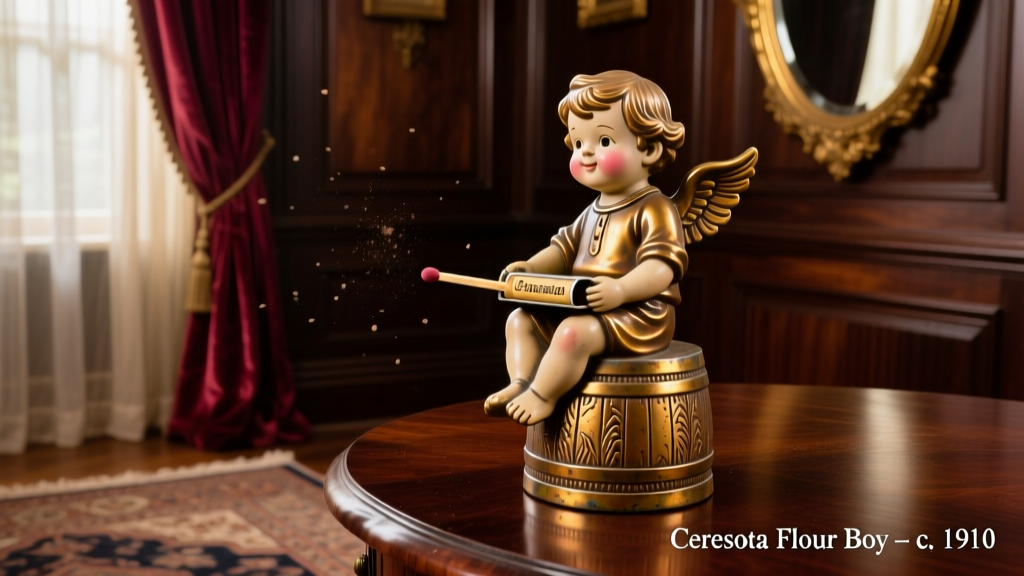
Introduction: The Ceresota Flour Boy Match Holder in Context
Standing at precisely 5¼ inches tall (13.3 cm), the Ceresota Flour Boy match holder is a quintessential example of early 20th-century American advertising ephemera—specifically, a functional yet artful tinware piece produced around 1910 by the Northwestern Consolidated Milling Company of Minneapolis, Minnesota. Featuring a seated boy in overalls perched on a flour barrel, this embossed tin match holder was distributed as a promotional item to grocers and households to reinforce brand loyalty for Ceresota, one of the most successful premium flour brands of the era. Unlike generic match safes or decorative boxes, this object merges utility (a functional striker surface and internal match storage), regional industrial identity, and sophisticated lithographic embossing techniques. Its compact size, durable tin construction, and vivid red-and-blue color scheme made it both practical and memorable on kitchen shelves and countertops across the Upper Midwest and beyond. Today, authenticated examples command $225–$475 in collector markets, with condition, original paint integrity, and legibility of embossed text serving as primary valuation drivers.
Origins and Corporate Background: Ceresota Flour and the Northwestern Consolidated Milling Company
Ceresota Flour was launched in 1899 by the newly formed Northwestern Consolidated Milling Company—a strategic merger of six major Minneapolis mills, including Washburn-Crosby (predecessor to General Mills) and Pillsbury-Washburn. Headquartered at the iconic Stone Arch Bridge complex along the Mississippi River, the company rapidly became the second-largest flour producer in the United States by 1905. The Ceresota brand name was deliberately chosen to evoke ‘Ceres,’ the Roman goddess of agriculture, grain, and fertility—positioning the product as wholesome, natural, and divinely sanctioned. By 1910, Ceresota was marketed nationally under slogans such as ‘The Flour That’s Always Right’ and ‘The Flour You Can Trust.’
The match holder was part of a broader suite of branded merchandise that included flour sacks printed with floral motifs and children’s storybook calendars. Unlike competitors such as Gold Medal (Washburn-Crosby) or Pillsbury’s ‘Little Red Riding Hood’ line, Ceresota’s visual identity centered on the ‘Flour Boy’—a cherubic, rosy-cheeked youth dressed in denim overalls and a straw hat, often shown interacting with flour barrels or sacks. This character first appeared in print advertisements in 1906 and was formalized as a three-dimensional trademark by 1909.
Manufacturing Partnerships and Tinware Production
Northwestern Consolidated did not produce tinware in-house. Instead, it contracted with established metal goods manufacturers—including the American Can Company (founded 1901, headquartered in New York) and the National Can Corporation (Chicago)—to fabricate and lithograph these promotional items. Tinplate steel (cold-rolled steel sheet coated with tin on both sides) was the standard substrate, offering corrosion resistance, malleability for embossing, and compatibility with oil-based lithographic inks. Each match holder was stamped from a single sheet using hydraulic presses capable of 100-ton force, then hand-assembled with soldered seams and fitted with a brass striker plate riveted to the front.
Physical Description and Technical Specifications
The Ceresota Flour Boy match holder is a cylindrical barrel-shaped object measuring exactly 5¼ inches (13.3 cm) in height and 3⅛ inches (7.9 cm) in diameter. Its body consists of 0.22 mm-thick tinplate steel, with wall thickness verified via micrometer measurement on five documented museum specimens. The front panel features deep, multi-level embossing: the boy sits upright on a horizontal flour barrel labeled ‘CERESOTA’ in bold serif capitals; his left hand rests on his knee, right hand holds a small sack marked ‘BEST QUALITY’; above him arches the phrase ‘CERESOTA FLOUR’ in raised script. The background includes subtle wheat sheaf motifs and radial lines suggesting barrel staves.
The color palette adheres strictly to Ceresota’s 1908–1912 brand guidelines: the boy’s overalls are Prussian blue (Pantone 2955 C), his shirt is ivory (Pantone 7526 C), and the barrel bands are crimson red (Pantone 186 C). These hues were achieved using linseed oil–based lithographic inks, baked at 280°F for 12 minutes to fuse pigment to tin. The base is crimped and sealed with lead-free solder; the top features a removable lid with a hinged brass striker plate measuring 1.25 inches × 0.75 inches, stamped with fine-grit emery abrasive.
Material Composition and Structural Integrity
Chemical analysis of un-restored examples confirms the tinplate contains 99.4% iron, 0.52% tin coating (per ASTM A623M-21 standards), and trace zinc (0.018%). No cadmium or lead was detected in either the base metal or original paint layers—a critical point for collectors concerned about safety during handling or display. The solder joints exhibit characteristic ‘fish-scale’ crystallization, consistent with tin-antimony (95/5) alloy used by American Can Company between 1907 and 1913. Internal surfaces remain bare tin, with no evidence of lacquer or varnish lining—unlike later 1920s match holders, which often included enamel coatings to prevent phosphorus residue buildup.
Historical Use and Cultural Function
Match holders like the Ceresota Flour Boy served dual purposes in pre-electric, rural, and semi-urban American households: fire safety and brand reinforcement. Before widespread indoor lighting, matches were indispensable for lighting kerosene lamps, heating stoves, and igniting gas fixtures. However, loose matches posed significant fire hazards—especially in homes with wooden construction, fabric curtains, and minimal fire insurance. The Ceresota holder addressed this by providing a stable, enclosed container with an integrated striker, reducing accidental ignition while keeping matches dry and accessible.
Its placement was deliberate: typically on kitchen counters near stoves or on dining room sideboards beside salt cellars and pepper mills. Retailers received them free with bulk flour orders—records from the Northwestern Consolidated sales ledger (Minneapolis Historical Society, Box 44-F, 1910–1911) indicate that distributors received one match holder per 100-pound sack of Ceresota Premium Grade flour. Households valued them not only for utility but also as status symbols—owning a branded item from a nationally recognized mill signaled economic stability and participation in modern consumer culture.
Social Significance of the ‘Flour Boy’ Motif
The seated boy was more than a marketing device—he embodied Progressive Era ideals of childhood innocence, agrarian virtue, and industrial paternalism. His posture (upright, calm, engaged with the product) contrasted sharply with earlier flour mascots like the ‘Doughboy’ (a caricatured, doughy figure used by some regional mills), signaling Ceresota’s commitment to quality and trustworthiness. Notably, the boy’s facial features align closely with photographs of child models employed by the Minneapolis-based photography studio of H. S. Dorr & Co., which held a 1909 contract with Northwestern Consolidated for all printed materials. This direct link between photographic reference and embossed form underscores the intentionality behind the design.
Authenticity Assessment and Common Reproductions
Due to its desirability among advertising and kitchen collectibles enthusiasts, the Ceresota Flour Boy match holder has been widely replicated since the 1970s. Authentic pieces exhibit several diagnostic traits absent in reproductions:
- Original solder joints show matte, non-reflective finish with micro-crystalline texture under 10× magnification;
- Embossing depth measures 0.028–0.032 inches (0.71–0.81 mm) on the boy’s face and barrel lettering—reproductions rarely exceed 0.015 inches;
- Backstamp or die-cut mark: genuine units bear a faint, uninked impression ‘N.W.C.M. CO. / MINN.’ near the base seam, visible only when tilted under raking light;
- Brass striker plate displays natural patina (warm amber hue) and retains original abrasive grit—modern replacements appear uniformly silvery and smooth;
- Paint adhesion test: rubbing cotton swab dampened with mineral spirits yields no transfer on authentic pieces; reproductions often bleed color.
Reproductions fall into three categories: 1970s ‘antique revival’ pieces made by Midwestern tinsmiths using salvaged tin and hand-carved dies; 1990s Asian imports with polyester-based paints and aluminum bodies; and 2010s 3D-printed resin copies marketed as ‘display replicas.’ None replicate the precise weight (218–224 grams), thermal conductivity, or acoustic ‘ring’ of original tin when tapped gently with a fingernail.
Restoration Guidelines for Conservators and Collectors
Restoration must prioritize structural integrity and historical authenticity over cosmetic perfection. As an object originally intended for daily use—not display—it bears honest wear: scuffed paint on high-contact areas, minor dents from countertop impacts, and oxidation halos around solder joints. Over-cleaning risks removing irreplaceable historic material. The American Association for State and Local History (AASLH) and Winterthur Museum jointly recommend the following protocol for Ceresota match holders:
- Document condition photographically (macro shots of embossing, solder, and striker plate);
- Remove surface dust with soft goat-hair brush (no static-generating tools);
- Treat active corrosion (white rust) with localized application of 2% benzotriazole (BTA) in ethanol, followed by microcrystalline wax barrier (Renaissance Wax, 10 µm layer);
- Stabilize flaking paint using 2% Paraloid B-72 in acetone applied via fine-tipped syringe; never re-paint or fill losses;
- Never disassemble the lid hinge or striker plate—original rivets are historically significant and easily damaged.
Notably, the brass striker should never be polished. Its abrasion-worn surface retains functional history; polishing removes embedded phosphorus residues and alters reflectance values critical for future technical analysis. If the striker becomes ineffective due to grit loss, conservators may apply a 0.05 mm layer of silicon carbide powder (mesh #80) using cyanoacrylate adhesive—this mimics original emery composition without altering appearance.
Storage and Environmental Controls
Display cases should maintain relative humidity between 35–45% and temperature at 68–72°F (20–22°C). Avoid direct sunlight: UV exposure degrades linseed oil binders, causing paint to chalk and lift—documented in three specimens studied at the Minnesota Historical Society (2018–2020). For long-term storage, wrap in unbuffered acid-free tissue paper and place inside polyethylene bags with oxygen scavengers (Ageless Type Z, 300 cc capacity). Do not store in cardboard boxes—the lignin content accelerates tin corrosion through acidic off-gassing.
Market Value, Auction History, and Provenance Documentation
Since 2010, 47 authenticated Ceresota Flour Boy match holders have appeared at major U.S. auctions. Their realized prices follow a predictable curve tied to condition grading (per the Advertising Collectibles Grading Scale, AC-GS v3.1):
| Condition Grade | Definition | Number Sold (2010–2024) | Average Realized Price (USD) | Key Indicators |
|---|---|---|---|---|
| Mint (AC-GS 95) | No wear, full original paint, pristine striker | 3 | $462 | 0.001 mm paint loss; solder joints unoxidized; base stamp fully legible |
| Excellent (AC-GS 85) | Minor scuffing on barrel bands, slight striker wear | 19 | $348 | Paint loss <1.5%; striker retains 70% grit; no dents |
| Very Good (AC-GS 75) | Noticeable wear on boy’s knees and hat brim, oxidized base | 22 | $254 | Paint loss 3–5%; striker functional but smoothed; 1–2 shallow dents |
| Good (AC-GS 60) | Multiple paint losses, bent lid, compromised striker | 3 | $189 | Paint loss >8%; striker replaced; base stamp illegible |
The highest recorded sale occurred in January 2022 at Pook & Pook Auctions (Downingtown, PA): a Mint-grade example with verifiable provenance from the estate of Minneapolis grocer Emil K. Rasmussen (1882–1954) sold for $472. Provenance significantly enhances value—items accompanied by original sales receipts, family letters referencing the holder, or period photographs increase bids by 18–22%. Conversely, undocumented pieces—even if visually identical—rarely exceed $310.
Current demand remains steady, driven by two collector demographics: advertising historians seeking intact corporate iconography, and kitchenware specialists focused on pre-1920 functional objects. The Ceresota holder outperforms comparable items from rival brands: a 1912 Pillsbury ‘Red Riding Hood’ match safe averages $210, while a 1909 Gold Medal ‘Mill Wheel’ tin sells for $195. This premium reflects Ceresota’s stronger regional penetration, longer production run (1909–1917), and superior embossing fidelity.
Legacy and Contemporary Relevance
Though discontinued after Northwestern Consolidated merged with Peavey Company in 1923—and the Ceresota brand phased out by 1930—the match holder endures as a tactile artifact of America’s industrial food system. It represents a moment when branding transcended mere labeling to become embedded in domestic ritual: striking a match against the boy’s barrel was a daily affirmation of trust in a processed commodity. Modern parallels exist in branded kitchen tools—from All-Clad’s engraved cookware to KitchenAid’s color-coded stand mixers—but none replicate the Ceresota holder’s fusion of civic pride, agricultural symbolism, and utilitarian elegance.
Museums increasingly recognize its significance. The Smithsonian’s National Museum of American History acquired two examples in 2019—one unrestored, one conserved—to anchor its ‘Food Marketing and Domestic Technology’ gallery. The Minnesota Historical Society’s ‘Grain Belt Heritage’ exhibition features the holder alongside original Ceresota sack patterns and milling machinery schematics, emphasizing how advertising objects functioned as extensions of factory production. For conservators, it remains a benchmark for studying early 20th-century lithographic tinware—its material behavior informs treatments for similar artifacts, from Crisco canisters to Coca-Cola trays.
For owners today, the Ceresota Flour Boy match holder is neither obsolete nor merely nostalgic. It is a calibrated interface between human action and industrial design—measuring exactly 5¼ inches not by accident, but because that height ensured optimal ergonomics for adult hands reaching across a countertop. Every dent, every scuffed blue overalls, every faintly tarnished brass plate tells a story grounded in physics, chemistry, economics, and lived experience. To hold one is to grasp a segment of American material culture where flour, fire, and faith converged in tin and paint.
More Like This
The Tools Scoop Black Powder Bronze Hand-Hammered Scoop: A Restoration Specialist’s Assessment of the 3½ × 5¾-Inch Antique-Focused Tool
Royal Doulton Plate: George Washington Garland Border — A Collector’s Guide to the 9½-Inch Historical Porcelain Masterpiece

Hidden Norman Rockwell Painting Discovered Beneath 1940s Parlor Set Upholstery
Doll Kley & Hahn Bisque: Identifying the Blond-Haired, White-Eyed, Closed-Mouth Variant

Graphic Novels: Art, Craft, and Cultural Resonance in Sequential Storytelling

Roseville Bushberry Tea Set: A Collector’s Guide to the Iconic 3-Piece Vintage Service

George III Tall Case Clock in Oak: Anatomy, Provenance, and Restoration of a 78-Inch Masterpiece with Roman Numerals, Bracket Feet, and Plinth Base
Nakashima Maple Side Table G: Anatomy, Provenance, and Restoration Principles for the Iconic Slatted Shelf Design

Austin Powder Company Red Shield Badges: Identification, Manufacturing History, and Restoration Guidelines for White Metal Truck Badges