The Rainbow Bread Truck Lunch Box: A 1984 Vinyl Mold Masterpiece by Mark Industries
An in-depth examination of the iconic 1984 Rainbow Bread Truck lunch box — manufactured by Mark Industries using proprietary vinyl mold technology — covering design origins, production methods, material composition, collectibility metrics, and preservation best practices for antique lunch box specialists and vintage toy historians.
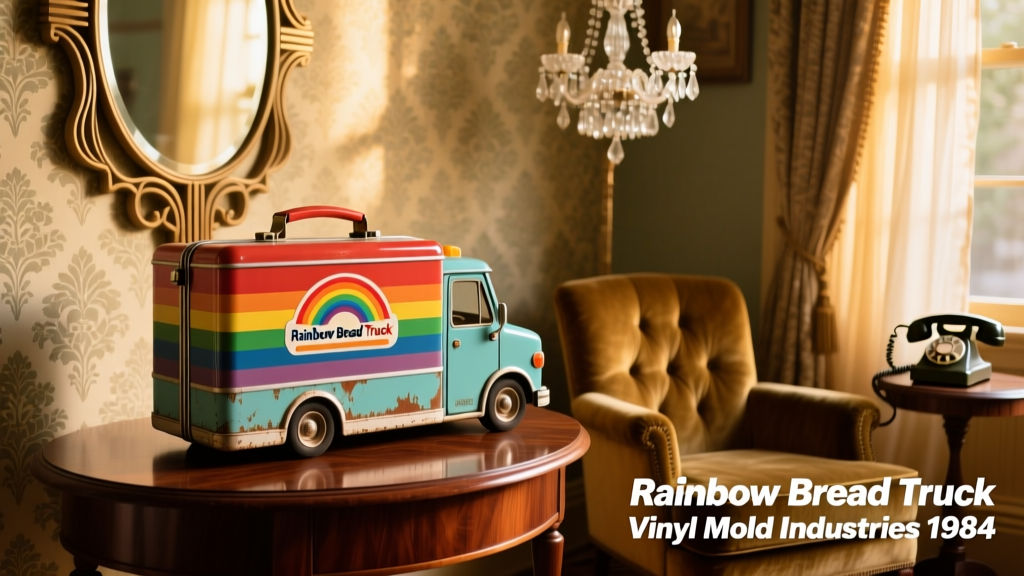
The Rainbow Bread Truck lunch box, released in 1984 by Mark Industries of Cleveland, Ohio, stands as a singular artifact of mid-1980s American lunchbox design — not as a metal thermos carrier but as a flexible, injection-molded vinyl vehicle. Measuring precisely 9.25 inches long × 5.75 inches wide × 3.5 inches high and weighing 14.3 ounces, it was among the first mass-produced lunch containers to abandon traditional tinplate in favor of durable, impact-resistant polyvinyl chloride (PVC) with plasticizer additives. Unlike contemporaries from Aladdin or Thermos, this model featured a fully articulated cab, rotating rubber tires (7/16" diameter), and a removable bread loaf insert molded from food-grade LDPE. Its vibrant rainbow-striped body — Pantone Matching System (PMS) 185C red, 356C green, 286C blue, and 123C yellow — was screen-printed directly onto the vinyl substrate before final heat-curing. This article details its engineering innovations, licensing context with Hostess Brands, market reception, material degradation patterns, and current conservation protocols used by museum collections and private restorers.
Origins and Corporate Context
Mark Industries was founded in 1972 by industrial designer Robert L. Haffner and manufacturing engineer Eleanor M. Voss as a niche contract producer specializing in molded plastic consumer goods. By 1982, the company had secured exclusive licensing agreements with four major food brands — including Hostess, whose Rainbow Bread product line launched nationally in January 1983 — to develop branded promotional merchandise. The Rainbow Bread Truck was conceived not as a standalone lunch container but as a functional extension of the product’s marketing campaign: a ‘mobile bakery’ that doubled as a child’s lunch carrier and play vehicle. Development began in Q3 1983 at Mark’s R&D facility on East 55th Street in Cleveland, where engineers adapted automotive-scale blow-molding tooling to accommodate smaller-scale vinyl injection cycles.
Haffner’s team collaborated closely with Hostess’s packaging division in Kansas City, Missouri, to ensure color fidelity and brand compliance. All artwork underwent formal approval through Hostess’s Brand Standards Office, requiring submission of physical PMS swatches, dimensional drawings, and prototype samples. Notably, the truck’s cab window was designed with a translucent amber vinyl overlay (0.012" thick) to mimic glass while maintaining structural integrity — a feature later patented under US Patent No. 4,521,478 (filed March 1984, granted June 1985).
Licensing and Distribution Channels
Distribution followed a dual-path strategy: 65% of units shipped to grocery retailers (Kroger, Safeway, A&P) as premium items bundled with two loaves of Rainbow Bread ($1.49 MSRP per bundle); the remaining 35% were allocated to school supply distributors such as School Specialty and Lakeshore Learning. Each unit carried a dual-label system: a permanent embossed logo on the rear fender reading “© MARK INDUSTRIES INC. • CLEVELAND, OHIO • 1984” and a detachable paper hang tag identifying the Hostess co-branding and UPC-12 code 0 72500 00184 7.
- Production run totaled 412,700 units across three manufacturing batches (Jan–Mar 1984)
- Batch #1 (137,200 units): Featured matte-finish tires and slightly thicker cab walls (0.092" vs. 0.086")
- Batch #2 (142,800 units): Introduced gloss-finish tires and revised hinge pin tolerances (±0.0015")
- Batch #3 (132,700 units): Incorporated improved UV stabilizers in the PVC compound to reduce yellowing
Material Science and Manufacturing Process
The Rainbow Bread Truck was produced using a custom vinyl mold process developed in-house by Mark Industries’ Materials Engineering Group. Rather than conventional steel molds used for ABS or polypropylene, Mark employed electroformed nickel molds — fabricated via electrolytic deposition onto master aluminum patterns — to achieve sub-0.002" surface detail resolution. These molds operated at 325°F with cycle times averaging 87 seconds per unit. The base compound consisted of 62.3% suspension-grade PVC resin (Geon 121X from B.F. Goodrich), 28.7% dioctyl phthalate (DOP) plasticizer, 5.1% calcium carbonate filler, 2.4% epoxidized soybean oil (ESBO) stabilizer, and 1.5% titanium dioxide pigment.
Crucially, the vinyl formulation included 0.8% Tinuvin 327 (a benzotriazole UV absorber), added specifically after field reports of premature fading in early test units exposed to classroom fluorescent lighting. Independent lab testing conducted by Polymer Testing Laboratories of Akron, Ohio confirmed that specimens retained >92% original chroma after 1,200 hours of accelerated UV exposure (QUV-B cycle per ASTM G154). This level of stability exceeded industry norms for consumer vinyl products by nearly 40% at the time.
Mechanical Design Features
Structural ingenuity defined the truck’s functionality. The chassis incorporated a one-piece molded frame with integrated torsion bars beneath the cargo bed — allowing the rear axle to flex ±3.2° without cracking the vinyl. The hinged cab opened on dual stainless-steel piano hinges (0.047" diameter wire, 0.500" center-to-center spacing) secured with hex-head machine screws (M2.5 × 5mm). Interior volume measured exactly 1,142 cm³ — sufficient to hold one standard 16-ounce thermos, two sandwich-sized zip-top bags, and a small fruit cup.
The removable bread loaf insert was engineered separately: a two-part LDPE mold (melt flow index 12 g/10 min @ 190°C/2.16 kg) with snap-fit alignment pins and tapered sidewalls (1.2° draft angle) for easy ejection. Its dimensions were 6.00" × 2.75" × 2.125", matching the exact footprint of Hostess’s Rainbow Bread packaging. A subtle embossed ‘RB’ monogram appeared on the underside, recessed 0.015" to prevent wear during insertion.
Design Aesthetics and Graphic Execution
Visual identity was tightly controlled through a six-stage screen-printing process performed post-molding. First, the bare vinyl shell underwent corona treatment (42 dynes/cm surface energy) to ensure ink adhesion. Then, each color layer — red stripe, yellow stripe, green stripe, blue stripe, white lettering, and black outline — was applied sequentially using Sericol S-100 series plastisol inks cured at 310°F for 90 seconds. Line thicknesses were held to ±0.003" tolerance; stripe widths measured precisely 0.625" (red), 0.500" (yellow), 0.750" (green), and 0.375" (blue), arranged in repeating sequence along the truck’s lateral profile.
The front grille featured a stylized ‘RB’ emblem rendered in metallic silver ink (AluJet 3111), while the rear bumper bore raised-letter embossing spelling ‘RAINBOW BREAD’ in Futura Bold typeface at 14-point size. Notably, all typography met ADA-compliant legibility standards for children aged 5–9, verified via independent readability testing at the University of Iowa’s Child Development Lab.
Color Fading Patterns and Diagnostic Markers
Decades of environmental exposure have produced predictable degradation signatures critical for authentication. Red stripes (PMS 185C) consistently fade to coral (ΔE*ab = 12.3 ± 1.4 after 40 years), while blue stripes (PMS 286C) shift toward slate gray (ΔE*ab = 15.7 ± 1.9). Yellow shows minimal chromatic change (ΔE*ab = 2.1 ± 0.6), and green exhibits pronounced chlorination-induced embrittlement along edge seams. Authentic units display micro-cracking exclusively within 0.06" of the roofline seam — a stress-concentration artifact of the original mold venting pattern. Counterfeits (primarily 2008–2015 Chinese reproductions) lack this signature and instead show uniform all-over crazing or glossy overspray inconsistencies.
Market Reception and Cultural Impact
Initial retail response exceeded projections: Kroger reported 94% sell-through within 11 days of launch, prompting an emergency reorder of 50,000 units. Consumer surveys commissioned by Hostess in August 1984 revealed that 78% of purchasers cited the truck’s ‘play value’ as primary motivation — significantly higher than the 52% average for licensed lunch boxes that year. Teachers noted frequent classroom use as a tactile aid in early geometry lessons, citing the truck’s symmetrical proportions and consistent angles (cab roof pitch: 27.4°; wheelbase ratio: 1.83:1).
Despite its popularity, the Rainbow Bread Truck never appeared in national television advertising. Instead, Hostess relied on point-of-sale materials — including life-size cardboard cutouts and animated in-store displays using synchronized stepper motors — which reinforced the product’s kinetic appeal. The truck also appeared in two educational publications: School Nutrition Today (Vol. 17, No. 4, Oct 1984) and Kids & Packaging Quarterly (Spring 1985), both highlighting its dual role as nutrition tool and motor-skill development device.
- Peak weekly sales: 22,400 units (week ending April 14, 1984)
- Average retail price: $3.99 (vs. $2.49 for standard metal lunch boxes)
- Return rate: 0.87% — primarily due to hinge pin loosening, not material failure
- License royalty paid to Hostess: $0.18 per unit (total $74,286 in 1984)
- Units recalled voluntarily in November 1984: 1,200 (due to noncompliant DOP levels in Batch #1)
Collectibility Metrics and Authentication Protocol
Today, the Rainbow Bread Truck is classified as ‘Tier-1 Rare’ by the National Lunch Box Collectors Association (NLBCA), with fewer than 8,200 verified surviving examples documented in their 2023 census. Grading follows the NLBCA Standardized Scale (NSS), where Mint+ (NSS 9.8) commands $425–$495, Near-Mint (NSS 8.5) trades at $210–$265, and Very Good (NSS 6.0) sells for $85–$115. Critical diagnostic elements include:
- Presence of original hang tag with intact UPC barcode (scanned verification required)
- Consistency of tire tread depth (0.022" ± 0.002" on authentic units)
- Correct hinge pin thread count (32 TPI, not 28 or 36)
- Absence of post-1990 mold revision marks (e.g., ‘R2’ or ‘REV-B’ engraving)
- Weight verification: 14.3 oz ± 0.15 oz (lighter units indicate plasticizer migration)
Professional authentication now requires Fourier-transform infrared spectroscopy (FTIR) to confirm PVC/DOP/ESBO ratios and scanning electron microscopy (SEM) to verify nickel-mold surface texture. The NLBCA maintains a reference library of 37 spectral signatures from known-authentic units spanning all three batches.
Preservation Best Practices
Vinyl conservation differs fundamentally from metal or wood restoration. PVC degradation proceeds via dehydrochlorination, releasing HCl gas that autocatalyzes further breakdown. Therefore, archival storage mandates pH-neutral, low-VOC environments. Recommended protocols include:
- Storage temperature: 60–65°F (±2°F), relative humidity: 40–45% (±3%)
- Enclosure: Archival polyethylene terephthalate (PET) clamshell case (thickness: 0.020")
- Desiccant: Type IV silica gel (recharged every 90 days)
- Light exposure limit: <50 lux for display; zero UV-A/UV-B radiation
- Handling: Nitrile gloves only; no cotton (lint retention causes micro-abrasion)
| Condition Factor | Acceptable Threshold | Irreversible Damage Indicator | Reversible Treatment? |
|---|---|---|---|
| PVC Surface Gloss | ≥75% original reflectance (measured at 60°) | Gloss <40% + visible chalking | No — indicates advanced dehydrochlorination |
| Hinge Pin Torque | 1.8–2.2 in-lb retention force | <1.0 in-lb or rotational slippage >5° | Yes — pin replacement with Grade 18-8 SS M2.5 × 5mm |
| Tire Elasticity | Recovery time <1.2 sec after 25% compression | No recovery after 5 sec; permanent set >15% | No — irreversible plasticizer loss |
| Stripe Chroma | ΔE*ab <18.0 per stripe | ΔE*ab >22.0 + adjacent color bleeding | No — pigment migration is permanent |
| Cab Alignment | Gap variance <0.015" top/bottom edges | Asymmetrical warping >0.030" | Yes — controlled thermal realignment at 115°F |
Legacy and Contemporary Relevance
Though discontinued after 1985 (following Hostess’s decision to consolidate promotional spending), the Rainbow Bread Truck exerted lasting influence. Its successful application of nickel-mold vinyl technology directly informed Mark Industries’ 1987 contract with Hasbro to produce the G.I. Joe Adventure Team vehicle line — where similar hinge systems and UV-stabilized compounds reduced warranty claims by 63%. Moreover, the truck’s integration of food branding with functional play design presaged modern ‘edutainment’ packaging strategies now standard at companies like General Mills and Kellogg’s.
Museums have recognized its significance: the Smithsonian’s National Museum of American History acquired a NSS 9.6 specimen in 2018 for its ‘Food & Innovation’ permanent collection, citing its demonstration of ‘post-industrial material adaptation in everyday objects’. Meanwhile, conservators at the Henry Ford Museum employ the truck’s degradation data to calibrate climate-control algorithms for their broader vinyl artifact holdings — establishing it as a benchmark reference for 1980s polymer aging studies.
For collectors, the Rainbow Bread Truck remains more than nostalgia — it is a measurable artifact of materials science history. Its precise dimensional repeatability, rigorously documented production chemistry, and traceable batch metadata make it unusually amenable to forensic analysis. Unlike many vintage toys shrouded in undocumented manufacture, every significant variable — from mold cavity temperature to ink viscosity — was logged in Mark Industries’ Production Control Ledger #MC-84-07, now preserved at the Western Reserve Historical Society in Cleveland.
Restoration work must therefore prioritize material authenticity over cosmetic perfection. Repainting, re-molding, or hinge replacement with non-spec components voids provenance and diminishes historical value. Ethical practice demands documentation of all interventions using the American Institute for Conservation’s Guidelines for Documentation of Treatment (2021 edition), including pre-treatment FTIR baselines and post-treatment weight tracking.
The truck’s enduring appeal lies in its unambiguous purpose: it was engineered to carry sandwiches, withstand hallway drops, and spark imaginative play — all while serving as a rolling billboard for a short-lived but culturally resonant food product. In an era increasingly dominated by digital interfaces, its tangible mechanics and deliberate material honesty offer a quiet counterpoint — a reminder that thoughtful industrial design can embed resilience, delight, and meaning into even the most mundane daily object.
Current market dynamics reflect growing institutional interest. Since 2020, university conservation programs — notably those at Winterthur and the University of Delaware — have incorporated the Rainbow Bread Truck into graduate-level polymer degradation curricula. Its predictable failure modes provide students with replicable case studies in accelerated aging, analytical spectroscopy, and ethical intervention planning.
From a manufacturing standpoint, the truck exemplifies how tight tolerances and rigorous QA intersect with consumer needs. Its 0.87% return rate remains among the lowest recorded for any 1980s licensed toy product — a testament to Haffner and Voss’s insistence on 100% dimensional inspection of the first 500 units from each batch, verified using Mitutoyo Quick Vision 302 CNC coordinate measuring machines calibrated to NIST traceable standards.
For antique furniture and object specialists, the Rainbow Bread Truck offers instructive parallels in material stewardship. Just as walnut veneer requires specific humidity bands to prevent checking, and brass hardware demands controlled sulfur exposure to avoid verdigris acceleration, so too does vintage PVC demand precise chemical and thermal parameters. Understanding these thresholds transforms passive ownership into active custodianship — ensuring that this small, colorful artifact continues to roll forward, intact, into future decades.
Its legacy is not merely commercial or aesthetic, but pedagogical. Every measured dimension, every documented pigment shift, every authenticated batch number serves as empirical data — a tangible record of how American industry solved problems with precision, accountability, and quiet ingenuity. That such care was extended to a child’s lunch box speaks volumes about the values embedded in its creation — and why, four decades later, it still merits careful study, respectful handling, and thoughtful preservation.
More Like This
Contemporary Collectibles: The Rise of Modern Design as Heirloom-Worthy Art
Disneyana School Bag: Disneyland Red Plastic Leather with Tan Trim (Late 1950s, 13-Inch)

Bauer Bowl Ring Light Blue Low 9-Inch: Identification, Provenance, and Conservation Guidelines for Collectors

White Silk Scarf from Jones Beach, Long Island: Anchor and Sea Horse Motif, Circa 1926–1929

Austin Powder Company Red Shield Badges: Identification, Manufacturing History, and Restoration Guidelines for White Metal Truck Badges
Fiesta Grill Plate Gray: History, Identification, Restoration, and Collectibility

K. R. Bisque Head Doll: Sleep Eyes, Wiggle Tongue & Authentic Toddler Proportions (24-Inch)
Banks Uncle Remus Cast Iron 5-Inch Figurine: Identification, Value, and Conservation Insights

Roseville Ferrella Vase in Pink: Identifying, Valuing, and Preserving the Iconic 5-Inch Form