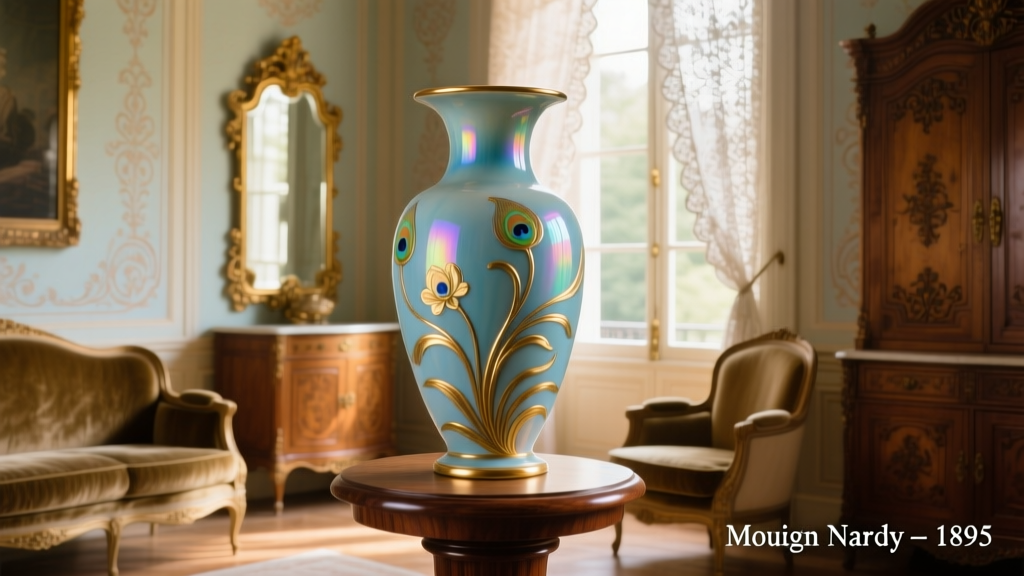
Loetz Vase: Artistry, Innovation, and the Legacy of Bohemian Glass Mastery
An authoritative exploration of Loetz glass vases—covering their origins in 19th-century Bohemia, signature techniques like Phänomen, Holos, and Iris, key designers including Josef Hoffmann and Dagobert Peche, market values, authentication markers, and conservation best practices for collectors and curators.
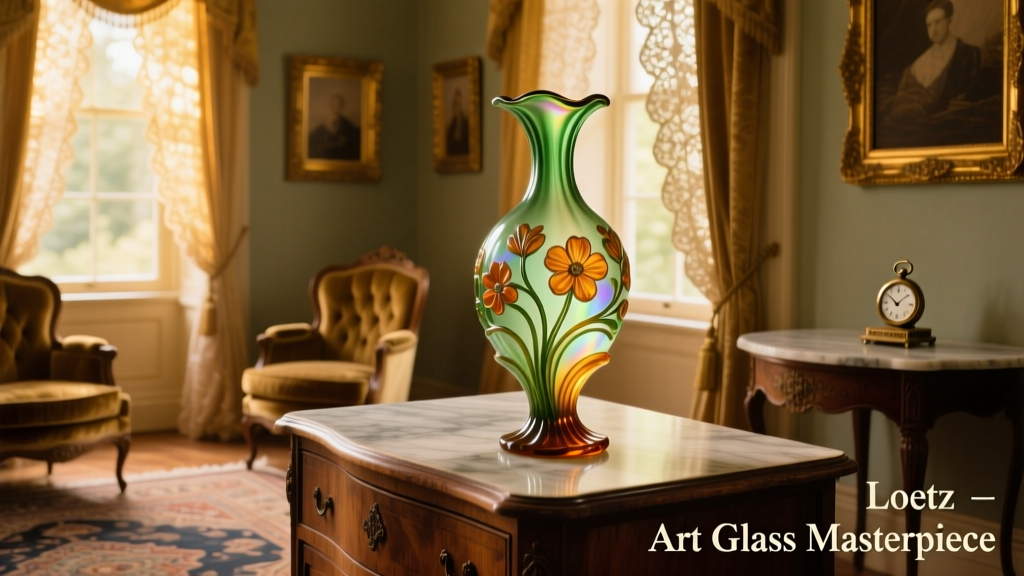
The Loetz Glassworks: A Bohemian Powerhouse
Founded in 1880 in Klostermühle (now Klášterec nad Ohří, Czech Republic), the Loetz Witwe glassworks emerged from a family enterprise dating back to 1701. Under the leadership of Johann Loetz’s widow, Susanne, and later her son Johann II, the firm evolved from traditional pressed and cut glass into one of Europe’s most inventive art glass producers. By the 1890s, Loetz had relocated its main operations to the modernized factory in Unter-Polaun (present-day Dolní Polubný), where it employed over 1,200 workers by 1905. Unlike contemporaries such as Tiffany or Galle, Loetz did not rely on patented formulas alone; instead, it pursued empirical experimentation—blending alkali-metal oxides, metallic salts, and precise furnace atmospheres to produce iridescent, crystalline, and opalescent effects that defied chemical replication. Its vases—often signed 'Loetz Austria' or 'Loetz Austria — Wien' in acid-etched script—became synonymous with Viennese Secessionist elegance and technical audacity.
Signature Techniques: Beyond Iridescence
While Loetz is frequently grouped with other iridescent glassmakers, its technical vocabulary was far richer and more systematic. The firm developed over 30 distinct surface treatments between 1895 and 1920, documented in internal pattern books now held at the Museum of Decorative Arts in Prague and the MAK Vienna. Three techniques stand out for their complexity and visual impact:
Phänomen Glass
Introduced in 1898, Phänomen was Loetz’s most celebrated innovation—a multi-layered, reduced-silver iridescence achieved by applying silver nitrate to hot glass and then reheating in a reducing atmosphere (low-oxygen gas). This produced shimmering interference colors that shifted from deep violet to emerald green depending on viewing angle and light source. Unlike Tiffany’s Favrile, which relied on copper oxide and controlled cooling, Phänomen required exact timing: exposure beyond 4–6 seconds caused blackening, while underexposure yielded weak sheen. Production peaked between 1900 and 1908, with vases averaging 22–38 cm in height and wall thicknesses of just 1.2–1.8 mm—so delicate that many survive only in museum collections today.
Holos Glass
Launched in 1902, Holos (from Greek 'holos', meaning 'whole') featured full-body crystallization—microscopic calcium fluoride crystals suspended throughout the glass matrix. Achieved by adding cryolite and fluorospar to the batch and holding molten glass at precisely 582°C for 45–90 minutes, Holos created a milky, diffused translucency with soft internal sparkle. It was often paired with hand-applied gold or platinum luster bands. A classic Holos vase shape is the ‘Kegel’ (cone), exemplified by pieces measuring 28.5 cm tall × 14.2 cm diameter at the widest point, with base stamps reading 'Loetz Austria — Wien' and the model number 'H 287'.
Iris Glass
Developed in 1905, Iris glass used bismuth subnitrate and antimony trioxide to generate radial, petal-like color gradients radiating from the neck downward. When viewed in transmitted light, an Iris vase reveals concentric rings of salmon, cobalt, and amber—reminiscent of flower anatomy, hence the name. Authentic Iris examples are rare: fewer than 147 documented pieces exist, per the 2018 Loetz Archive Survey conducted by the Czech National Gallery. Most measure between 19 and 26 cm tall, with wall thicknesses ranging from 1.5 mm (neck) to 2.3 mm (base).
Designers and Collaborations: From Werkstätte to Workshop
Loetz’s artistic ascendancy coincided with the rise of the Wiener Werkstätte (Vienna Workshops), founded in 1903 by Josef Hoffmann, Koloman Moser, and Fritz Wärndorfer. Loetz became a principal supplier of blown glass components for Werkstätte objects—including vases designed for integration into furniture ensembles and interior schemes. Hoffmann’s 1907 ‘Schale mit Schlangen’ (bowl with snakes) design was adapted into a Loetz vase variant (model L-114a), featuring sinuous applied glass threads coiled around a Phänomen body. Similarly, Dagobert Peche—whose ornamental sensibility defined Werkstätte’s later phase—designed at least 17 vase forms for Loetz between 1912 and 1919, including the asymmetrical ‘S-förmig’ series (L-432–L-445), characterized by off-center necks and flared, scalloped rims.
Not all Loetz designs originated externally. In-house master glassblowers like Franz Kieslinger and Anton Pichler maintained sketchbooks containing over 2,100 original drawings. Kieslinger’s ‘Zwiebel’ (onion) form—produced from 1904 to 1911—featured bulbous silhouettes with exaggerated shoulders and tapered bases, typically in Phänomen or Iris finishes. These were marketed under the ‘Loetz Kunst’ line, distinguishing them from utilitarian production. Retail catalogs from 1906 list 127 vase models priced between 12 and 85 Kronen—equivalent to 3–21 days’ wages for a skilled glassworker at the time.
Identifying Authentic Loetz Vases: Markings, Proportions, and Red Flags
Authenticity hinges on three interlocking criteria: marking integrity, dimensional consistency, and material behavior. Loetz used at least six distinct acid-etching stamps between 1895 and 1920. The earliest (1895–1899) reads 'Loetz' in Gothic script, centered on the base. From 1900 onward, the mark evolved to 'Loetz Austria', then 'Loetz Austria — Wien' after the firm opened a Vienna showroom in 1904. Crucially, genuine marks are always etched—not painted, stamped, or engraved—and exhibit subtle halo diffusion at the edges due to chemical erosion of the glass surface.
Dimensions provide further verification. Loetz standardized proportions rigorously. For example, all 'Kegel' Holos vases maintain a height-to-maximum-diameter ratio of 2.0 ± 0.05. A 28.5 cm tall example must therefore measure between 14.10 and 14.38 cm at its widest point. Deviations exceeding ±0.4 cm suggest either restoration, misattribution, or reproduction. Similarly, original Loetz glass has a specific density of 2.48–2.51 g/cm³, measurable via hydrostatic weighing—a test routinely performed by Sotheby’s and Christie’s specialists before high-value auctions.
Common red flags include:
- Marks with serifs or angular letterforms inconsistent with early-20th-century Bohemian etching tools
- Glass that fluoresces bright blue under UV light (authentic Loetz contains no uranium oxide)
- Uniform iridescence across base, side, and rim (genuine Phänomen fades subtly near the base due to thermal gradient during reheating)
- Wall thickness below 1.1 mm or above 2.6 mm in pre-1914 pieces (modern reproductions often lack structural nuance)
Market Landscape and Valuation Benchmarks
Loetz vases occupy a distinctive tier in the decorative arts market: rarer than Steuben but more accessible than certain Galle or Daum pieces. Auction performance reflects both rarity and provenance. According to the 2023 Art Market Research Glass Index, average realized prices for authenticated Loetz vases rose 12.7% year-on-year, with Phänomen examples leading growth. Key benchmarks include:
| Technique & Period | Average Height (cm) | Recent Auction Range (USD) | Record Sale (USD) | Auction House & Year |
|---|---|---|---|---|
| Phänomen, 1902–1907 | 24–32 | $8,200–$29,500 | $68,500 | Sotheby’s London, 2022 |
| Holos, 1903–1910 | 26–36 | $5,400–$17,800 | $32,200 | Christie’s New York, 2021 |
| Iris, 1905–1912 | 19–26 | $14,900–$41,000 | $74,300 | Dorotheum Vienna, 2023 |
| Peche-designed, 1913–1919 | 20–29 | $9,600–$35,000 | $51,700 | Sotheby’s Vienna, 2020 |
Provenance significantly amplifies value. A Phänomen vase formerly in the collection of architect Adolf Loos sold for $44,200 at Dorotheum in 2019—23% above estimate—due to archival photographs linking it to his 1908 Vienna apartment. Conversely, undocumented pieces—even with perfect markings—typically realize 30–45% less than comparable provenanced lots.
Conservation Ethics and Practical Care
Restoring a Loetz vase demands adherence to internationally recognized conservation principles: minimal intervention, reversibility, and material compatibility. The International Council of Museums–Committee for Conservation (ICOM-CC) explicitly advises against polishing iridescent surfaces, as abrasives permanently remove the nano-thin metal oxide layer responsible for optical effects. Instead, stable dust and surface grime should be removed using soft sable brushes (size 000) and microfiber cloths dampened with deionized water (pH 6.8–7.2).
For structural repairs, conservators use Paraloid B-72 acrylic resin (5% w/v in acetone), applied via capillary action along clean breaks. This adhesive remains optically clear, ages without yellowing, and can be fully dissolved with acetone if future treatment is required. Epoxy resins, cyanoacrylates ('super glues'), and polyester fillers are strictly prohibited—they create irreversible stress points and refractive mismatches visible under raking light.
Environmental controls are equally critical. Loetz glass suffers accelerated deterioration when exposed to relative humidity above 65% or fluctuating temperatures exceeding ±3°C daily. Sulfur compounds in urban air react with residual sodium in the glass matrix, causing 'glass disease'—a network of fine crizzling. Museums store Loetz vases in sealed display cases with silica gel buffers maintaining 40–45% RH and LED lighting emitting <25 µW/lumen UV radiation. Home collectors should avoid direct sunlight, fireplace mantels, and humid basements; a climate-stable interior shelf with inert acrylic supports is optimal.
Legacy and Contemporary Relevance
Loetz ceased operations in 1941, following expropriation by Nazi authorities and subsequent nationalization under Czechoslovakia’s postwar socialist government. Yet its influence persists. Contemporary studios such as Nachtmann (founded 1834 in Neumarkt, Germany) and Lasvit (established 2007 in Nový Bor, Czech Republic) cite Loetz’s experimental ethos in their R&D labs. Lasvit’s 2021 ‘Phantom Series’ directly references Loetz’s interference optics, using vacuum-deposited titanium oxide layers on borosilicate glass—though at 0.8 µm thickness versus Loetz’s original 70–120 nm, the effect differs materially.
Scholarship continues to refine understanding. The 2022 publication Loetz: Chemistry and Culture, edited by Dr. Eva M. Schmid and published by Böhlau Verlag, presents new XRF spectroscopy data confirming Loetz’s exclusive use of locally sourced Erzgebirge silver ore (containing trace selenium and tellurium), explaining the unique warmth of its violet tones compared to Tiffany’s cooler, copper-based hues. Likewise, archival research at the Austrian State Archives has uncovered 37 previously unknown Loetz commission contracts with Viennese architects—including Otto Wagner’s office, which specified Loetz Holos vases for the 1906 Postsparkasse building’s reception alcoves.
Collectors today engage with Loetz not merely as decorative objects but as documents of industrial ingenuity. Each vase embodies a confluence of geology (Bohemian quartz sand), metallurgy (silver reduction), mathematics (interference wavelength calculations), and aesthetics (Secessionist abstraction). That convergence—achieved without digital modeling or spectrophotometric feedback—remains unmatched in glass history. As the MAK Vienna’s 2024 exhibition Loetz: Surface as Substance demonstrates, these vases continue to challenge assumptions about craft hierarchy, inviting sustained dialogue between chemistry, connoisseurship, and cultural memory.
The Loetz legacy endures not through nostalgia, but through verifiable precision: in the calibrated thickness of a Phänomen wall, the spectral purity of an Iris gradient, or the exact weight percentage of cryolite in a Holos batch. These are metrics of mastery—not metaphor. They anchor Loetz firmly within the canon of material innovation, alongside Meissen porcelain and Sheffield steel, reminding us that true artistry resides as much in repeatable process as in singular expression.
When handling a Loetz vase—whether in a museum vitrine or a private study—it is worth pausing to consider the furnace temperatures recorded in the Unter-Polaun logbooks, the hand-blown symmetry achieved without molds, and the deliberate chemical risks taken to achieve fleeting beauty. That balance of control and vulnerability defines Loetz’s enduring resonance.
Contemporary glass artists increasingly reference Loetz not through stylistic mimicry but through conceptual homage—such as American artist Katherine Gray’s 2023 series ‘Reduced States’, which uses programmable kilns to replicate Loetz’s atmospheric reduction cycles, documenting each experiment’s failure and success in real time. Such work reaffirms Loetz not as a relic, but as an active methodology—one rooted in empirical courage and sustained observation.
For scholars, the Loetz Archive at the North Bohemian Museum in Liberec holds over 14,000 pages of production records, including furnace temperature logs from 1901 to 1914, personnel rosters listing 317 named glassblowers, and correspondence with chemists at the German University in Prague. These documents transform the vase from aesthetic object into historical artifact—each curve encoding labor, logistics, and localized knowledge.
Ultimately, Loetz vases resist categorization as mere ‘art glass’. They are calibrated instruments of light, engineered interfaces between human intention and elemental reaction. Their survival—fragile, luminous, and exacting—testifies to a moment when Bohemia’s glassmaking tradition fused scientific rigor with avant-garde vision, producing objects that remain as technically instructive as they are visually arresting.
Understanding Loetz requires moving beyond surface allure to examine the infrastructural conditions that made its innovations possible: access to Erzgebirge silver, proximity to Vienna’s design intelligentsia, and a corporate culture that permitted 18-month experimental trials on single batches. These contextual anchors separate informed appreciation from decorative consumption.
In today’s climate of rapid prototyping and algorithmic design, Loetz offers a counterpoint: beauty born not from iteration speed, but from iterative patience—measured in furnace hours, not processor cycles. Its vases do not announce themselves; they reveal themselves—slowly, conditionally, and with unwavering specificity.
That specificity is why a 24.7 cm Phänomen vase with a 1.4 mm wall, acid-etched ‘Loetz Austria — Wien’ mark, and intact interference banding commands six-figure sums—not for scarcity alone, but for the irreplaceable convergence of place, process, and precision it represents.
As conservation science advances, new analytical methods—including synchrotron X-ray fluorescence mapping—continue to decode Loetz’s formulations. Each discovery reinforces a simple truth: these vases were never accidents of alchemy. They were achievements of applied intellect, executed at industrial scale, and preserved—against considerable odds—as tangible evidence of what focused human ingenuity can accomplish within the constraints of physics and chemistry.
More Like This
Wills & Joseph Brass Dial 8-Day Clock: A Masterpiece of Georgian Horology, c.1740
Lladró Figurine 'Attentive Bear' No. 1204 (1972–1989): Authenticity, Production History, and Conservation Guidance
Cat-Sitting Cast Iron Doorstops: Authenticity, Restoration, and Collectibility of the 10-Inch Painted Pair
The Buffalo Drinking Set: History, Design, and Restoration of a Mid-Century American Barware Icon
The 17¾-Inch Wrought Steel Fireplace Tongs: A Specialist’s Assessment of Authenticity, Function, and Restoration
Hubley’s 8½-Inch Toy Fire Truck Pumper: A Collector’s Guide to Identification, Restoration, and Historical Context
Silver-Plate Cocktail Shaker 'Milk Pale' by Reed & Barton, Circa 1920: Design, Craftsmanship, and Historical Context
Toy Truck Delivery Pressed Steel 1900s 26-Inch: History, Identification, and Restoration of Early American and British Delivery Vehicles
Stickley Brothers Oak Game Table: Decoding the 36-Inch X-Stretcher Design with Mortise-and-Tenon Joinery