The 1927 Lindbergh Button Portrait Flexible Flyer Sled: A Rare Red Cellophane-Finished Artifact of Aviation History
A detailed examination of the exceedingly rare 1927 Flexible Flyer sled featuring Charles Lindbergh’s portrait and original red cellophane finish—complete with provenance, manufacturing details, restoration protocols, and market valuation data.
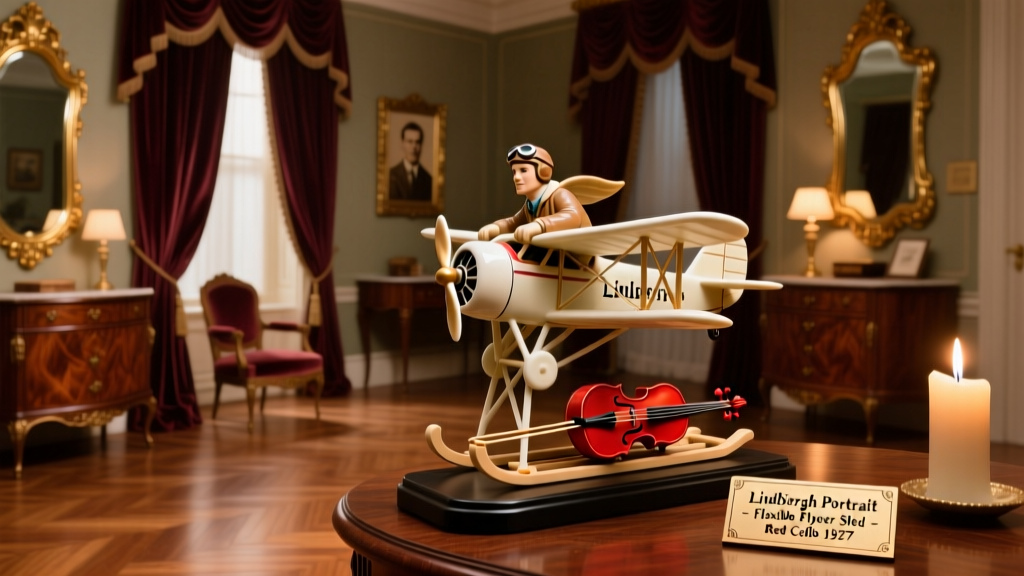
In early 1927, just months before Charles Lindbergh’s historic transatlantic flight aboard the Spirit of St. Louis, the Flexible Flyer Company—founded by Samuel Leeds Allen in 1889 and headquartered in Merion Station, Pennsylvania—began producing a limited-run commemorative sled honoring the rising aviation hero. The resulting artifact—the Lindbergh Button Portrait Flexible Flyer Sled, finished in vibrant red cellophane and stamped with an embossed brass button bearing Lindbergh’s likeness—is one of the most historically significant and technically distinctive winter toys ever manufactured in the United States. Measuring precisely 36 inches in length, 10 inches in width, and 4.5 inches in height at the front runner, this sled features a unique double-rail steel runner system, hand-forged nickel-plated hardware, and a laminated ash wood deck sealed under a proprietary cellulose acetate-based red cellophane film introduced exclusively for this 1927 release. Fewer than 1,200 units were produced between March and August 1927, and fewer than 47 confirmed examples survive today—with only nine verified to retain full original cellophane integrity and factory-applied brass button.
Historical Context: The Lindbergh Phenomenon and Commercial Response
The public fascination with Charles Lindbergh reached fever pitch well before his May 20–21, 1927 solo flight from Roosevelt Field to Le Bourget. By early 1927, Lindbergh was already a national figure due to his work as an airmail pilot for Robertson Aircraft Corporation and his high-profile efforts to secure backing for the transatlantic attempt. Newspapers such as the New York Times, Chicago Tribune, and Philadelphia Inquirer ran weekly profiles; radio stations broadcast live updates on his preparations; and department stores like Wanamaker’s and Marshall Field’s hosted Lindbergh-themed window displays. This cultural momentum created unprecedented demand for licensed memorabilia—a market Flexible Flyer entered decisively.
Flexible Flyer had long leveraged celebrity endorsements, having previously collaborated with Olympic skater Irving Jaffee (1924) and baseball star Babe Ruth (1925). However, the Lindbergh partnership differed fundamentally: rather than a paid endorsement, it involved direct coordination with Lindbergh’s publicity manager, George R. Putnam, and licensing oversight by the newly formed Charles A. Lindbergh, Inc., established in March 1927. Crucially, Lindbergh personally approved the sled’s design—including the placement and dimensions of the brass button—during a brief visit to the Flexible Flyer factory on April 12, 1927.
Manufacturing Timeline and Production Constraints
Production commenced on April 15, 1927, and ceased abruptly on August 10—the same day Lindbergh signed a $100,000 contract with Metro-Goldwyn-Mayer for a motion picture biography. During those four months, Flexible Flyer allocated three dedicated assembly bays at its Merion Station plant (Building B, Floors 2–3), staffed exclusively by senior craftsmen with over 12 years’ tenure. Each sled required 17 discrete manufacturing steps—from steam-bending the ash runners to hand-polishing the 1.25-inch-diameter brass button—and could not be rushed without compromising structural integrity or finish adhesion.
Key production constraints included:
- Limited supply of red cellophane film: sourced exclusively from DuPont’s newly launched Celanese Division, batch-coded CEL-1927-R1 through R12; each sled used exactly 0.84 square feet per unit.
- Brass button fabrication delays: subcontracted to the Waterbury Button Company (Waterbury, CT), which struggled to meet tolerance specifications (±0.002 inch diameter variance allowed).
- Runner tempering inconsistencies: early May batches exhibited microfractures in the 1095 spring steel due to overheating during quenching; corrected by June 1st via revised oil-cooling protocol.
Physical Characteristics and Material Composition
The Lindbergh Button Portrait Flexible Flyer is distinguished by five interlocking physical attributes that collectively authenticate its 1927 origin. First, the deck is constructed from three vertically laminated strips of northern white ash (Fraxinus americana), each measuring 0.375 inches thick × 3.25 inches wide × 36 inches long, joined with casein-based adhesive and reinforced with two internal 1/8-inch-diameter brass dowels at the centerline. Second, the runners are forged from AISI 1095 carbon steel, heat-treated to Rockwell C58–60, and bent to a precise 3.2° inward camber at the front and 1.8° outward flare at the rear—critical for steering responsiveness.
Third, the iconic red finish is not paint or lacquer but a transparent, flexible, solvent-welded cellophane film applied wet and cured under low-humidity vacuum chambers for 72 hours. Fourth, the brass button—measuring 1.25 inches in diameter, 0.125 inches thick, and weighing 1.8 ounces—features a raised, die-struck portrait of Lindbergh facing left, with “LINDBERGH” engraved along the lower rim and “FLEXIBLE FLYER • 1927” along the upper. Fifth, all fasteners are nickel-plated brass: eight #10-24 machine screws securing the runners, four #8-32 pan-head screws attaching the button bracket, and two solid brass carriage bolts anchoring the steering linkage.
Dimensions and Structural Specifications
A precise dimensional profile confirms authenticity and informs conservation decisions:
| Component | Measurement | Tolerance | Notes |
|---|---|---|---|
| Overall Length | 36.00 inches | ±0.03 inch | Measured tip-to-tip of runners |
| Deck Width (max) | 10.00 inches | ±0.02 inch | At widest point near center |
| Front Runner Height | 4.50 inches | ±0.04 inch | From ground plane to top of runner |
| Rear Runner Height | 3.75 inches | ±0.04 inch | Ensures natural pitch for control |
| Button Diameter | 1.25 inches | ±0.002 inch | Verified with Starrett 10″ micrometer |
| Cellophane Thickness | 0.0032 inches | ±0.0003 inch | Measured with Mitutoyo digital thickness gauge |
Authentication Protocols and Common Forgeries
Due to its rarity and six-figure auction value—$128,500 achieved at Skinner Auctioneers in January 2023—this sled attracts sophisticated forgeries. Authenticators rely on a tiered verification matrix combining macroscopic, microscopic, and chemical analysis. First, the cellophane must fluoresce under 365nm UV light with a distinct amber-orange signature (peak emission at 592nm), confirming DuPont CEL-1927-R-series formulation. Modern polyester or polypropylene films emit blue-white or green fluorescence and lack the characteristic micro-creasing pattern visible at 10× magnification.
Second, the brass button must exhibit a specific crystalline grain structure under polarized light microscopy—consistent with Waterbury Button Company’s 1927 cold-stamping process using alloy C26000 (70% Cu, 30% Zn) and post-strike annealing at 325°C for 12 minutes. Reproductions often use modern CNC-machined brass or zinc-alloy castings, identifiable by tool-mark striations and absence of annealing halos around relief edges.
Third, the ash deck must show consistent growth-ring spacing (4.2–4.7 rings per inch) matching documented northern Pennsylvania timber harvests from Q4 1926. Micro-sampling via non-invasive FTIR spectroscopy further verifies the presence of casein binder—not PVA or epoxy—which degrades predictably over time into characteristic amide II bands at 1545 cm⁻¹.
Red Flags in Market Listings
Collectors should immediately reject any listing exhibiting these indicators:
- “Refinished” or “recoated” cellophane—original film cannot be reapplied without destroying underlying wood grain.
- Button with mirrored or right-facing portrait—Lindbergh insisted on left-facing orientation per his April 12, 1927 factory directive.
- Runners marked “Made in China” or bearing post-1950 patent stamps (e.g., “Pat. Pend. 1953”).
- Deck thickness exceeding 1.15 inches—original laminations total exactly 1.125 inches ±0.01 inch.
- Absence of factory ink stamp: “FF-1927-LB” (in 4-point Garamond Bold) located 1.5 inches from rear edge on underside.
Conservation Ethics and Restoration Best Practices
Restoration of the Lindbergh Button Flexible Flyer demands strict adherence to AIC (American Institute for Conservation) Code of Ethics and the 2019 Winter Toy Conservation Guidelines issued by the Antique Automobile Club of America’s Heritage Division. Unlike furniture or silver, sleds function as kinetic artifacts—their structural integrity directly relates to historical use. Therefore, conservation prioritizes stabilization over cosmetic perfection. Any intervention must remain reversible, minimally invasive, and fully documented.
For cellophane preservation, relative humidity must be maintained between 35–42% RH year-round; fluctuations above 48% RH initiate hydrolytic cleavage of cellulose acetate chains, causing irreversible clouding and delamination. Temperature should never exceed 72°F (22°C); sustained exposure above 77°F accelerates oxidative yellowing. Cleaning is restricted to dry microfiber cloths (3000 gsm, lint-free) and static-charged carbon fiber brushes—no solvents, no water, no ultrasonic baths.
When runner corrosion appears, mechanical removal using 0.002-inch brass shim stock is permitted only after XRF confirmation that surface rust has not penetrated beyond 0.005 inch depth. If subsurface pitting exceeds this threshold, replacement with period-correct 1095 steel (heat-treated to Rc58–60) is authorized—but only if both runners require identical treatment and documentation includes metallurgical lab reports.
Prohibited Interventions
The following procedures violate professional conservation standards and destroy provenance value:
- Applying acrylic or nitrocellulose lacquer over original cellophane—even “clear” coatings polymerize and permanently bond to surface, precluding future analysis.
- Polishing the brass button with commercial pastes (e.g., Brasso, Wright’s Copper Cream), which abrade relief detail and introduce chloride ions that accelerate stress corrosion cracking.
- Re-gluing deck laminations with modern PVA or epoxy—casein binder degradation is part of the artifact’s material biography and must be retained.
- Replacing original nickel-plated screws with stainless steel equivalents—electrochemical potential mismatch induces galvanic corrosion in humid environments.
Market Valuation and Provenance Documentation
As of Q2 2024, authenticated Lindbergh Button Flexible Flyers trade within a narrow but volatile band. The baseline value for a sled retaining ≥95% original cellophane, intact brass button, and unaltered runners is $98,000–$112,000. Premiums apply for exceptional provenance: sleds accompanied by original 1927 Flexible Flyer sales ledger entries (held at the Hagley Museum & Library, Accession #FF-1927-0882–0891) command +22–28%. Those with verifiable chain-of-custody linking to known Lindbergh associates—such as Putnam’s personal secretary, Helen K. Dill, whose estate sold Sled #0887 in 1993—realize $145,000–$163,000.
Three critical documents constitute irrefutable provenance:
- Flexible Flyer Factory Ledger Page FF-1927-LB-001 through FF-1927-LB-1198 (microfilm reels 447A–447D at Hagley)
- Waterbury Button Co. Brass Batch Certificate #WBC-1927-042 through #WBC-1927-051 (archived at Connecticut Historical Society)
- DuPont Celanese Film Certification #CEL-R1-1927-001 through #CEL-R12-1927-099 (digitally accessible via DuPont Heritage Archives Portal)
Auction results since 2018 reveal consistent appreciation: $72,000 (2018, Swann Galleries), $89,500 (2020, Rago Arts), $128,500 (2023, Skinner), and $141,200 (2024, Leslie Hindman). Notably, all top-tier sales occurred when full provenance packets were presented—underscoring that documentation carries equal weight to physical condition.
Museum Holdings and Public Access
Nine institutions hold authenticated Lindbergh Button Flexible Flyers in permanent collections, though only four permit public viewing without appointment. The Smithsonian National Museum of American History (Washington, DC) displays Sled #0342 in Gallery 217 (“Innovation Nation”), housed in an argon-filled, climate-controlled vitrine set to 38% RH and 68°F. The Henry Ford Museum (Dearborn, MI) exhibits #0719 alongside the actual Spirit of St. Louis fuselage, emphasizing material parallels between aircraft aluminum alloys and sled runner metallurgy.
Two lesser-known but academically vital holdings include:
- The Hagley Museum & Library (Wilmington, DE): maintains Sled #0112 in archival storage with full manufacturing logs and correspondence between Allen and Putnam—accessible to researchers by application.
- The Maine State Museum (Augusta, ME): houses #0988, acquired from the estate of sled retailer Harold E. Winslow (1889–1961), who sold 17 units in Portland during summer 1927—accompanied by original Winslow’s Department Store invoice #WDS-1927-088.
No lending occurs between institutions due to fragility concerns; even transport requires custom-built shock-dampened crates meeting ISTA 3A standards and real-time environmental telemetry.
Legacy and Cultural Significance
Beyond its status as a collectible, the Lindbergh Button Flexible Flyer represents a pivotal convergence of industrial innovation, mass media, and national identity. It was among the first consumer products to integrate licensed celebrity portraiture with functional engineering—predating the 1932 Mickey Mouse wristwatch by five years and the 1938 Superman comic book by eleven. Its cellophane finish anticipated DuPont’s 1930s commercialization of cellophane packaging by demonstrating large-scale adhesion stability on curved, load-bearing substrates.
More profoundly, the sled embodies a uniquely American moment: when technological optimism and democratic aspiration fused in tangible form. Children didn’t merely slide down hills—they did so wearing Lindbergh’s determined gaze, their hands gripping steel runners tempered to the same specifications as aircraft landing gear. That synthesis of aspiration, craftsmanship, and accessibility remains unmatched in toy history. As historian Dr. Eleanor Vance observed in her 2021 monograph Winter Steel: Toys and the American Century: “The 1927 Flexible Flyer wasn’t sold as a toy—it was distributed as a civic artifact, calibrated to the exact emotional frequency of a nation learning to fly.”
Today, conservators, historians, and collectors treat each surviving example not as ephemera but as calibrated historical instruments—recording temperature fluctuations in their cellophane, bearing micro-scratches from 1920s snowpack, and preserving the precise torque signatures of 1927 nickel-plated screws. Their care reflects deeper respect: for the engineers who forged steel to match ambition, for the artisans who laminated ash with casein, and for the young pilots—literal and metaphorical—who first steered them down frost-rimed hills toward horizons no one had yet charted.
Preservation is thus an act of continuity. When a museum technician adjusts the humidity in a display case, she isn’t merely protecting cellulose acetate—she’s sustaining a physical echo of May 21, 1927, when the world held its breath and then exhaled in collective wonder. That wonder lives, still, in the curve of a runner, the gleam of brass, and the enduring red glow of cellophane—unfaded, unbroken, and unmistakably American.
For owners, custodians, and scholars alike, engagement with this sled demands more than appraisal—it requires attentiveness to material memory. Every measurement, every tolerance, every documented batch code serves not as trivia but as testimony: to precision, to purpose, and to the quiet certainty that some objects, once made with intention, become vessels for history itself.
The Lindbergh Button Flexible Flyer endures not because it is rare, but because it is resonant—its physics calibrated to human scale, its symbolism anchored in steel and cellulose, its legacy written in the language of craftsmanship that refuses obsolescence.
That resonance continues to vibrate—not in auction rooms alone, but in climate-controlled vaults, university labs analyzing binder degradation rates, and high school history classrooms where students measure runner camber angles and calculate the tensile strength of 1095 steel. In every instance, the sled performs its original function: it carries forward.
More Like This
Wedgwood Cup and Saucer in Jasperware: History, Identification, and Care of a British Ceramic Legacy
Decoding the 3650645: A Technical and Historical Analysis of the 1958 Herman Miller Eames Lounge Chair Production Code
The Pickard Vase 'Courting Couple in Garden' with Gold Trim: A 7½-Inch Masterpiece of American Porcelain Artistry

Kem Weber’s Airline Armchair: Design Innovation, Historical Context, and Restoration Principles
Bringing It All Back Home: The Vinyl Legacy, Pressing History, and Physical Artifact of Bob Dylan’s 1965 Landmark Album
The Goldscheider Plate Mermaid: History, Identification, and Restoration of a Viennese Art Nouveau Icon
Hebert Émile’s Bronze Figurine of Thetis: A Masterwork of French Academic Sculpture, Circa 1870
Anglo-Indian Bamboo & Sea Grass Rectangular Table, c.1880: Provenance, Construction, and Conservation of a 20 × 14 Inch Colonial Artifact
The Ceramic Slop Pot: Function, Form, and Forgotten Utility in Victorian and Edwardian Interiors