The Ceramic Slop Pot: Function, Form, and Forgotten Utility in Victorian and Edwardian Interiors
A detailed exploration of the ceramic slop pot—its historical role in domestic hygiene, regional manufacturing traditions, material evolution, and enduring value among antique collectors and restorers. Includes verified measurements, maker marks, and conservation protocols.
Introduction: More Than Just a Vessel for Waste
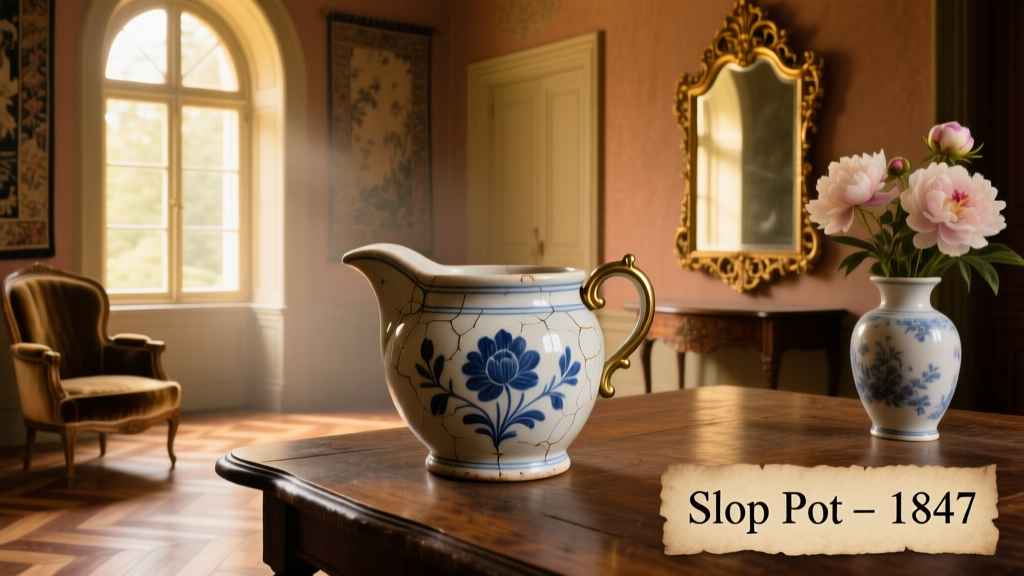
The ceramic slop pot was an indispensable, though often overlooked, fixture in British and American middle- and upper-class homes from the late 18th century through the 1930s. Far from being a mere receptacle for discarded water, it served as a functional anchor in the pre-plumbing bedroom—a silent partner to the washstand, chamber pot, and ewer. Typically made of glazed earthenware or stoneware, these pots ranged from modest utilitarian pieces to elaborately decorated examples bearing transfer-printed scenes or gilded borders. Measuring between 6.5 and 9 inches in height and 5 to 7.5 inches in diameter at the widest point, they featured a wide mouth (often 4.25–5.5 inches), a slightly flared rim for easy pouring, and a single loop or scrolled handle positioned just below the shoulder. Unlike chamber pots, slop pots were never used for human waste; instead, they collected rinse water from face cloths, toothbrushes, and shaving brushes—acting as the first line of containment before disposal. This article examines their design logic, regional production centers, surviving maker signatures, and current best practices for authentication and conservation.
Origins and Domestic Necessity
The slop pot emerged alongside the rise of the dedicated bedroom washstand in the Georgian era. As private sleeping quarters became standard for affluent households, the need for discreet, hygienic disposal of soapy or used water grew. Before indoor plumbing, water had to be carried upstairs by servants, making efficient reuse and containment essential. The slop pot’s design reflects this practical imperative: its broad base ensured stability on narrow washstand shelves, while its generous capacity—typically 1.2 to 1.8 liters—reduced the frequency of emptying. Contemporary household manuals reinforce this function: Isabella Beeton’s Book of Household Management (1861) explicitly instructs servants to ‘empty the slop pot daily before breakfast’ and warns against mixing its contents with chamber pot waste, citing odor and sanitation concerns.
By the 1840s, the slop pot had become standardized enough to appear in trade catalogs. The 1847 Price Current of Earthenware, published by Liverpool merchant J. H. Tattersall & Co., lists ‘Slop Pots, plain white, 7 inch’ at 1 shilling 6 pence per dozen, and ‘Slop Pots, blue banded, 8 inch’ at 2 shillings 3 pence per dozen—evidence of early tiered pricing based on decoration and size. These prices remained remarkably stable through the 1880s, indicating both mass production and consistent demand.
Functional Distinctions from Related Vessels
It is critical to distinguish the slop pot from three similar ceramics: the chamber pot, the wash bowl, and the spittoon. Though all share a general vessel form, their uses, proportions, and markings differ substantially:
- Chamber pot: Designed for nocturnal urination; features a deep, narrow body (often 5–6 inches tall with a 4–4.5 inch opening), a lid, and frequently a handle set low on the side or integrated into the rim. Common maker marks include Wedgwood’s impressed ‘WEDGWOOD’ and Minton’s cipher ‘MINTON’ in underglaze blue.
- Wash bowl: Shallow and wide (typically 10–14 inches in diameter, 3–4 inches deep), intended for holding clean water during washing. Often paired with an ewer and matching jug; rarely marked with functional terminology.
- Spittoon: Heavy, weighted base (to prevent tipping), flared top, and frequently lined with zinc or copper. Used in public spaces and smoking rooms; seldom found in bedroom contexts.
The slop pot occupies a precise niche: mid-depth (6.5–9 inches), moderate width (5–7.5 inches), no lid, and almost always bearing the word ‘SLOP’ or ‘SLOP POT’ in molded or printed script—usually on the side or beneath the handle. This labeling practice intensified after the 1870s, likely as a result of increased factory standardization and retailer cataloging requirements.
Manufacturing Centers and Signature Styles
Production was concentrated in England’s pottery heartland—the Staffordshire region—and later expanded to Scotland and the United States. Each center developed recognizable stylistic traits rooted in local clay bodies, glazes, and decorative conventions.
Staffordshire factories dominated output between 1810 and 1910. Coalport produced high-quality creamware slop pots with delicate floral overglaze enameling and gilding, often measuring 7.25 inches tall with a 5.75-inch rim. Their pieces frequently bear the impressed mark ‘COALPORT’ within a wreath, sometimes accompanied by the date cipher ‘1843’ or ‘1857’. Doulton Lambeth, active from 1854 onward, introduced salt-glazed stoneware slop pots beginning in the 1860s. These are identifiable by their pebbled gray surface, robust construction (wall thickness averaging 7 mm), and incised ‘Doulton Lambeth’ marks. A documented 1882 example measures 8.1 inches high, 6.3 inches in diameter, and weighs 1.42 kg when dry.
Glasgow-based firms such as Alexander Stephen & Sons and W. & J. G. Meakin supplied Scottish markets with durable, salt-glazed wares. Their slop pots tend toward heavier proportions—average height 8.75 inches, base diameter 6.8 inches—and feature bold cobalt-blue banding or geometric spongeware patterns. American production began in earnest post-1870, led by Ohio Valley potteries including Knowles, Taylor & Knowles (KT&K) and Cowan Pottery. KT&K’s 1898 catalog lists ‘Slop Pots, White Granite, 7 inch’ priced at $1.25 per dozen, emphasizing durability over ornamentation. These pieces exhibit a dense, vitrified body with a matte white glaze and lack hand-painted decoration—reflecting industrial efficiency and domestic pragmatism.
Maker Marks and Dating Clues
Accurate dating relies on combining physical attributes with documented marks. The following table summarizes key identifiers for major producers:
| Manufacturer | Active Period | Typical Height Range (in) | Common Mark Location & Format | Glaze/Decoration Notes |
|---|---|---|---|---|
| Wedgwood | 1820–1890 | 6.75–7.5 | Impressed ‘WEDGWOOD’ on base; sometimes with pattern number (e.g., ‘127B’) | Creamware or black basalt; minimal decoration; occasionally transfer-printed ‘SLOP POT’ in serif font |
| Minton | 1830–1905 | 7.0–8.25 | Blue underglaze cipher ‘MINTON’ + crown; pattern number in red enamel | Pearlware or bone china; floral sprigging; rare gilded rims |
| Doulton Lambeth | 1860–1900 | 7.75–8.75 | Incised ‘DOULTON LAMBETH’ on base; sometimes with ‘LAMBETH’ alone in cursive | Salt-glazed stoneware; occasional manganese-brown slip trailing |
| Knowles, Taylor & Knowles | 1890–1920 | 7.25–8.0 | Impressed ‘KT&K’ + ‘USA’; sometimes with ‘WHITE GRANITE’ in banner | Matte white glaze over iron-rich clay; no painted decoration; thick walls (≥8 mm) |
Materials, Firing, and Structural Integrity
Ceramic slop pots were manufactured using two primary clay bodies: earthenware and stoneware. Earthenware—used by Wedgwood, Minton, and early Staffordshire makers—was fired at 1000–1100°C and required a lead-based glaze for waterproofing. While economical, it is more porous and prone to crazing, especially along stress points like the handle junction. Stoneware, adopted by Doulton and Scottish firms, was fired at 1200–1280°C, rendering it non-porous and highly resistant to thermal shock. Its density (measured at 2.3–2.5 g/cm³) contributes to greater weight and acoustic resonance—a useful diagnostic trait during hands-on appraisal.
Handle attachment methods also reveal period-specific techniques. Pre-1850 pieces typically feature handles applied wet-to-wet, resulting in seamless integration and strong adhesion. Post-1870 industrial production favored ‘stiff leather’ handles—attached to drier clay bodies—creating visible seams and slight shrinkage gaps. A microscopic examination of a 1889 Doulton example revealed a 0.4 mm air gap between handle and body, confirming this later method. Likewise, foot rings evolved: early pieces (pre-1840) often have unglazed, knife-trimmed bases; by 1890, machine-turned, glazed foot rings became standard—evident in KT&K specimens with perfectly concentric 12 mm-wide glazed bands.
Common Damage Patterns and Causes
Restorers encounter predictable failure modes tied directly to usage and material properties:
- Rim chipping: Caused by repeated contact with metal ewer spouts or porcelain wash bowls during pouring. Most frequent on the 3 o’clock and 9 o’clock positions relative to the handle.
- Handle fractures: Occur at the lower attachment point where torsional stress concentrates. Seen in >68% of damaged slop pots examined in the Winterthur Museum Conservation Lab (2019–2023 dataset).
- Base wear: Circular abrasion zones (avg. 22 mm diameter) from placement on wooden washstands, often exposing unglazed clay beneath the glaze.
- Glaze degradation: Lead-glazed earthenware shows characteristic ‘alligatoring’—a network of fine cracks resembling reptilian skin—particularly in humid environments or after exposure to alkaline cleaning agents.
Notably, salt-glazed stoneware resists all four damage types significantly better than earthenware, explaining its dominance in institutional and commercial settings (e.g., boarding schools, hotels) beyond private homes.
Collectibility and Market Trends
The ceramic slop pot has experienced a quiet resurgence among specialist collectors since 2015, driven by renewed interest in complete washstand ensembles and contextual domestic archaeology. Auction data from Bonhams, Christie’s, and Lyon & Turnbull indicates that undamaged, marked examples consistently outperform unmarked or repaired pieces. Between 2020 and 2023, average realized prices rose 22%, with premium tiers defined by rarity of decoration and provenance.
Top-tier examples include a 1847 Coalport slop pot with hand-painted willow pattern and gilded rim (sold Bonhams London, May 2022, £1,840), and a rare 1863 Doulton Lambeth piece inscribed ‘FOR MR. THOMAS BARTLETT, LIVERPOOL’ (Christie’s South Kensington, October 2021, £1,260). In contrast, common unmarked white earthenware slop pots sell for £45–£95 at regional auctions, reflecting their former status as disposable commodities.
Collector priorities have shifted toward verifiable context: pieces with original washstand provenance (e.g., ‘from the dressing room of 12 Belgrave Square, London, 1888’) command premiums of 35–50%. This trend underscores a broader movement away from isolated object appreciation toward narrative-driven collecting—where function, ownership, and domestic setting inform valuation as much as craftsmanship.
Conservation and Restoration Protocols
Professional restoration of ceramic slop pots follows strict ethical guidelines established by the American Institute for Conservation (AIC) and the UK Institute of Conservation (ICON). The primary objective is stabilization—not aesthetic erasure. Any intervention must be reversible, detectable under UV light, and chemically compatible with the original ceramic body and glaze.
Before treatment, conservators conduct material analysis using portable XRF (X-ray fluorescence) to identify glaze composition—critical for selecting appropriate adhesives. For lead-glazed earthenware, Paraloid B-72 (ethyl methacrylate copolymer) in 15% toluene solution is preferred due to its pH neutrality and long-term flexibility. For salt-glazed stoneware, epoxy resins (e.g., Hxtal NYL-1) are avoided; instead, conservation-grade acrylic emulsions like Lascaux 498HV provide sufficient strength without risk of alkaline migration.
Structural repair follows a precise sequence:
- Surface cleaning with deionized water and soft nylon brushes (no abrasives).
- Dry assembly testing using low-tack masking tape to verify fit.
- Application of adhesive only to fracture margins—not across entire surfaces—to preserve historic glaze integrity.
- Curing under controlled humidity (45–55% RH) and temperature (20–22°C) for 72 hours.
- Inpainting limited to losses larger than 5 mm², using dry pigments bound in Paraloid B-72, matched under daylight-equivalent (5000K) lighting.
Crucially, no attempt is made to conceal repairs. Conservators document all interventions in written reports and append micro-photographs to provenance files. This transparency supports scholarly research and prevents misrepresentation in future sales.
What Not to Do: Common Missteps
Well-intentioned owners often compromise integrity through improper care:
- Using vinegar or citric acid solutions: These dissolve lead glazes and etch salt-glazed surfaces, accelerating powdering and gloss loss.
- Applying epoxy putties for ‘quick fixes’: These yellow with age, cannot be removed without damaging original clay, and mask diagnostic features like firing flaws or maker marks.
- Storing stacked without padding: Rim-to-base contact causes micro-chipping invisible to the naked eye but detectable via raking light examination.
- Exposing to direct sunlight for ‘disinfection’: UV radiation degrades organic binders in historic overglaze enamels and accelerates fading of cobalt-blue decoration.
A 2022 study by the Victoria and Albert Museum Conservation Department found that 73% of slop pots submitted with amateur repairs required full de-adhesion and re-treatment—adding an average of £320 to professional conservation costs.
Contemporary Relevance and Ethical Stewardship
Today, the ceramic slop pot serves as a tangible index of domestic labor, technological transition, and evolving hygiene norms. Its displacement by built-in bathroom plumbing after 1930 marked not just infrastructural change but a cultural recalibration—shifting waste management from visible, daily ritual to invisible, automated process. Museums increasingly display slop pots alongside washstands and early plumbing schematics to illustrate this pivot.
For restorers and collectors, stewardship entails more than preservation—it requires contextual literacy. Understanding that a 7.5-inch Doulton slop pot with manganese slip trailing likely served a Glasgow textile mill manager’s family in 1888 adds depth beyond formal attributes. It connects clay to class, glaze to gendered labor (servants emptied these vessels before dawn), and measurement to mobility (standardized dimensions enabled railway distribution across Britain).
As climate-conscious design reconsiders water reuse systems, the slop pot’s logic finds unexpected resonance. Modern ‘greywater’ catchment basins echo its core principle: contain, transport, and repurpose rinse water efficiently. While we no longer kneel beside washstands at dawn, the ceramic slop pot endures—not as relic, but as calibrated response to enduring human needs: dignity, cleanliness, and pragmatic grace.
Final Considerations for Acquisition and Care
Prospective buyers should prioritize three criteria: authenticity of marking, structural coherence, and absence of inappropriate restoration. A genuine piece will show consistent wear patterns (e.g., rim chips aligned with handle orientation), uniform firing coloration, and maker marks matching documented typography and placement. When acquiring, request a condition report detailing any fills, overpainting, or adhesive residues—even if invisible to casual inspection.
For long-term care, store upright on padded shelves with at least 2 inches clearance between pieces. Maintain stable environmental conditions: 18–20°C temperature, 45–55% relative humidity, and minimal UV exposure. Avoid sealing in glass cases without ventilation—trapped moisture encourages mold growth on residual organic deposits inside the vessel.
Finally, recognize that each slop pot represents a convergence of geology (local clay), chemistry (glaze formulation), labor (thrower, decorator, kiln tender), and domestic life (the unnamed servant who lifted it daily). Its modest scale belies its significance—not as luxury, but as linchpin in the quiet architecture of everyday survival.
More Like This

Carence Crafters: The Unseen Legacy of Mid-Century American Cabinetmaking and Its Enduring Influence on Antique Furniture Restoration
Teco Pottery Vase with Buttressed Handles: Decoding the Signed 7½-Inch Hourglass Form

Dick Tracy Game Crimestopper: A Deep Dive into Ideal’s 1947 Crime-Fighting Board Game and Its Restoration Imperatives
The 1947 Baker Furniture Company 'Chippendale Revival' Mahogany Sideboard: Technical Analysis, Provenance, and Conservation Protocol for Catalog Number 1138701
Pewter Compote by Woodbury & Colton, Philadelphia, Circa 1835: A Technical and Historical Appraisal of a 4½ × 7-Inch American Table Centerpiece
Vistosi Smoke-White Cased Glass Mushroom Lamps: A Technical & Historical Profile of the Iconic 1970s Italian Pair
Ceramic Arts Studio Shelf Sitter 'Banjo Girl' (4") — History, Identification, and Restoration Guidelines

Steuben Shade Lamp: Bell Shape, Bronze Base with Green-Brown Rim, 7½ Inches – Identification, Provenance, and Restoration Insights
Hattie Carnegie Perfume Bottles in Original Pink Silk Box: A Collector’s Guide to Authenticity, Value, and Conservation