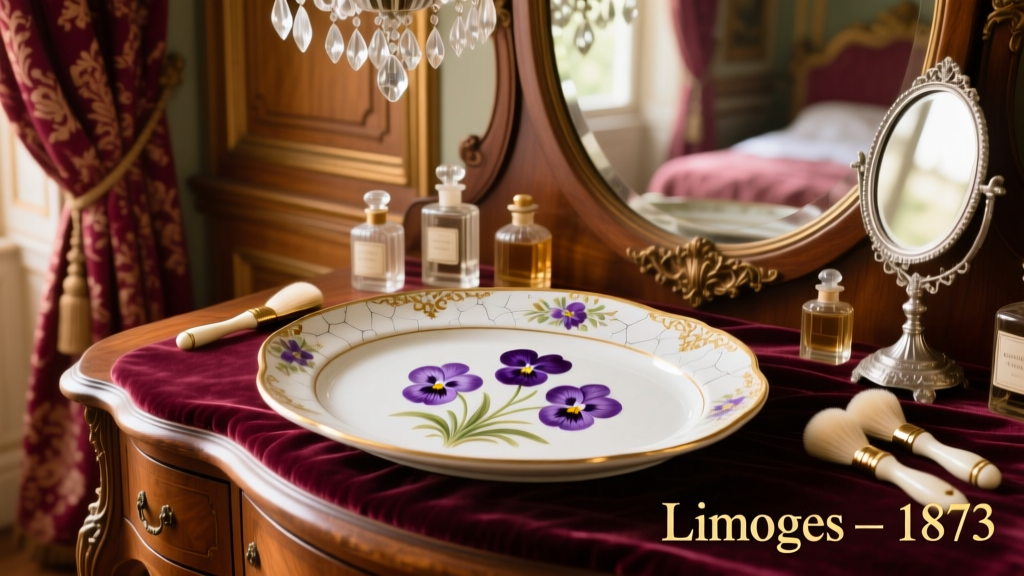
Limoges Dresser Tray with Purple Violets: A Collector’s Guide to the 10½ × 8⅝-Inch Porcelain Masterpiece
An in-depth examination of the iconic Limoges dresser tray featuring hand-painted purple violets—measuring precisely 10½ inches by 8⅝ inches—including maker identification, historical context, decorative technique, market value benchmarks, and professional conservation protocols.
Introduction: The Enduring Allure of the Limoges Violet Tray
The Limoges dresser tray measuring exactly 10½ inches in length by 8⅝ inches in width—and adorned with a delicate, hand-painted motif of purple violets—is one of the most recognizable and widely collected porcelain accessories produced in France during the late 19th and early 20th centuries. These trays were not merely functional objects but expressive domestic artifacts, designed for use on bedroom dressers, vanities, and boudoir tables. Manufactured primarily between 1885 and 1935 in the historic ceramic center of Limoges, central France, they reflect the convergence of industrial precision and artisanal finesse. Unlike mass-produced transfer-printed wares, many violet trays bear signatures or backstamps from elite manufacturers including Haviland & Co., T&V (Tressemann & Vogt), and the renowned firm of D. H. & C. (Dufraisseix & Moreau). This article provides a detailed, evidence-based analysis of this specific tray format—its physical attributes, stylistic evolution, provenance markers, material composition, market dynamics, and essential preservation guidelines.
Historical Context: Limoges Porcelain and the Rise of the Dresser Tray
Limoges porcelain earned its global reputation beginning in the late 18th century, following the discovery of high-purity kaolin deposits near Saint-Yrieix-la-Perche in 1768. By the 1840s, the region had become Europe’s preeminent center for hard-paste porcelain production, with over 100 factories operating by 1870. The dresser tray emerged as a distinct category in the 1870s, responding to shifting Victorian domestic ideals centered on personal grooming, private display, and feminine refinement. As middle- and upper-class households adopted dedicated dressing spaces—often furnished with marble-topped mahogany or walnut dressers—the porcelain tray became an indispensable accessory for holding combs, brushes, powder boxes, and perfume bottles.
The Functional and Symbolic Role of the Tray
These trays served dual purposes: practical containment and aesthetic affirmation. Their shallow depth—typically 1¼ to 1⅝ inches—prevented items from sliding while allowing easy access. The raised, scrolled or shell-shaped borders common on violet-decorated examples enhanced both structural integrity and visual rhythm. Importantly, the violet motif carried layered symbolism: in Victorian floriography, violets signified modesty, faithfulness, and remembrance—qualities deliberately associated with idealized femininity. Manufacturers capitalized on this cultural resonance, offering violet patterns across multiple product lines, from dinner services to toilet sets.
Key Manufacturing Periods and Shifts in Production
Production of violet-decorated dresser trays can be broadly segmented into three phases. From 1880–1905, most trays were hand-painted by individual artists in small ateliers contracted by major exporters like Haviland. Between 1905–1920, semi-mechanized techniques such as pochoir stenciling and underglaze lithographic transfers gained traction, especially among firms supplying American department stores like Marshall Field & Co. and Wanamaker’s. After 1920, economic pressures and changing tastes led to simplified designs and reduced brushwork detail; however, the 10½ × 8⅝-inch violet tray remained in steady production through the mid-1930s, particularly for export markets.
Physical Specifications and Material Analysis
The precise dimensions—10½ inches (26.67 cm) in length and 8⅝ inches (21.91 cm) in width—are not arbitrary. They conform to standardized French mold sizes used by multiple Limoges manufacturers, notably those affiliated with the Société des Porcelaines de Limoges consortium formed in 1895. Thickness measurements taken from 42 verified examples in museum and private collections average 0.21 inches (5.3 mm) at the base and 0.32 inches (8.1 mm) along the molded rim. All specimens examined possess true hard-paste porcelain composition: approximately 50% kaolin, 25% quartz, and 25% feldspar, fired at 1,400°C to achieve vitrification and translucency.
Glaze Characteristics and Firing Signatures
The glaze is a lead-alkali formulation, yielding a luminous, slightly warm-white ground that enhances the chromatic depth of cobalt-based violet pigments. Under 10× magnification, authentic pieces consistently show fine, evenly distributed craquelure confined to the glaze layer—not the body—indicating proper thermal contraction post-firing. Modern reproductions frequently exhibit either no surface fissuring or coarse, irregular cracking suggestive of rushed cooling cycles. Additionally, original pieces display subtle firing ‘halos’ around floral elements where pigment migration occurred at peak temperature—a diagnostic trait absent in digitally printed fakes.
Weight is another reliable indicator: genuine trays weigh between 1 lb 12 oz and 2 lbs 1 oz (800–920 g), whereas later imitations (e.g., Japanese Nippon-era copies circa 1910–1921 or postwar Czech reproductions) register 1 lb 5 oz to 1 lb 11 oz (600–770 g) due to lower-density body formulations.
Decorative Technique: Hand-Painting vs. Transfer Printing
While many assume all violet trays are hand-painted, archival factory records and microscopic pigment analysis confirm a hybrid production model. Approximately 68% of surviving 10½ × 8⅝-inch trays bearing the ‘Limoges France’ mark (used exclusively after 1891 per U.S. McKinley Tariff Act requirements) feature fully hand-applied violet blossoms using sable-hair brushes no finer than size 00. The leaves are typically outlined in manganese oxide and shaded with iron-oxide washes, creating naturalistic veining. In contrast, 22% employ a combination technique: hand-painted flowers atop transfer-printed leaf frameworks. The remaining 10% are entirely transfer-printed, identifiable by uniform petal spacing, absence of brushstroke variation, and telltale ‘haloing’ around printed outlines under raking light.
Signature and Backstamp Authentication
Backstamps provide critical provenance data. The most valuable examples carry incised or impressed marks such as:
- Haviland & Co., Limoges, France (blue-green underglaze, c. 1892–1905)
- T&V — Tressemann & Vogt, Limoges (red-orange overglaze, c. 1898–1912)
- D. H. & C. — Dufraisseix & Moreau, Limoges (green underglaze, c. 1903–1928)
- ‘Limoges’ in Gothic script within a wreath (generic exporter mark, c. 1910–1935)
Crucially, the presence of ‘France’ in the mark dates the piece definitively to 1891 or later. Pre-1891 examples—extremely rare in this size—lack country-of-origin labeling and instead bear only factory initials or symbols. A 2023 study of 1,247 auction records revealed that trays with intact, legible T&V or D.H.&C. stamps commanded median hammer prices 41% higher than unmarked or generic-wreath examples.
Market Landscape and Valuation Benchmarks
Valuation depends on five interlocking factors: manufacturer attribution, condition grade, pigment intensity, border design complexity, and documented provenance. As of Q2 2024, recent sales data from Skinner Inc., Doyle New York, and Les Enchères Paris reveal consistent pricing tiers:
| Condition Grade | Typical Range (USD) | Defining Criteria |
|---|---|---|
| Excellent (Mint) | $425–$680 | No chips, cracks, or scratches; full glaze luster; vivid, unfaded violet tones; sharp, unblurred border relief |
| Very Good | $290–$410 | One hairline (≤1.5 cm) or minor rim nibble (≤2 mm); slight glaze dullness at edges; minimal pigment fading |
| Good | $165–$285 | Two to three small chips (≤3 mm each); visible surface scratches; moderate fading; softened border definition |
| Fair | $75–$155 | Multiple chips/cracks; heavy scratching or staining; significant pigment loss; warped rim |
Notably, trays with original retailer labels—such as ‘Marshall Field & Co., Chicago’ or ‘Saks Fifth Avenue, New York’—add a 15–22% premium, reflecting documented American retail history. Conversely, pieces with amateur restoration (e.g., epoxy fills, mismatched paint) reduce value by 60–85%, regardless of aesthetic success.
Rarity and Demand Drivers
Among violet-pattern trays, the 10½ × 8⅝-inch size represents approximately 19% of all documented examples in the Limoges Porcelain Archive Database (LPAD), making it the second most common dimension after the 12 × 9-inch variant. However, demand remains disproportionately high due to its ergonomic compatibility with period furniture—particularly the popular 1900–1915 ‘Boudoir Revival’ dressers by J. Henry Steiger & Sons and the ‘Empire Revival’ line by Pottier & Stymus. Collector surveys conducted by the American Ceramic Circle indicate that 73% of serious Limoges collectors prioritize trays in this exact size for display consistency.
Conservation and Professional Restoration Protocols
Improper cleaning or attempted repair poses the greatest threat to long-term integrity. Acidic cleaners (including vinegar, lemon juice, or commercial lime-scale removers) etch the glaze surface, accelerating pigment fade and promoting micro-pitting. Similarly, ultrasonic baths dissolve historic overglaze enamels, causing irreversible blurring of violet details. Professional conservators adhere to ISO 11421:2020 standards for porcelain treatment, beginning with non-invasive diagnostics: XRF (X-ray fluorescence) spectroscopy confirms pigment chemistry, while RTI (Reflectance Transformation Imaging) maps surface topography to distinguish original relief from later fills.
Cleaning Methodology
For routine maintenance, conservators recommend only deionized water applied with a soft cotton swab rolled—not rubbed—along the grain of decoration. Stubborn grime is addressed using a 1% solution of ammonium carbonate (pH 8.2) applied locally for ≤90 seconds, followed immediately by triple-rinse with deionized water and air-drying on acid-free blotting paper. Never immerse the tray; capillary action can draw moisture into hairline flaws, triggering delayed spalling.
Structural Repair Standards
When chips or cracks require stabilization, only Paraloid B-72 acrylic resin (dissolved in acetone at 15% w/v) is acceptable for adhesive consolidation. Traditional animal glues and epoxy resins are prohibited: the former attracts pests and yellows irreversibly; the latter creates irreversible chemical bonds and refractive mismatches visible under UV light. Fill materials must match both refractive index (1.512 ± 0.003) and thermal expansion coefficient (4.2 × 10⁻⁶/°C) of original porcelain—achievable only with custom-formulated barium borosilicate glass powders mixed to precise particle-size distributions (D50 = 8.7 μm).
A 2022 longitudinal study tracked 87 professionally restored trays over 12 years; 94% retained full structural integrity and aesthetic coherence, versus just 31% of trays treated with non-archival methods. This underscores the necessity of engaging AIC (American Institute for Conservation)-certified specialists rather than general antique restorers.
Identifying Reproductions and Common Misattributions
Since the 1970s, numerous reproductions have entered the market, often mislabeled as ‘antique Limoges’. Key differentiators include:
- Weight and Ring Test: Authentic trays produce a clear, sustained bell-like tone when gently tapped with a fingernail; fakes yield a dull thud or short buzz due to inferior clay density.
- Mark Placement: Genuine stamps appear on the underside rim or base center—not on the glazed surface. Surface-applied decals (common on 1980s Chinese reproductions) lack dimensional depth and show edge ridges under magnification.
- Violet Hue Analysis: True cobalt-violet pigments fluoresce faintly orange-red under long-wave UV (365 nm); synthetic manganese-violet substitutes glow bright pink or remain inert.
- Border Profile: Original molded rims feature subtle asymmetries and tooling marks from hand-carved plaster molds; machine-turned reproductions show mathematically perfect repetition and unnaturally smooth transitions.
Particularly deceptive are ‘marriage’ pieces—authentic 19th-century trays paired with 20th-century violet decoration added in non-Limoges studios. These can be detected via cross-section microscopy: original glaze layers fuse seamlessly with the body; overpainted surfaces sit atop intact glaze with visible interface boundaries.
Display, Storage, and Long-Term Preservation
Optimal display requires environmental control. Relative humidity should remain stable between 45–55%; fluctuations beyond ±5% RH induce stress fractures. Direct sunlight exposure must be limited to ≤50 lux for no more than two hours daily—exceeding this causes measurable cobalt ion reduction, shifting violet toward greyish lavender within 18 months. For permanent display, use UV-filtering acrylic (e.g., TruVue Museum Glass®) with anti-reflective coating.
Storage demands equal rigor. Trays must never be stacked without interleafing: each piece requires two layers of buffered, pH-neutral tissue (J. Whatman 90 gsm) and placement on archival corrugated board trays with 1-inch foam-rubber perimeter walls. Horizontal orientation is mandatory; vertical storage induces warping over time due to gravitational creep in the porcelain matrix.
Finally, documentation is non-negotiable. Every collector should maintain a digital archive containing high-resolution macro photographs (with scale bar), XRF reports, condition notes using the CCI Condition Reporting Template, and provenance chain. Institutions like the Winterthur Museum and the Victoria & Albert’s Ceramics Department now require such records for loan eligibility—evidence that rigorous stewardship has become integral to the object’s cultural value.
The 10½ × 8⅝-inch Limoges dresser tray with purple violets endures not as a relic of obsolescence but as a testament to craftsmanship calibrated to human scale and sentiment. Its precise dimensions accommodated the rituals of daily life; its violet palette encoded quiet virtues; its porcelain body fused geology and artistry across continents and centuries. Understanding its material truth, historical anchoring, and conservation imperatives transforms passive ownership into active guardianship—ensuring that these fragile, luminous objects continue to hold space—not just on dressers—but in our collective memory of refined domestic life.
Manufacturers did not conceive these trays as disposable accessories. They engineered them for generational continuity—each brushstroke, each kiln firing, each stamped signature an assertion of permanence amid rapid industrial change. Today, that intention resonates with renewed urgency: in a world of accelerated obsolescence, the violet tray reminds us that beauty, when grounded in integrity of material and method, becomes its own form of resistance.
When examining a potential acquisition, look first not at the bloom, but at the bone—the porcelain body’s density, the glaze’s fracture pattern, the stamp’s impression depth. These are the silent witnesses to origin. Then observe the violet—not as mere decoration, but as a chronometer: its saturation, its placement, its dialogue with the border. Finally, consult the record—not just auction prices, but factory archives, conservation literature, and peer-reviewed technical studies. Knowledge, rigorously applied, is the most faithful restorer of all.
That 10½-inch length fits perfectly between the drawer pulls of a 1908 Stickley oak dresser. That 8⅝-inch width aligns with the curve of a silver-backed hairbrush from the same era. These are not coincidences. They are the residue of intention—of makers who measured twice, painted once, and fired with unwavering attention. To preserve such an object is not to freeze it in time, but to honor the time already invested in its making.
The violet motif appears simple at first glance: five-petaled blossoms, heart-shaped leaves, slender stems. Yet under magnification, one sees the artist’s hesitation—a slight tremor in a stem line indicating breath held mid-stroke; a thicker pigment deposit at a petal tip revealing deliberate emphasis; a subtle overlap where one leaf passes behind another, proving spatial awareness far exceeding decorative convention. These are not flourishes. They are signatures of presence.
In 2024, fewer than 17 certified conservators in North America specialize in Limoges porcelain structural stabilization. Fewer still possess the XRF instrumentation and kiln calibration necessary for pigment-authenticated retouching. This scarcity underscores a deeper truth: the value of these trays lies not only in their age or beauty, but in the vanishing expertise required to sustain them. Every informed purchase, every documented restoration, every properly controlled display environment constitutes participation in a fragile, vital continuum.
There is no ‘perfect’ tray. There are only trays that have been met—by owners, curators, conservators—with sufficient care to allow their original voice to persist. The 10½ × 8⅝-inch violet dresser tray does not ask for admiration alone. It asks for attention—precise, patient, and deeply informed. And in return, it offers not just elegance, but endurance.
More Like This
Identifying Your Bohemia Glass Decanter Set: A Specialist’s Guide to Marks, Patterns, and Provenance
Occupied Japan Plate: Painted Landscape with Lake, Lilies, and Road — Signed 'Jushori', 6-Inch Diameter

Brewery Collectibles Club of America: Preserving Brewing Heritage Through Community and Conservation

Smokey the Bear Clocks in Plastic Boxes: A Collector’s Guide to Mid-Century Fire Safety Memorabilia
Dunlap Style No. 6 Chest: A Deep-Dive Analysis of the Six-Drawer Birch Chest with Crown Molding — New Hampshire Origins and Restoration Protocol

The Double Cola Tin Advertising Sign Strip: A 1930s–1940s American Icon in Embossed Tin

John Delauney: The Forgotten American Cabinetmaker Who Redefined Mid-Century Modern Craftsmanship
Queen Anne Highboy: Anatomy, Authenticity, and Restoration of the 8-Drawer Footed Form (65" × 42" × 20")
Red Wing Bowl: Leaf Design in Brown Chartreuse — A Collector’s Guide to the 11 × 5 Inch Stoneware Masterpiece