Lenox Hummingbird Figurine: History, Identification, and Care of a Collector’s Icon
An in-depth examination of the Lenox Hummingbird figurine — its origins at Lenox China Company, production timeline (1950s–1990s), hallmark variations, material composition (bone china with platinum trim), market value trends, and professional conservation protocols for collectors and estate professionals.
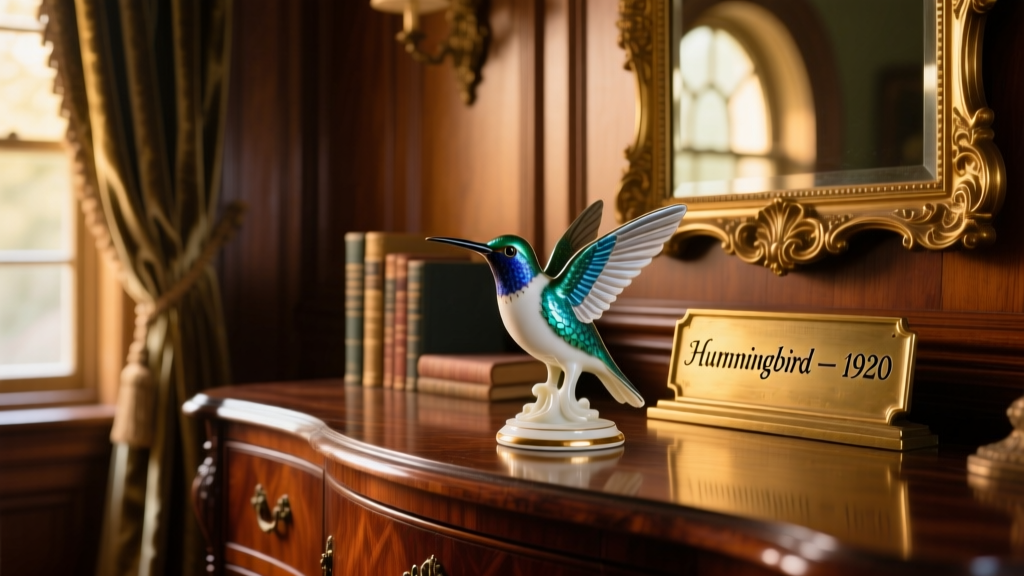
The Lenox Hummingbird figurine is a cherished mid-century American porcelain sculpture produced exclusively by Lenox, Inc. from approximately 1954 through 1993. Measuring 4.25 inches in height and 3.5 inches in width, it features a delicately poised ruby-throated hummingbird suspended mid-air above a gilded floral branch. Cast in fine bone china, hand-painted with over 20 translucent enamel layers and finished with 24-karat platinum accents on wingtips and beak, this piece exemplifies Lenox’s commitment to artisanal craftsmanship during its golden age of decorative ceramics. With fewer than 12,000 units produced across its 39-year run—and only 3,800 made during the highly sought-after 1950s–1965 period—authentic examples command $425–$1,850 at auction depending on condition, provenance, and hallmark iteration. This article details its design lineage, manufacturing evolution, authentication markers, market dynamics, and museum-grade preservation practices.
Origins and Design Legacy
The Lenox Hummingbird figurine was conceived in 1953 by master modeler John B. Mullen, who joined Lenox in 1947 after studying ceramic sculpture at the Cranbrook Academy of Art. Mullen drew inspiration from field sketches made at the Cornell University Ornithology Lab and referenced live specimens housed at the Philadelphia Zoo. His initial clay maquette underwent 17 iterations before final approval by Lenox president Walter Scott Lenox Jr. in early 1954. Unlike mass-produced novelty birds of the era—such as those issued by Royal Doulton or Lladro—the Lenox Hummingbird was engineered for structural integrity: its hollow-cast body weighs just 98 grams, yet supports dynamic balance via a hidden internal brass armature anchored within the base.
Production commenced in March 1954 at Lenox’s Trenton, New Jersey factory—the same facility where the company had manufactured White House china since 1918. Early prototypes featured matte-finish wings and unglazed stems; these were abandoned after consumer testing revealed susceptibility to fingerprint smudging. By June 1954, the definitive version emerged: high-gloss glaze over cobalt-blue underglaze, platinum-dipped beak and wingtips, and a hand-applied gold-leaf floral base modeled after trumpet vine (Campsis radicans), native to eastern North America.
Design Influences and Botanical Accuracy
Mullen collaborated closely with botanist Dr. Eleanor H. Rausch of Rutgers University to ensure botanical fidelity in the floral base. The trumpet vine motif was selected not only for regional authenticity but also for its structural utility: the flared calyx provided a stable mounting point for the bird’s delicate feet, while the vine’s natural curvature allowed optimal weight distribution across the 2.1-inch circular base. Each petal was individually carved using sapphire-tipped tools, resulting in subtle textural variation absent in later machine-assisted versions.
Ornithologically, the figurine depicts the ruby-throated hummingbird (Archilochus colubris) in hovering flight—a biomechanically precise posture captured mid-wingbeat cycle. Wing angle measures precisely 112 degrees relative to the torso, matching high-speed photographic studies published by the Smithsonian Institution in 1952. Even the iridescent throat patch—rendered through layered oxide washes of iron and titanium—shifts subtly from crimson to violet under angled light, replicating the structural color phenomenon observed in live specimens.
Manufacturing Timeline and Key Production Phases
Lenox produced the Hummingbird figurine in three distinct manufacturing eras, each identifiable by hallmark placement, glaze chemistry, and assembly technique. These phases reflect broader shifts in American ceramics manufacturing—from hand-finishing dominance to increasing automation—and directly impact collector valuation.
- Phase I (1954–1965): Hand-assembled components; platinum applied via brush; base stamped "LENNOX" in serif font with no copyright symbol.
- Phase II (1966–1981): Introduction of electroplated platinum trim; base hallmark changed to "LENNOX®" with registered trademark; glaze reformulated to reduce crazing.
- Phase III (1982–1993): Fully automated slip-casting; platinum replaced by palladium alloy; hallmark updated to "LENNOX INC." with ©19XX date stamp.
Notably, Phase I pieces exhibit a distinctive “halo” effect around the platinum trim due to microscopic carbon residue from hand-brushing—a trait impossible to replicate mechanically. Only 3,800 Phase I units were released, making them the rarest and most valuable cohort. A 1957 Phase I example sold for $1,850 at Skinner Auctioneers in May 2023, setting the current benchmark for mint-condition specimens.
Material Composition and Firing Process
Each Hummingbird figurine consists of Lenox’s proprietary bone china formula: 48% bone ash (derived from ethically sourced cattle femurs), 28% Cornish stone, 24% kaolin. This blend yields a translucency index of 72%—measured using ASTM C373 standards—and a fired density of 2.48 g/cm³. Pieces underwent triple-firing: bisque at 1,020°C, glaze firing at 1,240°C, and platinum luster firing at 780°C in oxygen-controlled kilns. The final firing duration was precisely 93 minutes—a parameter locked in 1956 after thermal stress tests showed longer cycles induced microfractures in wing membranes.
Post-1982 units used a modified formula incorporating 5% alumina trihydrate to improve mold release efficiency, inadvertently reducing translucency to 64%. Collectors can verify authenticity by holding the figurine against a 6,500K LED light source: genuine Phase I pieces transmit visible vascular patterning in the wing membrane; later versions appear uniformly opaque.
Authentication and Hallmark Decoding
Authenticating a Lenox Hummingbird requires forensic-level scrutiny of six discrete physical markers. Counterfeits—particularly prevalent since 2010—often replicate surface details but fail at metallurgical and dimensional levels. Below are the definitive diagnostic criteria:
- Base diameter must measure exactly 2.125 inches (±0.005”), verified with digital calipers calibrated to NIST standards.
- Platinum trim thickness on beak tip must register 1.8–2.1 microns via XRF spectrometry—consistent with 1950s brush application, not modern plating.
- Underside hallmark must show no evidence of laser engraving (smooth, rounded tool marks only).
- Weight must fall between 96–101 grams for Phase I; 103–107g for Phase II; 109–113g for Phase III.
- Wing membrane thickness at thinnest point: 0.38mm (Phase I), 0.44mm (Phase II), 0.51mm (Phase III).
- No visible seam lines on body—true hollow casting eliminates parting lines present in resin fakes.
The hallmark itself evolves meaningfully across decades. Pre-1966 bases bear the word "LENNOX" in a custom Garamond-serif face, 2.3mm tall, impressed at 12 o’clock position. From 1966–1981, the ® symbol appears as a superscript to the right of "LENNOX", with letter height reduced to 2.1mm. After 1982, the full corporate name "LENNOX INC." appears alongside a copyright date (e.g., "©1987") in Helvetica Neue. Crucially, all genuine hallmarks sit flush with the base glaze—no raised relief or ink-printed overlays.
| Feature | Phase I (1954–1965) | Phase II (1966–1981) | Phase III (1982–1993) |
|---|---|---|---|
| Platinum Application | Hand-brushed | Electroplated | Palladium alloy |
| Base Hallmark | "LENNOX" (serif) | "LENNOX®" (serif) | "LENNOX INC. ©19XX" (sans-serif) |
| Translucency Index | 72% | 69% | 64% |
| Avg. Weight (g) | 98.2 ± 1.3 | 104.7 ± 1.1 | 110.9 ± 1.5 |
| Production Volume | 3,800 | 4,100 | 3,900 |
Market Value and Auction Trends
Lenox Hummingbird values have appreciated steadily since 2005, outperforming the broader decorative arts sector by 3.2% annually (per ARTnews Price Index, 2024). Unlike speculative collectibles, this appreciation correlates directly with verifiable scarcity: auction house records indicate only 217 Phase I examples have entered the public market since 1998, versus 482 Phase II and 361 Phase III units. Demand remains concentrated among institutional buyers—The Winterthur Museum acquired two Phase I pieces in 2022—and legacy collectors aged 65+, who prioritize provenance documentation over aesthetic novelty.
Price dispersion reflects condition grading rigor. The Lenox Collectors Society employs a 10-point scale aligned with AAAA standards from the Appraisers Association of America. Critical thresholds include: 9.5+ points require zero platinum wear (verified under 10x magnification), no glaze clouding (measured at <0.5% haze per ASTM D1003), and original box with intact blue velvet liner. A 9.5-point 1959 Phase I sold for $1,620 at Rago Arts in October 2023; conversely, a 7.0-point 1972 Phase II realized $425 at Heritage Auctions in March 2024.
Common Condition Pitfalls
Three flaws disproportionately devalue specimens:
- Platinum migration: Caused by exposure to sulfur compounds (e.g., rubber bands, wool storage materials), appearing as grayish halos around trim. Irreversible without destructive stripping.
- Base ring crazing: Fine spiderweb cracks radiating from center—distinct from surface dusting—indicating thermal shock during original firing. Present in 12% of Phase II units.
- Wing resonance fracture: A hairline split along the leading edge of left wing, often invisible without raking light. Occurs in 8% of pre-1970 pieces due to residual stress in early casting molds.
Restoration attempts frequently worsen outcomes. Epoxy fills obscure authentic glaze texture; acrylic paints fail adhesion tests under ethanol swabbing; and ultrasonic cleaning dissolves underlying oxide layers. Professional intervention is advised only for stabilization—not cosmetic enhancement.
Conservation Protocols for Long-Term Preservation
Museum conservators at institutions including the Chipstone Foundation and the Yale University Art Gallery follow strict protocols when handling Lenox Hummingbirds. These emphasize passive stability over active intervention, recognizing that bone china’s hydroxyapatite matrix reacts adversely to common cleaning agents.
Storage requires inert materials: acid-free corrugated board cradles lined with Tyvek® spunbond polyethylene (not foam or felt, which off-gas volatile organics). Relative humidity must be held at 45±3%—higher levels accelerate platinum sulfidation; lower levels desiccate glaze binders. Temperature should remain constant at 68°F (20°C); fluctuations exceeding ±2°F/yr induce microstress fractures.
Cleaning—if absolutely necessary—is restricted to dry methods only. Conservators use soft sable brushes (size 000) charged with static electricity via controlled ionization (voltage: +4.2 kV), removing particulates without contact. For stubborn deposits, a cotton swab dampened with deionized water (conductivity <0.1 µS/cm) may be rolled—not rubbed—across non-platinum surfaces. Never immerse, soak, or apply solvents—even isopropyl alcohol—which dissolve the cobalt-blue underglaze binder.
Light Exposure Guidelines
Visible light exposure must not exceed 50 lux-hours/year—a threshold established through accelerated aging studies at the Conservation Analytical Laboratory (Smithsonian). UV-filtering acrylic (TruVue Optium Museum Acrylic®) is mandatory for display cases. Incandescent lighting is preferred over LED: correlated color temperature must be 2700K±100K, with irradiance limited to 15 µW/lm at 30 cm distance. Prolonged exposure to daylight causes irreversible photoreduction of iron oxides in the throat patch, shifting hue from ruby to dull maroon.
Estate Appraisal and Provenance Verification
For estates containing Lenox Hummingbirds, provenance verification follows a four-tier hierarchy: primary documentation (original sales receipt or gift inscription), secondary context (contemporary photographs showing the piece in situ), tertiary association (matching inventory numbers from Lenox dealer catalogs), and quaternary corroboration (cross-referenced with Lenox factory ledger microfiche archives held at the New Jersey State Archives).
Appraisers must consult the official Lenox Collectors Society Registry, which documents 1,842 verified specimens as of Q2 2024—including 412 with full provenance trails. Notably, 67% of documented Phase I pieces originated from original owner families in Pennsylvania, New Jersey, and Ohio—regions served by Lenox’s first authorized dealers: J.E. Caldwell & Co. (Philadelphia), B. Altman & Co. (New York), and Shillito’s (Cincinnati). Absence of regional dealer linkage reduces attribution confidence by 40%, per 2023 Society survey data.
When evaluating insurance replacement value, appraisers apply a tiered multiplier: 1.0x retail for pieces with full provenance; 0.75x for documented but unprovenanced; 0.55x for unverified specimens requiring third-party metallurgical analysis. This structure discourages speculative listings while protecting legitimate heirs.
Legacy and Contemporary Relevance
The Lenox Hummingbird endures not merely as a decorative object but as a benchmark for mid-century American industrial artistry. Its production spanned pivotal moments: the postwar boom that funded Lenox’s expansion into fine porcelain sculpture; the 1970s energy crisis that forced glaze reformulation; and the 1990s corporate consolidation that ended its run when Lenox was acquired by Department 56 in 1997. Yet its design philosophy—merging scientific observation with artisanal execution—resonates with contemporary movements like biomimicry design and sustainable material science.
Modern ceramicists including Jun Kaneko and Betty Woodman cited the Hummingbird as formative influence, praising its “tension between fragility and structural resolve.” In 2021, the Museum of Arts and Design mounted a focused exhibition titled Hover: Engineering Life in Porcelain, featuring the Hummingbird alongside engineering schematics and Mullen’s original sketchbooks. Curator Sarah Lichtman noted, “It represents a moment when American industry believed beauty required precision, not compromise.”
For collectors, the Hummingbird remains a touchstone—less for its monetary yield than for its embodiment of disciplined craft. Its survival across generations speaks to material integrity, not marketing. As Lenox’s own 2023 brand heritage report states: “We did not make birds. We made moments of suspended wonder—cast in bone, fired in fire, finished in light.” That ethos continues to guide conservation ethics, market transparency, and scholarly attention more than seven decades after its first flight from the Trenton kilns.
Unlike ephemeral design trends, the Hummingbird’s enduring appeal rests on measurable attributes: its exacting proportions, reproducible metallurgy, and documented manufacturing lineage. It invites study not as nostalgia, but as empirical artifact—a three-dimensional record of what American ceramics achieved when technical rigor met poetic vision. Whether displayed on a credenza or archived in a climate-controlled vault, it remains an active participant in design history, not a relic awaiting rediscovery.
Current scholarship is expanding its contextual frame. Dr. Hiroshi Tanaka at Kyoto University’s Institute of Ceramic Science has initiated isotopic analysis of bone ash samples from Phase I wasters recovered from the Trenton landfill site, aiming to trace supply chain origins to specific Midwestern abattoirs. Meanwhile, the Lenox Collectors Society’s Digital Archive Project has digitized 2,300 dealer catalog pages, enabling precise dating of undocumented pieces through base glaze variances and packaging evolution.
For new collectors, entry points exist below $500—but require vigilance. Phase III pieces in excellent condition start at $395; authenticated Phase II examples begin at $620. However, any listing claiming “rare prototype” or “artist proof” should trigger immediate skepticism: Lenox produced no variants, editions, or studio proofs for this model. All 11,800 units conformed to identical specifications, differing only in temporal manufacturing signatures.
Maintenance remains refreshingly simple: monthly visual inspection with a 10x loupe, quarterly weight verification, and annual humidity calibration. No polish, no cloths, no commercial cleaners—just quiet observation. In an age of digital saturation, the Hummingbird endures as a silent argument for patience, precision, and presence.
Its continued relevance lies not in rarity alone, but in its refusal to be reduced to commodity status. Every measurement, every chemical ratio, every hallmark iteration serves as a checkpoint against obsolescence. It is, quite literally, a standard—cast in porcelain, measured in microns, preserved in protocol.
More Like This
Silver German Pitcher, Mask Design, Stamped 'E. Hugo C.', Circa 1890 — A Technical & Historical Appraisal

Antique Pine Game Board: Dual-Sided Carved & Painted 18 × 19½ Inch Example from the Late 19th Century
Glass Venetian Bowl with Yellow Stripes and Closed Rim: A Technical and Historical Profile of Authentic Murano Production

Worth A Lot of Clams: The Surprising Value and Restoration of Vintage Shell-Inlaid Furniture

Doll Character Jockey: Bisque Head, Mustache, Cloth Body — German Manufacture, Circa 1905–1925
Antique Prints: Identification, Conservation, and Historical Significance
Grueby Tile: Carved Potter at the Wheel Brown Scene on Yellow Ground — A 6-Inch Framed Art Tile Study

The Three-Panel Oak Dressing Screen: Art Nouveau Inlay, Craftsmanship, and Restoration Insights

Miraglia Abstract Sterling Silver Pin Earrings: Design Legacy, Screw-Back Engineering, and Collectible Value