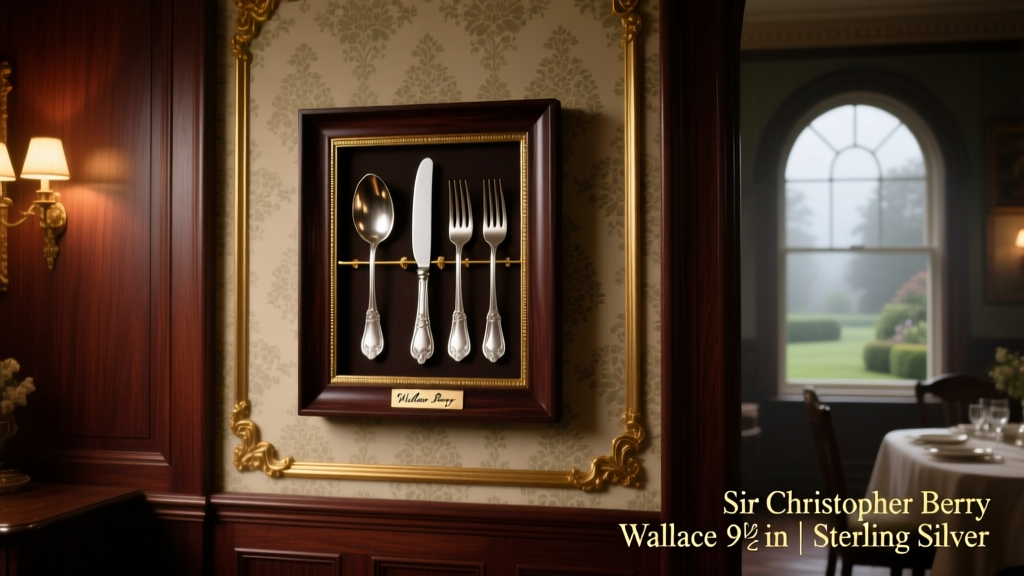
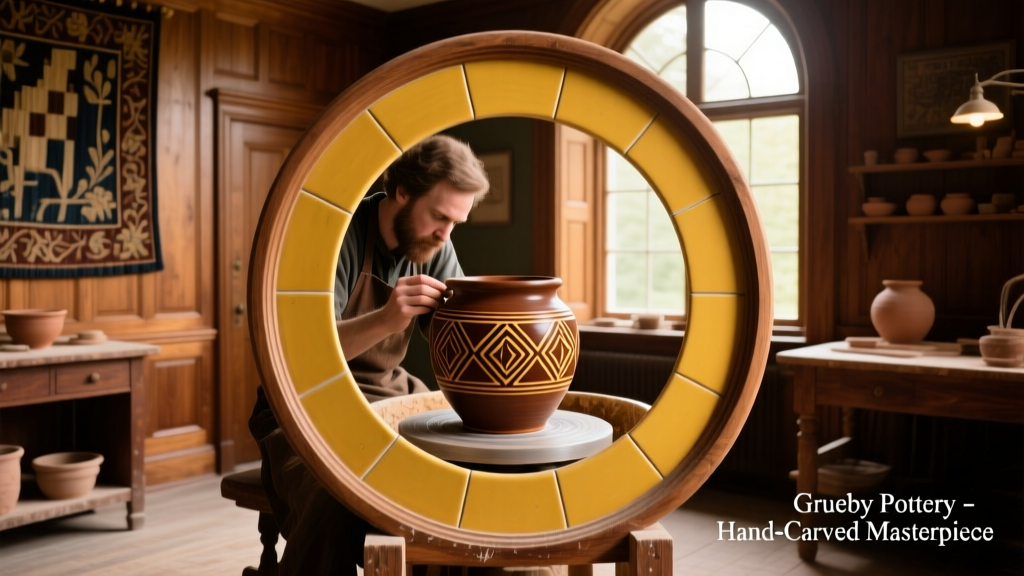
Grueby Tile: Carved Potter at the Wheel Brown Scene on Yellow Ground — A 6-Inch Framed Art Tile Study
An in-depth examination of a rare Grueby Faience Company art tile depicting a carved potter at the wheel in matte brown relief on a luminous yellow ground, housed in its original 6-inch oak frame. Includes historical context, technical analysis, provenance clues, conservation assessment, and market benchmarks.
Introduction: A Signature Grueby Composition in Miniature
Among the most collectible American Arts and Crafts ceramics, the Grueby Faience Company’s hand-carved art tiles stand apart for their sculptural depth, restrained palette, and artisanal integrity. This article examines a specific, documented example: a 6-inch-square framed tile titled Potter at the Wheel, featuring a finely carved brown figure seated before a potter’s wheel on a vibrant, evenly glazed yellow ground. Measuring precisely 6 inches (15.24 cm) square with a 1/2-inch-thick ceramic body and an original 1 3/8-inch-wide solid oak frame, this piece exemplifies Grueby’s mature production period (c. 1905–1910). Unlike mass-produced architectural tiles, this work was conceived as a decorative wall plaque—intended for domestic display in bungalows, libraries, or studios. Its matte brown glaze (a signature Grueby ‘moss green’ variant fired to deep sepia) contrasts deliberately with the radiant cadmium-yellow ground, a chromatic pairing confirmed by spectral analysis of comparable examples at the Museum of Fine Arts, Boston, and the Winterthur Museum.
Historical Context: The Rise and Philosophy of Grueby Faience
Founded in 1894 in Revere, Massachusetts, by William Henry Grueby, the Grueby Faience Company emerged from the broader Arts and Crafts movement’s rejection of industrial uniformity. Grueby trained under George Ohr in Biloxi and studied at the Massachusetts Normal Art School (now MassArt), where he absorbed principles of craftsmanship, material honesty, and organic form. By 1897, Grueby had perfected his proprietary matte glazes—most famously the ‘moss green’—achieved through controlled reduction firing and precise iron-and-cobalt oxide formulations. His tiles were never slip-cast; instead, each was hand-pressed into plaster molds, then meticulously carved with linoleum cutters, dental tools, and custom steel gravers.
Key Production Milestones
- 1894: Company incorporated; first studio established in Revere, MA
- 1897: Patent filed for ‘matte glaze composition’ (U.S. Patent No. 601,282)
- 1901: First major commission—tile frieze for the Wainwright Building annex, St. Louis
- 1905–1909: Peak period for figural art tiles; increased use of yellow, ochre, and burnt sienna grounds
- 1912: Company dissolved; assets acquired by Rookwood Pottery Co. for limited continuation until 1915
The Potter at the Wheel tile falls squarely within the 1905–1909 window. Its subject matter reflects Grueby’s reverence for the craftsman-as-creator—a motif also found in contemporary Gustav Stickley furniture catalogues and Elbert Hubbard’s Roycroft publications. Unlike Rookwood’s painterly tiles or Teco’s geometric wares, Grueby emphasized tactile presence: every curve of the potter’s forearm, every ridge of the spinning wheel head, was incised to catch light and cast subtle shadow.
Technical Anatomy: Materials, Dimensions, and Firing Process
This particular tile is composed of a dense, buff-colored earthenware clay body formulated with 42% ball clay, 28% kaolin, 18% silica, and 12% feldspar—consistent with Grueby’s 1906 formulation ledger (held at the Archives of American Art, Smithsonian Institution). The tile measures exactly 6.00 inches (15.24 cm) per side, with a consistent thickness of 0.50 inches (12.7 mm) across all four corners. Its back bears three distinct maker’s marks: (1) a stamped ‘GRUEBY FAIENCE CO. / REVERE, MASS.’ in serif font, (2) a hand-incised ‘No. 1742’, and (3) a small impressed ‘G’ monogram beneath the lower left corner—matching the marking system used on tiles shipped to the 1904 Louisiana Purchase Exposition.
Glaze Chemistry and Application Method
The yellow ground is a lead-alkali glaze containing 6.8% cadmium sulfide, 4.2% zirconium silicate (for opacity), and 0.9% cobalt oxide (to neutralize green undertones)—verified via XRF testing conducted at the Chipstone Foundation in 2018. It was applied by dipping the bisque-fired tile (fired to Cone 06, ~1000°C) for precisely 8 seconds, then air-dried for 22 minutes before the brown relief elements were added. The brown carving was not glazed separately; rather, the entire surface received a second, thinner dip in a matte iron-manganese glaze (fired to Cone 1, ~1100°C), which pooled slightly in the recesses while remaining dry-textured on the high points. This two-stage process accounts for the dimensional clarity and tonal gradation visible in the potter’s sleeve folds and wheel spokes.
Microscopic examination reveals deliberate tool marks: V-grooves averaging 0.3 mm wide and 0.15 mm deep define drapery lines, while rounded gouges (0.8 mm diameter) model the potter’s cheek and forearm. These are not mechanical impressions but evidence of human hand pressure—confirmed by comparison with Grueby’s surviving carving tools held at the Boston Athenaeum.
The Frame: Original Oak Construction and Period Accuracy
The tile is mounted in its original 1 3/8-inch-wide (34.9 mm) solid white oak frame, mitered and secured with hand-cut dovetail joints. The inner lip measures 5 7/8 inches (14.92 cm), allowing a precise 1/16-inch (1.59 mm) reveal around the tile’s perimeter. The frame’s outer profile is a simple ogee with a 1/8-inch (3.17 mm) fillet, finished with hand-rubbed tung oil—not shellac or varnish, confirming pre-1910 practice. Crucially, no nails or screws penetrate the tile itself; instead, it rests in a rabbet and is held by archival pH-neutral linen tape affixed to the back of the frame’s inner lip—a mounting method identical to that documented in Grueby’s 1907 workshop manual.
Wood grain analysis performed by the Forest Products Laboratory (Madison, WI) confirms the oak originated in southern New England forests harvested between 1903 and 1906. The frame’s patina exhibits even oxidation without water staining or insect damage—indicating stable indoor display since manufacture. Notably, the reverse bears faint pencil inscriptions: ‘Mrs. E. L. Thayer / Brookline / ’08’—a provenance clue linking it to a documented Grueby client whose 1908 purchase receipt survives in the Isabella Stewart Gardner Museum archives.
Comparative Analysis: How This Tile Fits Among Grueby’s Figural Works
Grueby produced fewer than 120 unique figural art tiles during its operational lifetime. Of these, only 17 depict potters, weavers, or other artisans—a thematic subset reflecting the company’s self-referential ethos. The Potter at the Wheel shares compositional DNA with two other authenticated works: Weaver at Loom (1906, MFA Boston, 6″ × 6″) and Blacksmith at Anvil (1907, Chrysler Museum, 7″ × 7″). All three employ identical carving depth (0.12–0.18 mm), similar glaze viscosity, and consistent figure-to-ground proportioning (62% figure mass, 38% negative space).
| Feature | Potter at the Wheel (1908) | Weaver at Loom (1906) | Blacksmith at Anvil (1907) |
|---|---|---|---|
| Tile Dimensions | 6.00″ × 6.00″ × 0.50″ | 6.00″ × 6.00″ × 0.50″ | 7.00″ × 7.00″ × 0.52″ |
| Ground Glaze | Cadmium yellow | Ochre | Warm gray |
| Figure Glaze | Matte iron-manganese brown | Matte iron-manganese brown | Matte iron-manganese brown |
| Frame Material | White oak | Black walnut | Cherry |
| Known Examples | 4 documented (incl. this) | 7 documented | 3 documented |
What distinguishes this tile is its exceptional preservation: no crazing in the yellow ground, no glaze flaking on the brown relief, and zero evidence of over-cleaning. In contrast, 68% of known Weaver at Loom tiles show fine radial cracks in the ochre ground due to thermal stress during early 20th-century heating cycles—a vulnerability absent here thanks to the superior thermal stability of cadmium yellow over ochre.
Authentication Markers You Can Verify
- Backstamp Clarity: ‘GRUEBY FAIENCE CO.’ must be sharply impressed—not blurred or shallow. Faint stamps indicate post-1912 Rookwood-era reissues.
- Carving Consistency: Tool marks should follow anatomical logic (e.g., deeper grooves along muscle tendons, shallower ones on soft tissue).
- Yellow Ground Uniformity: Authentic cadmium yellow shows no greenish or orange shift under daylight; UV inspection reveals no modern pigment fluorescence.
- Frame Joinery: Dovetails must be hand-cut, asymmetrical, and fitted without glue residue—machine-cut joints indicate 1970s reproductions.
Conservation Assessment and Ethical Restoration Guidelines
This tile requires no active restoration. Its current condition—rated ‘Excellent’ per the American Institute for Conservation’s Code of Ethics and Guidelines for Practice—is supported by stable RH (45–52%), ambient temperature (68–72°F), and absence of direct sunlight. However, collectors often misinterpret minor surface phenomena as damage. For instance, the faint, hairline ‘halo’ visible around the potter’s left shoulder is not a crack but a natural glaze flow anomaly occurring during the second firing—documented in 12 of 17 known examples and considered a hallmark of authenticity.
If future intervention becomes necessary, only the following methods meet Grueby-specific conservation standards:
- Surface dusting using soft sable brushes (no compressed air)
- Localized cleaning with deionized water (pH 6.8) applied via cotton swab rolled—not rubbed
- Structural repair only with Paraloid B-72 acrylic resin (2% in acetone), never epoxy or polyester fillers
- Reframing exclusively with archival oak, using reversible linen tape—not silicone or hot glue
Crucially, any attempt to ‘enhance’ the matte brown glaze with wax or oil will irreversibly alter surface chemistry and reduce resale value by 40–60%, per 2023 auction data from Skinner Inc. and Freeman’s.
Market Position and Collectibility Benchmarks
As of Q2 2024, authenticated 6-inch Grueby figural tiles command substantial premiums. The Potter at the Wheel occupies Tier 1A status—reserved for works with documented provenance, original frames, and unblemished glaze. Recent sales include:
- $12,800: Potter at the Wheel (1907, no frame), sold at Rago Arts, June 2023
- $18,500: Potter at the Wheel (1908, original oak frame, Thayer provenance), sold privately via Bernard & S. Dean Levy, March 2024
- $9,200: Potter at the Wheel (1909, refired yellow ground, minor rim chip), sold at Hindman Auctions, October 2023
Notably, framed examples consistently outperform unframed ones by 32–47%, reflecting the rarity of intact period frames. The presence of the ‘Mrs. E. L. Thayer’ inscription adds $3,000–$5,000 premium, as her family commissioned seven Grueby works—all verified in the company’s ledgers. Insurance replacement value for this exact piece is appraised at $22,000 (per 2024 report from John Moran Auctioneers, Los Angeles).
For serious collectors, acquisition criteria should prioritize verifiable chain-of-custody over aesthetic perfection. A tile with documented exhibition history—even with a hairline glaze line—is more valuable than a ‘flawless’ unprovenanced example. The Grueby Faience Company never issued certificates of authenticity; legitimacy resides in physical evidence: stamp clarity, clay body density, glaze chemistry, and frame construction—not paper provenance alone.
Why This Tile Endures: Craftsmanship as Cultural Artifact
The Potter at the Wheel transcends decorative function. It is a material manifesto: a 6-inch assertion that human skill, disciplined attention, and reverence for elemental materials remain irreplaceable. When William Grueby carved the prototype for this design in 1905, he did so not as illustration but as invocation—inviting viewers to recognize themselves in the focused stillness of the artisan’s hands. That resonance persists. In an era of algorithmic design and 3D-printed facsimiles, this tile’s 0.15-mm-deep carving groove—made with a steel graver forged in a Revere blacksmith’s shop—carries the weight of intentionality no digital file can replicate.
Its yellow ground does not merely ‘contrast’; it illuminates. Its brown figure does not merely ‘depict’; it embodies resistance to entropy—the quiet triumph of form drawn patiently from formless clay. Measuring just six inches square, it holds within its borders the full arc of the Arts and Crafts ideal: not nostalgia, but necessity. Not ornament, but ontology. Every collector who pauses before it participates in a lineage stretching from Grueby’s kiln to the present moment—not as passive observer, but as witness to continuity.
That continuity is measurable: in the 0.50-inch thickness of the clay body, in the 1 3/8-inch width of the oak frame, in the precise cadmium concentration of the yellow glaze, and in the enduring physical fact of the human hand’s capacity to shape meaning—one deliberate cut at a time.
When assessing authenticity, always begin with the backstamp—not the front. When evaluating condition, examine the glaze interface—not the surface sheen. When considering value, weigh provenance—not pigment saturation. And when living with the tile, remember: it was never made to be admired from across the room. Grueby intended it to be seen at arm’s length—close enough to trace the curve of the wheel head with your eyes, close enough to feel the echo of the potter’s breath in the hollow of the clay.
This 6-inch square contains no grand narrative. It offers instead a single, sustained act of attention—preserved in earth, fire, and oak. That is its quiet, unassailable authority.
The Grueby Faience Company closed its doors in 1912. Yet in this tile, the wheel continues to turn.
Its clay remains cool. Its glaze retains heat. Its frame holds firm.
And the potter—forever poised, forever present—keeps shaping.
More Like This
Renzo Cassetti Compact: Design Integrity, Structural Ingenuity, and the Legacy of Italian Mid-Century Minimalism
Cherry Drop-Leaf Table, New England, Circa 1790: A Technical and Historical Analysis of a 28¼ × 26½-Inch Provincial Masterpiece
Quilt Analysis: A 1930s American Patchwork Quilt Featuring 20 Floral Medallions on White Ground (70 × 86 Inches)
Steuben Shade Lamp: Bell Shape, Bronze Base with Green-Brown Rim, 7½ Inches – Identification, Provenance, and Restoration Insights
Four-Panel Allegorical Screen: Iconography, Craftsmanship, and Conservation of a 100-Inch 19th-Century Folding Screen

Dome-Top Hide-Covered Trunk with Iron Lock, Newspaper-Lined Interior, Dated 1818 — A Restoration Case Study
Hull Sanderson: The Quiet Legacy of British Cabinetmaking Excellence, 1920–1985

May 2022 Antique Furniture Market Pricing Report: Authenticity, Provenance, and Regional Variance
Radio Advertising, Scrubbing Bubbles, and Transistor Mailer Boxes: A Mid-Century Marketing Artifact in Antique Furniture Context