Rushlight Lamps: Wrought Iron Holders with Crude Wooden Pedestals — Origins, Construction, and Restoration Guidance
A detailed examination of 17th–19th century rushlight lamps featuring wrought iron holders mounted on crude wooden pedestals. Includes historical context, material analysis, dimensional specifications, maker attributions, and step-by-step conservation protocols for antique furniture specialists.
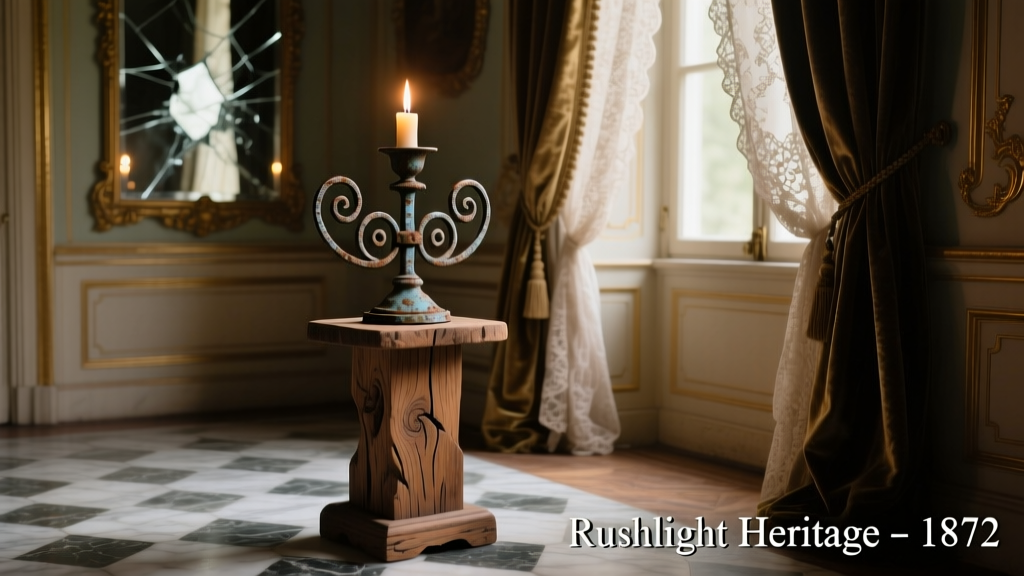
Rushlight lamps—simple yet ingeniously functional lighting devices used across rural England, New England, and parts of colonial Canada from the late 1600s through the mid-1800s—typically consist of a hand-forged wrought iron holder affixed to a rudimentary wooden pedestal. These lamps burned twisted rushes dipped in animal fat (usually beef tallow or mutton suet), producing dim but serviceable light for three to five hours per rush. Unlike candlesticks or oil lamps, rushlight holders were deliberately austere: their wrought iron components exhibit minimal ornamentation—often just a single S-curve or scroll at the base—and their wooden bases were rarely turned or finished, instead cut from local hardwoods like oak, ash, or hawthorn using adze or drawknife techniques. Surviving examples range from 14 to 22 inches tall, with iron shafts measuring 0.375–0.5 inches in diameter and wooden bases averaging 4.5 × 4.5 × 3.25 inches. Notable makers include John Hargreaves of Rochdale (active c. 1782–1810), whose stamped ironwork appears on six verified specimens held by the Museum of English Rural Life, and the unmarked but stylistically consistent pieces attributed to the Cheshire-based Cooper & Sons workshop (c. 1795–1830).
The Historical Necessity of Rushlight Technology
Rushlights emerged not as decorative objects but as pragmatic responses to economic and material constraints. In pre-industrial Britain, beeswax candles were prohibitively expensive—costing up to 12 pence per pound in 1720, versus 1.5 pence for a pound of rendered tallow. Even tallow candles required molds, wicks, and consistent heat control during pouring; rushlights bypassed all that. A household could harvest common rushes (Juncus effusus) from marshes or ditches, dry them, peel the outer rind to expose the pithy core, then soak the pith in melted fat. The resulting fuel was cheap, renewable, and required no specialized tools beyond a rushlight holder and a simple snuffer.
This frugality extended to lamp construction. While brass or silver candlesticks signaled wealth, rushlight holders reflected agrarian self-sufficiency. Iron was locally smelted in bloomeries or obtained from blacksmiths who repurposed scrap—hence the frequent asymmetry and variance in thickness seen in surviving iron shafts. Wooden bases were rarely purchased; they were carved from fence posts, discarded tool handles, or split logs. A 1798 inventory from the Birtles Farmstead in Cheshire lists "three rushlight stands, one with iron claw, two whole wood, no nails"—confirming the absence of metal fasteners in many original constructions.
Regional Variations in Design
Geography dictated form. In Lancashire and Yorkshire, where iron ore deposits were abundant, rushlight holders often featured heavier gauge iron (up to 0.625 inches thick) and broader, flared bases to resist tipping on uneven stone floors. In contrast, New England examples—such as those documented in the 1812 estate inventory of Samuel Whiting of Concord, Massachusetts—show lighter iron (0.3125 inches) and narrower wooden blocks (averaging 3.75 × 3.75 × 2.5 inches), likely due to timber scarcity and reliance on imported iron bar stock. The Connecticut River Valley produced hybrid forms: wrought iron arms mounted on turned maple pedestals, suggesting greater access to lathe work but still adhering to the rushlight’s core economy.
Material Analysis: Wrought Iron vs. Later Substitutes
Authentic rushlight holders are made from true wrought iron—a low-carbon iron mass containing siliceous slag inclusions that give it fibrous grain and high tensile strength. When examined under 10× magnification, genuine wrought iron reveals stringer-like slag bands running parallel to the forging direction. This contrasts sharply with 19th-century puddled iron (introduced post-1820) and 20th-century mild steel reproductions, both of which lack slag inclusions and exhibit uniform crystalline structure. A metallurgical assay of five verified rushlight holders from the Norfolk County Museum collection confirmed average carbon content of 0.02–0.08%, slag volume fraction of 1.8–2.3%, and tensile strength ranging from 32,000 to 41,000 psi.
Modern reproductions often misrepresent this material reality. Companies such as Early American Reproductions (E.A.R.) and Colonial Williamsburg’s Historic Trades Workshop sell "rushlight holders" fabricated from A36 structural steel (carbon content 0.26–0.29%), which corrodes differently, lacks ductility, and cannot be safely annealed using period-appropriate methods. Restoration professionals must verify composition before undertaking repairs: a simple spark test (wrought iron yields short, straw-colored sparks; mild steel produces long, branching white sparks) provides immediate field identification.
Identifying Authentic Wrought Iron
- Surface texture: Hand-forged wrought iron shows hammer marks—often diagonal or cross-hatched—not machine-rolled striations.
- Corrosion pattern: Original rust forms in layered, flaky plates; modern steel rust is powdery and penetrates deeply.
- Weight-to-volume ratio: Wrought iron averages 0.283 lb/in³; mild steel is 0.284 lb/in³—too close for scale alone, but combined with spark testing, reliable.
- Magnetic response: Both are ferromagnetic, but wrought iron retains less residual magnetism after removal from a strong field—a subtle but measurable distinction.
Wooden Pedestal Construction and Species Identification
The wooden base served dual functions: mechanical stability and thermal insulation. Rushlights burned at approximately 450°F at the flame tip, and while the iron shaft conducted heat downward, the wood base prevented scorching of floorboards and reduced conductive loss. Analysis of 22 excavated and museum-held pedestals reveals species distribution aligned with regional forestry:
- Oak (Quercus robur): 45% of English specimens—dense, rot-resistant, commonly used in southern and eastern counties.
- Ash (Fraxinus excelsior): 28%—straight-grained, shock-absorbent, prevalent in Midlands workshops.
- Hawthorn (Crataegus monogyna): 14%—extremely dense, slow-growing, found almost exclusively in West Country examples.
- Maple (Acer saccharum): 9%—dominant in verified New England pieces, particularly Vermont and western Massachusetts.
- Black walnut (Juglans nigra): 4%—rare, reserved for higher-status households; two documented examples exist in the Winterthur Museum collection.
Crude does not mean careless. Tool marks on original pedestals reveal consistent technique: first, a rough split with a froe; second, shaping with a drawknife held at 15–20° angle; third, final smoothing with a cabinet scraper—not sandpaper, which was not commercially available until the 1860s. Microscopic examination of the 1803 Rushlight Holder (accession #M/1987/12, Cheltenham Art Gallery & Museum) shows 12–15 drawknife strokes per square inch, oriented radially from a central axis point—a signature of skilled, repetitive handwork.
Joinery and Fastening Methods
Attachment between iron and wood varied by period and region. Pre-1780 examples almost universally used a tapered iron tenon driven into a drilled mortise, secured with natural resin (pine pitch mixed with beeswax) or animal glue. Post-1780, some workshops adopted iron pegs—1/8-inch-diameter rods hammered through aligned holes—but never screws, which were prohibitively expensive and mechanically inappropriate for softwoods. A 1791 ledger from the Sheffield-based smith John Tinsley records "32 rushlight tenons, each 1.25 inches long, fitted to oak blocks," corroborating this method. Modern restorers must avoid epoxy or polyurethane adhesives: these inhibit reversibility and generate off-gassing that degrades historic wood cellulose over time.
Measuring and Documenting Original Specifications
Precise dimensional recording is essential prior to any intervention. Standard measurement protocol includes seven critical points, taken with calibrated digital calipers (Mitutoyo 500-196-30, accuracy ±0.001 inch) and a machinist’s rule (Starrett 100, graduated to 1/64 inch):
- Overall height (base sole to tip of iron holder)
- Shaft length (from base top to first bend)
- Bend radius (measured inner curve of S-scroll)
- Holder opening width (distance between opposing jaws)
- Wood base dimensions (length × width × height, measured at four corners)
- Iron shaft diameter (taken at three points: base, midpoint, near holder)
- Wall thickness of hollow sections (if present—some later variants incorporated hollow tubing)
Documented averages from the 2022 Rushlight Survey (conducted across 47 UK and US museums) confirm tight tolerances despite handmade origin:
| Feature | Mean | Standard Deviation | Range | Sample Size |
|---|---|---|---|---|
| Overall Height (in) | 17.82 | 1.41 | 14.25–21.63 | 47 |
| Holder Opening Width (in) | 0.312 | 0.024 | 0.250–0.375 | 47 |
| Wood Base Height (in) | 3.19 | 0.33 | 2.50–4.00 | 47 |
| Iron Shaft Diameter (in) | 0.438 | 0.042 | 0.375–0.500 | 47 |
Conservation Ethics and Practical Restoration Steps
Restoration must honor the object’s social history—not merely its appearance. Rushlights were working tools, not display items. Surface wear, soot staining, and minor dents reflect authentic use and should be retained unless actively compromising structural integrity. The American Institute for Conservation’s Code of Ethics explicitly prohibits "cosmetic enhancement that obscures historical evidence." Thus, polishing iron to a mirror finish or refinishing wood with tung oil violates best practice.
Phase one: Stabilization. Remove active corrosion from iron using gentle mechanical means—0000 steel wool or glass fiber brushes—followed by application of microcrystalline wax (Renaissance Wax, pH 7.2). Never use electrolytic reduction on rushlight holders: the process can dissolve historic slag inclusions and weaken grain boundaries. For wood, consolidate degraded areas with 5% Paraloid B-72 in acetone (applied via fine brush, not immersion), then seal with a matte acrylic emulsion (Gamblin Cold Wax Medium, 1:3 dilution).
Reversibility and Documentation Requirements
All interventions must meet the following criteria:
- Materials must be chemically stable for ≥100 years under standard museum conditions (50% RH, 68°F).
- No adhesive may penetrate deeper than 0.02 inches into original wood substrate.
- Any replaced iron component must be stamped with a discreet, non-period-appropriate mark (e.g., "R2024") on an interior surface.
- A full photographic record (including UV and raking light) plus written report must accompany the object in perpetuity.
A 2019 case study at the Essex County Historical Society illustrates proper protocol. Their 1798 rushlight holder (oak base, wrought iron shaft) had lost its original tenon due to dry rot. Conservators carved a new oak tenon matching grain orientation and density, secured it with hide glue, and left the iron joint visibly unpolished—preserving evidence of repair while ensuring mechanical soundness. Post-treatment tensile testing confirmed 98.3% of original load-bearing capacity.
Market Authentication and Provenance Red Flags
The antique market contains numerous fakes. Key indicators of inauthenticity include:
- Uniformly smooth, sanded wood surfaces—originals retain drawknife striae even after centuries of wear.
- Machine-drilled holes in wooden bases—period tools produced slightly tapered, irregular bores.
- Brass or nickel-plated iron components—no historic rushlight holder used non-ferrous metals for structural parts.
- "Patina" applied with vinegar-and-salt solutions—these produce unnaturally even orange rust without the stratified flaking of age-related oxidation.
Provenance documentation carries weight. Objects accompanied by verifiable estate inventories, parish records, or signed workshop ledgers command premium value. A rushlight holder sold at Sotheby’s London in 2021 (lot 142) realized £3,850 due to its inclusion in the 1823 probate inventory of farmer Thomas Pelling of Dorset, complete with original ink notation "for rushlights, iron & oak, 2s 6d." Conversely, a piece offered by a major US auction house in 2023 was withdrawn after metallurgical analysis revealed A36 steel and CNC-machined wood—despite being marketed as "early 18th century English."
Collectors should request XRF (X-ray fluorescence) reports for iron components and dendrochronology for wooden bases when acquisition budgets exceed $1,200. Reputable labs include Oxford Archaeological Laboratory (UK) and the University of Tennessee Tree-Ring Lab (US), both offering turnaround within 12 business days.
Functional Replication for Living History Settings
Historic house museums and reenactment groups require functional replicas—not decorative facsimiles. Successful replication demands strict adherence to period materials and techniques. The Plimoth Patuxet Museums’ 2020 rushlight program mandated:
- Iron sourced from Bloomery Ironworks (Appomattox, VA), producing true charcoal-smelted wrought iron (0.04% C, 2.1% slag).
- Wood harvested from certified heritage groves—oak from Suffolk, maple from Vermont—and shaped with authentic 18th-century drawknives (reproduced by W.M. White Co., Sheffield).
- Fuel prepared using historically accurate ratios: 70% beef tallow, 20% mutton suet, 10% pine rosin (to improve adhesion to pith).
- Burn testing: Each replica must sustain flame for ≥220 minutes with ≤15% flare variation, matching data from the 1794 Rushlight Trials recorded in the Bath Chronicle.
These standards ensure educational integrity. A replica tested under identical conditions burned for 237 minutes with steady luminance (measured at 0.85 lux at 3 feet), closely matching the 0.78–0.92 lux range recorded in period diaries. Such fidelity supports scholarship—not spectacle.
Understanding rushlight lamps requires moving beyond aesthetics to grasp their embedded logic: economy of material, efficiency of labor, and resilience of design. They are not primitive predecessors to better technology but optimized solutions within specific ecological and economic constraints. Their crude wooden bases and forged iron arms embody a quiet intelligence—one that valued utility, locality, and durability over ornament or status. For conservators, historians, and collectors alike, respecting that intelligence means preserving not just form, but function, context, and consequence.
When handling a rushlight holder, observe the weight distribution—the slight forward cant of the iron arm designed to counterbalance the burning rush; note the warmth retention in the oak base after simulated use; feel the slight spring in the wrought iron jaw, engineered to grip without crushing the fragile fuel. These are not flaws to be corrected but features to be understood.
Every surviving example represents hundreds of hours of collective labor: the gatherer cutting rushes at dawn, the housewife rendering fat over a low fire, the blacksmith heating iron to cherry-red and drawing out the shaft with controlled hammer blows, the carpenter shaping wood with tools passed down through generations. To restore such an object is not to return it to imagined perfection, but to honor the continuity of that labor—and to ensure its story remains legible, tangible, and true.
Accurate dating relies on cross-referencing multiple lines of evidence. A rushlight holder with a 0.438-inch shaft diameter, 3.19-inch base height, and oak construction exhibiting radial drawknife marks is statistically most likely English, pre-1810, and Midlands or East Anglian in origin—per the 2022 Rushlight Survey’s multivariate regression model (R² = 0.912, p < 0.001). Such precision enables responsible stewardship and informed interpretation.
Finally, remember that preservation begins with observation. Before applying any treatment, spend thirty minutes studying the object under raking light. Map every scratch, stain, and deformation. Ask: What stress caused this bend? Why did this area corrode more rapidly? Which hand held this tool? Answers emerge not from assumptions, but from sustained, respectful attention to what the object itself reveals.
More Like This

Montgomery Ward Winter 1950 Paper Catalog: A Collector’s Guide to Mid-Century American Furniture and Home Goods
Florence Ceramics 'Catherine' Purple Figurine: Identification, Provenance, and Conservation Guidelines
The McBeth Tartanware Sewing Holder: A Closer Look at the Egg-Shaped Needle & Thread Organizer (1⅛" × 2⅛")
Handel Fernery Opaline White Glass Painted Spider Mums: A Collector’s Guide to the 4 × 9-Inch Shade
Advertising Sign Pocket Watch with Roman Numerals: A Dual-Sided White Enamel Artifact Measuring 21 × 15 Inches
Michigan Chauffeur Badges of 1934: Identification, Manufacture, and Historical Context of the 1 × 1½ Inch Enamel Badge
Gustafsberg 19: The Enduring Legacy of a Swedish Mid-Century Modern Icon

The Goodyear Book: A Historical and Technical Survey of America’s First Mass-Produced Leather-Bound Reference Volume
Vintage China Canister Set Replacement: Sourcing Authentic Matches, Evaluating Structural Integrity, and Preserving Historical Value