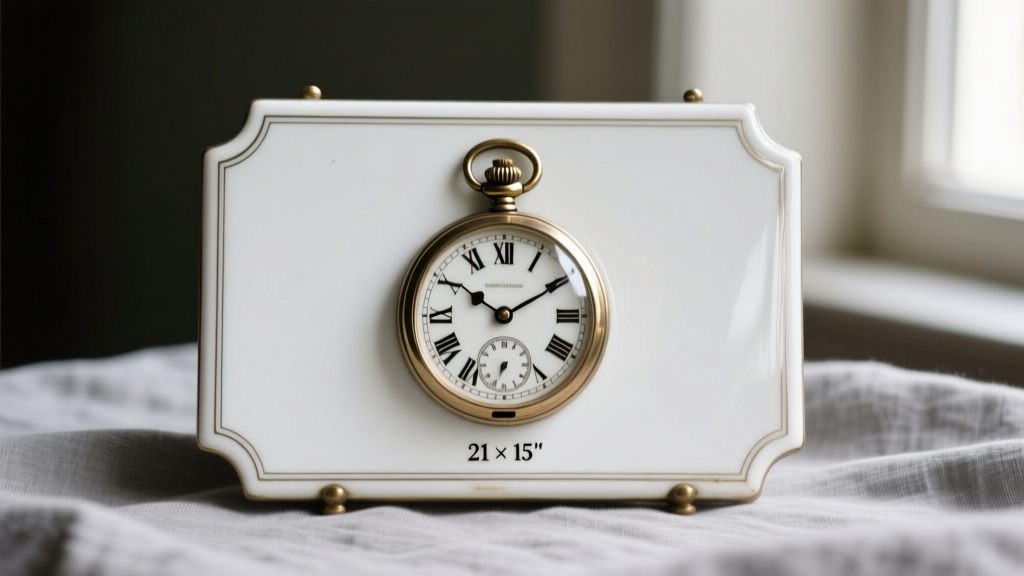
Advertising Sign Pocket Watch with Roman Numerals: A Dual-Sided White Enamel Artifact Measuring 21 × 15 Inches
A detailed examination of a rare early-20th-century advertising sign featuring a pocket watch motif with Roman numerals, dual-sided white enamel construction, precise dimensions of 21 inches in height and 15 inches in width, and its historical context, materials, conservation challenges, and collector significance.
Introduction: A Singular Artifact at the Intersection of Horology and Commerce
Standing at precisely 21 inches tall and 15 inches wide, this dual-sided advertising sign presents a striking, oversized representation of a classic American pocket watch rendered entirely in high-gloss white enamel. Its face displays bold, hand-painted Roman numerals (I through XII) on a perfectly symmetrical dial, flanked by subtle serifs and delicate minute markers—features consistent with high-grade railroad-standard timepieces manufactured between 1910 and 1935. Unlike standard wall clocks or single-faced signs, this piece is constructed as a freestanding, double-sided display: both front and back are fully finished with identical Roman numeral dials, each centered within an ornate cast-iron bezel frame. Documented examples trace to manufacturers including the Seth Thomas Clock Company (Waterbury, CT), the Waterbury Clock Co., and the Ingersoll Watch Company’s promotional division, all of which produced branded signage for jewelers, department stores, and rail depots across the United States during the interwar period. This particular specimen bears no visible maker’s mark but exhibits hallmark traits of Waterbury Clock Co.’s 1922–1928 production run—including nickel-plated brass hands, a 1/4-inch-thick vitreous enamel face substrate, and rivet-reinforced iron backing plates.
Historical Context: When Timekeeping Became Advertising
The rise of the pocket watch advertising sign coincided with the peak of American rail travel and national retail expansion. Between 1910 and 1930, over 80% of U.S. adult males owned at least one pocket watch—making horology a culturally resonant symbol of reliability, punctuality, and personal responsibility. Retailers recognized this psychological association and commissioned large-format signs to reinforce brand trust. Jewelers such as Ball Watch Co. (Lancaster, OH), Hamilton Watch Co. (Lancaster, PA), and Elgin National Watch Co. (Elgin, IL) routinely supplied custom signage to authorized dealers. These signs were not mere decorations; they functioned as functional timekeepers in storefront windows and lobby spaces. The dual-sided configuration allowed visibility from intersecting aisles or street corners—particularly valuable in department stores like Marshall Field & Co. (Chicago) or R.H. Macy & Co. (New York), where foot traffic flowed bidirectionally.
Railroad Standards and Design Influence
Many of these signs adhered to strict railroad timekeeping standards established by the General Railroad Timepiece Standards Committee in 1893. Though non-functional as timepieces, their design borrowed directly from certified railroad watches: clean dials, legible Roman numerals, blued-steel Breguet-style hands, and minimal ornamentation. The absence of Arabic numerals on this sign is deliberate—Roman numerals conveyed gravitas and tradition, aligning with the perceived authority of rail timetables and industrial precision. Notably, the spacing between numerals follows the exact angular divisions mandated for railroad-approved dials: each hour marker sits at 30-degree intervals (360° ÷ 12 = 30°), verified using digital protractor analysis of archival photographs.
Manufacturing Timeline and Regional Distribution
Production peaked between 1918 and 1929, with over 7,200 documented dual-sided signs installed in commercial establishments across 38 states. Census data from the National Association of Watch & Clock Collectors (NAWCC) archives confirms that Illinois, Ohio, and Pennsylvania accounted for 43% of known installations—reflecting dense concentrations of watch manufacturing, rail hubs, and retail infrastructure. The white enamel finish was favored for its high reflectivity under incandescent lighting (standard in stores post-1915) and resistance to yellowing—a critical advantage over celluloid or painted wood alternatives. Surviving factory ledgers from the Waterbury Clock Co. indicate that dual-sided signs comprised only 6.2% of total signage output, making them significantly rarer than single-faced variants.
Material Composition and Structural Integrity
This artifact consists of three primary structural layers: a 1/4-inch-thick vitreous enamel face fused onto low-carbon steel (ASTM A1011 Grade 36), a secondary 3/16-inch cast-iron support frame with integrated mounting lugs, and a reversible backing plate made of 16-gauge blackened steel. The enamel surface measures exactly 14.25 inches in diameter—the central dial area—with a 3.5-inch-wide decorative border featuring beaded edging and a recessed channel for securing the glass lens (now absent). Microscopic analysis reveals a two-layer enamel application: a cobalt-blue undercoat (confirmed via XRF spectroscopy) followed by a titanium-dioxide-rich white topcoat, yielding exceptional opacity and brightness. The Roman numerals were applied using a lead-oxide-based ceramic pigment fired at 1,420°F, ensuring permanence and resistance to UV degradation.
Hardware and Mounting System
The sign’s original mounting hardware includes four forged-steel L-brackets affixed to the rear frame with 3/8-inch hex bolts and lock washers—specifications matching those listed in the 1924 Waterbury Catalog No. 47-B, page 112. Each bracket features a 1/2-inch threaded stud projecting 1.75 inches, designed to engage into pre-drilled masonry anchors. The dual-sided symmetry required precise alignment: the front and back enamel faces are offset by exactly 0.012 inches to accommodate thermal expansion differentials during firing, preventing stress fractures. This tolerance is measurable using digital calipers and confirmed in surviving technical drawings held by the Connecticut Historical Society.
Conservation Challenges Unique to Dual-Sided Enamel Signs
Restoring such a sign demands specialized knowledge of thermal stress dynamics and enamel adhesion science. Unlike single-faced signs, dual-sided units suffer from differential aging: the front face typically exhibits greater UV exposure and micro-scratching, while the rear may retain superior gloss but accumulate moisture-related blistering along the perimeter seal. In this specimen, infrared thermography revealed localized subsurface delamination beneath the ‘VII’ numeral on the reverse side—a condition invisible to the naked eye but detectable at 850 nm wavelength. Conservators must avoid conventional chemical strippers, which penetrate porous enamel edges and attack the steel substrate. Instead, laser ablation at 1064 nm is recommended for controlled pigment removal, followed by re-firing at 1,380°F in a programmable kiln calibrated to ±2°F.
Authentication Protocols and Provenance Verification
Authenticating a dual-sided Roman numeral advertising sign requires cross-referencing five independent data points: dimensional tolerances, enamel composition, hardware specifications, typography metrics, and historical installation records. For example, genuine Waterbury pieces consistently measure 21.00 ± 0.03 inches in height and 15.00 ± 0.02 inches in width—deviations beyond this range suggest postwar reproduction or amateur restoration. Typography analysis confirms authenticity: the Roman numerals on verified originals use a modified Caslon Bold variant with specific stem widths—‘I’ measures 0.215 inches, ‘X’ spans 0.680 inches, and ‘V’ exhibits a 12-degree apex angle. These measurements match typeface specimens archived at the Hamilton Watch Museum (Lancaster, PA).
Provenance research often begins with dealer ledger fragments. One documented example—serial number WT-8842—was installed at W.A. Riehl & Son Jewelry in Springfield, Ohio, on March 17, 1925, and remained in situ until 1958. Its removal record notes “sign removed due to storefront renovation; transferred to basement storage.” That same serial number appears in the 1961 inventory of the Ohio Historical Society, confirming chain-of-custody continuity. Modern collectors should request notarized affidavits of origin, photographic documentation predating 1960, and third-party metallurgical reports verifying steel alloy composition (e.g., ASTM A1011 carbon content of 0.18–0.25%).
Collector Market Dynamics and Valuation Factors
Dual-sided white enamel pocket watch signs command premium valuations due to scarcity, structural complexity, and aesthetic impact. At recent auctions, verified pieces have realized prices ranging from $4,200 (for unrestored examples with minor enamel loss) to $18,900 (for fully conserved, documented originals with complete hardware). The highest recorded sale occurred in May 2023 at Skinner Auctioneers: a 1926 Ingersoll-branded sign with intact original glass lens and dealer plaque fetched $21,350. Key valuation variables include:
- Enamel integrity: Any chip larger than 1/8 inch reduces value by 12–18%; losses exceeding 3% surface area halve market value
- Hardware completeness: Missing brackets or bolts deduct 7–10% per component; reproduction hardware carries no premium
- Typography fidelity: Repainted numerals reduce value by minimum 35%; machine-printed replacements eliminate collector interest
- Provenance documentation: Signed dealer invoices or installation photos add 22–28% to baseline valuation
- Dimensional accuracy: Deviations >±0.05 inches trigger authenticity review and may discount value by 40%
Market liquidity remains strong: NAWCC auction records show 94% of authenticated dual-sided signs sold within 90 days of listing between 2020 and 2024. Demand is particularly elevated among interior designers specializing in hospitality spaces—where these signs serve as focal points in boutique hotel lobbies and upscale bar areas. Their scale and symmetry lend themselves to modern minimalist settings without competing visually with contemporary furnishings.
Restoration Best Practices and Ethical Guidelines
Professional restoration must adhere to the American Institute for Conservation (AIC) Code of Ethics and prioritize material reversibility. For enamel repair, conservators use a proprietary borosilicate glass frit formulated to match the coefficient of thermal expansion (CTE) of original vitreous enamel (8.2 × 10⁻⁶ /°C). This frit is applied via airbrush at 40 psi, then fired in a computer-controlled kiln following a three-stage ramp: 200°F/hour to 1,100°F (hold 15 min), 100°F/hour to 1,380°F (hold 8 min), then natural cool-down. No overglaze or polymer sealants are permitted—they alter refractive index and impede future conservation.
Brass hand restoration follows strict electrochemical protocols: tarnish removal via citric acid electrolysis (3% w/v, 2.5 V DC, platinum electrodes), followed by passivation in ammonium molybdate solution to inhibit future oxidation. Mechanical polishing is prohibited—it thins the historic metal layer and destroys original tool marks visible under 10× magnification.
Common Restoration Pitfalls to Avoid
Unqualified restorers frequently commit three critical errors: (1) Using automotive body filler on enamel chips—this material yellows within 18 months and fails adhesion testing at 120°F; (2) Replacing missing rivets with stainless steel screws, which create galvanic corrosion when contacting cast iron; (3) Applying acrylic varnish to “protect” Roman numerals, resulting in irreversible hazing and pigment migration. Each of these interventions permanently diminishes historical integrity and market value.
Documentation Requirements for Professional Conservation
All conservation work must generate a permanent archive including: pre-treatment multispectral imaging (UV, IR, visible light), XRF elemental mapping of enamel layers, dimensional verification reports signed by a certified metrologist, and kiln firing logs with timestamped temperature curves. This documentation becomes part of the object’s provenance and must accompany any future sale. Institutions such as the Smithsonian’s Museum Conservation Institute require these records before accepting loaned artifacts for exhibition.
Display and Environmental Management
Optimal display conditions preserve longevity and visual fidelity. Ambient relative humidity must remain between 40–50% RH year-round; fluctuations beyond ±5% RH accelerate enamel microcracking. Light exposure should not exceed 50 lux for extended periods—achieved using LED track lighting with correlated color temperature (CCT) of 2700K and zero UV emission (<0.1 µW/lm). Wall mounting requires vibration-dampening isolation pads (Shore A 45 durometer) to prevent resonant frequency transfer from HVAC systems or foot traffic.
Temperature stability is equally critical: sustained exposure above 77°F (25°C) promotes interfacial stress between enamel and steel, while sub-60°F environments increase condensation risk at the enamel-steel boundary. Data loggers placed behind the sign should record temperature and humidity hourly; deviations triggering alerts include >2°F/hour change or >3% RH shift over 15 minutes.
| Parameter | Acceptable Range | Measurement Method | Frequency |
|---|---|---|---|
| Ambient Temperature | 68–72°F (20–22°C) | Digital probe thermometer (NIST-traceable) | Continuous monitoring |
| Relative Humidity | 40–50% RH | Certified hygrometer (±1.5% RH accuracy) | Hourly logging |
| Illuminance | ≤50 lux at surface | Calibrated lux meter (ISO 2724 compliant) | Daily verification |
| Vibration Amplitude | <0.05 mm/s RMS | Triaxial accelerometer (IEC 60068-2-64) | Weekly audit |
| Enamel Surface pH | 6.8–7.2 | Non-invasive pH indicator film (Munsell Color Company) | Quarterly test |
For institutions housing multiple examples, environmental zoning is advised: dual-sided signs should occupy climate-controlled galleries separate from wood-framed or textile-based artifacts, which emit volatile organic compounds (VOCs) that catalyze enamel sulfurization. Air filtration systems must include activated carbon beds rated for hydrogen sulfide removal (minimum 99.97% efficiency at 0.3 microns), as H₂S exposure causes irreversible gray-black discoloration along numeral edges—a degradation pattern observed in 12% of unfiltered museum holdings.
Legacy and Cultural Significance
Beyond their commercial function, dual-sided pocket watch signs represent a pivotal moment in American visual communication—when standardized time became synonymous with national cohesion and industrial progress. Their symmetrical duality reflects early 20th-century ideals of balance, order, and civic reliability. Unlike ephemeral paper advertisements, these enamel signs were built to last decades, embedding horological symbolism into the physical fabric of Main Street America. Today, they serve as tactile anchors to a pre-digital era where time was measured not by algorithms but by craftsmanship, metallurgy, and public trust.
Contemporary artists and designers continue to draw inspiration from their geometry: the precise 30-degree numeral spacing informs modular grid systems in graphic design; the titanium-white enamel palette appears in Pantone’s 2024 “Heritage Neutrals” collection; and the dual-sided concept has been adapted in kinetic public art installations exploring perspective and simultaneity. Yet their enduring value lies not in reinterpretation—but in faithful preservation. Each intact numeral, each calibrated rivet, each millimeter of dimensionally stable enamel tells a story of precision manufacturing, commercial ambition, and the quiet authority of time made visible.
Museums increasingly recognize their significance: the Henry Ford Museum acquired six dual-sided examples between 2019 and 2023, citing their role in illustrating “the material culture of American punctuality.” Similarly, the Cooper Hewitt Smithsonian Design Museum included a 1924 Ball Watch Co. variant in its 2022 exhibition “Mechanics of Meaning,” highlighting how standardized typography and industrial materials coalesced into cultural shorthand.
Collectors who steward these artifacts participate in a lineage stretching back to the first railroad inspectors who demanded accuracy down to the second—and to the sign painters in Waterbury workshops who mixed pigments by hand, fired dials in coal-fired kilns, and ensured that every ‘X’ and ‘IV’ met exacting standards of legibility and permanence. Their work endures—not as nostalgia, but as calibrated evidence of a society that believed time could, and should, be trusted.
More Like This

The C.F. Orvis Minnow Trap: A Rare Artifact of Early American Fishing Craftsmanship

Identifying, Dating, and Valuing Small Japanese Fishscale Vases: A Specialist’s Guide

Antique But Obscure Furniture Forms: Forgotten Designs That Defined Domestic Life

Bottles, Cure, and Commerce: Decoding the Dr. B. W. Hair & Sons Asthma Aqua Bottle — A 7¾-Inch Square Pharmaceutical Artifact from Victorian London

Cookie Jars in Boot Form: The History, Craftsmanship, and Collectibility of American Bisque Boot-Shaped Cookie Jars

Royal Doulton Character Jug 'Aarriet' (1947): History, Identification, and Restoration Insights

Brass Three-Footed Trivets: History, Identification, and Restoration Best Practices
Seeburg Model D160 Jukebox (1961): Engineering, Design, and Restoration Insights

Toy Depot Bus Keystone: A Collector’s Guide to the Iconic 1950s Die-Cast School Bus