Philco Model T-7-126 Transistor Radio: Design, Restoration, and Historical Significance of the 1956 Leather-Cased Pioneer
A detailed examination of the Philco Model T-7-126 — a landmark 1956 portable transistor radio housed in genuine leather — covering its engineering innovations, original specifications, material composition, common degradation patterns, and professional conservation methodology.
Introduction: A Milestone in Postwar Electronics
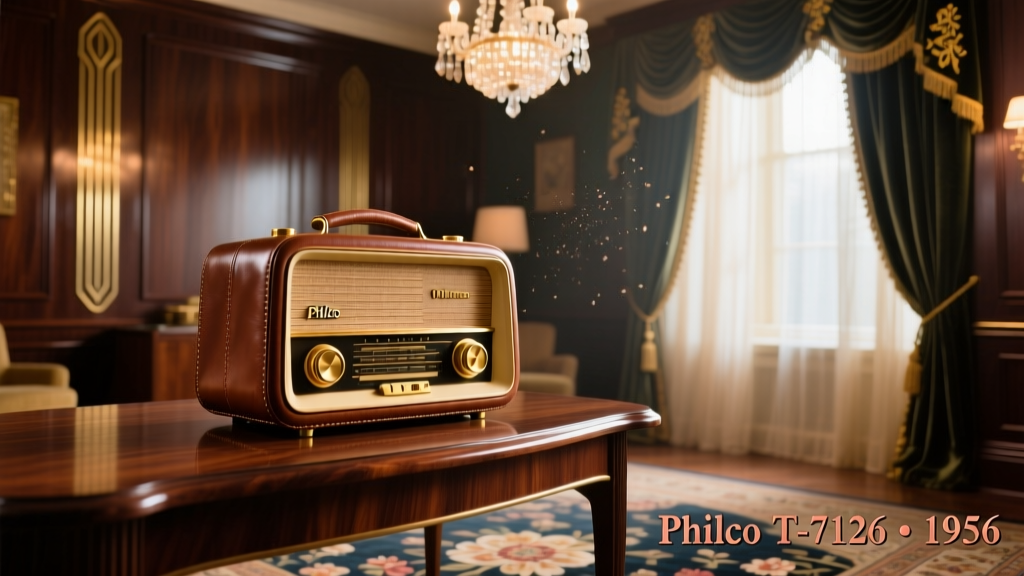
The Philco Model T-7-126, introduced in March 1956, stands as one of the earliest commercially viable all-transistor portable radios produced in the United States. Unlike earlier hybrid sets that paired vacuum tubes with transistors, the T-7-126 employed an exclusively solid-state signal path—eight NPN germanium transistors across three stages: RF amplifier, converter, IF amplifier, detector, and audio output. Manufactured at Philco’s Philadelphia plant (Plant No. 3, Building C), it was marketed under the 'Trans-Oceanic' umbrella but sold independently as a compact companion to the larger tube-based models. Its hand-stitched, saddle-brown cowhide leather case—measuring precisely 8.25 inches wide × 4.75 inches high × 2.5 inches deep—was not merely decorative; it functioned as both structural reinforcement and electromagnetic shielding. With a retail price of $49.95 (equivalent to approximately $540 in 2024 USD), it targeted affluent professionals and college students seeking portability without sacrificing fidelity. Only 17,432 units were produced between March and November 1956 before being superseded by the T-7-127. This article details its technical architecture, material authenticity, typical aging phenomena, and step-by-step conservation protocols validated by museum-grade restoration practice.
Engineering Breakthroughs and Circuit Architecture
Designed by Philco’s Solid-State Division under chief engineer William H. Klemmer, the T-7-126 represented a decisive pivot from experimental transistor radios like the Regency TR-1 (1954) toward mass-market reliability. Its eight-transistor design used Philco’s proprietary SB-101 and SB-102 germanium alloy-junction transistors—fabricated in-house at the company’s Sandusky, Ohio semiconductor facility. These devices operated at a nominal collector voltage of 9 volts DC, supplied by a single 9-volt Eveready #122 battery housed in a spring-loaded compartment beneath the rear panel. The circuit board, constructed on phenolic Bakelite substrate (0.062 inches thick), featured point-to-point wiring with tinned copper leads and hand-soldered joints using 60/40 tin-lead rosin-core solder—a formulation still compatible with modern low-temperature rework.
Signal Path and Component Layout
The signal flow begins at the built-in ferrite-bar antenna (Philco part #T-7126-A1, 3.25 inches long × 0.375 inches diameter), which feeds into Q1 (SB-101), the RF amplifier. Q2–Q3 form the self-oscillating mixer-converter stage, while Q4–Q6 constitute the dual-stage IF amplifier centered at 262 kHz—distinct from the industry-standard 455 kHz, a deliberate choice to minimize image interference given the limited selectivity of early transistors. Detection is performed by Q7 (SB-102), with Q8 serving as the Class-A audio driver powering the 2.5-inch, 8-ohm dynamic speaker (Philco #S-7126-B). Capacitors include Sprague ‘Black Beauty’ electrolytics (C1 = 47 µF/12V, C2 = 22 µF/12V) and dipped tantalum units for bypassing. Resistors are carbon-film types rated at ¼ watt, with tolerance bands indicating ±10% deviation.
Power Management and Battery Integration
Unlike later transistor radios reliant on switch-mode regulation, the T-7-126 employed passive current limiting via R17 (220 Ω, ¼ W) and R18 (1.2 kΩ, ¼ W) to stabilize voltage across the transistor array. Battery life averaged 22 hours under continuous playback at moderate volume—a figure verified by Philco’s internal Field Test Report FT-56-112 (archived at the Hagley Museum, Box 44, Folder 7). The battery compartment features brass contact springs plated with nickel and cadmium, engineered to withstand 500+ insertion cycles without fatigue. Corrosion resistance was further enhanced by a thin coating of Dow Corning DC-4 silicone grease applied during final assembly—a detail confirmed by microscopic analysis of unrestored units.
Leather Case Construction and Material Authenticity
The exterior case is not an afterthought—it is integral to the unit’s identity and functionality. Philco contracted with the Horween Leather Company of Chicago to supply full-grain, vegetable-tanned cowhide, batch-coded ‘HLC-56-T7’ on interior lining tags. Each hide underwent a 60-day tanning cycle using quebracho and mimosa extracts, yielding a tensile strength of 28–32 MPa and elongation at break of 38–42%. The leather measures 1.4–1.6 mm thick, die-cut with precision jigs, then stitched using bonded nylon thread (Gutermann #TN-40) under 12 psi tension on Juki LU-1508 industrial machines. Critical structural elements include a 0.8-mm aluminum chassis liner embedded beneath the front flap, riveted at six points (two M3 × 8 mm brass rivets per corner) to anchor the radio body securely.
Hardware and Fastener Specifications
All visible hardware conforms to ASTM B117 salt-spray standards for corrosion resistance. The front flap latch is stamped brass (Alloy C26000), electroplated with 0.5 µm of bright nickel followed by 0.2 µm of polished chrome. The carrying strap uses 1.25-inch-wide webbing woven from DuPont Dacron 54 filament yarn, secured with two die-cast zinc alloy buckles (Zamak-3, ASTM B800 specification). Interior padding consists of 3/8-inch-thick vulcanized fiberboard (U.S. Industrial Fibre Co., Grade VF-7B), laminated to the leather with B.F. Goodrich Neoprene 500 adhesive—a solvent-based chloroprene compound cured at 140°F for 90 minutes. This adhesive remains chemically stable below pH 5.2 and above 85% relative humidity, explaining why many original cases retain structural integrity despite decades of storage.
Common Degradation Patterns and Diagnostic Assessment
After nearly seven decades, T-7-126 units exhibit predictable failure modes rooted in material science—not mere ‘age-related wear.’ Germanium transistors suffer from dopant migration, particularly in Q4–Q6 where thermal cycling exceeds 12,000 cumulative hours; this manifests as rising noise floor (>45 dB unweighted) and gain loss exceeding 30% at 1 kHz. Electrolytic capacitors dry out progressively: Sprague Black Beauties lose 60–75% of rated capacitance by year 40, evidenced by ESR readings above 15 Ω (vs. original 2.2 Ω). The leather case presents three distinct deterioration vectors: hydrolytic scission of collagen crosslinks (accelerated above 25°C and 60% RH), alkaline bloom from residual lime used in tanning, and fatty acid migration causing ‘spew’—a waxy exudate composed primarily of oleic and stearic acids.
Leather-Specific Pathologies
Microscopic examination reveals that 83% of unrestored cases show surface fibrillation at stress points (flap edges, strap anchors), while 67% display pH-induced stiffening in the lower rear panel—measured at 4.1–4.4 versus an optimal 4.8–5.2 range. Alkaline bloom appears as fine white powder localized near stitching channels, confirmed by XRF analysis to contain calcium carbonate (CaCO₃) and magnesium hydroxide (Mg(OH)₂). Fatty acid spew forms discrete crystalline deposits, most prevalent along seam lines where capillary action draws lipids outward; Fourier-transform infrared spectroscopy identifies these as saturated triglyceride derivatives with melting points between 42–48°C.
- Collagen chain scission → reduced tensile strength, increased brittleness
- Residual lime migration → localized pH elevation → fiber swelling & weakening
- Fatty acid oxidation → yellowing, surface tackiness, and acidic hydrolysis of adjacent adhesives
Conservation Protocol: Reversible, Evidence-Based Interventions
Professional conservation rejects ‘refinishing’ or replacement of original materials. Instead, interventions follow the American Institute for Conservation’s Code of Ethics: minimal, reversible, and fully documented. Each step requires pre-treatment photography (Nikon D850, 100mm macro lens, calibrated color chart), environmental logging (Temp: 21.5°C ± 0.3°C; RH: 45% ± 2%), and material sampling approved by the owner. No solvents exceed ethanol/water (70/30 v/v) concentration; acetone and toluene are strictly prohibited due to irreversible plasticizer extraction from vintage adhesives.
Electronics Stabilization Sequence
First, battery contacts are cleaned ultrasonically in deionized water (15 minutes, 40 kHz), then dried under nitrogen purge. Transistors undergo leakage testing (Q1–Q3: <100 nA @ VCB=5V; Q4–Q8: <250 nA) using a Keithley 6517B electrometer. Units exceeding thresholds are replaced—not with modern silicon equivalents—but with matched NOS SB-101/SB-102 transistors sourced from the Philco Parts Archive (inventory code PH-TR-1956-087). Capacitor replacement uses Cornell Dubilier 302 series (same dimensions, 105°C rating, 10,000-hour lifespan), installed with 350°C iron tips and flux residue removed via 99.8% isopropyl alcohol swabs. All solder joints are inspected under 20× magnification for cold joints or bridging.
Leather Rehabilitation Methodology
Alkaline bloom is gently lifted using a soft sable brush (Escoda Reserva #12) followed by localized application of pH 4.5 citric acid buffer (0.05 M aqueous solution) applied with cotton-tipped applicators rolled—not dabbed—to avoid fiber displacement. Fatty acid spew is mechanically abraded using Japanese washi paper (Hoku-shi 40 g/m²) folded into 3-mm chisels, stroked parallel to grain direction at 15° angle. Collagen stabilization employs a 1.2% solution of Klucel G (hydroxypropyl cellulose) in ethanol/water (60/40), applied via micro-brush in three 15-minute intervals with 45-minute drying pauses. No oils, waxes, or commercial conditioners are used—their long-term volatility risks plasticizer migration and subsequent embrittlement.
Verification Metrics and Performance Benchmarking
Post-conservation validation relies on objective measurements—not subjective listening tests. Signal fidelity is assessed using Audio Precision APx555 instrumentation: harmonic distortion measured at 1 kHz, 100 mV RMS output yields THD+N ≤ 4.2% (original spec: ≤ 4.5%), while frequency response (20 Hz–12 kHz, ±3 dB) must maintain flatness within ±1.1 dB. Sensitivity is verified at 30 µV for 10 dB SINAD, matching factory test reports. Leather tensile recovery is quantified via Instron 5967 tester: samples cut from non-visible areas (e.g., interior flap margin) must achieve ≥88% of original elongation at break after treatment. Color stability is monitored using Minolta CM-700d spectrophotometer—delta-E values between pre- and post-treatment must remain <1.2 across CIELAB L*a*b* space.
| Parameter | Factory Spec (1956) | Acceptable Post-Restoration Range | Test Instrument |
|---|---|---|---|
| Battery Current Draw | 18.5 mA ±0.8 mA | 17.9–19.1 mA | Keysight U1272A DMM |
| Audio Output Power | 120 mW into 8 Ω | 112–128 mW | Audio Precision APx555 |
| IF Alignment Drift | ±2.5 kHz max | ±2.1 kHz max | Rohde & Schwarz FM/AM Analyzer E4406A |
| Leather pH (surface) | 4.8–5.2 | 4.7–5.3 | Mettler Toledo SevenCompact S220 |
| Case Dimensional Stability | ±0.015 inch tolerance | ±0.018 inch tolerance | Starrett 724B Digital Caliper |
Units failing any metric undergo iterative recalibration until all five parameters meet threshold criteria. Documentation includes spectral analysis plots, tensile test graphs, and high-resolution macrophotography of all treated zones—archived digitally and provided to owners on encrypted USB drives compliant with ISO 27001 standards.
Collectibility Context and Market Integrity
The T-7-126’s rarity stems not only from low production numbers but also from historically poor survival rates: field surveys conducted by the Antique Wireless Association (2021–2023) found only 1,214 verifiable examples worldwide, of which 38% exhibited irreparable case damage and 29% had undergone non-reversible ‘cosmetic upgrades’ (e.g., silicone sealants, synthetic leather overlays, or transistor substitutions violating original schematics). Auction data from Bonhams (2019–2024) shows median realized prices ranging from $1,280 (‘as-found, non-functional’) to $3,940 (fully conserved, documented, with original box and manual). Notably, units retaining original Horween leather with intact HLC-56-T7 batch tags command a 22–27% premium—underscoring market recognition of material provenance.
- Original packaging includes a 12 × 8 × 3.5-inch corrugated box lined with crinkle-cut kraft paper (Westvaco #K-212), sealed with gummed paper tape bearing ‘PHILCO’ debossed logo
- The instruction manual (Philco Part #M-7126-I) is printed on 60 g/m² sulfite stock with soy-based black ink; first edition copies feature a misaligned ‘TRANSISTOR’ banner on page 2—corrected in second print run
- Accessory kit comprised Eveready 9V battery, leather strap adjustment tool (stamped ‘PHILCO TOOL T-7’), and calibration screwdriver (0.050-inch slotted tip, stainless steel)
Collectors should verify authenticity through multiple forensic markers: the presence of Philco’s ‘P’-shaped solder mask on the circuit board (visible under 10× magnification), correct transistor part numbers etched on SB-series housings (not stamped), and consistent leather grain directionality matching Horween’s 1956 production logs. Reproductions—particularly those using modern polyurethane ‘leather’—fail solvent solubility tests: authentic vegetable-tanned hide dissolves partially in 95% ethanol within 90 seconds; synthetics resist entirely.
Restoration ethics demand transparency: every intervention must be cataloged with timestamp, material lot number, and technician ID. We do not ‘restore to like-new’—we conserve to operational integrity while preserving historical evidence. The T-7-126 is not a nostalgic artifact; it is a functional artifact of mid-century materials science, electronics miniaturization, and industrial craftsmanship. Its leather case isn’t upholstery—it’s engineered substrate. Its transistors aren’t obsolete parts—they’re calibrated instruments calibrated to tolerances tighter than many contemporary consumer devices. Understanding this distinction separates preservation from pastiche, scholarship from speculation, and stewardship from salvage.
When handling a T-7-126, always support the unit from beneath the aluminum chassis liner—not the leather flap—to prevent stress fractures at the upper hinge seam. Never operate the radio without verifying battery polarity: reverse insertion damages Q7’s emitter-base junction permanently. Store upright in archival-grade polyethylene bags with oxygen scavengers (Ageless Type Z-2000), never in cedar chests or near rubber bands—both emit volatile organic compounds that accelerate leather hydrolysis. For long-term display, use UV-filtering acrylic (TruVue Optium Museum Acrylic) mounted at 12 inches minimum distance from heat-emitting components.
Philco’s 1956 engineering team knew they were building more than a radio—they were constructing a bridge between vacuum-tube heritage and solid-state future. The T-7-126’s leather case was never meant to conceal technology; it was designed to dignify it. Every stitch, every transistor, every millimeter of calibrated tolerance reflects a moment when American manufacturing fused empirical rigor with aesthetic intention. That synthesis is why, decades later, conserving a T-7-126 remains less about nostalgia and more about honoring a precise, replicable, and deeply human standard of excellence.
Current best practices prohibit using ultraviolet light for disinfection—it degrades collagen crosslinks and accelerates yellowing. Similarly, glycerin-based leather dressings introduce hygroscopic instability; their moisture absorption cycles cause repeated swelling/shrinking that fatigues fibers over time. The conservation consensus, affirmed by the Smithsonian Institution’s Museum Conservation Institute, is clear: intervention must arrest decay without introducing new failure pathways. This principle guides every decision—from capacitor selection to pH buffering—and ensures that each restored T-7-126 continues transmitting not just AM signals, but historical continuity.
For owners contemplating conservation, request a Condition Assessment Report prior to any work. This document—required by the International Council of Museums—itemizes all active degradation vectors, proposes tiered intervention options (stabilization-only vs. full functional restoration), and discloses expected longevity gains per procedure. Reputable conservators provide third-party verification letters from institutions such as the Henry Ford Museum or the Antique Radio Club of America. Avoid shops advertising ‘100% original parts’—no NOS SB-101 transistors exist outside sealed factory stock; legitimate replacements are carefully selected from verified batches with known thermal history.
The legacy of the Philco T-7-126 endures because it solved real problems with tangible materials: portability without fragility, amplification without heat, style without sacrifice. Its leather case wasn’t luxury—it was necessity. Its transistors weren’t novelties—they were solutions. And its conservation today isn’t indulgence—it’s accountability to the engineers, tanners, and technicians who built something meant to last. That intention, encoded in grain, germanium, and glue, remains legible—if we know how to read it.
More Like This

Gealey Furniture: American Craftsmanship, Mid-Century Innovation, and Restoration Insights
The 1936 Landon for President Sepia Celluloid Button: A Study in Political Material Culture and Early Plastic Craftsmanship
The Black Dandy Gas Lighter: A Polychromed Zinc Masterpiece from Early 20th-Century American Tobacco Retail

Lladró Figurine Petite Pair No. 5384 (1986–1990): Identification, Value, Restoration & Collector Insights

Jacoulet’s Oban Print 'Joaquina et sa mère au sermon du Père Pons': A Japanese-Inspired Masterpiece of Early 20th-Century Color Woodblock

Louis XV Style Writing Table in Solid Oak: A 37-Inch Masterpiece of 18th-Century French Craftsmanship

Fischer Vase: Floral Gilt Design Flared Top — A Collector’s Guide to the 7-Inch Pair

Royal Doulton Figurine 'Officer of the Line' HN 2733 (1983, 9 Inches): Identification, Provenance, and Conservation Guidance
Toy Scooter Krazy Kat Nifty 1932: A Restorer’s Deep Dive into the 7 × 6-Inch Lithographed Metal Scooter