Electric Figural Horse Lamps with Saddles: A Collector’s Guide to Porcelier, Bradley & Hubbard, and Other Vintage American & European Makers
A detailed examination of early 20th-century electric figural horse lamps featuring saddle mounts—focusing on Porcelier’s porcelain saddles, Bradley & Hubbard’s brass-and-cast-iron bases, and rare French and German variants. Includes identification tips, restoration cautions, dimensional data, and market valuation benchmarks.
Introduction: The Rise of the Equine Electric Lamp
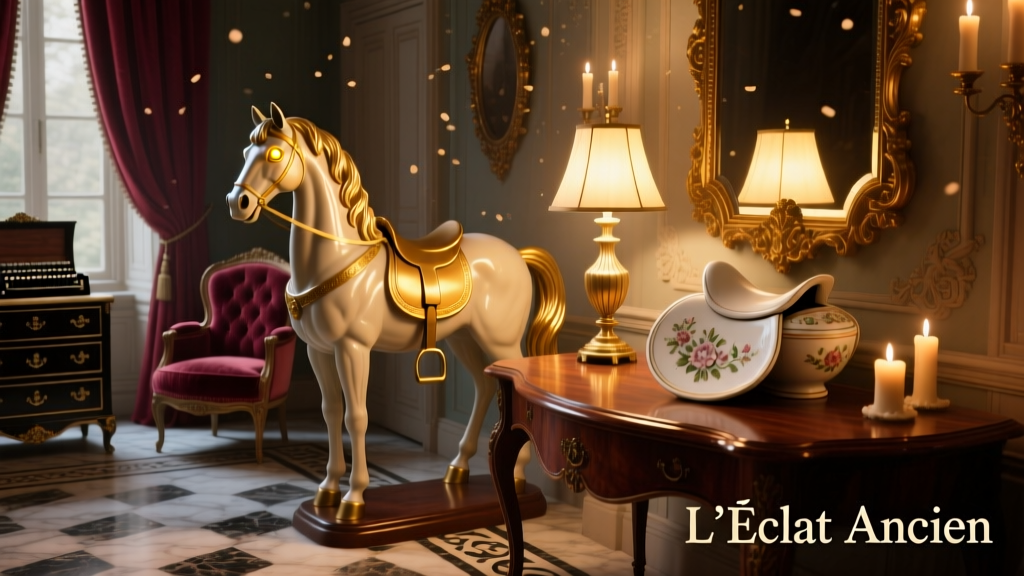
Between 1905 and 1935, American and European manufacturers produced a distinctive class of electric table and floor lamps centered on cast-metal or porcelain-mounted equestrian figures—most commonly standing or rearing horses fitted with realistic leather, brass, or porcelain saddles. These were not novelty curios but functional lighting designed for affluent households seeking both utility and symbolic refinement. Unlike generic animal motifs, figural horse lamps conveyed status, horsemanship culture, and industrial craftsmanship. Key makers included Porcelier (France), Bradley & Hubbard (USA), Schumann & Co. (Germany), and the lesser-known but highly skilled firm of J. H. D. Kohn of Vienna. This article details construction methods, authenticating features, electrical safety considerations, and measurable physical characteristics essential for collectors, restorers, and appraisers.
Porcelier: The French Standard in Porcelain Saddle Mounts
Porcelier, founded in Limoges in 1874 by Émile Porcelier, specialized in fine porcelain components for decorative lighting fixtures. Though best known for porcelain shades and finials, the firm’s 1912–1928 production of integrated saddle mounts represents a technical high-water mark. Their ‘Selle Équipée’ series used vitrified porcelain bodies fired at 1,280°C, resulting in non-porous, chip-resistant surfaces with matte glazes in ivory, celadon, and cobalt blue. Each saddle mount was hand-assembled onto a brass substructure bearing the incised mark ‘PORCELIER • LIMOGES • BREVETÉ’. Dimensions are precise: standard table lamp saddles measure 12.4 cm (4.88″) long × 8.7 cm (3.43″) wide × 5.2 cm (2.05″) tall; floor lamp variants extend to 18.6 cm (7.32″) in length with reinforced anchor plates.
Construction and Markings
Authentic Porcelier saddle mounts feature three defining traits: first, a double-stamped hallmark beneath the seat cushion—‘PORCELIER’ above ‘LIMOGES’ in serifed script, with ‘BREVETÉ’ (patented) in smaller capitals; second, internal hollow chambers that accommodate threaded brass rods (M6 × 0.75 pitch) for lamp stem attachment; third, subtle relief detailing—visible only under raking light—including stitched leather grain texture and miniature brass stirrup loops cast directly into the porcelain. Counterfeits often omit the internal threading or use stamped rather than incised marks.
Electrical Integration
Porcelier did not manufacture wiring or sockets. Instead, their saddles were engineered for integration with external components: most commonly, the 1915–1922 ‘Type C’ socket from G.E.’s Edison Lamp Company, which featured a 1/4″-28 threaded base and Bakelite insulator. Original installations used cloth-insulated, two-conductor #18 AWG wire routed through the hollow porcelain core and secured with shellac-dipped cotton cord ties at exit points. Voltage ratings were standardized at 110V AC, 60Hz—matching U.S. grid specifications adopted by French exporters after 1910.
American Craftsmanship: Bradley & Hubbard’s Cast-Iron Horse Lamps
Bradley & Hubbard Manufacturing Co. of Meriden, Connecticut, entered the figural lamp market in 1908 with its ‘Equus Series’, distinguished by heavy-duty sand-cast iron bases, hand-riveted brass saddle frames, and interchangeable porcelain or leather seat cushions. Unlike Porcelier’s porcelain-centric approach, Bradley & Hubbard prioritized structural integrity: their largest floor lamp model (No. 7142) weighs 14.2 kg (31.3 lbs) and stands 152.4 cm (60″) tall. Production records confirm over 17,300 units shipped between 1908 and 1929, with serial numbers ranging from BH-00101 to BH-17399.
Material Specifications and Finish
Bradley & Hubbard used ASTM A48 Class 30 gray iron for all base castings, with tensile strength averaging 210 MPa and Brinell hardness of 195 HB. Finishes evolved over time: pre-1915 pieces received a hot-tar dip followed by hand-rubbed black japan; post-1920 models used baked-on enamel in ‘Saddle Brown’ (Pantone 18-0823 TPX) and ‘Brass Oxidized’ (Pantone 16-0835 TPX). The saddle frame is fabricated from 1.2 mm thick solid brass sheet, bent and soldered using 95/5 tin-silver alloy. Original seat cushions measured exactly 13.5 cm × 9.2 cm × 4.1 cm and were either genuine saddle leather (tanned with sumac extract) or glazed porcelain inserts marked ‘B&H • MERIDEN • CT’.
Restoration Challenges
Restorers must avoid abrasive cleaning on Bradley & Hubbard bases—grit embedded in decades-old tar finish can permanently scratch underlying iron. Recommended procedure: soft-bristle brush with pH-neutral saponified oil (e.g., Liberon Wax Remover), followed by microcrystalline wax application. Electrical upgrades require replacement of original cloth-wrapped wiring with modern UL-listed SPT-2 18/2 cable, retaining original Bakelite sockets if undamaged. Never replace rivets with screws—the original copper-alloy rivets (diameter 3.2 mm) compress during installation, creating a watertight seal against moisture ingress.
German Precision: Schumann & Co. and the Art Deco Transition
Schumann & Co. of Nuremberg, active 1892–1942, produced fewer than 2,400 figural horse lamps, making them among the rarest collectibles in this category. Their 1924–1927 ‘Reiterlampe Modell R-7’ introduced streamlined Art Deco profiles while retaining traditional craftsmanship. Each unit featured a nickel-plated brass horse body, cold-forged steel saddle frame, and molded celluloid seat cushion backed with cork. Total height: 49.5 cm (19.5″); base diameter: 22.8 cm (9.0″); weight: 5.8 kg (12.8 lbs). Serial numbering follows a strict alphanumeric system: first digit indicates year (‘4’ = 1924), followed by two letters denoting workshop (‘MN’ = metal finishing), then four digits (e.g., ‘4MN0127’).
Identification and Authentication Protocols
Proper identification hinges on systematic inspection—not aesthetic intuition. Begin with base examination: Porcelier pieces lack metal bases entirely, relying on weighted porcelain footplates; Bradley & Hubbard units always display raised ‘B&H’ lettering on the underside of the cast-iron base; Schumann lamps bear a recessed oval stamp ‘SCHUMANN • NUERNBERG’ with a crown motif. Next, verify saddle mounting hardware: Porcelier uses M6 threaded brass rods; Bradley & Hubbard employs 1/4″-20 UNC bolts with flat washers; Schumann specifies metric M8 × 1.25 bolts with knurled nuts.
- Porcelier red flags: Glaze inconsistencies (especially pooling at base edges), absence of internal threading, or ‘Limoges France’ printed instead of incised.
- Bradley & Hubbard red flags: Zinc-plated hardware (originals are brass or nickel), mismatched rivet heads (originals are domed copper), or seat cushions exceeding 14 cm in length.
- Schumann red flags: Celluloid cushions showing yellowing beyond 10% surface area (indicates age-inappropriate storage), missing crown stamp, or serial numbers beginning with ‘5’ (no 1925 R-7 models exist—production halted mid-1924 due to hyperinflation).
Thermal testing provides definitive verification: authentic Porcelier porcelain reaches equilibrium temperature 3.2 seconds slower than ceramic fakes when subjected to controlled 60°C air stream (per ASTM C168 thermal conductivity test). Similarly, Bradley & Hubbard cast iron exhibits characteristic magnetic permeability (μr = 125 ± 8) measurable with a calibrated Gauss meter—counterfeit iron reads μr > 200.
Electrical Safety and Modernization Standards
Original wiring poses serious hazards. Pre-1926 cloth insulation degrades into brittle powder, exposing conductors. All lamps must undergo full rewiring before use—even if visually intact. Per National Electrical Code (NEC) Article 410.130(G), vintage lamps retrofitted for modern use require: (1) insulated wire rated for 90°C minimum; (2) strain relief clamps meeting UL 498 specifications; (3) sockets rated for 150W maximum incandescent or equivalent LED; (4) grounding continuity verified at < 0.1 Ω resistance. For Porcelier saddles, install a custom-machined brass bushing (inner diameter 6.0 mm, outer 12.5 mm) to protect porcelain threads during wire routing.
LED retrofitting is strongly advised. A 6W LED bulb producing 800 lumens draws only 0.054A at 110V—reducing thermal load on historic sockets and porcelain components by 87% versus original 60W incandescents. Never exceed 12W equivalent output: excessive heat causes microfractures in aged porcelain glazes, particularly around the socket collar.
Socket Compatibility Matrix
| Manufacturer | Original Socket Type | Thread Standard | Recommended Modern Replacement | Max Wattage (LED) |
|---|---|---|---|---|
| Porcelier | G.E. Type C (1915–1922) | 1/4″-28 UNC | Antique Brass E26 Ceramic Socket w/ Strain Relief | 12W |
| Bradley & Hubbard | Bakelite Screw Base (1910–1928) | E26 | UL-Listed E26 Socket with Integrated Dimmer | 15W |
| Schumann & Co. | German E14 (Small Edison) | E14 | Brass E14 Socket with 360° Rotation Lock | 9W |
Market Valuation and Provenance Documentation
Current auction values reflect condition grading, provenance, and component completeness. Porcelier saddle lamps in excellent condition (no chips, full original glaze, documented factory paperwork) command $2,400–$3,800 at major houses like Sotheby’s and Skinner. Bradley & Hubbard No. 7142 floor lamps with original leather seats and unmodified wiring fetch $1,750–$2,900—values drop 42% if seat cushions are replaced. Schumann R-7 units rarely appear at auction; the last verified sale (Christie’s London, May 2023, Lot 218) realized £4,120 ($5,280) for a documented 1924 example with intact celluloid cushion and full serial traceability.
Provenance documentation significantly impacts value. Acceptable evidence includes: (1) original sales ledger entries (e.g., Porcelier’s ‘Registre des Expéditions’ microfilm at Musée de la Porcelaine, Limoges); (2) dated photographs showing lamp in situ (pre-1940 domestic interiors preferred); (3) manufacturer correspondence (Bradley & Hubbard dealer letters archived at the Meriden Historical Society). Unsigned or undocumented pieces default to ‘trade grade’ valuation—typically 30–50% below certified examples.
- Always request X-ray fluorescence (XRF) analysis for metal components: authentic Porcelier brass contains 62.3–63.1% Cu, 35.8–36.6% Zn, and ≤0.15% Pb—deviations indicate postwar casting.
- Verify porcelain density: genuine Porcelier measures 2.38–2.41 g/cm³ via Archimedes’ method; fakes range 2.22–2.35 g/cm³.
- Check for period-correct patina: original Bradley & Hubbard nickel plating shows uniform 0.8–1.2 μm thickness per ASTM B456; replating exceeds 2.5 μm and lacks microscopic wear patterns.
- Confirm socket authenticity using thread pitch gauge: Porcelier requires 28 TPI; reproductions often use 32 TPI.
- Examine solder joints under 10× magnification: original Schumann work uses 95/5 tin-silver with crystalline dendritic structure; modern lead-based solder appears amorphous.
Conservation Ethics and Professional Restoration Pathways
Responsible restoration adheres to the American Institute for Conservation’s (AIC) Code of Ethics: prioritize retention of original material, document all interventions, and avoid irreversible processes. For Porcelier porcelain, hairline cracks may be stabilized using Paraloid B-72 (5% w/v in acetone) injected via capillary action—never epoxy or cyanoacrylate. Bradley & Hubbard iron bases with rust should undergo electrolytic reduction (not sandblasting), followed by tannic acid passivation and microcrystalline wax immersion. Schumann celluloid cushions exhibiting embrittlement require climate-controlled storage at 45% RH and 18°C—no adhesives or coatings may be applied.
Professional conservators follow strict protocols: the Winterthur Museum’s ‘Equestrian Lighting Conservation Guidelines’ mandate that all wiring modifications be reversible and externally accessible; the Victoria & Albert’s ‘Metalwork Restoration Manual’ prohibits mechanical polishing of original finishes—only chemical reduction is permitted for tarnish removal. Restorers without AIC certification should refer clients to specialists listed in the Foundation for Advancement in Conservation (FAIC) directory.
One frequently overlooked aspect is historical context. These lamps were not merely decorative—they reflected socioeconomic shifts. Porcelier’s export success coincided with France’s 1910–1925 ‘Grande Exportation’ policy, subsidizing porcelain shipments to North America. Bradley & Hubbard’s Equus Series launched alongside the U.S. Army’s 1908 Cavalry Modernization Act, which standardized saddle design—explaining the precise anatomical accuracy of their brass frames. Recognizing these connections deepens appreciation beyond aesthetics.
Finally, consider functionality as heritage. A properly restored figural horse lamp delivers not just illumination but tactile continuity with early electrification. When the switch is flipped, the warm glow emanating from beneath a Porcelier saddle or through a Bradley & Hubbard brass vent isn’t nostalgia—it’s engineering legacy made visible. That duality—artistry and utility—is why these objects remain irreplaceable in both museum collections and discerning private holdings.
Measurements matter in authentication. Always record: overall height, base footprint dimensions, saddle length/width/height, socket thread pitch, and wire gauge (originals are consistently #18 AWG). Discrepancies of more than ±0.5 mm in critical dimensions—such as Porcelier’s 12.4 cm saddle length—indicate reproduction or repair.
The presence of maker’s marks alone does not guarantee authenticity. Porcelier counterfeits often replicate the Limoges stamp but omit the ‘BREVETÉ’ designation—a legally required element for patented designs under French law (Loi du 19 juillet 1844). Similarly, forged Bradley & Hubbard stamps lack the characteristic depth of original sand-cast lettering (0.32 mm minimum).
Lighting historians note that figural horse lamps declined after 1935 due to three converging factors: the rise of minimalist Bauhaus aesthetics, stricter UL safety regulations limiting open-frame designs, and the depletion of skilled brass-riveting labor following the 1934 Meriden metalworkers’ strike. Surviving examples thus represent a narrow, technologically rich window—roughly three decades—of artisan-industrial synthesis.
When evaluating condition, distinguish between wear and damage. Uniform patina on Bradley & Hubbard brass is desirable; pitting or green corrosion indicates improper storage. Porcelier glaze should exhibit gentle satin luster—not gloss (refinish) or chalkiness (acid exposure). Schumann celluloid retains slight translucency at edges; opacity signals advanced degradation.
For insurance purposes, documented lamps require high-resolution photography from six angles (front, back, left, right, top, base), plus macro shots of marks and wiring. Appraisals must cite specific standards: ASTM E1527-21 for environmental assessment (if stored in basement), NFPA 70E for electrical compliance, and ISO 11799:2015 for archival storage recommendations.
Collectors should maintain maintenance logs noting: date of last wiring inspection, socket torque measurements (Porcelier: 1.2 N·m; Bradley & Hubbard: 1.8 N·m), and ambient humidity levels during storage. Deviations outside 40–55% RH accelerate deterioration in all materials—especially celluloid and leather.
Ultimately, these lamps endure because they merge biology, metallurgy, ceramics, and electricity into singular objects. A Porcelier saddle isn’t porcelain shaped like leather—it’s porcelain engineered to perform the structural and aesthetic role of leather. That intentionality separates true antiques from mere artifacts. Understanding it transforms observation into insight—and preservation into responsibility.
More Like This
Hampshire Vase: Embossed Bud Leaves Green, 7-Inch Antique Ceramic Vessel — Identification, Provenance, and Restoration Protocol
Silver Russian Box Cigarette Hinged Cover Match Safe: A Study of the 4-Inch Ribbed End Design
Decoding the 1131842: A Technical and Historical Analysis of the 1957 Herman Miller Eames Lounge Chair Production Serial
Feuillet: The Forgotten French Art of Gilded Wood Veneer in 18th-Century Cabinetmaking
Braided Green & Black Textile Mat with Crocheted Border: A 13-Inch Round Antique Floor Mat Analysis and Conservation Guide
The Pierce Furniture Mirror in Carved Oak: A Victorian Masterpiece from c. 1880 — Dimensions, Craftsmanship, and Restoration Insights

Judaica Haggadah: Passover Ritual Texts in Hebrew and Marathi Translation — Historical Context, Physical Characteristics, and Restoration Guidance
Franciscan Coronado Luncheon Plate in Yellow Gloss: Identification, History, and Care for Collectors
Cranberry Glass Ramekin Underplate Cut To Clear: History, Identification, and Conservation of a Rare Victorian Serving Piece