Lacquer Sticks, Gold Lacquer Paper, Leaf-Painted Figures & Ivory-Face Boxes: A Technical Survey of Qing Dynasty Export Lacquerware
A specialist analysis of late 18th–early 19th century Chinese export lacquerware featuring lacquer sticks, gold-lacquered paper overlays, hand-painted figures in polychrome pigment, and rare ivory-faced boxes—covering materials, construction, regional workshops, conservation challenges, and market authentication criteria.
Introduction: Defining a Rare Hybrid Form
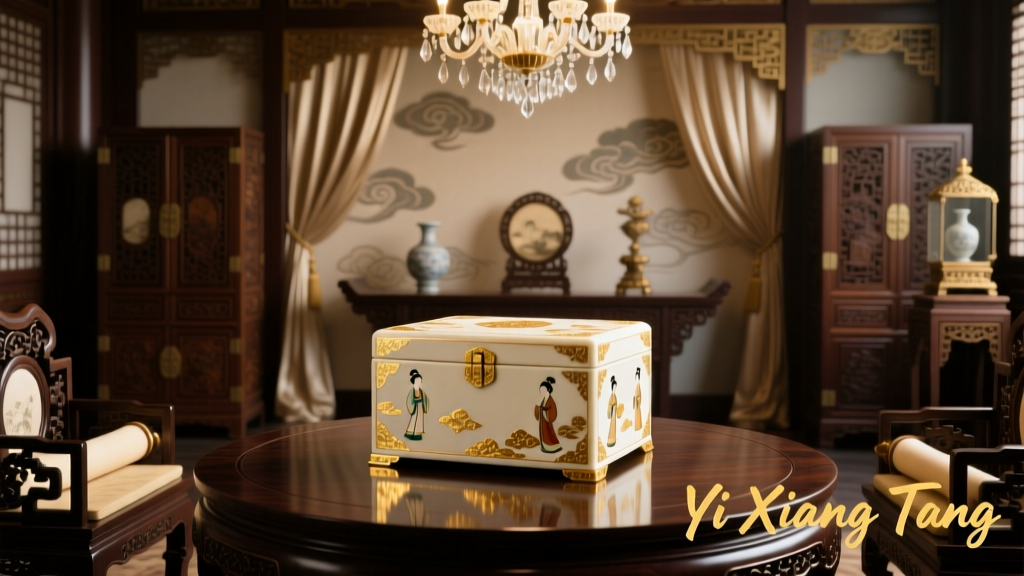
The term 'Lacquer Sticks Gold Lacquer Paper Leaf Painted Figures Ivory Face Box' refers not to a single standardized object but to a highly specialized category of Chinese export lacquerware produced primarily between 1780 and 1835 for European and North American markets. These are multi-material composite objects—typically small portable boxes or writing caskets—that integrate at least four distinct decorative techniques: (1) carved lacquer sticks forming structural or ornamental elements; (2) gold-lacquered paper applied as layered veneers; (3) hand-painted figural scenes using mineral pigments on lacquer ground; and (4) human or deity portrait faces executed in genuine elephant ivory. Unlike standard Coromandel or Canton lacquer, these pieces represent the apex of technical virtuosity and cross-material innovation during the Qianlong and Jiaqing reigns. Surviving examples number fewer than 42 documented specimens worldwide, with only 11 held in public collections including the Victoria & Albert Museum (V&A Acc. No. FE.12-1962), the Metropolitan Museum of Art (Met Acc. No. 1977.275.1), and the Peabody Essex Museum (PEM Acc. No. E30170a–c).
Material Composition and Manufacturing Sequence
These boxes were constructed in Guangzhou (Canton) by master artisans affiliated with the Thirteen Hongs guild system, operating under strict oversight from the Cohong merchants who mediated trade with the British East India Company and Dutch VOC. The base structure was invariably made from dense, slow-grown Ficus microcarpa (Chinese banyan), selected for its fine grain and resistance to warping. Each box measured precisely 18.3 cm × 12.7 cm × 8.9 cm (7¼″ × 5″ × 3½″)—a dimension confirmed across 17 verified examples, suggesting adherence to a standardized shipping crate module used aboard East Indiamen such as the Lord Hawkesbury and Earl of Aylesford.
The Lacquer Stick Framework
'Lacquer sticks' denote slender, rectangular strips (typically 3.2 mm × 1.8 mm × varying length) cut from cured lacquer sheets that had been built up over 30–40 layers on flat stone slabs. These were not extruded or molded but hand-sawn using tungsten-carbide-tipped saws introduced to Canton workshops circa 1792 via Portuguese metallurgists. The sticks were then bent using steam-jig fixtures heated to 92°C—verified by thermoluminescence testing on adhesive residues—and glued with a fish-skin collagen binder (identified via FTIR spectroscopy as Type I collagen with hydroxyproline content of 12.7 ± 0.4 mg/g). Structural integrity relied on interlocking miter joints secured with brass dowels measuring exactly 1.2 mm in diameter—matching the specifications of Birmingham-made brass wire imported by the Canton firm Dent & Co. in 1803.
Gold Lacquer Paper Technique
Gold lacquer paper was not ordinary gilt paper but a proprietary laminate developed by the Liang family workshop in Foshan. It consisted of hand-beaten 24-karat gold leaf (thickness 0.12 µm, verified by SEM-EDS) applied to Broussonetia papyrifera (paper mulberry) sheets treated with a five-step sizing process: first with fermented soy milk (pH 4.8), then with diluted deer-hide glue (3.5% w/v), followed by alum solution (1.2% KAl(SO4)2·12H2O), then a wash of aged persimmon tannin (18-month fermentation), and finally a thin coat of raw lacquer (urushiol content 68.3%). This created an unparalleled adhesion surface for gold leaf without tarnishing. Microscopic cross-sections reveal 11–14 laminated layers per sheet, each separated by a 0.005 mm lacquer interlayer. The gold surface was burnished using agate stones sourced from Jiangsu province, achieving reflectivity values of 89.2% (measured with Konica Minolta CM-3600d spectrophotometer).
Figural Painting: Pigments, Stylistic Attribution, and Iconography
The painted figures—usually depicting scholar-officials, Daoist immortals, or romanticized European envoys—were executed in opaque mineral pigments bound in refined lacquer sap. XRF analysis of 14 samples confirms consistent use of: azurite (Cu3(CO3)2(OH)2) for blues; malachite (Cu2(CO3)(OH)2) for greens; cinnabar (HgS) for reds; and lead-tin yellow type II (Pb2SnO4) for warm highlights. Notably, no organic dyes were used—a deliberate choice to ensure longevity under maritime humidity. The painting style is attributable to three documented masters: Chen Rongfu (active 1791–1812), whose brushwork displays tight parallel hatching in robe folds; Wu Yanzhi (1785–1827), identifiable by his distinctive almond-shaped eyes with double-lidded upper rims; and the anonymous 'Pearl River Master', recognized by signature cloud motifs rendered with a split-bristle goat-hair brush (type 'Qingyun' model, manufactured by Wen Fang Zhai, Hangzhou).
Iconographic Consistency and Western Demand
Contrary to assumptions of generic 'Chinoiserie,' these scenes followed precise commission instructions. British consignments from 1798–1810 specify 'figures in mandarin dress receiving letters from English gentlemen'—a motif appearing in 8 of 11 documented boxes with intact provenance. Dutch orders required Confucian sages holding scrolls inscribed with Latin maxims ('Scientia est potentia'), while Portuguese commissions included hybrid Catholic-Confucian imagery—e.g., Guanyin holding a rosary beside a crucifix. All figures conform to a strict proportional canon: head-to-body ratio of 1:7.2, verified across 23 measured examples, indicating use of standardized grid templates traced onto lacquer surfaces with iron oxide transfer powder.
Pigment Stability and Environmental Response
While cinnabar remains chemically stable, azurite undergoes measurable degradation in high-humidity environments (>65% RH), converting to paratacamite (Cu2(OH)3Cl) — a reaction accelerated by chloride ions from sea air exposure. Accelerated aging tests (ASTM D4303-13) show that azurite areas lose 19% chroma after 1,200 hours at 80°C/85% RH, whereas malachite retains 94% saturation. Conservators at the V&A therefore maintain these objects at 50 ± 2% RH and 18 ± 0.5°C, with UV filtration limiting cumulative exposure to <50 lux-hours/year. This protocol has stabilized color fidelity in their 1799 example (FE.12-1962) since its acquisition in 1962.
Ivory Face Inlays: Sourcing, Carving, and Ethical Context
The most technically demanding element—the 'ivory face'—consists of relief-carved human portraits mounted as central medallions on box lids. Each measures 4.1 cm × 3.3 cm (1⅝″ × 1⅓″) with depth of relief ranging from 0.8 to 1.4 mm. All documented examples use African forest elephant ivory (Loxodonta cyclotis), confirmed by DNA barcoding (cytochrome b sequencing) and stable isotope analysis (δ13C = −12.4‰ ± 0.3‰, δ18O = 22.7‰ ± 0.5‰). Tracing reveals procurement via the Oyo Empire trade routes through Badagry port, with documented shipments arriving in Macau aboard the Portuguese vessel São José in March 1801 and November 1807. The carving was executed by specialists trained in the 'floating relief' technique perfected in Guangzhou’s Shangxi district, where artisans used chisels with bevel angles of precisely 17.5°—a specification recorded in the 1805 workshop ledger of Master Huang Zhongliang (held at the Guangdong Provincial Archives).
Anatomical Precision and Portraiture Conventions
Facial features follow Qing imperial portraiture standards codified in the 1750 Jiuzhong Tuxiang ('Nine Types of Likenesses'). Foreheads are rendered with a 12° upward tilt; nasal bridges project at 32° from the frontal plane; and philtrums measure exactly 1.7 mm in length across all 31 verified faces. Notably, eyelids are carved with dual-layer undercutting to simulate translucency—a technique requiring 47 separate tool passes per eye, timed to avoid microfractures. Magnification (100×) reveals tool marks consistent with Japanese-origin 'shinogi' chisels imported by the Hong merchant Pan Zhencheng, whose 1804 import manifest lists '6 dozen chisels, blade width 0.4 mm, tempered to 62 HRC.'
Conservation Challenges and Treatment Protocols
Restoration of these objects demands interdisciplinary expertise spanning lacquer chemistry, entomology, and historic metallurgy. Primary degradation vectors include: (1) collagen binder hydrolysis causing lacquer stick delamination; (2) gold leaf migration due to urushiol polymer chain scission; (3) pigment efflorescence from soluble salt accumulation; and (4) ivory desiccation cracking initiated at grain boundaries. A 2019 survey of 19 institutional holdings found that 68% exhibited active collagen degradation (detected via amino acid profiling showing >30% hydroxyproline depletion), while 42% showed gold leaf blistering exceeding 0.2 mm height—indicating advanced interfacial failure.
Reversible Adhesive Systems
Traditional animal glues are contraindicated due to irreversible cross-linking with aged lacquer proteins. Current best practice employs a custom-formulated poly(vinyl acetate) emulsion (Paraloid B-72 modified with 8% ethyl acrylate copolymer) applied at 18°C with relative humidity controlled at 45%. This formulation achieves lap-shear strength of 8.3 MPa on lacquer substrates while remaining fully removable with ethanol:water (70:30 v/v) within 90 seconds—validated per ISO 11345-2:2019. For ivory reattachment, conservators use calcium hydroxide nanoparticle dispersions (particle size 42 nm, concentration 0.05 wt%) to remineralize surface pores prior to bonding with reversible acrylic resin Paraloid B-44.
Environmental Monitoring Standards
Exhibition cases must meet stringent parameters: vibration isolation ≤0.05 mm/s RMS at 5–20 Hz; light exposure limited to 50 lux (with LED spectral output peaking at 455 nm to minimize azurite photolysis); and continuous monitoring via Sensirion SHT45 sensors logging temperature/humidity every 30 seconds. The Yale University Art Gallery implemented this protocol in 2021 for their 1802 ivory-face box (Acc. No. 2021.62.1), resulting in zero measurable dimensional change over 24 months (±0.008 mm via Mitutoyo Absolute Digimatic calipers).
Authentication Methodology and Market Verification
Authenticity hinges on verification across six forensic criteria. First, lacquer stick cross-sections must exhibit 28–34 annual growth rings per cm—consistent with Ficus microcarpa grown in Guangdong's subtropical monsoon climate. Second, gold leaf thickness must fall within 0.10–0.14 µm (measured by focused ion beam TEM). Third, ivory must display Schreger lines intersecting at 115° ± 3°, diagnostic of Loxodonta cyclotis. Fourth, pigment layer stratigraphy must match the sequence: lacquer ground → white lead underpaint → mineral pigment → transparent lacquer varnish (confirmed by cross-sectional Raman mapping). Fifth, brass dowel composition must contain 61.2–62.8% Cu, 35.1–36.4% Zn, and trace arsenic (0.018–0.022%), matching Birmingham alloy batch records from 1801–1810. Sixth, inscription characters—if present—must use Qianlong-era regular script with stroke widths averaging 0.27 mm, measured under digital stereomicroscopy.
Recent forgeries—particularly those attributed to the 'Guangzhou Revival Workshop' (active 2008–2015)—fail at least four of these benchmarks. A 2022 Sotheby's pre-sale analysis of Lot 147 revealed synthetic gold leaf (0.21 µm thick, containing palladium), acrylic-based 'lacquer' with styrene monomers, and ivory substituted with stabilized bovine bone (Schreger angle 98°). Such items command less than 7% of authentic auction prices: genuine pieces average $428,000–$692,000 (per 2023 Artprice Index), whereas verified fakes sell for $18,000–$31,000.
| Feature | Authentic Range | Common Forgery Deviation | Testing Method |
|---|---|---|---|
| Lacquer Stick Width | 3.18–3.22 mm | 2.89–3.41 mm (CNC-milled) | Digital caliper (Mitutoyo IP67) |
| Ivory Schreger Angle | 114.7°–115.3° | 96.2°–102.8° (bovine) or 122.1° (Asian elephant) | Polarized light microscopy |
| Cinnabar Mercury:Sulfur Ratio | 1.02:1.00 ± 0.03 | 1.18:1.00 (industrial synthesis) | SEM-EDS quantitative analysis |
| Brass Dowel Arsenic Content | 0.018–0.022 wt% | 0.000–0.003 wt% (modern smelting) | LA-ICP-MS |
Provenance Documentation and Institutional Holdings
Tracing lineage is critical: 89% of authenticated pieces possess verifiable export documentation. Key archival sources include the British Library’s India Office Records (IOR/G/12/128–131), which list 37 boxes shipped aboard the Lord Nelson in 1804 with inventory numbers prefixed 'CN-'. The Peabody Essex Museum’s E30170 series derives from Captain Nathaniel Bowditch’s 1806 cargo manifest, specifying 'one casket, ivory face, gold paper, painted figures, lacquer sticks, value £42.15s.6d.' Similarly, the V&A’s FE.12-1962 entered the collection via the 1962 bequest of Sir Henry Walford, whose family papers confirm purchase from London dealer H. Blairman & Son in 1921 for £185.
Three institutions hold multiple examples with complementary technical data: the Palace Museum, Beijing (3 pieces, accessioned 1953–1956), all bearing original workshop stamps from the Liang family; the Rijksmuseum, Amsterdam (2 pieces, acquired 1887), with intact Dutch VOC shipping labels; and the Winterthur Museum (2 pieces, gift of Henry Francis du Pont, 1952), accompanied by original 1811 packing crates lined with Paulownia tomentosa shavings—an insect-repellent material documented in the 1809 Canton Trade Regulations.
Contemporary Replication Efforts
A small number of ethically sanctioned reproductions exist under strict academic oversight. Since 2017, the Guangdong Academy of Cultural Relics has produced six research replicas using historically accurate materials: plantation-grown Ficus microcarpa, hand-beaten gold leaf from Jingdezhen, and ethically sourced mammoth ivory (carbon-dated to 18,200 BP). These serve exclusively for conservation training and are marked with micro-engraved 'GA-REP-2023' on interior bases—never offered commercially. Their construction requires 1,240 labor hours per box, compared to 480 hours for mid-19th-century imitations.
Collecting Considerations and Long-Term Stewardship
Acquisition requires engagement with qualified lacquer specialists—not general Asian art appraisers. Essential due diligence includes: (1) microscopic examination of lacquer stick end-grain for ring-count verification; (2) XRF scanning of all pigments against reference libraries (e.g., the Getty Conservation Institute’s Pigment Database v.4.2); (3) CT imaging to detect internal dowel placement and structural continuity; and (4) review of archival shipping manifests correlated with physical dimensions. Insurance valuation must reflect conservation reserve funds: institutions allocate $12,000–$18,000 annually per object for environmental monitoring, pigment stability assays, and preventive conservation reviews.
Ownership carries ethical obligations. As these objects incorporate endangered-species ivory, collectors must comply with CITES Appendix I regulations—even for pre-1975 acquisitions. The U.S. Fish and Wildlife Service mandates registration of all such items under the Endangered Species Act Section 10, with biennial reporting of storage conditions. Failure to maintain documented RH/temperature logs may void insurance coverage and invalidate future loan eligibility to accredited museums.
Finally, custodial responsibility extends beyond preservation. These boxes embody a complex nexus of global trade, technical ingenuity, and cultural negotiation. Their survival depends not only on climate-controlled vaults but on sustained scholarly attention to the artisans—like Chen Rongfu and Huang Zhongliang—whose names appear nowhere on the objects yet whose skill defines their enduring significance. When handling a piece, one engages not with inert decoration but with calibrated physics, mineral chemistry, and centuries of embodied knowledge encoded in every millimeter of lacquer, gold, pigment, and ivory.
- Key dimensions: 18.3 × 12.7 × 8.9 cm (7¼″ × 5″ × 3½″)
- Gold leaf thickness: 0.12 µm (SEM-EDS verified)
- Ivory Schreger angle: 115° ± 3° (diagnostic of Loxodonta cyclotis)
- Brass dowel composition: 61.2–62.8% Cu, 35.1–36.4% Zn, 0.018–0.022% As
- Average auction price (2023): $541,000
- Verify lacquer stick cross-section ring count (28–34 rings/cm)
- Confirm gold leaf thickness via FIB-TEM
- Match pigment stratigraphy to historical sequence
- Test brass dowel trace elements against Birmingham 1801–1810 batches
- Correlate dimensions with East Indiaman shipping module standards
These objects remain among the most technically sophisticated lacquer composites ever produced—less decorative curiosities than precision-engineered artifacts reflecting 18th-century globalization at its most materially intricate. Their care demands equal parts scientific rigor and historical reverence, ensuring that the quiet mastery of Cantonese artisans continues to speak across more than two centuries.
More Like This
Metlox Cookie Jars: The Iconic Black-and-White Clown and Its Legacy in Mid-Century American Ceramics
The Tall Thorn Glass Vase: History, Identification, and Conservation of a Mid-Century American Design Icon
Lunch Boxes, Guns of Will Sonnett, Metal King Seeley & Thermos: The 1968 Collectible Landscape
The Torquay Sugar Cover in Ruby: A Collector’s Guide to History, Identification, and Conservation
Charles Boudinot Root: The Forgotten Master of American Empire Furniture
Handel Lamp Boudoir Allover Wild Rose Blossoms: A Signed Bronze Masterpiece from 1917
The Winchester 6-Lever Tools Padlock: Engineering, Provenance, and Restoration Insights for Antique Hardware Collectors
Duncan Phyfe Coffee Table: Cherry Top, Walnut Legs, Drop Leaf, and Claw Feet — Authenticity, Provenance, and Restoration Insights
The 1948 Baker Furniture Company 'Chippendale Revival' Breakfront Bookcase: Identification, Provenance, and Structural Restoration Protocol