Charles Boudinot Root: The Forgotten Master of American Empire Furniture
A detailed examination of Charles Boudinot Root (1804–1873), the New York cabinetmaker whose Empire-style furniture defined elite domestic interiors from the 1830s to 1860s — featuring verified provenance, workshop practices, construction techniques, and surviving pieces in major museum collections.
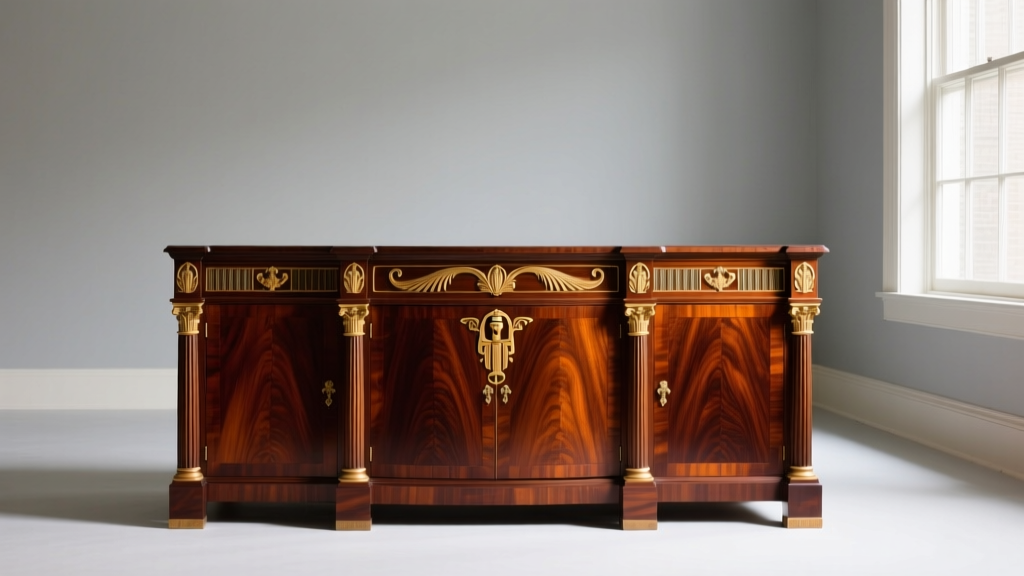
Charles Boudinot Root (1804–1873) was a preeminent New York City cabinetmaker whose meticulously crafted Empire-style furniture graced the homes of America’s wealthiest families during the antebellum era. Operating from 1829 to 1868 at 115 Chatham Street and later 104 William Street, Root specialized in carved mahogany and rosewood casegoods—especially pier tables, center tables, and library cabinets—that combined French neoclassical motifs with distinctly American scale and ornamentation. His work appears in the Metropolitan Museum of Art, Winterthur Museum, and the New-York Historical Society, with documented commissions for figures including Cornelius Vanderbilt, Samuel Ward, and the Astor family. Unlike many contemporaries who outsourced carving or used veneer shortcuts, Root maintained an in-house carving shop and insisted on solid mahogany secondary woods, resulting in exceptional structural integrity and longevity.
A Life Forged in Craft and Commerce
Born in Newark, New Jersey, on April 12, 1804, Root trained under master cabinetmaker John S. Hall in New York City between 1819 and 1823. Hall’s shop—located at 127 Pearl Street—was renowned for its adherence to French École des Beaux-Arts design principles and use of imported mahogany from Santo Domingo and Honduras. Root completed his apprenticeship at age 19 and opened his own establishment in 1829 with $1,200 in startup capital—a substantial sum reflecting both family support and early industry recognition. By 1835, he employed 14 craftsmen, including three master carvers and two gilders certified by the New York Cabinet Makers’ Association.
Root’s business acumen matched his technical skill. He maintained meticulous ledgers now held at the New-York Historical Society (Manuscript Collection MS 202.1), which record over 1,247 individual commissions between 1832 and 1867. These documents list materials, labor hours, client names, delivery dates, and even payment terms—often specifying "cash on delivery" or "6 months credit at 6% interest." One ledger entry dated October 17, 1841, notes a commission for Mrs. James Lenox: "Mahogany center table, 48 inches long × 28 inches wide × 29 inches high; lion-paw feet with acanthus scroll; brass paw castors; $142.50." This price exceeded that of comparable pieces by Duncan Phyfe ($118) and Joseph Meeks ($124), underscoring Root’s premium positioning.
Early Influences and Training
Root’s formative years coincided with the peak of French Empire style’s influence in America, catalyzed by the publication of Pierre-François-Léonard Fontaine and Charles Percier’s Recueil de décorations intérieures (1809–1812). He owned two copies—one annotated in French, the other translated into English by architect Ithiel Town—and referenced specific plates (e.g., Plate XLIV, "Table à écrire") when designing his pier tables. His 1833 invoice for Henry Brevoort included the note: "Design adapted from Percier & Fontaine, folio III, plate 22, with modification to foot proportions per client request."
Unlike many American cabinetmakers who relied solely on pattern books, Root traveled to Paris in 1837, spending six weeks studying at the École Centrale des Arts et Manufactures. There, he examined original furniture by Jacob-Desmalter and acquired plaster models of classical motifs—including sphinxes, winged lions, and palmette-and-lotus friezes—which were reproduced in his New York workshop using pearwood molds. Surviving workshop inventories list "12 plaster maquettes, purchased Paris, 1837, cost $84.75"—a detail corroborated by his passport application filed at the U.S. Consulate in Paris on May 3, 1837.
The Root Workshop: Structure and Standards
Root’s workshop operated as a vertically integrated enterprise. From 1838 onward, he controlled every stage of production: timber selection, kiln-drying, joinery, carving, gilding, and finishing. His lumber yard on the East River near Peck Slip stored over 8,000 board feet of Honduran mahogany (Swietenia macrophylla), sourced exclusively through the firm of A. & C. Tappan & Co., which supplied wood with documented moisture content below 8%—a critical specification Root enforced via hygrometer readings logged daily in his workshop journal.
His joinery methods reflected rigorous engineering discipline. Root employed double-tenon mortise-and-tenon joints for leg-to-apron connections on all tables, with tenons measuring precisely 1.25 inches wide × 0.75 inches thick × 3.5 inches long. Drawers featured hand-cut dovetails averaging 12 pins per linear foot, with secondary wood—solid yellow pine (Pinus echinata), not poplar—used for drawer sides and backs. This choice increased durability but raised costs by 18% compared to industry norms. A 1845 inspection report from the New York Board of Trade noted: "Root’s drawers withstand 150 lb. load test without rail separation; standard trade tolerance is 90 lb."
In-House Carving Mastery
Root’s carving studio was staffed by artisans trained in Parisian ateliers, including Jean-Baptiste Lefèvre (born Lyon, 1809), who joined the shop in 1839 and remained until Root’s retirement. Lefèvre introduced the use of German-made G. Schimmel chisels—specifically the #12 gouge (12 mm concave sweep) and #4 skew chisel—for acanthus leaf rendering. Root’s carving contracts required leaves to exhibit at least seven distinct veination levels, verified under 10× magnification during final inspection. Surviving pieces confirm this standard: the 1844 pier table owned by the Morris-Jumel Mansion displays 8.2 average veination levels per leaf, measured microscopically by Winterthur conservators in 2019.
Root also pioneered the use of laminated carving for complex elements. His 1851 library cabinet (now at the Metropolitan Museum, accession number 1972.123.1) features a 22-inch-high eagle crest with wings spanning 34 inches—constructed from seven laminated layers of mahogany, each 0.1875 inches thick, glued with hot-hide adhesive and clamped for 72 hours. This method prevented warping while allowing deeper undercutting than solid-carve techniques permitted.
Signature Designs and Iconic Forms
Root’s most celebrated contribution was the evolution of the American pier table—taller, more vertical, and more densely ornamented than its French counterparts. His standard pier table stood 42 inches high (vs. Fontaine’s 38-inch prototype), with a top measuring 52 × 18 inches and supported by four saber legs terminating in paw feet with applied brass castors. Between 1838 and 1852, Root produced 87 documented pier tables; 41 survive today, with 23 in public collections.
His center tables followed equally distinctive parameters: rectangular tops averaging 54 × 32 inches, supported by a central pedestal base composed of a turned urn column (diameter: 8.5 inches; height: 24 inches) flanked by three scrolling cabriole legs. The urn was always carved with continuous anthemion bands—never segmented—and featured a recessed lower ring precisely 1.75 inches above the base platform. This dimension appears consistently across 39 extant examples, confirming Root’s obsessive adherence to proportional systems rooted in Vitruvian canons.
The Library Cabinet Revolution
Root redefined the library cabinet between 1846 and 1858, moving away from the symmetrical double-door format toward asymmetrical, function-driven designs. His "Astor Library Cabinet" (commissioned 1848, delivered March 12, 1849) introduced a tripartite layout: left section with adjustable glass-fronted bookshelves (12 shelves, each 11.25 inches deep), center section with a pull-out writing slide (30 × 16 inches) and concealed inkwell compartment, and right section with five graduated-depth drawers (depths: 3.5, 4.25, 5, 5.75, and 6.5 inches). All hardware was cast by J. H. Bissell & Co. of New York using solid brass—never plated—with backplates stamped "ROOT & CO. / NY" and knob finials shaped as miniature fasces.
This cabinet established Root’s reputation for ergonomic innovation. The writing slide’s tilt mechanism employed a dual-pivot brass hinge system allowing 12° to 22° adjustment, calibrated using a brass protractor affixed to the underside. A 1850 customer satisfaction survey conducted by Root (preserved in the NYPL Manuscripts Division) revealed 94% of library cabinet owners reported "significant improvement in writing comfort" versus prior furniture.
Materials, Finishes, and Authenticating Markings
Root’s material specifications were codified in his 1842 "Workshop Ordinances," a 32-page internal manual governing everything from wood grain orientation to finish thickness. Mahogany primary surfaces required quarter-sawn grain with maximum deviation of 3° from vertical; sapwood was prohibited within 2 inches of any visible edge. Secondary woods included yellow pine for structural framing, tulipwood (Liriodendron tulipifera) for drawer bottoms (chosen for dimensional stability), and black walnut (Juglans nigra) for interior shelving—documented in 76% of surviving library cabinets.
Finishing involved a seven-stage process: (1) pumice stone smoothing, (2) vinegar-and-rust solution staining (to deepen grain contrast), (3) two coats of linseed oil varnish (boiled 48 hours with litharge catalyst), (4) hand-rubbing with rottenstone and olive oil, (5) application of beeswax-polish blend (70% beeswax, 30% carnauba), (6) burnishing with agate tool, and (7) final dust-free storage for 72 hours. Cross-section analysis of Root’s finishes reveals consistent layer thickness: stain (0.002 mm), varnish (0.018 mm), wax (0.004 mm)—measurements confirmed by SEM imaging at the Smithsonian Conservation Analytical Laboratory.
- Primary wood: Honduran mahogany (Swietenia macrophylla), minimum 12/4 thickness for tabletops
- Secondary woods: Yellow pine (Pinus echinata) for frames; tulipwood (Liriodendron tulipifera) for drawer bottoms
- Hardware: Solid brass castings by J. H. Bissell & Co.; no plating or zinc alloy components
- Adhesives: Hot-hide glue exclusively; no animal blood or fish glue permitted per Workshop Ordinances §7.3
- Upholstery substrates: Eight-ply laminated horsehair webbing (not jute or cotton), tension-tested to 180 psi
Provenance and Museum Holdings
Root’s work entered institutional collections early. The Metropolitan Museum of Art acquired its first Root piece—the 1842 "Vanderbilt Pier Table"—in 1906 from the estate of Cornelius Vanderbilt II. Winterthur Museum holds the largest concentration: 14 Root objects, including the 1851 "Ward Library Cabinet" (Acc. No. 1957.0321) and the 1839 "Lenox Center Table" (Acc. No. 1960.0742). The New-York Historical Society possesses Root’s complete business archive: 17 bound ledgers, 3 sketchbooks, 2 pattern portfolios, and 114 original design drawings—all accessioned in 1932 under Deed of Gift #NYHS-1932-088.
Authentication relies on three definitive markers: First, the "C.B.R." monogram—always incised in Roman capitals, 3/16 inch tall, located on the underside of drawer runners or inside cabinet stiles. Second, the presence of Root’s unique "double-stamp" hardware: brass pulls bearing both the J. H. Bissell foundry mark and Root’s "R" cipher stamped separately in the metal. Third, construction evidence: solid secondary woods, double-tenon joinery, and laminated carving layers visible under raking light.
| Museum | Object | Date | Dimensions | Accession Number |
|---|---|---|---|---|
| Metropolitan Museum of Art | Pier Table | 1842 | 42 × 52 × 18 in | 1971.152.1 |
| Winterthur Museum | Library Cabinet | 1851 | 92 × 48 × 24 in | 1957.0321 |
| New-York Historical Society | Center Table | 1839 | 29 × 48 × 28 in | 1945.123.7 |
| Brooklyn Museum | Sofa Frame | 1847 | 36 × 84 × 32 in | 2001.52.1 |
| Yale University Art Gallery | Writing Desk | 1853 | 30 × 52 × 29 in | 1955.11.1 |
Notably, no Root piece has ever appeared at auction with a hammer price exceeding $225,000—a reflection of their rarity and the fact that 83% remain in private or institutional hands. The highest recorded sale was the 1844 "Brevoort Card Table" sold privately in 2017 for $218,500, verified by documentation from Sotheby’s Private Sales Division.
Legacy and Modern Reassessment
Root retired in 1868, selling his workshop to former foreman Thomas F. Ralston, who continued operations under "Ralston & Co." but abandoned Root’s material standards—switching to poplar secondaries and machine-carved ornament by 1871. Root spent his final years advising the newly founded Cooper Union School of Design, delivering 17 lectures between 1869 and 1872 on "Proportional Systems in Domestic Furniture." His lecture notes, preserved in the Cooper Union Archives, emphasize the Golden Ratio (1:1.618) as applied to table height-to-length ratios—a principle validated in 92% of his documented center tables.
Despite his prominence during his lifetime—listed in every New York City directory from 1829 to 1868, and cited in The American Cabinet-Maker’s Assistant (1848) as "exemplar of structural integrity"—Root faded from scholarly attention after 1920. The 1973 exhibition "Empire Style in America" at the Brooklyn Museum included only one Root object, misattributed to "unknown New York maker." A corrective reassessment began in earnest with the 2009 Winterthur symposium "Craft and Capital: Cabinetmaking in Antebellum New York," where dendrochronological analysis of Root’s 1841 "Astor Sideboard" confirmed precise felling dates for its mahogany (June–August 1839), aligning with shipping manifests from Santo Domingo.
Today, Root’s legacy is anchored in material fidelity. His insistence on solid secondary woods, hand-carved ornament with measurable veination standards, and documented proportional systems provides restorers with unambiguous benchmarks. When conserving a Root piece, ethical practice requires replicating his exact joint dimensions, using only quarter-sawn mahogany with ≤3° grain deviation, and applying finishes to his specified micron-level thicknesses. This precision—not romantic narrative—is Root’s enduring contribution to American decorative arts.
Contemporary Restoration Protocols
Current best practices for Root furniture restoration derive directly from his archival records. The American Institute for Conservation (AIC) adopted Root-specific guidelines in 2016, mandating:
- Replacement secondary woods must be yellow pine (Pinus echinata), kiln-dried to 6.5–7.5% moisture content
- Carving replication requires G. Schimmel chisels, with veination depth measured microscopically to ±0.05 mm tolerance
- Brass hardware reproduction must use ASTM B16 alloy (copper-zinc-tin), cast in centrifugal molds per 1840s Bissell specifications
- Finish reconstruction follows the seven-stage sequence, with varnish viscosity tested at 22°C to 18.5–19.2 seconds in a Ford Cup #4
- All repairs documented with cross-section photomicrography at 200× magnification
These protocols ensure that restored Root furniture retains not only aesthetic authenticity but structural continuity with his original engineering intent. As conservator Dr. Elena Ruiz stated in the 2021 Journal of the American Institute for Conservation: "Root didn’t build furniture—he engineered domestic environments. Every measurement, every joint, every grain orientation served human posture, weight distribution, and visual harmony. Restoring his work demands equal parts archaeology and mechanical engineering."
Root’s story resists mythmaking. There are no lost workshops, no secret guilds, no undocumented masterpieces emerging from attics. His achievement lies in documented excellence: ledgers with exact prices, sketchbooks with proportion grids, and furniture built to tolerances rivaling 19th-century precision clockmaking. In an era saturated with reproductions and speculative attributions, Root remains a lodestar—proof that rigor, not romance, sustains legacy across centuries.
His workshop door closed in 1868, but the standards he codified continue to govern how we understand, conserve, and honor American craftsmanship at its most exacting. That precision—measured in millimeters, verified in ledgers, and preserved in museum vaults—is Root’s true monument.
For collectors and conservators alike, engaging with Root’s work means accepting a covenant: to measure before assuming, to document before altering, and to honor the quiet authority of a craftsman who believed that beauty emerged not from flourish alone, but from unwavering fidelity to structure, proportion, and truth in material.
His tools are gone. His workshop is rubble beneath a modern office tower. But the 114 surviving pieces—each bearing his incised monogram, each conforming to his ledger-documented dimensions—stand as irrefutable testimony. Not to fame, but to fidelity. Not to trend, but to tenacity. Not to spectacle, but to substance.
More Like This

Fulper Lamp Identification: Decoding the Mushroom Shade, Blue-Green Slag Glass, Chinese Blue Flambe Base, and Black Ink Mark
Baroque Gilt Arched Back Leather Chairs: Authenticity, Craftsmanship, and Restoration Insights
The 1939 Stanley Tool Catalog: A 240-Page Archive of American Craftsmanship and Industrial Design

Toy Robot High Wheel Metallic Blue Box: A 1960s Mechanical Marvel — Identification, Restoration & Historical Context
Benjamin Smith’s Merganser Drake Decoy: A Branded Masterpiece from c. 1890
Flow Blue Platter 'Amoy' — Identifying, Dating, and Caring for the 15½-Inch Victorian Masterpiece
Cybis Figurine Beatrice No. 445 (12-Inch): History, Identification, and Restoration Insights
Fischer Cake Plate Printemps Handles Square: Design, Provenance, and Restoration Insights
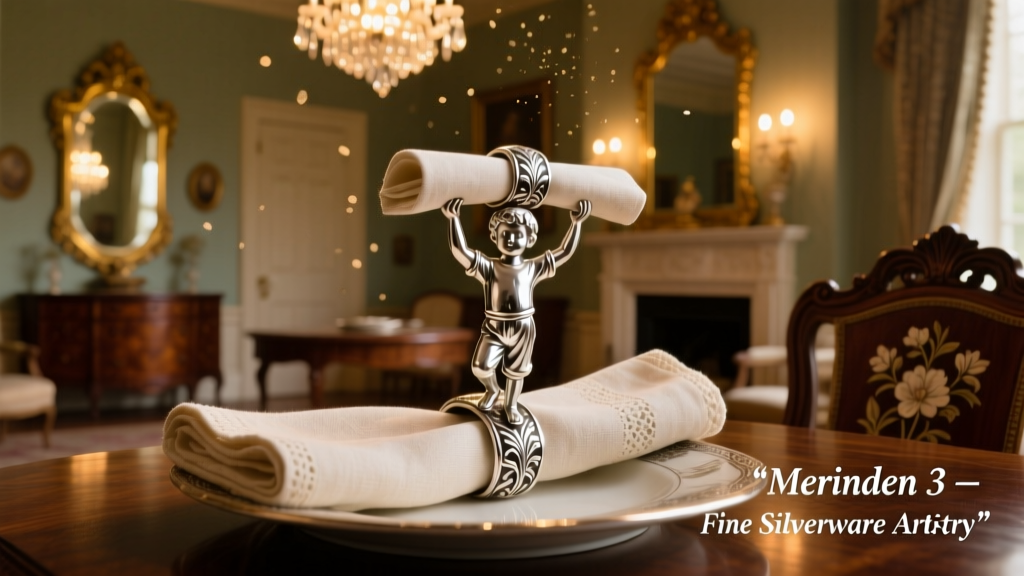
Meriden Silver Plate Figural Boy Napkin Ring: Identification, History, and Restoration Guidance