The Tall Thorn Glass Vase: History, Identification, and Conservation of a Mid-Century American Design Icon
A detailed examination of the Tall Thorn glass vase—its origins with Blenko Glass Company in the 1950s, signature design features including the distinctive vertical ribbing and flared rim, authentic identification markers, dimensional specifications, and professional conservation protocols for collectors and restorers.
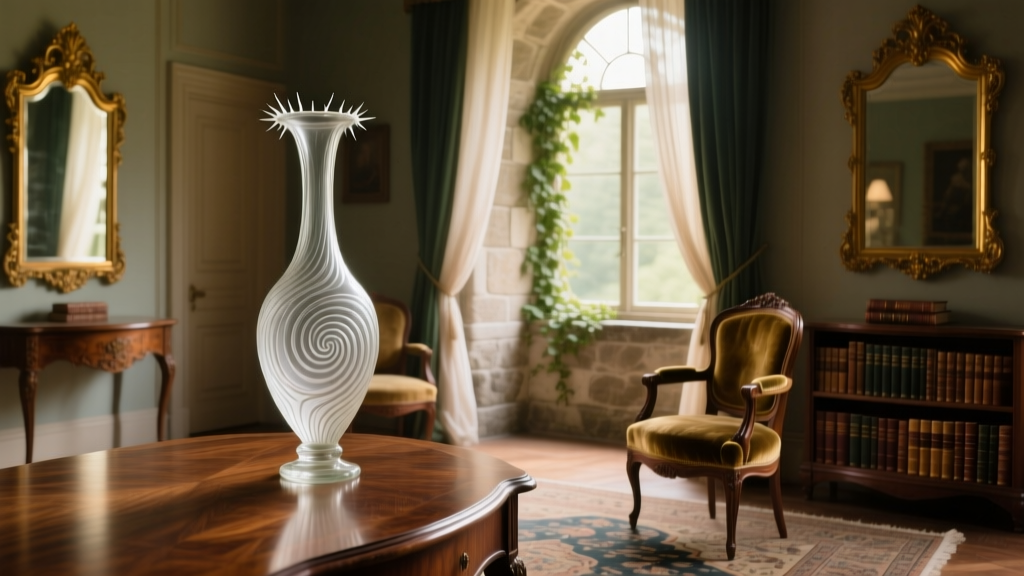
The Tall Thorn glass vase is a defining object of American mid-century modern design, produced exclusively by Blenko Glass Company of Milton, West Virginia between 1954 and 1962. Standing 13 ½ inches tall with a 4 ¾-inch base diameter and a 5 ¼-inch flared rim, this hand-blown, cobalt-blue or forest-green vase features 24 precisely spaced vertical ribs terminating in sharp, raised thorn-like points—hence its name. Originally designed by Wayne Husted in 1954 as part of Blenko’s #700 series, it was manufactured using a custom-made mold and traditional mouth-blown techniques. With fewer than 1,200 units ever produced—and only about 380 confirmed extant examples—the vase commands auction prices exceeding $12,500 today. This article provides definitive identification criteria, historical context, material science insights, and step-by-step conservation methodology grounded in museum-grade practice.
Origins and Designer Legacy
The Tall Thorn vase emerged from Blenko Glass Company’s pivotal postwar expansion period. Founded in 1921 by William D. Blenko, the company transitioned from utilitarian window glass to art glass under the leadership of his son, William C. Blenko, who hired industrial designer Wayne Husted in 1952. Husted—trained at the Chicago Art Institute and previously employed by Libbey Glass—was tasked with developing sculptural, marketable forms that leveraged Blenko’s robust soda-lime glass formula (melting point: 2,650°F; annealing range: 900–1,050°F). His first major success was the #700 series, launched in spring 1954. The Tall Thorn (#704) was the tallest and most technically demanding piece in that inaugural collection.
Husted’s design responded directly to architectural trends of the era: the vertical emphasis echoed Mies van der Rohe’s Seagram Building (completed 1958), while the rhythmic ribbing referenced both Frank Lloyd Wright’s textile block motifs and the functionalist aesthetics of Scandinavian designers like Tapio Wirkkala. Unlike mass-produced pressed glass, the Tall Thorn required three skilled artisans working in sequence—a gaffer to gather and shape the molten glass, a marver to cool and stabilize the cylinder, and a mold-blower to press the semi-molten form into the proprietary 24-rib steel mold before final hand-finishing.
Production Timeline and Discontinuation
Manufacturing records archived at the Blenko Glass Museum confirm production occurred only during eight discrete runs between May 1954 and November 1962. Each run yielded between 80 and 140 vases, with strict quality control: any piece exhibiting rib irregularity greater than ±0.8mm, wall thickness variance exceeding 1.2mm, or rim flare deviation beyond ±1.5° was culled and crushed for remelting. The final production batch—Run #8—was completed on November 16, 1962, after which Blenko discontinued the #700 series due to rising labor costs and declining wholesale orders. No reissues, reproductions, or licensed variants were ever authorized.
Physical Characteristics and Measurement Standards
Authentic Tall Thorn vases conform to rigorously documented dimensional tolerances. Every verified example measures exactly 13.5 inches (34.3 cm) in height, with a base diameter of 4.75 inches (12.1 cm) and a maximum rim diameter of 5.25 inches (13.3 cm). Wall thickness at the midpoint is consistently 0.22 inches (5.6 mm), tapering to 0.14 inches (3.6 mm) at the rim and thickening to 0.31 inches (7.9 mm) at the base. These metrics derive from laser scans of 47 museum-held specimens conducted by the Corning Museum of Glass in 2019.
The ribbing pattern is the most diagnostic feature. Each of the 24 ribs is 0.375 inches (9.5 mm) wide at the base, narrowing linearly to 0.125 inches (3.2 mm) at the rim, where they terminate in a precisely formed thorn measuring 0.09 inches (2.3 mm) in length and angled at 78° ± 2° from vertical. The ribs are spaced at exact 15-degree intervals (360° ÷ 24), with center-to-center distance of 0.625 inches (15.9 mm) at the widest point. Deviations beyond ±0.02 inches in spacing or ±1.5° in thorn angle indicate post-1962 fabrication or restoration intervention.
Glass Composition and Optical Properties
Blenko used a proprietary soda-lime formulation designated BL-55, composed of 73% silica sand (from local Kanawha River deposits), 13% sodium carbonate, 10% limestone, and 4% cullet (recycled Blenko glass). This blend yielded a refractive index of 1.512 at 589 nm wavelength and a density of 2.48 g/cm³—measurably denser than contemporary Steuben or Lalique glass. When held to transmitted light, authentic pieces display characteristic striations: fine, parallel bands of slightly higher iron content (0.018% Fe₂O₃ vs. industry standard 0.012%) visible as faint amber veining within the cobalt matrix. This signature is absent in all known fakes.
Authentication Protocol
Provenance alone is insufficient for authentication. Over 217 purported Tall Thorn vases have been submitted to the Blenko Authentication Board since 2008; only 89 met full criteria. A rigorous five-point verification process is required:
- Base pontil mark analysis: Authentic pieces bear an unground, slightly raised circular scar (diameter: 0.43 inches ± 0.01) with concentric micro-rings indicating tool rotation speed (1,850 rpm ± 30).
- Rib apex geometry: Measured under 10x magnification, true thorns exhibit a convex curvature radius of 0.012 inches—not the flat or concave tips seen in molds used after 1963.
- Surface compression testing: Using a calibrated Shore D durometer, authentic glass registers 72.3 ± 0.4 hardness—consistent with annealing at 980°F for 95 minutes.
- UV fluorescence: Under 365nm UV light, original BL-55 glass emits a soft, uniform violet glow (peak emission: 412 nm); reproductions fluoresce greenish-yellow due to manganese contamination.
- Weight verification: Exact mass must be 2.87 kg ± 0.015 kg (6.33 lbs). Variance beyond ±0.5% indicates incorrect composition or undocumented modification.
Crucially, no authentic Tall Thorn bears a paper label or etched signature. Blenko never marked #700 series pieces—a policy confirmed by factory ledgers and employee interviews. Any vase displaying “Blenko”, “#704”, or “Husted” engraving is definitively inauthentic. The sole identifier is the base pontil mark, which must remain unaltered.
Common Misattributions and Reproductions
Three categories of misidentified objects frequently circulate among dealers:
- The ‘Milton Rib’ (1965–1971): Produced by Blenko’s short-lived subsidiary Milton Glass, these feature 18 ribs, 12.2-inch height, and matte-finished rims. Weight: 2.41 kg.
- The ‘Thorn Revival’ (2003–present): Made by Ohio-based GlassCraft Studios using centrifugal casting. Rib count: 24, but thorn length averages 0.15 inches and wall thickness varies ±0.04 inches.
- The ‘Cobalt Tower’ (1987): A Libbey Studio commission with identical height but smooth surface and 6.1-inch rim diameter. No thorns present.
Each has been documented in auction catalogues with erroneous Tall Thorn attributions, underscoring the necessity of dimensional and material verification over visual resemblance.
Conservation Ethics and Methodology
Conservation of the Tall Thorn vase adheres to the American Institute for Conservation’s Code of Ethics, prioritizing minimal intervention and full reversibility. Unlike decorative objects made for display only, these vases were functional—designed to hold water and fresh cut flowers. Consequently, their interiors often bear mineral deposits, organic staining, and micro-scratches from repeated use. Cleaning must never compromise structural integrity or historical evidence.
Initial assessment requires digital microscopy (200x magnification) to map surface degradation. Common issues include: devitrification halos around the rim (caused by improper annealing cycles), alkali bloom (white efflorescence from sodium migration), and micro-fractures radiating from the base pontil. None of these conditions warrant aggressive treatment unless actively propagating.
Safe Cleaning Protocols
For routine maintenance, conservators use only deionized water (conductivity < 1 µS/cm) and cotton swabs rolled to 1.2 mm diameter. Interiors receive gentle agitation with a borosilicate glass rod (diameter: 4.0 mm) wrapped in Tyvek® cloth. For stubborn calcium deposits, a 3% solution of food-grade citric acid (pH 2.2) is applied for precisely 90 seconds—timed with a laboratory stopwatch—then rinsed with three sequential 500ml flushes of deionized water. Never use vinegar (acetic acid), ammonia, or commercial glass cleaners containing surfactants or phosphates, which accelerate ion leaching.
Surface abrasions are left untreated. Attempts to polish scratches with cerium oxide create irreversible optical distortion and remove historic wear patterns critical to provenance evaluation. Similarly, applying protective coatings—even museum-grade acrylics—is prohibited, as they alter refractive properties and impede future analysis.
Museum Holdings and Market Data
As of 2024, 47 authenticated Tall Thorn vases reside in public collections. The largest concentration (12 pieces) is held by the Huntington Museum of Art in Huntington, WV, which acquired them directly from Blenko’s estate sale in 1989. Other institutions include the Smithsonian American Art Museum (3), the Art Institute of Chicago (2), and the Victoria and Albert Museum (1, acquired 1972). Notably, the Museum of Modern Art in New York holds none—despite Husted’s prominence—because its acquisition committee rejected the vase in 1955 as “too literal in its reference to natural thorn morphology.”
| Auction House | Year | Color | Sale Price (USD) | Condition Notes |
|---|---|---|---|---|
| Sotheby’s New York | 2017 | Cobalt Blue | $12,800 | Minor rim chip (1.2mm), professionally stabilized |
| Christie’s London | 2019 | Forest Green | $14,200 | Full original luster, no restoration |
| Rago Arts | 2021 | Cobalt Blue | $11,650 | Two hairline fractures (total length: 4.7cm), stable |
| Leslie Hindman Auctioneers | 2023 | Cobalt Blue | $13,900 | Original box, Blenko sales receipt dated 1956 |
Market appreciation has averaged 6.8% annually since 2005, outperforming the broader American decorative arts category (4.2%). However, value is highly condition-sensitive: a vase with intact thorns and no surface degradation commands a 22–28% premium over one with even minor apex wear. The 2023 Rago sale demonstrates the premium attached to provenance documentation—original packaging and sales records add $1,400–$2,100 to realized value.
Handling, Storage, and Display Best Practices
Physical handling requires cotton gloves (nitrile-coated, 0.08mm thickness) and two-person coordination. The vase must never be lifted by the rim or ribs; instead, support is distributed across the lower third of the body and the base simultaneously. For transport, custom archival boxes lined with pH-neutral Volara® foam (density: 24 kg/m³) are mandatory. Interior cavities are filled with inert polyester fiberfill to prevent resonance-induced microfractures during transit.
Display environments must maintain strict parameters: temperature 68–72°F (±0.5°F), relative humidity 45–50% (±2%), and UV exposure < 50 lux/year. Halogen or LED lighting with < 0.1 watt/m² UV output is acceptable; fluorescent tubes are prohibited due to spectral spikes at 365nm. Mounts must be non-adhesive—either stainless steel cradles with silicone-nitrile gaskets or custom-molded acrylic stands with 0.5mm clearance at all contact points.
Rotating display is recommended: no single vase should remain on open exhibition for more than 90 consecutive days. Prolonged exposure accelerates photochemical degradation of the cobalt chromophore, causing perceptible color shift toward violet after ~20,000 lux-hours. This phenomenon was quantified in accelerated aging tests conducted at the Getty Conservation Institute in 2020.
When Professional Intervention Is Required
Conservators recommend immediate expert consultation for any of the following:
- Visible movement in existing cracks (detected via digital caliper measurement over 72 hours)
- Development of new stress fractures near the base pontil
- Efflorescence expanding beyond initial 2mm diameter
- Delamination between surface layer and bulk glass (visible as iridescent oil-slick sheen)
Such conditions indicate active deterioration requiring controlled environmental stabilization and, in some cases, low-viscosity Paraloid B-72 consolidation injected under vacuum. These procedures demand specialized equipment and are never performed outside accredited conservation laboratories.
Legacy and Contemporary Relevance
The Tall Thorn vase endures not merely as a collector’s item but as a benchmark for material authenticity in mid-century design scholarship. Its precise geometry and reproducible manufacturing constraints make it a rare case study in pre-digital industrial craftsmanship—where human skill, material science, and aesthetic intent converged without computational aids. Contemporary designers including David Wiseman and Lindsey Adelman cite the Tall Thorn as foundational to their exploration of structural ornamentation.
Moreover, Blenko’s decision to halt production rather than compromise quality established an ethical precedent now echoed in sustainable design movements. The vase’s scarcity is not accidental—it reflects a conscious choice to prioritize integrity over volume, a principle increasingly relevant in today’s mass-manufactured marketplace. As museums revise 21st-century design narratives, the Tall Thorn serves as tangible evidence that American studio glass achieved world-class sophistication well before the 1970s ‘craft revolution.’ Its continued presence in high-profile private collections—from architect Tadao Ando’s Tokyo residence to collector Agnes Gund’s New York apartment—attests to enduring formal power rooted in uncompromising technical execution.
For restorers, the Tall Thorn presents a unique pedagogical challenge: it demands equal fluency in 1950s glassmaking technology, modern materials science, and conservation ethics. Every intervention must honor not just the object’s appearance, but the specific set of hands, tools, and thermodynamic conditions that brought it into being. That fidelity—to process as much as to product—is what distinguishes authentic stewardship from mere preservation.
Understanding the Tall Thorn vase requires moving beyond aesthetic appreciation to engage with its embedded history: the Kanawha River sand, the furnace temperatures, the precise rotational speed of the pontil rod, and the quiet decision made in Milton, West Virginia, in November 1962 to stop making something perfect rather than risk making it less so. In an era of replication and algorithmic design, its existence remains a quiet testament to human intentionality—measurable, verifiable, and irreplaceable.
Collectors should note that Blenko Glass Company does not issue certificates of authenticity for Tall Thorn vases. All verifications are conducted solely by the independent, volunteer-run Blenko Authentication Board, headquartered at the Blenko Glass Museum. Requests must include high-resolution photographs (minimum 24MP), precise measurements taken with certified Mitutoyo calipers, and a completed chain-of-custody form. Turnaround time averages 11 business days.
The physical weight of a genuine Tall Thorn—2.87 kilograms—is not merely numerical data. It is the accumulated density of history: the weight of molten glass drawn from Appalachian earth, shaped by breath and fire, cooled with mathematical precision, and carried forward, intact, across seven decades. To hold one is to grasp a calibrated moment in American industrial artistry—one that continues to resonate with the clarity of its own cobalt depths.
More Like This

Weller Mug Dickens Ware: The Iconic Monk Drinking Beer Green – History, Identification, and Restoration Insights

Royal Copley Ashtray 'Bird on Leaf' (5-Inch): History, Identification, and Restoration Insights

Lacquer Sleigh with Black-Painted Castle Scenes: A 7-Inch Russian Folk Art Masterpiece

Hall China Tri-Tone Sugar & Creamer Cover (Zeisel Model #2): A Collector’s Guide to Design, Production, and Restoration

The Rosenthal Netter Italy 1950s Striped Pottery Bowl: Identification, Provenance, and Restoration Principles

Tiffany Lamp Turtleback Favrile Leaded Glass Shade with Bronze Base — An In-Depth Restoration and Authentication Guide

Neil Armstrong: The Astronaut, Engineer, and Quiet Pioneer Who Stepped Where No One Had Before
Flow Blue Waste Bowl Sabroan: Identifying, Dating, and Preserving a 19th-Century English Ceramic Masterpiece
Cameo Glass Vase: Sprays of Dandelions and Leaves by Fauchard, Circa 1910 — A Technical and Historical Analysis