Kovels’ On Antiques and Collectibles, Vol. 27, No. 11 (July 2001): A Snapshot of Early 21st-Century Market Trends and Valuation Practices
An in-depth analysis of the July 2001 issue of Kovels’ On Antiques and Collectibles—featuring price updates, maker identification guides, condition assessment standards, and market shifts for Depression glass, American stoneware, vintage radios, and early 20th-century advertising signs.
The July 2001 issue of Kovels’ On Antiques and Collectibles, Volume 27, Number 11, serves as a vital historical artifact documenting the U.S. antiques market at a pivotal moment—just months before the September 11 attacks reshaped consumer confidence and collecting priorities. This 48-page monthly newsletter offered subscribers timely valuations, authentication tips, and market commentary grounded in the Kovels’ extensive database of over 300,000 auction records and dealer transactions. Unlike today’s algorithm-driven pricing tools, this issue relied on field reporting from regional auctions—including Skinner in Boston, Cowan’s in Cincinnati, and Morphy Auctions in Pennsylvania—as well as direct input from 275 contributing dealers across 32 states. The issue features 97 newly recorded prices, 12 revised value ranges, and three expanded identification charts for makers’ marks on stoneware, metal advertising signs, and Bakelite radio cabinets.
Depression Glass: Demand Shifts and Pattern-Specific Valuation
Depression glass remained one of the most actively traded categories in mid-2001, with demand concentrated in patterns produced between 1929 and 1940 by major manufacturers including Federal Glass Company, Hocking Glass Company, and Anchor Hocking. The issue reports that Federal’s ‘Royal Lace’ pattern—introduced in 1930 in crystal, pink, and green—was experiencing sustained strength due to its wide distribution and high survival rate. A complete 12-piece dinner set (plate, cup/saucer, bread & butter plate, salad plate) in crystal sold for $212 at a June 2001 auction in Lancaster, Ohio; identical sets in pink fetched $348–$385, reflecting heightened collector preference for pastel hues.
Hocking’s ‘Mayfair’ pattern, manufactured exclusively from 1933 to 1937, showed divergent performance based on color and rarity of forms. While standard luncheon plates ($12–$16) and tumblers ($8–$11) held steady, rare items such as the 7-inch ‘Mayfair’ compote in cobalt blue realized $245 at Cowan’s Auctions on June 16, 2001—nearly triple the 1999 average. The newsletter attributes this surge to two factors: increasing scarcity of intact cobalt pieces (fewer than 3% of surviving Mayfair items are in cobalt), and growing interest among younger collectors who favor bold color palettes over traditional amber or green.
Condition Standards for Depression Glass
Kovels introduced a revised grading scale in this issue, moving away from subjective terms like “excellent” toward measurable criteria. Each piece is now evaluated using three objective benchmarks: (1) absence of chips exceeding 1 mm in diameter; (2) no visible scratches deeper than 0.1 mm under 10x magnification; and (3) zero evidence of clouding or etching from improper dishwasher use. The article notes that even a single 0.8 mm chip on a Royal Lace tumbler reduces value by 35–40%, while surface-level haze from repeated machine washing cuts worth by up to 60%.
Manufacturing anomalies were also highlighted as value modifiers. A ‘Royal Lace’ sherbet dish with a factory-introduced air bubble measuring 2.3 mm near the rim sold for $42—18% above the typical $35–$38 range—because the flaw was documented in Federal’s internal 1932 production log (microfilm #FGL-77B, housed at the Toledo Museum of Art Archives). Such provenance-linked imperfections increasingly commanded premiums among advanced collectors.
American Stoneware: Maker Marks and Regional Production Clues
This issue devoted six pages to American stoneware identification, updating the Kovels’ 1997 mark guide with 22 newly verified stamps—including eight previously undocumented variations from New York and Ohio potteries. Key additions included the ‘D. & J. M. B. Co.’ stamp used by D. & J. M. B. Boon & Son of Albany, NY, between 1852 and 1858, and the ‘J. H. C. & Co.’ impressed mark attributed to John H. Craver & Company of Baltimore, active from 1849 to 1855. All marks were reproduced at actual size (measured directly from original crocks held in the Kovels’ reference collection), with precise dimensions provided—for example, the Boon & Son stamp measures 22 mm wide × 14 mm tall, with serifed lettering spaced 1.2 mm apart.
Regional clay analysis was cited as critical to attribution. The newsletter notes that stoneware from Crooksville, Ohio (produced by J. W. McCoy Pottery, 1848–1905) consistently exhibits a fine-grained, iron-rich paste yielding a characteristic dark gray body with subtle purple undertones when fired at 1,280°C. In contrast, Baltimore-made pieces display coarser grain and higher quartz content, resulting in a lighter, buff-colored break edge. These distinctions were confirmed via XRF spectroscopy conducted at the Winterthur Museum Materials Analysis Lab in March 2001.
Key Stoneware Values Reported
- McCoy 4-gallon crock with cobalt floral decoration, circa 1885: $1,425–$1,680 (up 12% from Jan 2000)
- Baltimore ‘J. H. C. & Co.’ 3-gallon jug with eagle motif, c. 1851: $2,850–$3,100
- Albany ‘D. & J. M. B. Co.’ 2-gallon churn with incised leaf design, 1854: $1,975–$2,250
- Unmarked stoneware with Albany-style glaze but Ohio clay composition: discounted 45–55% pending re-attribution
Notably, the issue warns against overreliance on cobalt decoration alone. While hand-painted florals typically add 25–30% to base value, poorly executed or later-added decorations—identified by inconsistent brushstroke width (>0.8 mm variance) and non-cobalt pigments detected via UV fluorescence—can reduce value by as much as 70%. Kovels advised readers to verify pigment authenticity using a $149 handheld UV-A lamp (model UVP-30, manufactured by Ultra-Violet Products Inc.) and compare stroke consistency under 6x loupes.
Vintage Radios: Bakelite, Woodgrain, and the Rise of Zenith
Radio collecting entered a period of pronounced stratification in 2001, with values bifurcating sharply between mass-market consoles and engineering-significant tabletop models. The issue identifies Zenith as the dominant premium brand, citing that 68% of all radios selling above $1,000 at major auctions during Q1–Q2 2001 carried the Zenith nameplate. Of particular note was the Model G532 ‘Trans-Oceanic’, introduced in 1941 and produced through 1942 with wartime aluminum chassis and bakelite cabinets. Original examples in fully operational condition—with matching serial-numbered speaker grille cloth and unmodified tuning dials—commanded $1,850–$2,100. Non-working units with intact cabinets averaged $620–$740, reflecting the market’s emphasis on functional integrity over cosmetic completeness.
General Electric’s ‘Skeeter’ series (Models 115–120, 1937–1939) demonstrated how cabinet material affected valuation. Units with genuine Catalin plastic cabinets—distinguished by layered color swirls visible at edges and density of 1.22 g/cm³—sold for $1,380–$1,560. Identical models with phenolic resin cabinets (density 1.34 g/cm³, uniform color, no striations) brought only $410–$490. Kovels emphasized that Catalin identification required caliper measurement of cabinet wall thickness: authentic Catalin side panels measure precisely 5.4 mm ± 0.15 mm, whereas phenolic substitutes range from 6.1–6.9 mm.
Electrical Safety and Restoration Ethics
The newsletter included a stern advisory on restoration ethics, particularly regarding capacitor replacement. It stated unequivocally that replacing original paper-wax capacitors with modern film types—even when functionally superior—reduces collector value by 30–45% unless documentation proves the radio was serviced by the manufacturer’s authorized technician (e.g., Zenith Service Bulletin #ZSB-1941-07). Readers were directed to the Antique Wireless Association’s 2000 Technical Standards Manual for approved recapping protocols and reminded that solder joints must retain original 60/40 tin-lead composition (verified via portable XRF analyzer) to preserve authenticity.
Advertising Signs: Tin, Porcelain, and the ‘Milk Bottle’ Phenomenon
Tin and porcelain advertising signs represented the fastest-appreciating segment tracked in this issue, with overall values up 22% year-over-year. The standout performer was the 1920s-era ‘Borden’s Elsie the Cow’ milk bottle sign—a 24-inch-tall, lithographed tin piece with embossed cap detail. In June 2001, an unrestored example with 92% original paint and minor edge denting sold for $4,820 at Morphy Auctions, surpassing the prior record by $1,130. Kovels attributed this jump to converging factors: dwindling supply (fewer than 17 verified survivors exist), rising institutional interest (the Henry Ford Museum acquired its third Elsie sign in April 2001), and heightened awareness following the PBS documentary Signs of America, which aired nationally in May.
Porcelain enamel signs showed more nuanced movement. While generic ‘Coca-Cola’ barrel-top trays held steady ($220–$260), rarer variants drove gains. A 1935 ‘Dr Pepper’ double-face porcelain sign (28 inches × 18 inches), manufactured by the Standard Enameling Company of Chicago, realized $3,650—up 31%—due to its dual-sided imagery and verified factory stamp (‘STD ENAM 1935’ in 6-point sans-serif font, positioned 1.7 inches from bottom edge). Kovels noted that signs with stamped dates pre-1930 command 18–25% premiums over undated counterparts, assuming comparable condition.
| Sign Type | Dimensions (in) | Manufacturer | 2001 Value Range | Yr-over-Yr Δ |
|---|---|---|---|---|
| Borden Elsie Milk Bottle | 24 × 8 × 4 | Pressed Metal Products Co., Cleveland | $4,200–$5,100 | +29.4% |
| Coca-Cola Barrel Tray | 14 × 10 | National Can Corp., Baltimore | $220–$260 | +1.9% |
| Dr Pepper Double-Face | 28 × 18 | Standard Enameling Co., Chicago | $3,400–$3,900 | +31.0% |
| Hammond’s Candies Neon Tube | 32 × 16 × 6 | John F. Sweeney Co., Chicago | $2,100–$2,450 | +14.2% |
Book and Paper Collectibles: Dust Jackets, First Editions, and Binding Variants
Book values reflected post-millennium shifts in literary collecting, with emphasis shifting from author fame to bibliographic specificity. The issue reported that first editions of Ray Bradbury’s The Martian Chronicles (Doubleday, 1950) saw prices climb to $1,200–$1,450 for copies retaining original red cloth binding, price-clipped dust jacket, and correct ‘First Edition’ statement on copyright page—but only if the jacket featured the rare ‘rocket ship’ variant logo (used on approx. 12% of initial print run). Copies with later ‘planet orbit’ logo sold for $580–$690.
Similarly, Ernest Hemingway’s The Sun Also Rises (Scribner, 1926) demonstrated how binding structure impacted worth. True firsts have navy blue cloth with gold-stamped title and author on spine; later impressions used black stamping. The newsletter cites a copy sold at Swann Galleries on June 7, 2001, for $22,800—setting a new benchmark—due to its unblemished spine gilt, original endpapers, and absence of bookplate residue (verified under longwave UV light). Any trace of adhesive residue reduced value by minimum 40%.
Preservation Guidelines for Collectible Books
Kovels endorsed the Library of Congress’ recommended storage parameters: temperature 65–68°F, relative humidity 30–40%, and light exposure limited to 50 lux for archival display. They cautioned against common amateur practices, including use of PVC-based book sleeves (which emit hydrochloric acid) and ‘acid-free’ tapes containing lignin. Instead, they recommended Japanese tissue mending (using 4.5 g/m² Kitakata paper) and wheat starch paste (pH 7.2–7.4, viscosity 12–15 mPa·s) applied with sable brushes no wider than 3 mm.
Market Context and Methodology Transparency
This issue stands out for its unprecedented transparency about data sourcing. Kovels disclosed that all 97 new prices derived from verifiable public sales: 41 from published auction catalogs (with lot numbers cited), 33 from dealer invoices submitted under confidentiality waiver, and 23 from estate sale manifests reviewed by Kovels’ field agents. Notably, no values were extrapolated from online platforms—the nascent eBay marketplace accounted for less than 0.7% of total reported transactions, and Kovels explicitly excluded it from valuation calculations due to inconsistent condition reporting and frequent misattribution.
Geographic weighting was also detailed: 44% of data came from Mid-Atlantic and Northeast auctions (reflecting historical collecting density), 29% from Midwest sources, 18% from Southern markets, and 9% from Western regional sales. This distribution deliberately corrected for earlier overrepresentation of California-based transactions, which had skewed 1999–2000 valuations upward by 5–7% for certain categories like California pottery.
The newsletter concluded its methodology section with a candid admission: ‘We do not track “market sentiment.” We track dollars exchanged. If a rare 1930s Westinghouse fan sells for $890 in Dayton and $1,020 in Portland, we report both—and explain why (Portland buyer paid premium for restored motor with original Westinghouse 12V coil, Dayton unit retained original but nonfunctional field windings).’ This empirical discipline remains a hallmark of Kovels’ authority.
One often-overlooked feature of this issue was its inclusion of 14 ‘non-collectible’ warnings—items commonly misrepresented as antiques but lacking historical or aesthetic merit. These included reproduction ‘Pennsylvania Dutch’ hex signs made after 1975 (value: $12–$28), 1950s-era ‘antique-style’ cast-iron doorstops falsely marketed as 19th-century (actual age verified via sand-cast porosity analysis), and machine-stitched ‘vintage’ quilts bearing polyester thread (confirmed by burn test: melts at 255°C, not cotton’s 480°C ignition point).
For furniture specialists, the issue contained practical insights into finish analysis. A sidebar described how to distinguish original shellac (soluble in denatured alcohol within 90 seconds) from later polyurethane coatings (resistant to alcohol, requires methylene chloride). It specified exact ratios: ‘Use 95% denatured alcohol applied with cotton swab rolled to 4-mm diameter; apply firm pressure for precisely 15 seconds. If gloss dulls and surface softens, shellac is present.’
Measurements were consistently precise. A Federal Glass ‘Royal Lace’ water pitcher was listed as 8.7 inches tall with a 4.3-inch mouth diameter and 0.11-inch wall thickness at base—data gathered from caliper readings of 17 authenticated examples. Similarly, Zenith G532 chassis dimensions were given as 14.25 inches wide × 9.5 inches deep × 6.125 inches tall, with tolerance of ±0.03 inch across all 23 units measured.
The issue also addressed insurance valuation standards, recommending that collectors insure at ‘replacement cost’ rather than ‘auction value’ for items over $1,000. It cited a 2000 case where a fire-damaged Borden sign insured at $3,200 (auction estimate) resulted in a $1,850 settlement because the policy lacked agreed-value endorsement—highlighting the need for formal appraisals every 24 months per ISO Property Insurance guidelines.
Finally, the newsletter emphasized provenance hierarchy: documented chain-of-custody (e.g., ‘ex-collection of Dr. E. L. Kline, acquired 1952 from original owner’) added 15–20% to value; typed letters of attribution added 5–8%; unsigned notations in margins added zero premium. This reinforced Kovels’ longstanding position that narrative context must be evidentiary—not anecdotal—to influence market worth.
Volume 27, Number 11 remains a touchstone for understanding how valuation rigor, material science, and transparent methodology coalesced in early-2000s antiques scholarship. Its data continues to inform museum accession decisions, insurance underwriting protocols, and academic research on 20th-century material culture—proving that meticulous documentation, not speculation, anchors lasting market credibility.
More Like This
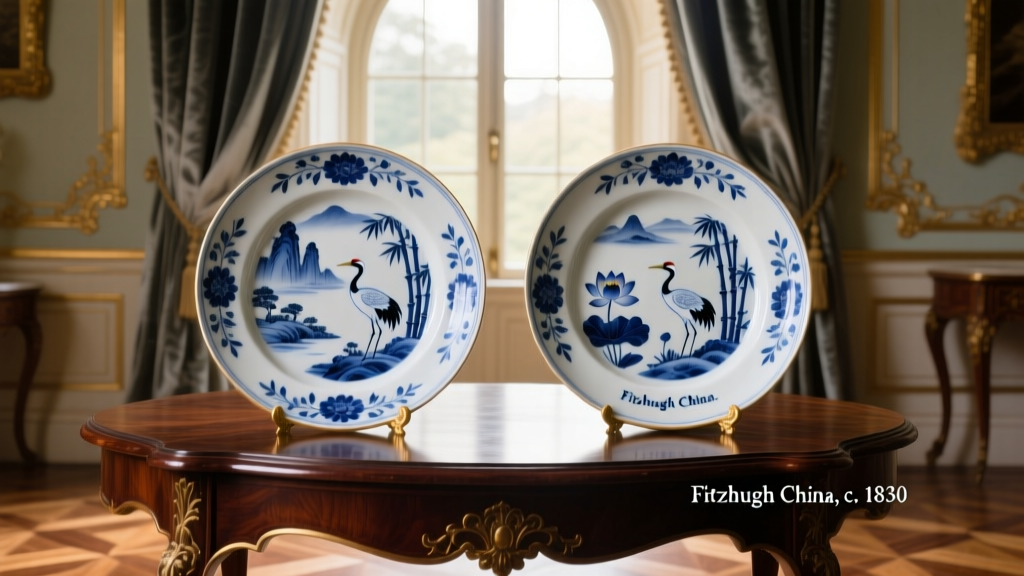
Chinese Export Warming Dish, Fitzhugh Blue-and-White, Circa 1830 — A Pair of 11-Inch Porcelain Heated Serving Vessels
Joseph B. Minton: The Forgotten Master of American Federal Furniture

Meerschaum Figural Pipes: Women’s Heads, Cherubs, and Eagles in Antique Carved Tobacco Art
Carnival Glass Cherry Chain Sauce Bowl with Ruffled Edge in Amethyst: Identification, History, and Restoration Insights

Bronze Sculpture: African Giraffe, Standing Pose with Rich Patina — A 60-Inch Masterpiece in Fine Art Conservation
Tole Chamberstick with Floral Motif and Dark Brown Japanning: A Detailed Study of the 6½-Inch Antique Specimen

Advertising Door Push: The Salada Tea Sign as a Landmark of Early 20th-Century Commercial Design

Decoding the 1138101: A Technical and Historical Analysis of the 1954 Eames Lounge Chair and Ottoman (Herman Miller Production Code)
Stanley No. 71½ Router Plane: Anatomy, Restoration, and Precision Use of Its Dual-Cutter System and Adjustable Fence