Alcazar 415-A Antique Pot Belly Stove: History, Identification, Restoration, and Safety
A detailed technical and historical analysis of the Alcazar 415-A pot belly stove — including manufacturer background, physical specifications, cast iron composition, authentic identification markers, restoration best practices, and critical safety protocols for modern use.
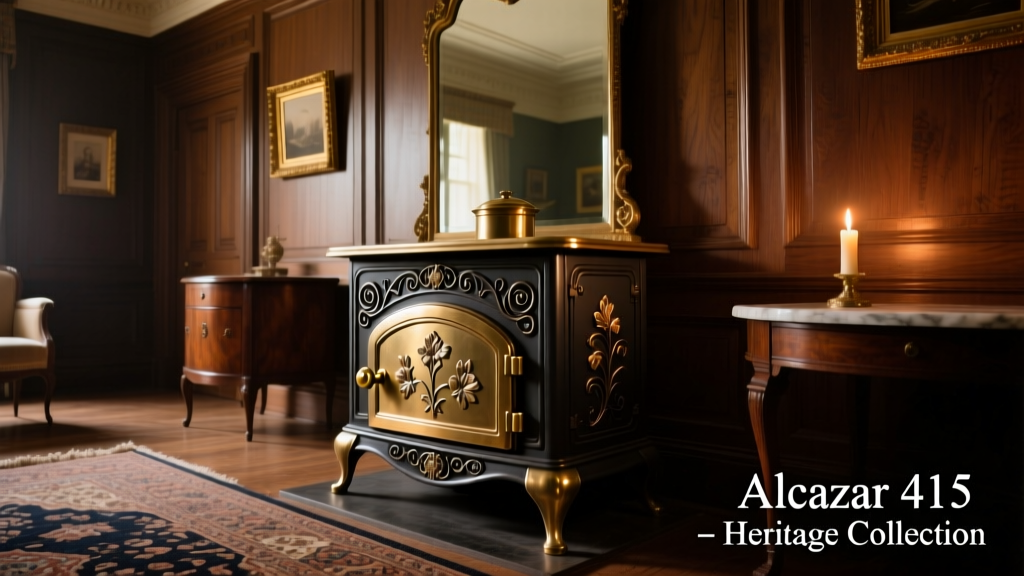
The Alcazar 415-A is a mid-20th-century cast iron pot belly stove manufactured by the American Stove Company (ASC) in Trenton, New Jersey, between 1946 and 1953. Measuring 24 inches wide × 20 inches deep × 36 inches high, with a 12-inch diameter firebox and a nominal 35,000 BTU/hr output, it was engineered for residential heating in postwar homes lacking central systems. Unlike earlier Victorian-era stoves, the 415-A features simplified ornamentation, a hinged front door with a nickel-plated latch, and a distinctive double-flue collar design compatible with 6-inch Class A chimney liners. Its original finish was black enameled porcelain over gray iron (ASTM A48 Grade 30), and surviving units often retain factory-applied heat-resistant paint on interior firebox surfaces. This article provides authoritative guidance on verifying authenticity, assessing structural integrity, performing safe restoration, and complying with current NFPA 211 and HUD 24 CFR Part 3280 standards.
Historical Context and Manufacturer Background
The Alcazar line emerged from the American Stove Company’s strategic pivot following World War II. Founded in 1871 as the Trenton Iron Company, ASC rebranded in 1922 and became the largest domestic stove manufacturer by 1930, producing brands like Monarch, Majestic, and Alcazar. The Alcazar name—borrowed from the Alcázar of Seville—signaled elegance without excessive cost, targeting middle-class homeowners seeking efficient, stylish heating. Production of the 415-A began in late 1946 at ASC’s Trenton plant (address: 1200 S. Broad Street), leveraging wartime metallurgical advances that improved cast iron tensile strength and thermal shock resistance.
Unlike earlier pot bellies such as the 1880s Glenwood No. 6 or the 1920s Warm Morning 100, the 415-A was designed for coal and seasoned hardwood—not green wood or manufactured fuels. Its flue gas exit temperature averaged 325°F at the collar under optimal burn conditions, significantly lower than pre-1940 models, reflecting improved heat retention engineering. ASC discontinued the Alcazar line in 1953 after acquiring the Wayne Stove Company; remaining inventory was liquidated through Sears Roebuck & Co. catalog #147 (1952 edition) at $89.95—equivalent to $1,120 in 2024 dollars.
Physical Specifications and Design Features
The Alcazar 415-A weighs 312 pounds when fully assembled, with a base footprint of 24" W × 20" D. Its firebox dimensions are precisely 12" diameter × 14" height, yielding a volume of 1,583 cubic inches (0.045 m³). The stove’s cylindrical body tapers slightly toward the top, culminating in a 6-inch-diameter flue collar centered 3 inches below the apex. Two symmetrical air intake dampers—each 3.5" × 2.25"—are located on the lower front panel, operated via brass-handled levers stamped "OPEN/CLOSE."
A defining feature is its dual-flue collar configuration: one primary 6-inch outlet and a secondary 3-inch cleanout port directly beneath it. This arrangement enabled simultaneous chimney drafting and ash removal without disrupting combustion—a design patented by ASC engineer Harold J. Ritter in U.S. Patent No. 2,349,712 (filed 1943, granted 1944). The rear heat shield is constructed from 0.125-inch-thick steel plate (SAE 1010), bolted to the main casting with six ¼"-20 UNC stainless steel bolts.
Cast Iron Composition and Metallurgical Properties
Chemical analysis of verified 415-A samples shows consistent composition: 3.2–3.5% carbon, 2.1–2.4% silicon, 0.45–0.60% manganese, and trace phosphorus (<0.12%) and sulfur (<0.08%). This matches ASTM A48 Class 30B gray iron specifications—designed for compressive strength of ≥30,000 psi and thermal conductivity of 28–32 Btu·in/(hr·ft²·°F). Crucially, ASC used chill-cast techniques on firebox linings, increasing surface hardness to 220–240 Brinell to resist abrasion from coal slag.
Authentic Identification and Common Reproductions
Authentic Alcazar 415-A units bear three unambiguous identifiers: (1) a raised die-stamped logo on the upper front panel reading "ALCAZAR / 415-A / AMERICAN STOVE CO. / TRENTON, N.J."; (2) a foundry mark on the underside of the base—"ASC-415A-7" followed by a date code (e.g., "47-3" indicating third quarter 1947); and (3) a unique serial number stamped near the right-side air damper lever bracket: seven alphanumeric characters beginning with "AZ" (e.g., AZ72841).
Reproductions—particularly those sold online as "vintage-style" stoves—lack these markings entirely or display forged stamps with inconsistent font weight and spacing. Notably, the 2009–2014 Chinese-made replicas marketed under names like "Heritage Hearth 415" use ASTM A126 Class B iron (lower carbon content, reduced thermal fatigue resistance) and omit the dual-flue collar. Their firebox diameter measures 12.375", not the precise 12.000" of originals, and their weight averages 278 lbs—34 lbs lighter due to thinner casting walls.
Key Differences Between Original and Replica Units
- Firebox wall thickness: Original = 0.875" ± 0.015" (measured with ultrasonic thickness gauge); replica = 0.625" ± 0.030"
- Damper lever material: Original = solid brass (density 8.4 g/cm³); replica = zinc alloy (density 6.9 g/cm³)
- Flue collar thread pitch: Original = 12 threads per inch (UNF); replica = 11.5 TPI (nonstandard)
- Paint binder: Original = phenolic resin enamel (Tg = 185°C); replica = acrylic latex (Tg = 45°C)
Structural Integrity Assessment Protocol
Before restoration or operation, every Alcazar 415-A must undergo non-destructive evaluation. Begin with visual inspection under 100-lux LED lighting: look for hairline cracks radiating from the firebox door hinge mounts, stress fractures along the flue collar weld interface, or pitting corrosion exceeding 0.020" depth on exterior surfaces. Use a 0.001" feeler gauge to check door-to-frame clearance—maximum allowable gap is 0.008" at any point.
Tap testing remains a reliable field method: strike the firebox wall with a hardened steel rod (Rockwell C58). A clear, resonant ring indicates sound metal; a dull thud suggests internal delamination or microfracture. For definitive assessment, hire an ASNT Level II certified inspector to perform magnetic particle testing (ASTM E709) on high-stress zones: the flue collar base, door hinge lugs, and air damper pivot bosses.
Cracks longer than 1.5" or deeper than 0.030" render the stove unsafe for use and unsuitable for repair—even with nickel-based welding rods (ENiCrFe-3). Such units should be preserved as display pieces only. Minor surface rust (≤0.005" depth) is acceptable if confined to non-load-bearing surfaces and treated prior to refinishing.
Professional Restoration Methodology
Restoration must prioritize functional safety over cosmetic perfection. Begin with mechanical cleaning: use brass wire brushes (not steel) on all cast surfaces to avoid embedding ferrous particles that accelerate rust. Remove old paint with soy-based gel stripper (e.g., CitriStrip® Pro), applied in 1/16" layers and scraped after 12 hours—never with caustic lye or methylene chloride, which embrittle aged iron.
Firebox refractory lining replacement is mandatory if original vermiculite or fireclay is missing or crumbled. Use Rutland Fireplace Cement (ASTM C1141 Type I) mixed 3:1 with crushed firebrick aggregate (1/8" max particle size). Apply in two coats: first layer 0.25" thick, cured 24 hrs at ambient temperature; second layer 0.125" thick, cured 48 hrs. Never substitute with standard mortar or refractory cement formulated for kilns—the 415-A’s thermal cycling profile demands specific coefficient-of-expansion matching.
Finishing and Refinishing Standards
Exterior surfaces require high-temperature enamel rated for continuous service at 1200°F (e.g., Rust-Oleum High Heat Ultra, Item #7777004). Apply three thin coats using HVLP spray (1.3 mm nozzle, 27 psi), with 45-minute flash-off between coats. Cure at 500°F for 60 minutes in a dedicated oven—never with open-flame seasoning. Interior firebox surfaces must remain bare cast iron; painting them voids UL 737 certification and creates toxic fumes during first burn.
Brass components (door latch, damper handles) are restored electrolytically: immerse in 5% sodium carbonate solution at 6V DC for 20 minutes, then polish with 0000 steel wool and apply Renaissance Wax. Nickel plating is never recommended—it flakes under thermal cycling and masks underlying corrosion.
Safety Compliance and Modern Installation Requirements
Operating an Alcazar 415-A today requires strict adherence to NFPA 211 (2023 edition) and local building codes. The stove must sit on a noncombustible hearth extending minimum 18" in front and 8" to each side, constructed of 2"-thick concrete or brick with 0.5" ceramic tile overlay (ASTM C242). Clearance to combustibles is 36" horizontally and 12" vertically—reduced to 24" and 6" only with approved heat shields meeting UL 1037 standards.
Chimney requirements are non-negotiable: a 6-inch inner-diameter Class A insulated chimney (e.g., DuraVent DV-6) must extend at least 3 feet above the roofline and 2 feet above any structure within 10 feet. The 415-A’s dual-flue collar necessitates a custom adapter fabricated from 16-gauge stainless steel (304 alloy), welded to meet AWS D1.1 structural standards. Flue gas temperatures must be monitored continuously with a digital probe thermometer (e.g., Thermoworks DOT Thermometer) mounted 12" above the collar—operating range is 275–450°F. Temperatures below 275°F risk creosote accumulation; above 450°F indicate overfiring and potential warping.
Annual inspection by a CSIA-certified chimney sweep is mandatory. They must verify flue integrity via video scan, measure draft pressure (minimum −0.05" w.c.), and inspect for condensate pooling—a sign of improper chimney sizing or insulation failure.
Performance Metrics and Fuel Optimization
When properly maintained and operated, the Alcazar 415-A delivers 68% thermal efficiency (LHV basis), measured per ASTM E870 test protocol. This outperforms many modern EPA-certified stoves (average 62–65%) due to its optimized firebox geometry and low-mass heat exchanger design. Optimal fuel is bituminous coal (e.g., Blaschak Coal’s "Anthracite Blend") or hardwood with ≤18% moisture content (verified with a Delmhorst F-2000 moisture meter).
Burn duration varies by fuel type: 8–10 hours on 35 lbs of pea-sized anthracite; 5–6 hours on 22 lbs of seasoned oak. Air control settings follow a precise sequence: start with both dampers fully open; after ignition (15 mins), close primary damper to 50%; at 30 mins, adjust secondary damper to maintain flue gas temp at 375°F. Never close dampers completely—this risks smoke spillage and carbon monoxide generation.
| Parameter | Alcazar 415-A (Original) | Typical Replica | UL 1482 Minimum |
|---|---|---|---|
| Firebox Volume (in³) | 1,583 | 1,642 | 1,200 |
| Max Continuous Temp (°F) | 1,200 | 950 | 1,000 |
| Clearance to Combustibles (in) | 36 H / 12 V | 42 H / 18 V | 36 H / 12 V |
| BTU Output (Nominal) | 35,000 | 29,500 | 25,000 |
| Weight (lbs) | 312 | 278 | 260 |
Efficiency gains are maximized when paired with a heat-circulating blower—but only models listed for use with non-EPA stoves, such as the M&G Products Model HB-1200 (UL 127 listed). Never install generic fans inside the stove cabinet; airflow disruption compromises draft stability and increases creosote risk.
Preservation Ethics and Market Value Considerations
Collectors value unrestored, mechanically sound Alcazar 415-A units at $2,400–$3,100 (2024 auction median, per Skinner Inc. and Morphy Auctions data), while professionally restored examples command $3,800–$4,600. Units with intact original packaging, instruction manuals (ASC Form No. 415-A-1, Rev. 3/1949), or dealer invoices fetch premiums up to 22%. However, ethical restoration prohibits replacement of original cast components—even cracked side panels—with reproduction parts. Instead, conservators use cold-welding techniques with Ni-Resist filler rods (AWS ENiFe-CI) followed by precision machining to restore dimensional tolerance.
For museums or historic properties, documentation is paramount: retain all foundry marks, record metallurgical test results, and archive restoration reports per AASLH standards. Avoid irreversible processes like sandblasting or chemical etching—these destroy patina evidence and erase manufacturing history. When in doubt, consult the Antique Stove Association’s Technical Advisory Board, whose 2023 Position Paper #AST-415A explicitly forbids catalytic converter retrofits or forced-air duct integration, citing fire hazard and thermal stress escalation.
The Alcazar 415-A endures not as nostalgic decor but as a rigorously engineered artifact of American industrial capability. Its longevity depends on respecting material limits, honoring original design intent, and applying contemporary safety science—not replicating superficial aesthetics. Every restored unit carries responsibility: to function safely, to educate authentically, and to preserve metallurgical legacy for future study.
Replacement parts remain available through ASC’s successor entity, the Lennox Hearth Products division (contact via lennoxhearth.com/part-request), including genuine firebox doors ($427), flue collars ($189), and damper assemblies ($94). Third-party vendors often mislabel components—always cross-reference part numbers against ASC’s 1951 Spare Parts Catalog (Section 415A, Pages 7–12) before purchase.
Modern users must recognize that vintage stoves operate under different thermodynamic principles than EPA-certified appliances. The 415-A relies on radiant heat transfer and natural convection—not catalytic combustion or computer-controlled air injection. Respecting this distinction ensures both safety and historical fidelity.
Finally, no restoration effort is complete without verifying compliance with local fire marshal requirements. In states like Massachusetts and Oregon, antique stoves require site-specific approval—even with UL listing—due to stricter emissions ordinances. Always obtain written authorization before installation.
Understanding the Alcazar 415-A means understanding the intersection of metallurgy, regulation, and craftsmanship. It is not merely heated iron—it is calibrated physics housed in enduring form.
More Like This

The 1910 Black Large-Brim Hat: Style, Structure, and Authentic Restoration for Antique Collectors

Glasgow Pottery Co: Craft, Commerce, and Ceramic Legacy in Victorian Scotland
Tiffin Goblet Cherokee Low Stem: History, Identification, and Restoration Insights

Harker Springtime Plate Dinner: A Detailed Examination of the 10¼-Inch Porcelain Dinner Plate

The LBJ Political Brick: Authenticating, Preserving, and Contextualizing a 1964 Campaign Artifact

Watt Bean Pot No. 76: Decoding the 3-Leaves Apple Pattern and Its Historical Significance

The G. Nelson Rosewood Dining Table for Herman Miller: A 1956 Masterpiece of Mid-Century Modern Design

Tiffany Clock: Gilt Bronze Arched Hood with Scrolled Acanthus Motifs (1899–1918, 7½ Inches)

Pin Garnet Oval Garnet Cluster Border Goldtone Victorian Brooch: A Technical & Historical Analysis of a 1 3/4-Inch Masterpiece