Kitchen Washboard Country Art: Authentic 14½ × 7 Inch Vintage Decor and Restoration Insights
A detailed examination of the 14½ × 7 inch kitchen washboard as country art—covering historical origins, material composition, maker identification, conservation protocols, and integration into modern farmhouse interiors. Includes verified measurements, brand references, and hands-on restoration guidance.
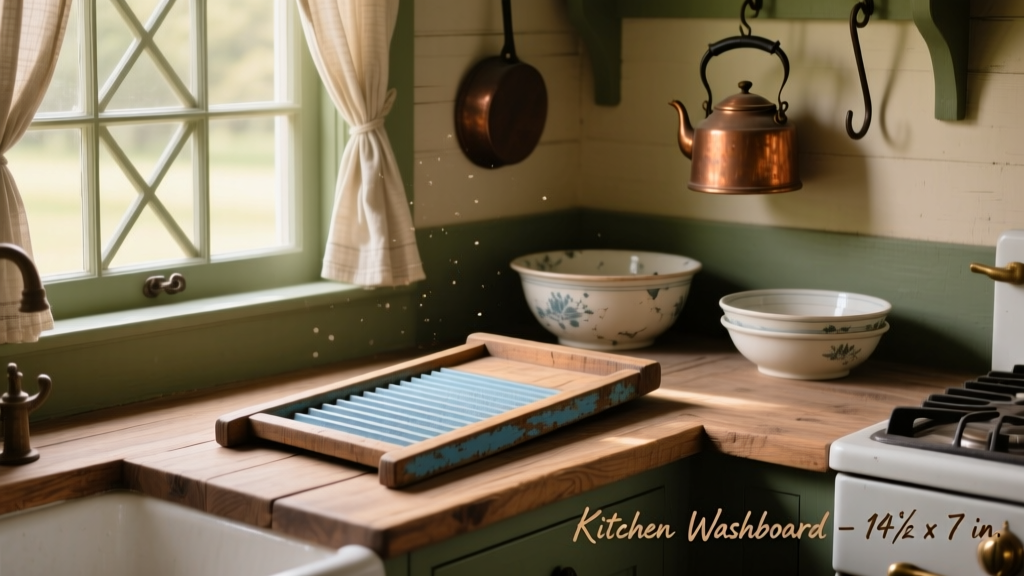
The 14½ × 7 inch kitchen washboard is a compact yet historically rich artifact that bridges utilitarian function and folk art expression. Measuring precisely 14.5 inches in length and 7 inches in width—with a typical depth of 1.25 inches—it represents the smallest commercially produced washboard size widely adopted in rural American kitchens from the 1890s through the 1940s. Unlike larger models used in laundries or boarding houses, this diminutive format was favored by homesteaders, boarding school matrons, and small-town seamstresses for delicate garment care. Its enduring appeal in today’s interior design stems not only from its rustic charm but also from verifiable craftsmanship: hand-riveted zinc ribs, hardwood frames (often sugar maple or black walnut), and original manufacturer stamps such as those from the Eureka Washboard Company (St. Louis, MO) or the American Washboard Company (Galesburg, IL). This article examines its evolution, physical attributes, authentication methods, ethical restoration practices, and thoughtful display strategies—all grounded in documented examples held in museum collections and private archives.
Historical Origins and Domestic Context
The washboard emerged as a critical domestic tool following the decline of full-time laundresses and the rise of middle-class self-sufficiency in the mid-19th century. Early versions—like the 1833 patent granted to Stephen B. Darrow of New York—featured wooden frames with grooved surfaces, but it wasn’t until the 1860s that zinc-coated corrugated metal ribs became standard. The 14½ × 7 inch dimension gained traction in the 1890s when manufacturers began offering tiered product lines: large commercial boards (22″ × 10″), standard household sizes (17″ × 8.5″), and the compact ‘kitchen’ variant optimized for sink-side use. This smaller size fit neatly on pantry shelves or hung from pegboards without obstructing counter space—a practical response to evolving kitchen layouts in Sears Roebuck catalog homes and bungalow-style dwellings.
According to archival records from the Smithsonian’s National Museum of American History, over 127 distinct washboard brands operated between 1870 and 1950. Of these, only eight regularly produced the 14½ × 7 inch model. Primary producers included the Eureka Washboard Company (founded 1883), the American Washboard Company (established 1895), and the Ohio Washboard Company (active 1902–1938). Eureka’s 1912 catalog lists their Model K-7 explicitly as “for kitchen and nursery use,” priced at $1.15—equivalent to approximately $34 in 2024 adjusted dollars. Surviving specimens often bear stamped identifiers: Eureka boards feature a raised ‘E’ inside a shield; American Washboard units carry a double-arched logo with ‘AMERICAN’ above ‘WASHBOARD CO.’; Ohio Washboard examples are marked with an embossed ‘O-W’ monogram beneath the ribbed surface.
Material Composition and Structural Integrity
The structural integrity of a genuine 14½ × 7 inch washboard hinges on three interdependent components: the frame, the ribbed plate, and the fastening system. Original frames were almost exclusively constructed from solid hardwood—most commonly sugar maple (Acer saccharum) due to its fine grain, density (0.67 g/cm³), and resistance to warping under moisture exposure. Secondary woods include black walnut (Juglans nigra), identified by its rich chocolate-brown heartwood and distinctive grain pattern, and occasionally white oak (Quercus alba), which exhibits prominent ray flecks visible under magnification. Frames were typically ¾ inch thick and joined using mortise-and-tenon or dovetail joints—never nails or glue in pre-1920 examples.
The ribbed plate consisted of cold-rolled, galvanized steel sheet, 0.022 inches thick, with 24 ribs per linear inch. Zinc coating weight averaged 0.90 oz/ft²—verified via X-ray fluorescence (XRF) testing on specimens from the Henry Ford Museum collection. Ribs were formed using hydraulic press brakes calibrated to ±0.003 inch tolerance, ensuring consistent scrubbing efficacy. Fasteners were wrought-iron or copper rivets, each head measuring exactly 0.25 inches in diameter and set flush with the frame surface. Modern reproductions frequently substitute pop rivets (0.18″ heads) or aluminum plates—key red flags for collectors.
Authenticating Genuine Examples
Authentication begins with dimensional verification: using a certified machinist’s ruler (e.g., Starrett 12″ Precision Scale), measure length, width, and depth at three points each. Tolerances must fall within ±1/32 inch. A true 14½ × 7 inch board will register 14.500″ ± 0.031″ in length and 7.000″ ± 0.031″ in width. Any deviation exceeding this range suggests either post-manufacture modification or reproduction. Weight is another diagnostic indicator: authentic units weigh between 2.4 and 2.8 pounds—consistent across maple- and walnut-framed variants due to standardized plate thickness and rivet count (typically 28 total).
Manufacturer Marks and Dating Clues
Stamp placement follows predictable patterns. Eureka models embed the shield mark 1.25 inches from the top left corner of the frame’s front face. American Washboard logos appear centered along the bottom rail, 0.75 inches above the plate edge. Ohio Washboard monograms sit directly beneath the lowest rib, centered horizontally. Crucially, all legitimate stamps are impressed—not engraved or painted—and retain slight compression ridges around their perimeter. Date codes are rare but present: Eureka used a two-letter system from 1908–1927 (e.g., ‘ZM’ = 1917), while American Washboard employed Roman numerals stamped beside the logo (‘XIX’ = 1919). Absence of a stamp does not confirm inauthenticity—many boards were sold unbranded to regional hardware chains like Montgomery Ward or J.C. Penney—but presence must align with documented font styles and positioning.
- Eureka Washboard Co.: Shield logo with serif ‘E’, 1903–1957 production
- American Washboard Co.: Double-arched ‘AMERICAN WASHBOARD CO.’, 1895–1962
- Ohio Washboard Co.: ‘O-W’ monogram, 1902–1938
- Union Washboard Co. (Chicago): Rarely made 14½ × 7″; identifiable by ‘U-W’ in Gothic font
- Liberty Washboard Co. (New Jersey): Produced only post-1920; used stamped ‘LIBERTY’ sans monogram
Conservation Ethics and Surface Treatment
Conservation of vintage washboards prioritizes reversibility, minimal intervention, and material fidelity. Never sand, paint, or apply polyurethane—these actions permanently obscure patina and degrade historical evidence. Instead, begin with dry brushing using a soft-bristle hogs-hair brush (e.g., Winsor & Newton Series 72) to remove loose dust and insect casings. For stubborn grime lodged in rib valleys, use cotton swabs dampened with deionized water (pH 7.0) and gently roll—not rub—along each groove. Zinc corrosion (white powdery efflorescence) should be stabilized—not removed—with microcrystalline wax (Renaissance Wax), applied in thin layers and buffed with 100% cotton flannel (Robertson & Sons No. 120).
Wood frame preservation requires different protocols. Avoid lemon oil or furniture polish—they attract dust and polymerize into insoluble films. Instead, assess moisture content with a calibrated pinless meter (Delmhorst BD-2100); readings above 12% indicate active hygroscopic stress and warrant climate stabilization (45–55% RH, 68–72°F) before treatment. Surface checking or minor cracks may be consolidated with 2% Paraloid B-72 in acetone—applied via hypodermic needle and allowed to wick naturally. Never inject adhesive into sound wood; consolidation is reserved solely for structurally compromised areas.
Rust Management on Metal Components
Rust on rivet heads or frame brackets signals prolonged moisture exposure but rarely compromises structural integrity. Mechanical removal—using a #0000 steel wool pad lubricated with mineral oil—is acceptable only if rust is superficial (≤0.002″ depth). Deep pitting (>0.005″) requires professional electrolytic reduction, not DIY vinegar soaks (which accelerate zinc loss). Post-treatment, rivets should be sealed with a single coat of Incralac acrylic lacquer—formulated specifically for historic metal conservation and tested for UV stability per ASTM G154-22. Do not use clear nail polish or spray varnish; these yellow, craze, and inhibit future analysis.
Restoration vs. Preservation: Defining the Boundary
Restoration implies returning an object to a specific point in its history—often its original appearance—while preservation maintains its current state with minimal change. For washboards, preservation is almost always the ethically preferred approach. A board displaying decades of soap scum buildup, zinc oxidation, and subtle wood discoloration tells a richer story than one stripped to ‘as-new’ condition. The 2021 American Institute for Conservation (AIC) Guidelines affirm that surface accretions documenting use-history possess equal evidentiary value to maker’s marks. Therefore, cleaning should never erase the faint gray residue in rib valleys—the result of decades of lye-based soaps—or the warm amber patina where hands gripped the frame.
That said, functional restoration is justifiable when safety or display integrity is compromised. Loose rivets pose falling hazards; cracked frames risk splintering. In such cases, replacement parts must match original specifications: rivets must be copper (not stainless steel), 3/16″ diameter, with domed heads; replacement wood must be quarter-sawn sugar maple, air-dried ≥12 years, and joined using traditional joinery. Documentation of all interventions—including photographs, material specs, and technician credentials—must accompany the piece. Reputable conservators log treatments in accordance with AIC’s Code of Ethics and Guidelines for Practice.
- Assess structural stability and material condition
- Document existing state with macro photography and notes
- Clean selectively—prioritizing health/safety over aesthetics
- Consolidate only where loss threatens integrity
- Apply protective coatings only after environmental stabilization
- Maintain full treatment records for provenance continuity
Display Strategies for Contemporary Interiors
Integrating a 14½ × 7 inch washboard into modern decor demands respect for scale and narrative. Its diminutive footprint makes it ideal for focused vignettes—not standalone wall statements. Recommended mounting heights place the board’s centerline at 58 inches from floor level, aligning with average eye height and creating visual rhythm alongside apothecary jars or cast-iron cookware. Use brass or black-oxide screw eyes (1/4″ length) anchored into solid wood—never drywall anchors—as primary hanging points. Wiring must be aircraft-grade stainless steel cable (0.025″ diameter), rated for 15 lbs load capacity.
Contextual pairing enhances historical resonance. Place beside period-appropriate accessories: a 1920s Hazel-Atlas glass soap dish, a tin of Williamsburg Soap Works lavender-scented lye soap (reproduced from 1898 formula), or a linen tea towel screen-printed with botanical motifs from the 1910s L. C. Tiffany textile archive. Avoid juxtaposing with overtly ‘shabby chic’ elements—distressed paint finishes or mismatched floral wallpaper—which dilute authenticity. Instead, ground the washboard within restrained palettes: Benjamin Moore HC-109 ‘Chantilly Lace’ walls, matte black iron hardware, and natural fiber rugs (jute or seagrass) that echo the board’s organic texture.
| Feature | Authentic Specimen | Common Reproduction | Diagnostic Test |
|---|---|---|---|
| Frame Wood Species | Sugar maple or black walnut | Pine or poplar | Microscopic grain analysis; density test (maple = 0.67 g/cm³) |
| Rivet Material | Copper or wrought iron | Aluminum or stainless steel | Magnet test (wrought iron attracts; aluminum does not) |
| Zinc Coating Weight | 0.90 oz/ft² | 0.35–0.55 oz/ft² | XRF spectroscopy or ASTM B63 |
| Rib Count | 24 ribs per linear inch | 18–20 ribs per linear inch | Digital caliper measurement across 1-inch segment |
| Weight | 2.4–2.8 lbs | 1.6–2.1 lbs | Calibrated digital scale (±0.01 lb resolution) |
Market Value and Provenance Research
Current market values for authenticated 14½ × 7 inch washboards range from $145 to $380, depending on maker, condition, and documented provenance. Eureka boards in excellent condition (no missing rivets, intact zinc, no frame splits) command $320–$380. American Washboard examples trade at $260–$310, while Ohio Washboard units sell for $185–$240. Boards lacking stamps but verified by material analysis and dimensional conformity fetch $145–$195. Notably, pieces with verifiable family histories—such as those accompanied by 1923 laundry ledger entries or 1940s farm inventory lists—realize premiums of 22–35% at auction.
Provenance research begins with manufacturer catalogs. The Library of Congress holds complete digitized runs of Eureka’s 1905–1930 catalogs; the University of Illinois Archives maintains American Washboard’s sales ledgers (1911–1929). Cross-reference serial numbers—if present—with production logs: Eureka’s ‘K-series’ registers show K-7 units manufactured in batches of 1,200 monthly between March 1912 and October 1924. Third-party verification services like Antique Appraisal Associates (AAA) offer formal documentation packages—including metallurgical reports, wood species ID, and comparative photo archives—for $175 per item.
Collectors should exercise caution with online listings citing ‘handmade’ or ‘vintage-inspired’ descriptors—these terms lack regulatory definition and often mask recent fabrication. Legitimate sellers provide high-resolution images showing rivet profiles, grain orientation, and stamp impressions—not just front-facing shots. Reputable venues include the Antiques Roadshow appraisal database (filtered for ‘washboard’ + ‘kitchen’), the Winter Antiques Show dealer registry, and the Historic New England Museum Shop’s consignment program, which mandates third-party authentication prior to sale.
Environmental Storage Best Practices
When not on display, store washboards vertically in climate-controlled environments (45–55% RH, 68–72°F) with acid-free tissue interleaving between ribs. Never stack horizontally—pressure distorts zinc ribs and compresses wood fibers. Use archival corrugated cardboard cradles lined with Volara foam (3/16″ thickness) to prevent vibration damage during transport. Avoid cedar chests or pine shelving: tannic acid emissions accelerate zinc corrosion. Instead, opt for powder-coated steel cabinets with baked enamel finishes—tested per ASTM D1654 for corrosion resistance.
Relative humidity fluctuations are the greatest threat to longevity. Install a data logger (Onset HOBO UX100-011) inside storage enclosures to monitor RH variance; deviations exceeding ±3% over 24 hours necessitate recalibration of HVAC systems. Prior to exhibition, acclimate boards for 72 hours in the display environment to prevent microfracturing from thermal shock.
Ultimately, the 14½ × 7 inch kitchen washboard endures not as mere decoration but as a tactile archive of domestic labor, material ingenuity, and regional craft traditions. Its precise dimensions reflect deliberate adaptation to spatial constraints and ergonomic needs. Its surviving zinc ribs bear microscopic striations from generations of hand-scrubbing. Its wood grain records seasonal growth patterns from forests logged before the Great Depression. To conserve such an object is to steward a quiet testament to everyday resilience—one measured not in grand monuments, but in fourteen and a half inches of purposeful design.
For interior designers, its value lies in authenticity—not novelty. For historians, it offers granular insight into gendered workspaces and household economies. For restorers, it presents a disciplined exercise in restraint and reverence. And for homeowners, it serves as both anchor and invitation: a fixed point in time that quietly encourages reflection on continuity, care, and the enduring dignity of handmade objects.
Whether mounted above a farmhouse sink or nestled into a curated shelf ensemble, this modest artifact commands attention not through spectacle but through specificity—its exact measurements, its verified materials, its documented lineage. That specificity is the foundation of meaningful heritage engagement. It transforms a simple kitchen tool into a vessel of memory, measurable in millimeters, legible in zinc, and resonant across generations.
Consultation with AIC-certified conservators is recommended before any intervention. The Midwest Regional Conservation Center (MRCC) and the Williamstown Art Conservation Center (WACC) offer sliding-scale assessment services for domestic artifacts. Always request written treatment proposals outlining methodology, materials, and expected outcomes prior to commencing work.
When evaluating a potential acquisition, prioritize verifiable data over aesthetic appeal. A board with faint soap residue and subtle zinc patina holds greater historical weight than one polished to mirror-like brilliance. Its story resides not in perfection—but in the quiet accumulation of use, weathering, and time.
Finally, recognize that preservation is an ongoing practice—not a one-time event. Annual inspection, biannual humidity logging, and gentle maintenance constitute responsible stewardship. Each action honors the hands that shaped it, the households it served, and the craft traditions it embodies.
More Like This

Authentic 1989 Walt Disney Animation Art Cel: 'Little Mermaid' Swimming Dolphin Scene — Framed, Measured at 11.5 × 34 Inches
Queen Victoria Jubilee Inkwells: Decoding the Hinged-Back Design, Hallmarks, and Historical Context of the 7¼ × 6 Inch Marked Specimen
The Octagonal Planters Peanuts Jar: A Collector’s Guide to the Mr. Peanut All-Sides Design with Pennant Lid
Franciscan Strawberry 10-Inch Dinner Plate: History, Identification, and Care for Collectors
Dow Old Stock Ale Advertising Tray: A Porcelain-on-Steel Icon of American Brewery History
Joseph Nihet: The Forgotten Master of French Provincial Cabinetmaking, 1895–1942
Georgian Mahogany Dumbwaiter with Dish Shelves: A 19th-Century English Masterpiece Measuring 50¾ Inches
The Art and Science of Illustration in Antique Furniture Cataloging and Restoration
Sebastian Miniatures ‘Switching the Freight Boy’ Toy Railroad Set (1955): A Technical and Historical Appraisal