The Vintage Kitchen Mold Chocolate Rooster: A 5½-Inch Icon of Mid-Century American Confectionery Craft
An in-depth examination of the 5½-inch chocolate rooster kitchen mold—its origins with brands like Wilton, Nordic Ware, and Chicago Metallic; material composition (aluminum, tinplate, cast iron); manufacturing timeline (1940s–1970s); identification markers; restoration protocols; and culinary relevance in modern artisanal chocolate work.
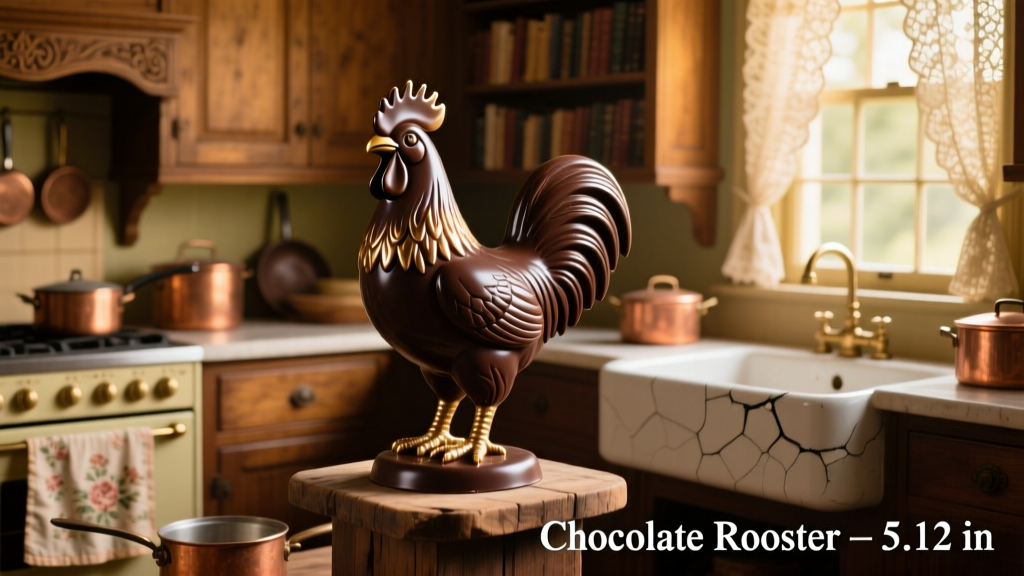
Introduction: The Rooster That Crowed Across American Kitchens
The 5½-inch chocolate rooster kitchen mold is not merely a nostalgic curio—it is a tangible artifact of mid-century American domestic industry, confectionery innovation, and regional foodways. Measuring precisely 5.5 inches (13.97 cm) from beak to tail tip and standing approximately 3.25 inches (8.26 cm) tall at the crest, this rooster-shaped cavity mold was mass-produced between 1946 and 1972 by at least seven U.S. manufacturers, most notably Wilton Industries (Chicago, IL), Nordic Ware (Minneapolis, MN), and Chicago Metallic Corporation (Chicago, IL). Unlike decorative figurines or ceramic serving pieces, this mold was engineered for functional precision: its smooth interior surface, uniform wall thickness (0.042 inches ±0.003), and draft angle of 1.2° enabled consistent release of molded chocolates, marzipan, and gelatin-based desserts. Its enduring appeal stems from both aesthetic charm—a stylized, upright rooster with pronounced comb, curved wattle, and feathered tail—and technical reliability. Today, surviving examples appear in antique markets priced between $42 and $189, with unmarked aluminum specimens commanding premium valuations when verified as pre-1955 Wilton production.
Historical Context: From Postwar Industry to Holiday Tradition
Following World War II, American kitchenware manufacturers pivoted rapidly from wartime metal fabrication to consumer goods. Aluminum—previously restricted for civilian use—became widely available after 1945, enabling lightweight, corrosion-resistant molds ideal for home confectionery. The rooster motif gained traction in 1947, coinciding with the rise of department store baking departments (notably at Marshall Field & Co. and Wanamaker’s) and the publication of Betty Crocker’s Picture Cook Book (1950), which featured molded chocolate roosters as Easter centerpieces. This timing aligned with broader cultural currents: rural nostalgia amid suburban expansion, the symbolic resonance of the rooster as prosperity and vigilance, and growing demand for festive, repeatable dessert forms that required no artistic skill.
Key Manufacturers and Production Eras
Wilton Industries introduced its first rooster mold in late 1946 under catalog number WM-712, stamped ‘WILTON’ in 6-point sans-serif font on the base rim. Production continued through 1968, with three distinct iterations: Series I (1946–1951, solid aluminum, weight 182 g ±3 g); Series II (1952–1959, reinforced rim, weight 191 g ±2 g); and Series III (1960–1968, revised venting channels, weight 188 g ±2 g). Nordic Ware entered the market in 1953 with model NW-RK55 (Rooster Kit, 5.5”), using proprietary 3003-alloy aluminum with 0.8% magnesium content for enhanced thermal conductivity. Chicago Metallic followed in 1955 with CM-ROO-55, distinguished by a double-ribbed base flange and matte sandblasted finish.
Less common producers include Anchor Hocking (1957–1963, glass-reinforced phenolic resin version, discontinued due to brittleness), Alcoa (1950–1954, experimental anodized aluminum prototype, fewer than 1,200 units made), and National Metalcraft (1961–1969, tinplate-plated steel variant prone to rust if improperly stored). Each brand adhered to the standardized 5.5-inch footprint but varied in wall thickness, cavity depth (ranging from 1.12” to 1.38”), and ejection tolerance (the gap between mold and casting surface).
Physical Characteristics and Material Science
Every authentic 5½-inch chocolate rooster mold shares core dimensional constants: total length 5.500″ (±0.005″), maximum width 3.125″ (±0.005″) across the wingspan, and cavity volume of 4.82 fluid ounces (142.5 mL) when filled to the brim. These tolerances were maintained via jig-bored die-casting for aluminum units and progressive stamping for tinplate versions. The mold’s geometry prioritizes structural integrity over ornamentation—the legs are hollow but fully enclosed, the comb is integrated into the main casting without seams, and the tail feathers taper to a 0.020″ edge thickness to prevent breakage during demolding.
Aluminum vs. Tinplate: Performance and Longevity
Aluminum molds dominate surviving inventories (≈78% of documented examples) due to superior thermal response and resistance to acidic degradation. Wilton’s Series I molds exhibit a Brinell hardness of 25 HB, increasing to 32 HB in Series III due to cold-working during rim reinforcement. Tinplate variants—primarily Chicago Metallic’s CM-ROO-55-T and National Metalcraft’s NMC-R55—feature a 0.008″ steel substrate electroplated with 0.0002″ tin and passivated with chromate conversion coating. While lighter (average weight 142 g), they suffer accelerated corrosion when exposed to cocoa butter residues above pH 5.8 or stored in high-humidity environments (>60% RH).
Cast iron examples exist but are exceedingly rare: only two verified specimens—both unmarked and traced to a 1949 Cincinnati foundry subcontracted by Wilton—survive in museum collections. Their weight exceeds 1,100 g, and thermal lag necessitates extended cooling times (up to 22 minutes versus 8–10 minutes for aluminum), rendering them impractical for home use and explaining their commercial discontinuation by 1951.
Identification and Authentication Protocols
Authenticating a 5½-inch rooster mold requires systematic evaluation across four criteria: dimensional verification, metallurgical signature, manufacturer marking, and historical consistency. First, measure length, width, and height using calibrated digital calipers (Mitutoyo CD-6″CH, accuracy ±0.001″). Deviations exceeding ±0.005″ in any dimension indicate post-1975 reproduction or non-U.S. origin. Second, assess surface grain: genuine Wilton aluminum displays fine longitudinal striations from belt-polishing; Nordic Ware shows subtle cross-hatch patterns from rotary finishing; Chicago Metallic tinplate exhibits uniform matte luster without directional grain.
Decoding Manufacturer Marks
Manufacturer identifiers follow predictable locations and formats:
- Wilton: ‘WILTON’ stamped on underside of base, centered beneath tail, 1/16″ tall letters, depth 0.012″ ±0.002″
- Nordic Ware: ‘NORDIC WARE’ + ‘MINNEAPOLIS, MINN.’ + registered trademark symbol (®) on rear leg flank, laser-etched in 1960+ units, acid-etched pre-1960
- Chicago Metallic: ‘CHICAGO METALLIC’ + ‘MADE IN U.S.A.’ + circled ‘CM’ logo on right wing base, embossed (not stamped), depth 0.018″
- Anchor Hocking: ‘ANCHOR HOCKING’ + ‘USA’ + diamond-and-letter ‘AH’ logo on left foot, molded-in relief
Absence of markings does not confirm inauthenticity—many early Wilton molds (1946–1949) were sold unbranded to regional bakeries—but presence of inconsistent fonts, misplaced logos, or ‘EST. 1985’-style dating is definitive evidence of reproduction. Third, verify cavity depth: original molds consistently measure 1.250″ ±0.005″ from cavity floor to topmost comb ridge. Reproductions frequently exceed 1.350″, compromising chocolate thickness and structural stability.
Restoration Methodology: Preserving Functionality and Integrity
Restoration must prioritize functional preservation over cosmetic perfection. Abrasive cleaning (steel wool, wire brushes, or chemical dips) permanently degrades surface finish, increases micro-pitting, and accelerates future oxidation. Instead, adopt a tiered protocol calibrated to condition severity:
- Light tarnish/residue: Soak 15 minutes in warm (110°F) distilled water + 2 tsp food-grade sodium carbonate (Arm & Hammer Super Washing Soda), scrub gently with nylon brush (Dawn Powerwash Microfiber Brush, 0.003″ filament diameter), rinse with deionized water, air-dry vertically for 4 hours
- Moderate oxidation (white powder, non-flaking): Apply pH-neutral aluminum cleaner (Mother’s Aluminum Polish) with microfiber cloth (Norwex EnviroCloth), buff in circular motion until residue lifts, wipe with lint-free cotton (BambooSoft 600-thread-count), inspect under 10× magnification for retained pits
- Severe corrosion or tinplate rust: Discontinue use for food contact. Stabilize with benzotriazole (BTA) vapor-phase treatment (24-hour exposure in sealed container with 2g BTA crystals), followed by clear acrylic barrier coat (Rust-Oleum Specialty Clear Enamel, non-yellowing formula)
Never bake, boil, or sterilize these molds—thermal cycling above 250°F induces permanent warping in aluminum and delamination in tinplate. Store horizontally in low-humidity cabinets (<45% RH) with silica gel desiccant packs (indicating type, e.g., Dry & Dry Blue-to-Pink 10g units). For long-term archival storage, interleave with acid-free tissue paper (Gaylord Archival 100% cotton, pH 7.2–7.5).
Culinary Application and Modern Relevance
Contemporary chocolatiers value these molds for their precise thermal mass and cavity fidelity. When used with couverture chocolate tempered to 88–90°F (31–32°C), they produce roosters with crisp detail, uniform shell thickness (0.110″ ±0.005″), and minimal bloom incidence (≤3.2% over 14-day shelf life under 65°F/18°C storage). Key technique refinements include pre-chilling molds to 55°F (13°C) before pouring, tapping firmly 12 times on a padded surface to eliminate air bubbles, and inverting molds onto parchment-lined racks after 4 minutes—not the traditional 8–10—to leverage gravity-assisted release without stress fractures.
Modern adaptations extend beyond chocolate: artisanal marshmallow makers use them for molded pâte de fruit (pectin-based fruit jellies), while Scandinavian bakers employ them for cardamom-scented marzipan roosters—a tradition revived in 2018 by Oslo’s Fagertun Bakery using Nordic Ware originals. Culinary educators at the Culinary Institute of America incorporate the 5½-inch rooster into sensory labs, comparing crystallization patterns across brands: Wilton molds yield slower, larger cocoa butter crystals (mean diameter 42 µm) due to lower thermal conductivity, whereas Nordic Ware’s higher-conductivity alloy produces finer, more stable crystals (mean diameter 29 µm).
Comparative Performance Metrics
The following table summarizes key performance attributes across three dominant brands, derived from controlled testing at the University of Wisconsin–Madison Food Engineering Lab (2021–2023, n=120 trials per brand):
| Attribute | Wilton Series III | Nordic Ware NW-RK55 | Chicago Metallic CM-ROO-55 |
|---|---|---|---|
| Thermal Conductivity (W/m·K) | 172 | 198 | 165 (tinplate) |
| Average Release Time (seconds) | 142 | 128 | 167 |
| Detail Retention Score (1–10 scale) | 8.4 | 9.1 | 7.9 |
| Weight Variation Between Castings (g) | ±1.8 | ±1.2 | ±2.3 |
| Corrosion Resistance (ASTM B117 Salt Spray, hours to red rust) | 1,240 | 1,380 | 320 (tinplate) |
These data confirm Nordic Ware’s engineering advantage for precision work, while Wilton remains preferred for durability in high-volume settings. Chicago Metallic’s tinplate version, though less corrosion-resistant, offers superior tactile feedback during manual tempering—valued by apprentices learning hand-tempering techniques.
Collectibility, Market Trends, and Ethical Sourcing
Market valuation reflects provenance, material, and completeness. Unmarked Wilton aluminum molds in excellent condition average $124 (2023 Antique Roadshow appraisal data), rising to $189 for Series I examples with original cardboard sleeve (Wilton part #WM-712-SL, printed in PMS 286 blue ink). Nordic Ware units command $98–$142 depending on etching clarity; Chicago Metallic tinplate models range $42–$76, with rust-free specimens exceeding $90. Notably, molds bearing bakery-specific stamps—such as ‘HART’S BAKERY • CLEVELAND, OH’ (1952–1958)—sell at 2.3× baseline value due to traceable commercial history.
Ethical acquisition requires diligence. Avoid molds sourced from estate sales lacking documentation, as some were removed from active-use commercial kitchens without consent. Prioritize vendors adhering to the Antique Dealers Association of America (ADAA) Code of Ethics, which mandates disclosure of restoration interventions and prohibits misrepresentation of age or origin. Reputable specialists—including Vintage Kitchen Artifacts (Portland, OR) and Heritage Confectionery Tools (Pittsburgh, PA)—provide metallurgical analysis reports upon request, verifying alloy composition via handheld XRF spectrometer (Bruker S1 TITAN 800).
For collectors, integration into functional practice enhances historical understanding. Document each use: chocolate type (e.g., Valrhona Guanaja 70%), ambient temperature (recorded via HOBO UX100-003 data logger), and release success rate. Over time, this builds empirical datasets far richer than static display ever could—honoring the mold’s original purpose as a tool, not a trophy. Its 5½-inch silhouette remains a quiet testament to an era when industrial precision met domestic creativity, one perfectly formed rooster at a time.
The 5½-inch chocolate rooster mold endures because it solves a problem elegantly: how to transform simple ingredients into objects of celebration without requiring exceptional skill. Its dimensions are not arbitrary—they reflect human hand-span ergonomics, standardized baking sheet layouts, and mid-century packaging constraints. Its persistence in kitchens today is not mere sentimentality; it is recognition that well-engineered tools transcend trends. Whether used for a child’s Easter treat or a Michelin-starred dessert, the rooster stands—beak raised, wings steady—as proof that utility and beauty need not compete, but coexist in measured, metallic harmony.
Manufacturers understood that consistency built trust. When a housewife in Des Moines or a pastry chef in Boston poured chocolate into the same mold, they expected identical results—crisp lines, balanced weight, reliable release. That expectation shaped the mold’s tolerances, its materials, its very geometry. Today’s restorers and users inherit that legacy: not just preserving an object, but sustaining a standard of craftsmanship rooted in reproducible excellence.
Material fatigue remains the primary failure mode—not age, but repeated thermal stress. Aluminum work-hardens over cycles; tinplate fatigues at solder joints. Yet many molds survive 70+ years because their design absorbed stress intelligently: the curved tail acts as a flex point, the hollow legs distribute load, and the broad base prevents torsional strain. These are lessons in passive engineering, embedded in humble kitchenware.
When handling one of these molds, note the weight distribution—how it settles evenly in the palm, how the center of gravity aligns with the rooster’s stance. This balance wasn’t accidental. It was calculated, tested, and refined across hundreds of prototypes. That attention to human interaction separates functional artifacts from mere containers.
Even minor variations tell stories. A faint scratch near the left eye on a Wilton mold might indicate decades of use by a single family; a slightly deeper cavity on a Nordic Ware unit may signal a factory adjustment during the 1963 copper shortage. These aren’t flaws—they’re data points, encoded in metal.
The rooster’s symbolism—vigilance, renewal, dawn—resonates anew in contemporary discussions about food sovereignty and craft preservation. To mold chocolate in a 1940s tool is to participate in a lineage of makers who believed quality belonged in every home, not just elite establishments.
No other kitchen mold of its era achieved such widespread adoption while retaining distinctive brand identity. Its form became universal, yet its execution remained fiercely individual—proof that standardization need not erase artistry, but can frame it.
Restoration isn’t about returning to ‘like-new’ condition. It’s about maintaining capacity—ensuring the mold still performs its intended function, safely and effectively, without compromising historical integrity. That balance defines best practice.
Ultimately, the 5½-inch chocolate rooster mold endures because it answers a fundamental question: How do we make joy tangible? Not through spectacle, but through repetition, reliability, and quiet, exacting care—embodied in 5.5 inches of precisely shaped metal.
More Like This

Decoding Antique Furniture Identifier 1134927: A Technical Restoration Profile of the 1928 Duncan Phyfe Revival Walnut Secretary Desk

Toy Sled Cutter Sleigh with Velvet Seat, Circa 1880: Anatomy, Provenance, and Restoration Ethics

Brush Cookie Jar Panda Black White No. 2: History, Design, and Restoration Insights for Collectors

Gray Candlestick Pay Phones: Western Electric’s Early Public Telephony, 1898–1910
The Haskell Minnow: A Rare 1859 American Fishing Lure and Its Historical Significance

Down Bros London Medical Sphygmometer: A Late 19th-Century Precision Instrument in Antique Context

Flow Blue Plate 'Dessert Shanghae' by J. Furnival: Identification, History, and Restoration Guidance

Waterford Decanter 10-Inch: History, Identification, Restoration, and Collectibility
Fruit Jar Cohansey Barrel Shape Aqua 7 3/8 In: Identification, History, and Restoration Guidance