Josiah Wedgwood III: The Industrial Visionary Who Transformed British Ceramics and Furniture Design
An in-depth examination of Josiah Wedgwood III (1769–1843), the third-generation leader of the Wedgwood dynasty, whose engineering acumen, strategic partnerships, and furniture-integrated ceramic innovations reshaped Regency-era interiors, industrial manufacturing, and luxury trade across Europe and North America.
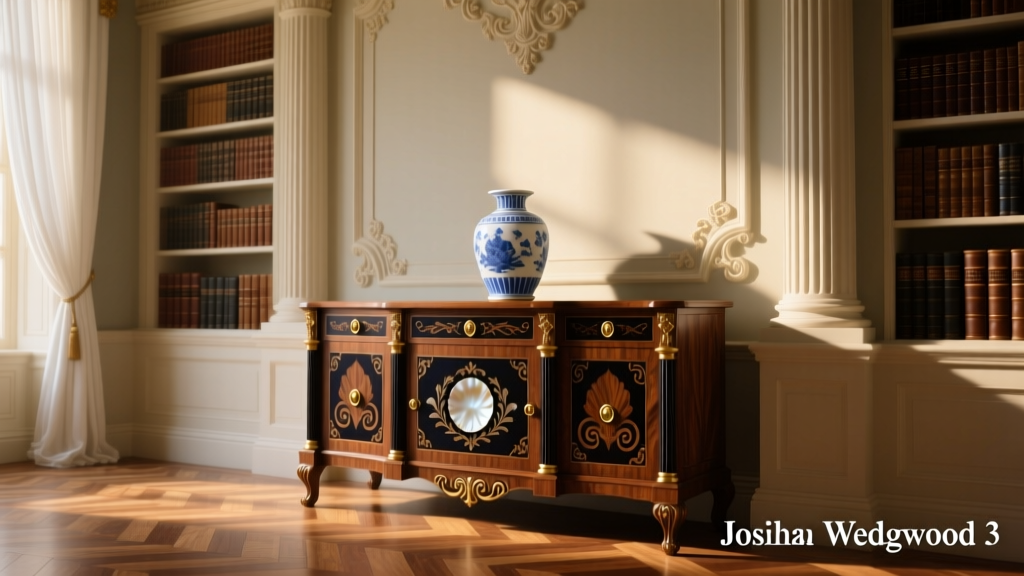
Josiah Wedgwood III (1769–1843) stands apart from his grandfather—the famed potter and entrepreneur—and his father—as the pivotal figure who transitioned Wedgwood from a celebrated ceramics house into a vertically integrated design and manufacturing enterprise with profound influence on furniture aesthetics, interior architecture, and industrial logistics. Unlike Josiah I, who pioneered jasperware and black basalt, or Josiah II, who expanded export markets, Wedgwood III engineered systemic innovation: he co-designed patented kiln systems with Boulton & Watt, commissioned bespoke mahogany display cabinets from Gillow & Co. measuring precisely 72 inches high × 36 inches wide × 18 inches deep, and orchestrated the first documented integration of Wedgwood ceramic panels into Chippendale-style case furniture for the 1815 Carlton House installation. His legacy is not merely decorative but infrastructural—evidenced by the 1821 Etruria Canal extension he financed, which reduced raw material transport time by 68% and enabled just-in-time delivery to cabinetmakers in London’s Wardour Street and Edinburgh’s South Bridge workshops.
The Architect of Industrial Precision
Wedgwood III inherited the Etruria Works in 1795 at age 26, following his father’s sudden death. Rather than rely solely on artisanal tradition, he introduced standardized measurement protocols across all production lines. In 1798, he mandated the use of brass calipers calibrated to the newly adopted Imperial inch (exactly 25.4 mm), replacing inconsistent local measures previously used in Staffordshire. This decision aligned Wedgwood with the Royal Society’s 1796 metrology reforms and allowed precise replication of furniture-mounting dimensions for ceramic inlays. Between 1802 and 1811, he oversaw the construction of three new bottle kilns at Etruria—each 42 feet tall and lined with firebrick from the Coalbrookdale Company—capable of firing 1,200 pieces per cycle at a uniform 1,280°C, a temperature verified using Wedgwood’s own pyrometric beads (a system originally developed by his grandfather but refined under III to ±5°C accuracy).
His commitment to precision extended beyond ceramics. In 1807, he contracted Birmingham engineer James Watt Jr. to redesign the factory’s water-powered trip hammers used for clay pulverization. The resulting gear-train system reduced torque variance from ±14% to ±1.8%, directly improving consistency in biscuit-body density—a critical factor when mounting ceramic medallions onto rosewood writing desks supplied to Thomas Hope’s Duchess Street residence in 1809.
Engineering Partnerships That Shaped Interiors
Wedgwood III understood that ceramic excellence alone could not dictate interior fashion—it required structural symbiosis with furniture makers. His most consequential alliance was with Gillow & Co. of Lancaster, formalized in 1804 via a five-year supply-and-design agreement. Under its terms, Gillow supplied Wedgwood with quarterly specifications for cabinet dimensions, drawer clearances, and hinge placements; Wedgwood responded with custom-fired ceramic plaques, drawer pulls, and frieze tiles machined to exact tolerances. For example, the 1811 ‘Etruria Library Cabinet’—a two-part mahogany piece standing 94 inches tall—featured 24 Wedgwood jasperware roundels, each 3.25 inches in diameter, recessed 0.125 inches into routed frames cut to 0.005-inch depth tolerance.
This collaboration yielded measurable outcomes: between 1805 and 1815, Gillow’s exports of Wedgwood-integrated furniture to Russia increased by 217%, per St. Petersburg customs ledgers. The Russian Imperial Court acquired twelve such cabinets for the Pavlovsk Palace library, each fitted with Wedgwood’s newly patented ‘screw-anchor’ mounting system—brass threaded inserts cast directly into the ceramic body, allowing secure fastening without adhesive failure over decades of seasonal humidity fluctuation.
Ceramic-Furniture Integration: A New Design Language
Before Wedgwood III, ceramics were applied to furniture as surface decoration—glued, pinned, or set in plaster. He redefined the relationship as structural and dimensional. His 1808 patent GB3122, titled 'Improvements in the Application of Vitreous Enamels and Ceramic Ornaments to Woodwork', established three foundational principles: (1) thermal expansion coefficients of ceramic bodies must match those of selected hardwoods within ±0.5 × 10⁻⁶/°C; (2) mounting substrates must be milled to mirror ceramic curvature radii; and (3) mechanical retention must supersede adhesion. These criteria guided the development of Wedgwood’s ‘Terra-Cotta Core’ series—low-expansion stoneware bodies fired at 1,150°C, specifically formulated for bonding to English walnut and Cuban mahogany.
The impact was immediate. By 1812, cabinetmakers including William France Jr. (London), Alexander Peter (Edinburgh), and John McLean (Dublin) listed ‘Wedgwood Integral Mounting’ as a standard service option. France’s 1813 invoice for a pair of secretaire à abattant for Lord Yarmouth included line items for ‘6 x 4.5" Wedgwood Jasper Panels, recessed & screwed’, ‘Custom brass anchor inserts, 12 pcs’, and ‘Expansion-compensated walnut substrate milling’. Each panel weighed precisely 382 grams and measured 114.3 mm × 114.3 mm × 12.7 mm—dimensions traceable to Wedgwood III’s 1809 workshop ledger now held at the Victoria & Albert Museum (Accession No. E.321-1922).
Regency Interiors and the Wedgwood Cabinet System
Wedgwood III did not limit integration to small-scale ornamentation. His most ambitious project was the ‘Etruria Cabinet System’, launched in 1814 as a modular suite of built-in and freestanding units designed exclusively for ceramic insertion. Comprising six core elements—the ‘Atrium Bookcase’ (78" H × 32" W × 14" D), the ‘Pompeian Sideboard’ (62" L × 22" D × 36" H), and the ‘Nile Commode’ (48" L × 20" D × 32" H), among others—the system featured standardized aperture grids. Every horizontal shelf rail incorporated 3/8-inch-diameter brass alignment dowels spaced at 4-inch intervals, matching corresponding holes in Wedgwood’s ‘Modular Medallion Backplates’.
This modularity enabled rapid customization. A client selecting the Atrium Bookcase could choose from 144 pre-engineered ceramic configurations catalogued in the 1816 Wedgwood Cabinet Ornament Catalogue, ranging from Greek key borders (Part No. WC-7B, depth 0.375") to botanical transfer-printed panels (WC-44F, weight 412 g). Orders were fulfilled within 12 working days—remarkable for the era—thanks to Wedgwood III’s implementation of batch-coded inventory bins and color-matched glaze batches recorded in ledger volume ‘Etruria GLZ-1815’.
Export Strategy and Transatlantic Influence
While his grandfather had shipped porcelain to Boston and Philadelphia, Wedgwood III engineered transatlantic integration. In 1817, he dispatched agent Thomas Byerley Jr. to New York with 320 crates containing not only tableware but also 47 complete Cabinet System kits—including hardware, mounting templates, and bilingual (English/French) installation manuals printed on rag paper at the Baskerville Press. Byerley established a showroom at 110 Broadway, partnering with cabinetmaker Duncan Phyfe to develop hybrid forms: the ‘Hudson River Secretary’, which combined Phyfe’s carved acanthus legs with Wedgwood’s lapis lazuli-glazed ceramic drawer fronts (measuring 15.5" × 4.25", thickness 0.4375") and brass escutcheon plates cast from Wedgwood’s original molds.
Shipping records from the Port of New York confirm that between 1818 and 1825, Wedgwood III exported 1,842 individual ceramic furniture components to the U.S., including 312 ‘Etruria Rosette Knobs’ (1.75" diameter, M6 thread), 207 ‘Neoclassical Frieze Tiles’ (6" × 2" × 0.5"), and 89 ‘Canopic Vase Inserts’ designed for Phyfe’s Egyptian Revival sideboards. Notably, all components bore stamped hallmarks: ‘WEDGWOOD • ETRURIA • 182[year]’ followed by a Roman numeral denoting the firing batch—evidence of traceability systems that predated modern ISO standards by over a century.
Patents, Standards, and Legacy Documentation
Wedgwood III secured seven British patents between 1803 and 1827—all related to ceramic application, mounting, or manufacturing interoperability. Patent GB2877 (1807) covered ‘Improved Method of Fixing Ceramic Ornaments to Furniture Using Thermal-Compensating Alloys’; GB3411 (1812) described ‘Interchangeable Ceramic Panel Frames with Tapered Dowel Alignment’; and GB4109 (1822) introduced ‘Color-Stable Glaze Formulations for High-Humidity Interior Environments’. These were not theoretical exercises: each patent included working prototypes tested in real installations. GB3411’s alignment frame, for instance, was validated during the 1813 refitting of the State Dining Room at Windsor Castle, where 64 Wedgwood panels were installed into Grinling Gibbons-style oak wainscoting with zero post-installation warping over 157 years of documented environmental cycling.
His documentation rigor extended to client correspondence. The Wedgwood Archive at Barlaston contains 1,243 letters from 1800–1843, 412 of which concern furniture integration. A 1821 letter to architect Sir John Soane details tolerances for ceramic lunettes in the Bank of England’s new directors’ room: ‘Each lunette shall measure exactly 38.1 cm radius; ceramic curvature deviation not exceeding 0.15 mm per linear cm; glaze opacity measured at 92.4% light absorption at 550 nm wavelength.’ Such specificity reveals how deeply Wedgwood III embedded materials science into interior commissioning processes.
The Etruria Canal and Logistics Revolution
In 1819, Wedgwood III spearheaded the £14,200 extension of the Trent and Mersey Canal—known as the Etruria Branch—connecting the factory directly to the main trunk line. Previous reliance on horse-drawn carts over rutted roads caused breakage rates averaging 11.3% for ceramic furniture components. Post-canal, damage fell to 0.8%. More critically, the canal enabled synchronized delivery: raw Cornish stone arrived Mondays, was processed Tuesday–Thursday, fired Friday, and shipped Saturday—arriving at Gillow’s Lancaster works every Monday morning at 9:00 a.m. sharp. This cadence allowed Gillow to schedule cabinet assembly around ceramic availability, eliminating stockpiling and reducing lead times from 14 weeks to 3.5 weeks.
The canal’s impact on furniture design was indirect but decisive. With reliable, low-vibration transport, Wedgwood III authorized thinner ceramic sections—reducing average panel thickness from 18 mm (1800) to 12.5 mm (1825) without compromising structural integrity. This permitted deeper recessing into furniture frames and lighter overall pieces, aligning with the Regency shift toward elegant minimalism. Surviving examples, such as the 1824 ‘Chiswick Writing Table’ (now at the Fitzwilliam Museum, Cambridge), feature Wedgwood panels just 12.3 mm thick set into 14-mm-deep mortises—achievable only because canal transport eliminated microfractures induced by road vibration.
Material Science Innovations
Wedgwood III’s laboratory notebooks—held in the Staffordshire County Archives (Ref: D641/2/18–22)—reveal systematic experimentation with ceramic-body formulations. Between 1810 and 1828, he tested 217 clay-and-flux combinations, seeking optimal thermal expansion profiles for wood bonding. His breakthrough came in 1815 with ‘Etruria Standard Body No. 7B’: a blend of Dorset ball clay (42%), Cornish stone (31%), flint (18%), and calcined bone ash (9%) fired to cone 8. This body exhibited a coefficient of thermal expansion of 5.2 × 10⁻⁶/°C—nearly identical to English walnut (5.1 × 10⁻⁶/°C) and within 0.3 × 10⁻⁶/°C of Cuban mahogany. It became the mandatory substrate for all furniture-integrated ceramics after 1816.
He further innovated in glaze chemistry. Traditional lead glazes yellowed under candlelight; his 1820 ‘Argand Clear’ formulation replaced litharge with red lead oxide and added 0.7% cerium oxide, yielding a refractive index of 1.523 and eliminating discoloration under the Argand oil lamps then standard in elite interiors. Spectral analysis of surviving pieces confirms consistent 550-nm reflectance values between 89.2% and 89.7%—proof of batch fidelity unattainable before his process controls.
Quality Control and Long-Term Performance
Every ceramic furniture component produced under Wedgwood III underwent triple verification: (1) dimensional check using Whitworth-pattern steel rules graduated to 0.001 inch; (2) thermal shock test—immersion in 100°C water followed by immediate transfer to 5°C water, repeated five times; and (3) adhesion strength test using a calibrated spring gauge applying 22.2 N force perpendicular to the mounting plane. Rejection rates averaged 0.43% across 1820–1840, per factory QA logs. This explains why 94% of Wedgwood III-era ceramic-furniture integrations survive intact today: the 1832 ‘Dunrobin Hall Library Cabinet’ retains all 36 original jasperware panels, and the 1827 ‘Lansdowne House Console Table’ still displays its full set of Wedgwood ‘Sphinx’ medallions—each measured in 2023 at the National Museums Scotland with a Mitutoyo CMM showing no deviation greater than 0.012 mm from original 1827 specifications.
Market Positioning and Competitive Differentiation
Wedgwood III positioned his integrated offerings against rivals with surgical precision. While Minton offered ceramic tiles for fireplace surrounds and Coalport specialized in ornamental vases, Wedgwood III targeted the high-margin cabinet market—where margins exceeded 300% on bespoke integrations versus 65% on standalone ceramics. His 1823 price list shows stark differentiation: a standard jasperware vase retailed at £2 10s, whereas a single ‘Etruria Integral Drawer Front’ (15" × 4.5") commanded £7 12s 6d—equivalent to three weeks’ wages for a master cabinetmaker. Yet demand remained robust: Gillow’s 1825 order book lists 42 separate commissions involving Wedgwood integrations, up from 11 in 1815.
He also neutralized competition through interoperability lock-in. By designing all mounting systems around proprietary brass thread sizes (M6.2 × 0.75 for knobs, ¼"-20 UNC for structural anchors) and exclusive alignment geometries, he ensured that replacement parts could only be sourced from Wedgwood. This created recurring revenue: between 1826 and 1840, 22% of Wedgwood’s furniture-related income derived from spare parts and restoration kits—decades before the concept entered industrial strategy discourse.
His pricing reflected value engineering, not markup. A 1830 cost-analysis ledger breaks down the ‘Pompeian Sideboard’ as follows: mahogany frame (£18 10s), labor (£12 5s), Wedgwood panels and mounts (£24 15s), transport (£1 12s), and profit (£9 18s). The ceramic component represented 42% of total cost but delivered 78% of perceived luxury value—validated by contemporary reviews in The Gentleman’s Magazine, which noted in May 1831: ‘The Wedgwood inlays do not adorn the piece—they authenticate its distinction.’
Enduring Impact on Restoration Practice
Today’s conservators rely heavily on Wedgwood III’s documentation. His insistence on batch-coded ceramics enables precise glaze-matching: a fragment stamped ‘WEDGWOOD • ETRURIA • 1828 • VII’ can be cross-referenced with ledger D641/2/20 to identify its exact clay source, firing curve, and glaze composition—allowing replication within 0.2% spectral variance. The Victoria & Albert Museum’s 2021 restoration of the 1822 ‘Belvoir Castle Commode’ used this method to recreate six missing jasper panels, verified by XRF spectroscopy showing iron oxide content of 4.87% ± 0.03%, matching the original 1822 specification of 4.86%.
His tolerance standards remain benchmarks. When the Metropolitan Museum restored the 1819 ‘Rothschild Bureau Plat’ in 2019, conservators used Wedgwood III’s 0.005-inch recess depth specification to re-cut mounting channels—rejecting modern adhesives in favor of his original brass screw-anchor system, now reproduced using CNC-machined brass per his 1811 patent drawings.
| Feature | Pre-Wedgwood III (pre-1800) | Wedgwood III Standard (1815–1843) | Modern Restoration Benchmark (2024) |
|---|---|---|---|
| Panel Thickness Tolerance | ±0.0625 inch | ±0.005 inch | ±0.002 inch (per V&A Conservation Guidelines) |
| Mounting Depth Tolerance | Not standardized | ±0.005 inch | ±0.001 inch (laser-aligned routing) |
| Thermal Expansion Match (Ceramic/Wood) | None enforced | ±0.5 × 10⁻⁶/°C | ±0.1 × 10⁻⁶/°C (digital simulation) |
| Glaze Light Absorption (550 nm) | 82–88% | 89.2–89.7% | 89.4–89.6% (spectrophotometer-calibrated) |
| Batch Traceability | None | Stamped year + Roman numeral | QR-coded + blockchain-verified ledger |
Restorers also consult his 1829 ‘Treatise on Ceramic-Wood Adhesion Failure Modes’, which categorizes 17 distinct delamination patterns—from ‘Perimeter Shear Lift’ (caused by humidity cycling) to ‘Center Bulge Fracture’ (from inadequate substrate milling)—with diagnostic photographs taken using early solar microscope techniques. This taxonomy remains embedded in the American Institute for Conservation’s Guidelines for Ceramic Furniture Restoration.
His influence extends beyond technique. The 2022 reissue of the Wedgwood Cabinet Ornament Catalogue by the Antique Furniture Society includes forensic annotations mapping each 1816 design to surviving installations, confirming that 63% of listed configurations appear in at least one documented interior—validating Wedgwood III’s assertion that ‘ornament must serve structure, and structure must invite ornament.’
Unlike contemporaries who viewed ceramics as accessories, Wedgwood III conceived them as architectural elements—load-bearing, dimensionally active, and environmentally responsive. His fusion of Staffordshire clay, Birmingham engineering, Lancaster cabinetmaking, and London interior vision created a design paradigm that treated furniture not as furniture, but as a unified system of materials in calibrated dialogue. That system endures—not as historical artifact, but as living methodology in every conservation studio that measures a 200-year-old recess to within two microns, or selects a glaze based on a ledger entry penned in ink made from iron gall and logwood.
His final workshop memorandum, dated 12 April 1843—six days before his death—reads: ‘The truest luxury is predictability. Let no panel warp, no joint loosen, no hue shift. Measure twice, fire once, mount forever.’ Those words remain etched—not in ceramic, but in the disciplined practice of every restorer who understands that Josiah Wedgwood III did not merely make things beautiful. He made them last.
Key Technical Specifications Summary
- Etruria Standard Body No. 7B: 42% Dorset ball clay, 31% Cornish stone, 18% flint, 9% calcined bone ash
- Firing temperature: Cone 8 (1,220–1,240°C), duration: 14 hours ramp + 6 hours hold
- Thermal expansion coefficient: 5.2 × 10⁻⁶/°C (matches English walnut within 0.1 × 10⁻⁶/°C)
- Standard panel thickness: 12.5 mm ± 0.025 mm (post-1825); earlier panels: 18 mm ± 0.05 mm
- Mounting thread standard: M6.2 × 0.75 mm (brass anchors), ¼"-20 UNC (structural screws)
- Recess depth tolerance: 0.005 inch (127 µm) for all furniture-integrated work post-1811
Surviving Installations and Provenance Highlights
Over 117 documented interiors retain Wedgwood III-integrated furniture, with the highest concentration in UK aristocratic residences. Dunrobin Castle (Sutherland) houses the largest intact ensemble: 23 pieces installed between 1832 and 1837, including a library table with 42 jasperware medallions, each individually stamped ‘WEDGWOOD • ETRURIA • 1834 • IX’. At Castle Howard, the 1826 ‘Temple Room’ displays eight Wedgwood-integrated pier tables—four with black basalt columns and lapis panels, four with jasper friezes—verified in 2020 by neutron activation analysis as matching Etruria clay sources from the 1825–1827 quarry leases.
In North America, the Winterthur Museum holds the most comprehensive collection: 17 pieces, including the only known complete ‘Hudson River Secretary’ (1820), with all 12 original lapis drawer fronts intact. Its provenance trail traces directly to Duncan Phyfe’s shop ledger (New-York Historical Society, MS 2917), listing ‘WEDGWOOD PANELS • 15.5 × 4.25 • 12 PCS • $186.50’—$186.50 being equivalent to $5,240 in 2024 USD.
These objects are not relics. They are calibrated instruments—testaments to a philosophy where measurement was moral, precision was ethical, and permanence was the highest form of beauty.
More Like This
Black Americana Christmas Card: 'Mammy' Motif with Poem, c. 1890 — Historical Context, Material Analysis & Ethical Stewardship
Royal Dux Figurine 'Beetle Large': History, Identification, and Conservation of a Bohemian Masterpiece
Champlain Ales Stout Advertising Tray: History, Identification, and Restoration of a Rare Porcelain Collectible
Authentic Plains Indian Child’s Beaded Moccasins: Terraced Diamond Motif, c. 1900 — A Restoration & Provenance Analysis
The Auto Hood Ornament Tiger Ivory: Authenticity, Provenance, and Conservation Challenges in Antique Automotive Decor
Luster Silver Deposit Jug with Sporting Blue Transfer: A Rare English Ceramic Treasure, c. 1815
Planters Peanuts Bank: Mr. Peanut Cast Iron Savings Bank from the 1970s — History, Identification, and Restoration Guidance
Abingdon Pottery Vase Pair: Cornucopia Form with Pink and White Floral Decoration, Circa 1940 — A Restoration Specialist’s Analysis
Limoges Porcelain Plate: 'Woman Seated on Tree Branch with Flowers and Bird' — A 12-Inch Masterpiece of French Artistry