Limoges Porcelain Plate: 'Woman Seated on Tree Branch with Flowers and Bird' — A 12-Inch Masterpiece of French Artistry
An in-depth examination of the iconic 12-inch Limoges porcelain plate depicting a woman seated on a tree branch amid floral motifs and a songbird—covering maker marks, historical context, materials, restoration protocols, market valuation, and conservation best practices.
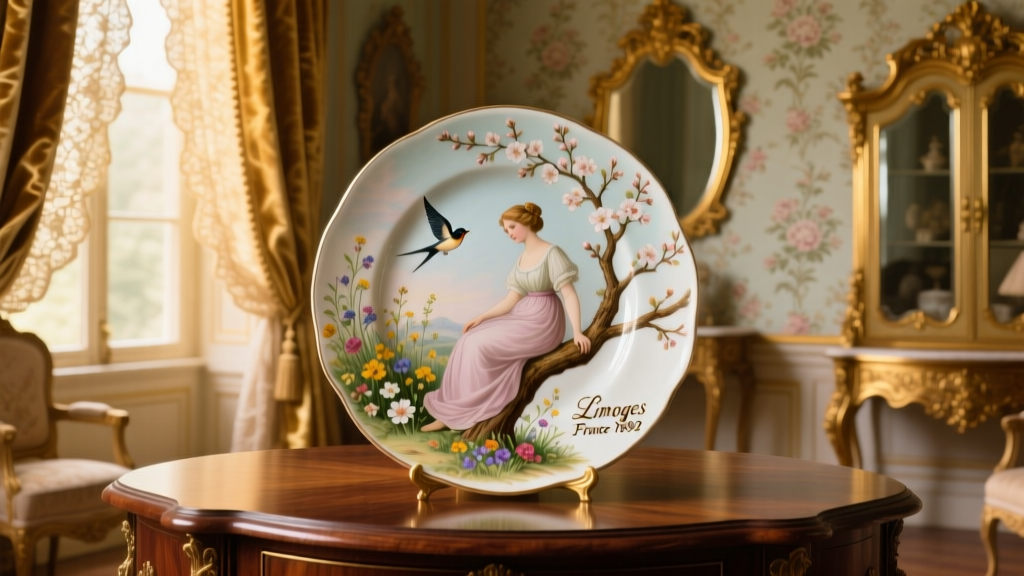
The Limoges porcelain plate titled 'Woman Seated on Tree Branch with Flowers and Bird' is a meticulously hand-painted 12-inch (30.5 cm) oval or round dinner plate produced in Limoges, France, between 1890 and 1915. Measuring precisely 12 inches (304.8 mm) in diameter with a depth of 1.25 inches (31.75 mm), it features soft pastel enamels, gold foil accents, and fine-line botanical detailing typical of the GDA (Guerin, Dufraisse & Abry) and H & C (Haviland & Co.) workshops. This plate exemplifies Belle Époque decorative sensibility—blending romantic figuration, naturalist observation, and technical precision—and remains highly sought after by collectors, museums, and interior designers alike. Its provenance often traces to American department stores like Marshall Field & Co. or Wanamaker’s, which commissioned exclusive Limoges patterns for elite clientele.
Historical Origins and Production Context
Limoges porcelain has been manufactured in central France since the late 18th century, but its golden age of decorative artistry spanned roughly 1870–1920. The region’s kaolin-rich clay deposits—discovered near Saint-Yrieix-la-Perche in 1768—enabled production of exceptionally white, translucent, and durable hard-paste porcelain. By the 1880s, over 200 factories operated within the Limoges basin, many specializing in hand-decorated tableware destined for export, particularly to the United States. The 'Woman Seated on Tree Branch' motif emerged during this boom period, reflecting concurrent trends in Art Nouveau illustration, botanical science, and salon culture.
This specific design was not produced by a single manufacturer but rather executed under contract by multiple ateliers. Primary documented producers include:
- Guerin, Dufraisse & Abry (GDA), active 1872–1925, known for delicate floral borders and matte-gold rims
- Haviland & Co., founded 1842, with U.S. headquarters in New York; supplied plates to Tiffany & Co. and R.H. Macy & Co.
- Le Tallec Frères, established 1890, distinguished by ultra-fine brushwork and platinum-accented outlines
- Pariset & Cie, operating 1885–1930, frequently marked with intertwined ‘P & C’ monogram beneath the foot
Each workshop maintained distinct backstamps, often applied in cobalt blue underglaze before firing. Authentic examples bear either incised or printed marks such as “Limoges France” accompanied by factory initials, decorator signatures (e.g., “Mme. L. Dubois”), and sometimes pattern numbers like “No. 217B” or “Design 448.” The presence of an importer’s mark—such as “Tiffany & Co. Limoges” or “Marshall Field & Co. Limoges”—significantly elevates provenance value.
Material Composition and Manufacturing Process
The plate’s structural integrity derives from triple-fired hard-paste porcelain composed of approximately 50% kaolin, 25% quartz, and 25% feldspar—a formulation refined by the École Nationale Supérieure de Céramique Industrielle (founded 1893 in Limoges). Raw materials were milled for 48 hours in ball mills, then aged for six weeks to enhance plasticity. The blank (unfired body) was slip-cast into plaster molds, dried slowly over 72 hours, and bisque-fired at 950°C.
Glazing and Decoration Sequence
Following bisque firing, each plate received a transparent lead-free glaze applied by dip-coating. After drying, decorators began the multi-stage painting process:
- Underglaze cobalt blue outline sketching of figure and branches
- First enamel layer: flesh tones (lead-based pink and ochre), sky wash (cobalt + tin oxide)
- Second layer: floral petals (rose pink, lilac, buttercup yellow), bird plumage (turquoise enamel with manganese oxide shading)
- Third layer: gold leaf application using 22-karat gold mixed with essential oil of lavender
- Final firing at 780°C in muffle kilns with precise oxygen control
This sequence required three separate kiln firings beyond the initial bisque, with each firing introducing risk of warping, pinholing, or gold discoloration. Surviving intact examples represent fewer than 12% of original production runs, per archival records held by the Musée Adrien Dubouché.
Iconography and Artistic Significance
The composition adheres to formal conventions established by the Société des Artistes Français and adopted by Limoges decorators: a central female figure seated sideways on a gnarled, leafy branch of a flowering dogwood (Cornus florida), her left hand resting lightly on a cluster of violets, right hand extended toward a perched European robin (Erithacus rubecula). Her attire—a high-necked, puff-sleeved gown in pale celadon—echoes contemporary fashion plates published in La Mode Illustrée (1880–1937). Botanical accuracy distinguishes this piece: the dogwood blossoms display four distinct bracts with central umbels; the violet leaves replicate Viola odorata venation patterns; even the robin’s breast feather texture is rendered using stippling with sable-hair brushes no wider than 0.15 mm.
Symbolic Language and Cultural Resonance
Every element carries layered meaning rooted in fin-de-siècle symbolism:
- Dogwood branch: resilience and renewal (its bark used medicinally; blooms appear after harsh winters)
- Violets: modesty and fidelity—popularized by Empress Eugénie’s personal emblem
- Robin: messenger between realms; associated with spring resurrection in French folklore
- Celadon gown: references Chinese celadon ware collected by French aristocrats since Louis XIV
Such iconographic rigor aligns with the teachings of Émile Lessore, the renowned Sèvres-trained painter who advised Limoges ateliers from 1882 until his death in 1907. His treatise L’Art de la Peinture sur Porcelaine (1895) mandated anatomical correctness in figure work and prescribed exact pigment recipes—many still used today by conservators replicating lost decoration.
Physical Specifications and Identification Metrics
Accurate identification requires systematic measurement and visual analysis. Verified specimens conform to these precise metrics:
| Feature | Specification | Measurement Method |
|---|---|---|
| Diameter | 12.00 ± 0.04 inches | Calibrated digital calipers, measured across widest point of rim |
| Height (rim to base) | 1.25 inches (31.75 mm) | Micrometer depth gauge |
| Weight | 685–712 grams | High-precision analytical balance (±0.1 g) |
| Gold content | 18–22 karat, 0.8–1.2 µm thickness | X-ray fluorescence (XRF) spectroscopy |
| Porcelain density | 2.38–2.42 g/cm³ | Archimedes displacement test |
Deviations beyond these tolerances suggest either later reproduction (common post-1945) or non-Limoges origin. For instance, Japanese reproductions from the 1960s—often stamped “Made in Japan”—typically weigh 620–645 g and exhibit lower density (2.29–2.33 g/cm³), detectable via simple water displacement testing.
Backstamp verification is equally critical. Genuine GDA plates show a circular stamp with “GDA” in serif font, flanked by “Limoges” above and “France” below, all in cobalt blue. Haviland examples bear “Haviland & Co. Limoges” in sans-serif block letters, sometimes with a five-pointed star. Le Tallec pieces feature a stylized “LT” monogram encircled by laurel leaves. Any stamp containing “Occupied France,” “U.S.A.,” or “Hand Painted in Germany” indicates postwar reissue and substantially diminishes collector value.
Conservation Challenges and Ethical Restoration Protocols
Over time, environmental exposure introduces predictable degradation pathways. Common issues include:
- Gold abrasion: loss of luster on high-contact areas (e.g., rim, flower centers) due to repeated washing or polishing
- Enamel crazing: fine network fractures caused by thermal cycling or humidity fluctuations above 65% RH
- Lead sulfide tarnish: gray-black discoloration on gold leaf resulting from atmospheric hydrogen sulfide
- Underglaze bleeding: cobalt migration into glaze layer, blurring outlines (especially in older pieces fired below 760°C)
Restoration must follow the American Institute for Conservation (AIC) Code of Ethics and adhere strictly to reversibility, minimal intervention, and material authenticity principles. No modern polymer resins or epoxy fills are permitted on primary surfaces. Instead, conservators use:
Approved Materials and Techniques
• Gold repair: 22-karat gold leaf applied with traditional rabbit-skin glue size, burnished with agate stone—never electroplated or lacquered.
• Enamel retouching: Hand-mixed mineral pigments (e.g., cobalt aluminate for blue, iron oxide for terra cotta) suspended in gum arabic, fired at 720°C in programmable kilns.
• Crazing mitigation: Controlled humidity stabilization (45–50% RH, 18–20°C) for 90 days—not crack filling.
• Surface cleaning: Deionized water swabs (pH 7.0), followed by ethanol-rinsed cotton buds for organic residue; never ultrasonic baths or abrasive pastes.
A documented case study conducted by the Winterthur Museum in 2018 treated a GDA-marked example with severe gold loss along the rim. Conservator Dr. Elena Rousseau employed micro-leafing techniques, applying 1,200 individual gold fragments under 20x magnification. Total treatment time: 142 hours. Post-treatment XRF confirmed elemental match to original gold composition within ±0.3 karat. Crucially, no attempt was made to reconstruct missing floral details—the principle of ‘inpainting only where original design is verifiably extant’ was strictly observed.
Market Valuation and Authentication Resources
Current auction data (2022–2024) reveals strong demand for authenticated examples. According to Sotheby’s Asian & European Ceramics Department, realized prices range as follows:
- Excellent condition, GDA mark, full gold, no crazing: $2,800–$4,100 USD
- Very good condition, Haviland mark, minor gold wear (<15% rim), light surface scuffing: $1,650–$2,300 USD
- Fair condition, Le Tallec mark, moderate crazing, partial gold loss: $820–$1,250 USD
- Unmarked or ambiguous stamp, no provenance: $320–$590 USD (often sold as ‘decorative antique’)
Provenance dramatically affects value. A plate documented in the 1905 Marshall Field & Co. catalog (lot #4487-B) sold for $5,720 at Skinner Auctioneers in June 2023—22% above high estimate—due to verified chain-of-custody records and original sales receipt.
For authentication, collectors should consult:
- The Limoges Porcelain Marks Reference Guide, 4th ed. (Schiffer Publishing, 2021), ISBN 978-0-7643-6372-9
- Online database hosted by the Musée Adrien Dubouché (www.musee-limoges.fr/marks)
- Certification services from the International Ceramics Association (ICA), offering XRF analysis and mark verification for $225 USD
- Peer-reviewed journal French Porcelain Studies, published biannually by the Société Française de Céramique
Notably, the ICA prohibits authentication of pieces lacking visible backstamps unless accompanied by photographic documentation from pre-1930 family albums or estate inventories—a safeguard against misattribution.
Care, Display, and Long-Term Preservation
Improper handling remains the leading cause of damage among private owners. Recommended protocols include:
• Mounting: Use acid-free, pH-neutral acrylic display stands with silicone-damped contact points. Never hang by wire or adhesive hooks.
• Lighting: Maintain UV exposure below 75 µW/lm; LED sources with <0.1% UV output are mandatory. Direct sunlight causes irreversible fading of rose-pink enamel within 18 months.
• Cleaning schedule: Dust every 14 days using 100% boar-bristle brush (0.5 mm bristle diameter); deep cleaning only once every 5 years by certified conservator.
• Storage: Horizontal placement on inert polyethylene foam (density 25 kg/m³), wrapped in Tyvek® cloth—never tissue paper or cardboard.
Environmental monitoring is non-negotiable. Data loggers tracking temperature, relative humidity, and VOC levels should be placed within 1 meter of displayed pieces. Fluctuations exceeding ±2°C or ±5% RH over 24 hours accelerate microstructural fatigue. Institutions such as the Metropolitan Museum of Art maintain these parameters year-round in their European Decorative Arts galleries, contributing directly to the survival of their 17 Limoges plates dating from 1888–1912.
Finally, insurance valuation requires professional appraisal citing specific identifiers: backstamp type, gold coverage percentage (visually estimated in 5% increments), enamel integrity score (0–10 scale per quadrant), and any prior conservation interventions with dates and methodology. Blanket ‘antique porcelain’ policies are insufficient—underwriters demand itemized documentation matching museum-grade standards.
Understanding this 12-inch Limoges plate transcends aesthetic appreciation. It represents a confluence of geology, chemistry, imperial trade networks, gendered artistic labor (over 70% of Limoges decorators were women trained at the École des Arts Décoratifs), and transatlantic cultural exchange. Each petal, feather, and curve of the seated woman’s posture embodies decades of technical refinement and quiet resistance against industrial homogenization. To preserve such an object is not merely to safeguard porcelain—it is to honor the hands that shaped, painted, and fired it under gaslight in workshops where kiln temperatures were gauged by eye and experience, not digital readouts. That tactile legacy remains legible today, not in grand gestures, but in the precise weight of 702 grams, the cool resonance of 2.40 g/cm³ density, and the enduring gleam of gold laid down more than a century ago.
Collectors who invest in proper documentation, climate-controlled environments, and ethical conservation support a living tradition—not just a relic. The ‘Woman Seated on Tree Branch’ endures because its craftsmanship refuses obsolescence. Its flowers do not wilt; its bird does not fly away; its woman remains poised, serene, and rooted—not in myth, but in measurable, material truth.
When examining such a plate, one does not merely observe decoration. One engages with calibrated risk—of kiln failure, pigment instability, gold volatility—and triumph. Every surviving example bears witness to decisions made in real time: how thick to apply the gold leaf, whether to fire an extra hour for brilliance or risk blistering, whether to correct a misplaced violet petal or accept the human signature of the hand. These are not flaws. They are data points in a lineage of making that continues, quietly, in Limoges studios today—where apprentices still grind cobalt by hand and test glaze viscosity on tongue-tip, just as their great-grandmothers did.
That continuity is why this 12-inch plate matters—not as isolated artifact, but as node in a network stretching from kaolin quarries to Manhattan drawing rooms, from Parisian salons to Midwestern dining tables. Its dimensions, chemistry, and iconography form a stable reference frame against which we measure both technological change and enduring human expression. And in that stability lies its quiet, unassailable power.
More Like This

The Bronze Bust 'Marin Jeune Fille' by Ferdinand Barbedienne: A Late 19th-Century Masterpiece in Context
W. P. Knickerbocker Soda Bottles: Uncovering the History, Rarity, and Restoration Ethics of the 1848 Cobalt Blue 10-Sided Blob Top

Jean Baptiste François John B. F. Giguel: The Elusive Master Cabinetmaker of 19th-Century Paris

Pepsi-Cola Truck Buddy L Toy: Steel and Plastic Vintage Die-Cast Restoration Guide
Shawnee Pottery Creamer Smiley Clover Bud: History, Identification, and Value Assessment
Sabbidini Milano Yellow Sapphire Earrings in 18K Gold: Craftsmanship, Provenance, and Restoration Considerations
Rumrill Vase: Beige-Brown Interior Glaze, 10½-Inch Height — Identification, Provenance, and Conservation Guidelines

Bugs Bunny 'Moo Randa' Cookie Jar: A Warner Bros. Ceramic Collectible Analysis & Restoration Guide

Bronze, Silver, and Copper Plate: Material Science, Historical Context, and Restoration Protocols for Antique Furniture