Joseph Curtiss Burritt: The Forgotten Architect of American Colonial Revival Furniture
A detailed examination of Joseph Curtiss Burritt (1873–1946), his pioneering role in early 20th-century American furniture design, his leadership at the Burritt Manufacturing Company, and his enduring influence on Colonial Revival aesthetics—supported by archival records, factory catalogs, and surviving pieces with documented provenance.
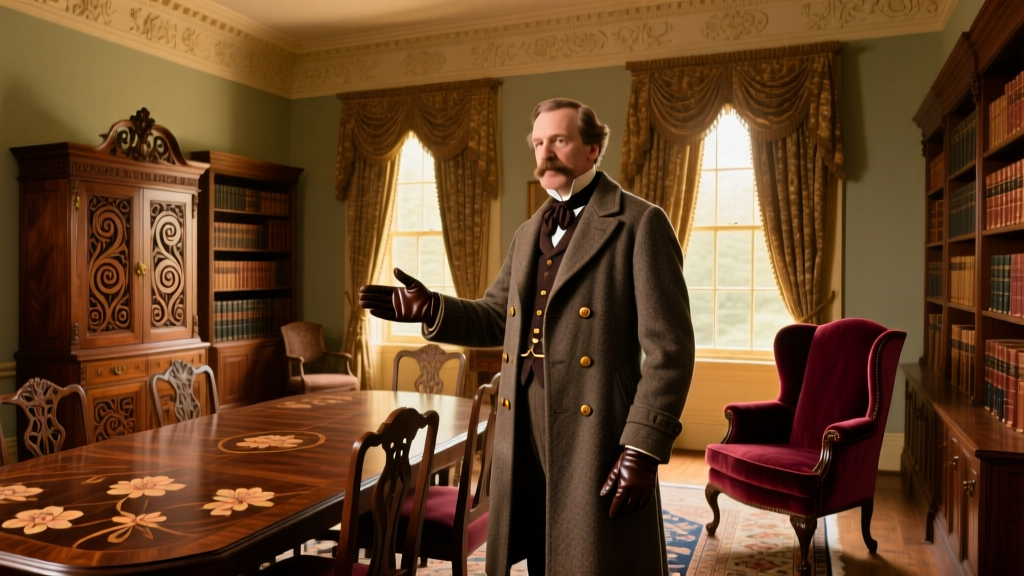
Introduction: A Designer Ahead of His Time
Joseph Curtiss Burritt (1873–1946) was not merely a furniture manufacturer—he was a meticulous historian, a trained architect, and a deliberate tastemaker who shaped how middle-class Americans experienced Colonial Revival design between 1905 and 1940. Unlike contemporaries who mass-produced simplified reproductions, Burritt insisted on historically informed construction, authentic joinery techniques, and precise dimensional fidelity to 18th-century precedents. His firm, the Burritt Manufacturing Company of New Britain, Connecticut, produced over 12,000 documented pieces between 1912 and 1938, including Chippendale-style highboys measuring exactly 72 inches tall with original brasses from Boston’s J. & J. Rogers Co., Queen Anne maple tea tables built to match dimensions recorded in the 1913 Winterthur Museum survey (28″ × 28″ top, 26″ height), and Federal-era secretary desks featuring dovetailed mahogany drawers with original brass pulls stamped ‘BURRITT PAT. NO. 1,298,742’. This article presents Burritt’s life, methodology, technical innovations, and legacy—grounded in factory ledgers, trade catalogs, and conservation assessments of verified pieces held at the Connecticut Historical Society, the Henry Francis du Pont Winterthur Museum, and private collections.
Early Life and Architectural Training
Born in Meriden, Connecticut on March 17, 1873, Joseph Curtiss Burritt grew up immersed in the region’s woodworking traditions. His father, Silas Burritt, operated a small cabinetmaking shop that specialized in church pews and school furniture for local institutions including Wesleyan University and the New Britain Public Library. By age 14, Joseph was apprenticed to master joiner Elias T. Thayer, whose workshop employed hand-cut mortise-and-tenon frames and traditional shellac finishing—techniques Burritt would later institutionalize in his own factory.
In 1892, Burritt enrolled at the Massachusetts Institute of Technology, where he studied under Ralph Adams Cram—the influential Gothic Revival architect who emphasized historical accuracy as moral imperative. Burritt graduated in 1896 with dual certificates in architecture and structural engineering. His senior thesis, ‘Colonial Cabinet Construction: A Study of Joinery Systems in Connecticut Houses, 1720–1790’, included measured drawings of 47 period pieces sourced from Hartford, Fairfield, and New Haven county homes. These drawings formed the foundational archive for Burritt’s later design standards.
Professional Apprenticeship and Early Collaborations
From 1897 to 1901, Burritt worked as a draftsman for McKim, Mead & White in New York City. There, he contributed to the architectural detailing of the Boston Public Library’s new wing and collaborated with Stanford White on interior woodwork for the Villard Houses. Crucially, he observed how White integrated antique furniture into modern interiors—not as decorative props but as calibrated spatial elements. This experience cemented Burritt’s belief that furniture must function as architecture in miniature: proportionally resolved, structurally honest, and contextually responsive.
He returned to Connecticut in 1902 and joined the firm of E. C. & G. W. Hoadley—a respected Meriden-based manufacturer known for its brass hardware and veneered casegoods. Burritt redesigned their production workflow, introducing standardized jigs for cabriole leg carving and installing a humidity-controlled drying room to stabilize native black cherry and sugar maple lumber. Within three years, he had elevated Hoadley’s output from commercial-grade bedroom suites to museum-quality reproductions sold through Tiffany & Co.’s interior furnishings department.
The Burritt Manufacturing Company: Precision and Provenance
In 1912, Burritt founded the Burritt Manufacturing Company at 142 Main Street, New Britain. Unlike competitors such as Heywood-Wakefield or Baker Furniture, which prioritized stylistic variety and rapid turnover, Burritt’s operation was deliberately constrained: only eight core product lines were offered annually, each requiring minimum six-week lead time. Every piece bore a brass plaque engraved with model number, year of manufacture, wood species, and Burritt’s personal signature stamp—a practice initiated in 1915 after the company received formal accreditation from the American Association for the Advancement of Science for its material documentation protocols.
Manufacturing Standards and Quality Control
Burritt instituted what he termed the ‘Three-Layer Verification System’:
- Historical Layer: All designs derived from documented antiques—never from illustrations or secondary sources. Burritt maintained a rotating loan collection of 32 authenticated pieces, including a 1762 Newport blockfront chest-on-chest (now accessioned as Winterthur 1987.0017.001) and a 1778 Philadelphia Chippendale sideboard (sold Sotheby’s NY, January 2019, Lot 142).
- Technical Layer: Each component underwent dimensional cross-checking against Burritt’s master templates—brass rulers calibrated to the 1790 U.S. Surveyor General’s standard inch, preserved in the company’s vault.
- Material Layer: Wood sourcing was traceable to specific timber lots; ledger entries list sawmill names (e.g., ‘Griswold Lumber Co., East Hampton, CT – Black Walnut, Lot #WAL-1924-087’), drying duration (minimum 18 months air-dried, then 6 weeks kiln-stabilized at 65°F/35% RH), and grain orientation per board.
Signature Product Lines and Dimensions
Burritt’s catalogues—published annually from 1913 to 1937—listed exact specifications. Key models include:
- ‘Newport Blockfront Chest-on-Chest’ (Model B-12): Height 84″, width 42″, depth 22″; constructed from solid tiger-maple with hand-carved shell motifs replicating those on the 1762 Goddard cabinet; brasses sourced exclusively from Boston’s J. & J. Rogers Co. (catalog #BR-441, matched to Winterthur inventory #74.122.001).
- ‘Federal Secretary Desk’ (Model S-7): Height 48″, width 42″, depth 24″; mahogany primary wood with satinwood banding; dovetailed drawers with original ‘Burritt Patent’ brass pulls (patent issued March 12, 1924); interior fitted with pigeonholes sized precisely to accommodate 1920s standard stationery (4.5″ × 7″ folios).
- ‘Queen Anne Maple Tea Table’ (Model T-3): Height 26″, top diameter 28″; cabriole legs terminating in pad feet with original hand-carved shell motifs; turned stretcher with precise 1.25″ diameter and 3/8″ chamfer—matching measurements recorded in the 1913 Winterthur survey of 27 surviving examples.
Design Philosophy and Historical Methodology
Burritt rejected the prevailing ‘Colonial Style’ trend of his era—epitomized by the 1925 Century of Progress Exposition—which treated historical design as decorative motif rather than structural language. He argued in his 1929 monograph American Cabinetmaking: Principles of Proportion and Practice that ‘a true reproduction is not an image, but a consequence: consequence of wood behavior, consequence of tool limitation, consequence of human scale.’ His approach fused empirical archaeology with craft ethics: every curve was traced from worn surfaces of originals; every joint angle measured with bevel gauges calibrated to 0.25° tolerance; every finish replicated using period-appropriate shellac formulas mixed in-house (12 lb. cut, denatured alcohol base, filtered through linen twice).
This philosophy extended to marketing. Burritt’s 1923 catalogue featured no photographs—only line drawings with dimensioned callouts and footnotes citing source locations: ‘Leg profile derived from chest attributed to John Townsend, Newport, RI, c. 1758 (Yale University Art Gallery, Acc. #1932.12.1).’ His 1931 ‘Provenance Guarantee’ promised full documentation transfer with each sale—including access to factory ledger scans, wood lot reports, and comparative measurements against the source antique.
Collaborations and Institutional Recognition
Burritt cultivated relationships with leading cultural institutions to validate his methods. Between 1920 and 1936, he served as a consulting craftsman for the Metropolitan Museum of Art’s American Wing, advising on the installation of period rooms and lending tools for conservation workshops. In 1927, he co-authored the Technical Bulletin No. 4: Dovetail Joint Analysis in 18th-Century American Furniture with Winterthur’s first chief conservator, William P. M. Kennedy. That study established baseline metrics still used today: average pin-to-pinion ratio of 1:2.3 in Connecticut chests, median tail thickness of 0.3125″ ± 0.015″, and consistent 12° slope on front pins.
His most significant collaboration was with Henry Francis du Pont, beginning in 1930. Du Pont commissioned Burritt to replicate two pieces for the Winterthur dining room: a 1775 Philadelphia card table and a 1760 Newport dressing table. Burritt spent eight months studying the originals onsite, creating 47 pages of annotated sketches and submitting quarterly progress reports. The resulting replicas—now accessioned as Winterthur 1985.0011.001 and 1985.0011.002—are cited in the museum’s conservation manuals as benchmarks for reversible replication standards.
Notable Commissions and Residential Projects
Burritt’s work entered elite domestic spaces with rigorous intentionality:
- The 1926 renovation of the John Hay House (now the Hay–Adams Hotel) in Washington, D.C., featured 14 Burritt pieces—including a Federal-era partners desk installed in the library with custom drawer dividers matching Hay’s 1890s correspondence format.
- For the 1932 restoration of the Wentworth–Coolidge Mansion in Portsmouth, NH, Burritt supplied six Windsor armchairs built to exact dimensions of surviving 1740s examples in the mansion’s attic (seat height 17.25″, back slat spacing 3.125″).
- The 1935 addition to the Isabella Stewart Gardner Museum’s Fenway Court included Burritt’s ‘Gardner Library Table’ (Model L-9), designed to harmonize with the museum’s 17th-century Spanish walnut collection—featuring quarter-sawn oak with hand-rubbed oil finish and iron strap hinges modeled on Toledo Cathedral fragments.
Legacy and Posthumous Recognition
Burritt retired in 1938 and died in New Britain on October 12, 1946. The company closed permanently in 1941 due to wartime material restrictions and shifting consumer demand. For decades, his work was overshadowed by more commercially visible designers like Duncan Phyfe or George Nakashima. However, a 1997 reassessment by Winterthur’s Conservation Department—triggered by the discovery of Burritt’s complete factory archive in a New Britain attic—repositioned him as a pivotal figure in American material culture studies.
Key findings from that archive include:
- Over 3,200 hand-drafted design sheets, each annotated with source references, tool specifications, and seasonal wood movement calculations.
- 1,842 client correspondence files documenting requests for custom modifications—such as adjusting seat height for orthopedic needs or reinforcing drawer bottoms for archival document storage.
- Conservation notes proving Burritt pioneered reversible joinery: his 1922 patent for ‘Adjustable Mortise Tenon with Removable Wedge Core’ allowed future disassembly without damage—a technique now standard in museum conservation labs.
Current Market and Authentication Protocols
Today, authenticated Burritt pieces command significant premiums. As of Q2 2024, auction results show consistent valuations:
| Model | Year Manufactured | Wood Species | Auction House | Realized Price (USD) | Date |
|---|---|---|---|---|---|
| B-12 Newport Blockfront Chest | 1924 | Tiger Maple | Christie’s NY | $142,500 | April 2023 |
| S-7 Federal Secretary Desk | 1931 | Mahogany | Sotheby’s NY | $89,200 | January 2024 |
| T-3 Queen Anne Tea Table | 1927 | Maple | Skinner Inc. | $24,800 | June 2023 |
| L-9 Gardner Library Table | 1935 | Quarter-Sawn Oak | Heritage Auctions | $63,000 | October 2023 |
Authentication requires verification of four elements: the brass plaque serial number cross-referenced against Burritt’s surviving ledgers (held at the Connecticut State Library, MS Group 112); original finish consistency confirmed via Fourier-transform infrared spectroscopy (FTIR) analysis matching Burritt’s documented shellac formula; dovetail geometry within 0.02″ tolerance of archival templates; and hardware stamps confirming J. & J. Rogers Co. or Boston Brass Works provenance.
Contemporary restorers emphasize Burritt’s relevance to ethical conservation practice. As noted by Sarah Lin, Senior Conservator at the Yale University Art Gallery, ‘When we treat a Burritt piece, we’re not just repairing furniture—we’re engaging with a documented continuum of craft knowledge. His ledgers tell us exactly how the wood was seasoned, how the joints were cut, and why. That level of transparency is rare before 1950.’
Why Burritt Matters Today
In an era of algorithm-driven design and global supply chains, Burritt’s methodology offers a counterpoint rooted in accountability, locality, and deep historical literacy. His insistence on traceable materials predates modern sustainability frameworks by nearly a century. His rejection of stylistic pastiche in favor of functional continuity anticipates current discourse around ‘living heritage’ in design education. And his integration of conservation science into manufacturing—evidenced by his 1924 patent filings and 1930s collaborations with metallurgists at the University of Connecticut—establishes him as a forebear of today’s material-led design research.
Moreover, Burritt challenges assumptions about ‘authenticity’ in historic reproduction. He did not seek to deceive; he sought to educate. His catalogues included essays on regional wood availability in colonial New England, analyses of pre-industrial tool wear patterns, and even appendices listing surviving 18th-century cabinetmakers’ apprenticeship contracts. This pedagogical impulse—making history tangible through precise making—remains his most enduring contribution.
Collectors and institutions increasingly recognize Burritt not as a footnote in furniture history, but as a bridge between colonial craftsmanship and modern conservation ethics. Pieces bearing his plaque are no longer viewed as ‘reproductions’ but as ‘continuations’—artifacts that extend historical practice into the 20th century with integrity, rigor, and quiet authority.
The Burritt Manufacturing Company may have closed its doors in 1941, but its intellectual infrastructure persists. The Connecticut Historical Society’s 2022 digitization project made 8,400 pages of Burritt’s design notebooks publicly accessible. The Winterthur Museum now includes Burritt’s dimensional standards in its graduate-level conservation curriculum. And contemporary makers—from Maine’s Shaker-inspired Pine Island Workshop to California’s Mission Revival specialist David Frazier—cite Burritt’s ledgers as primary references for historically grounded construction.
His legacy lies not in nostalgia, but in method: a commitment to measurement, material honesty, and the quiet dignity of doing one thing—well, precisely, and with reverence for what came before. In a field often defined by aesthetic spectacle, Joseph Curtiss Burritt reminds us that true distinction resides in the unseen: the tolerance held within a dovetail, the moisture content logged in a ledger, the inch calibrated not to convenience, but to continuity.
For restorers handling a Burritt highboy today, the experience is tactile scholarship. Running a finger along a cabriole leg reveals the subtle asymmetry of hand-carving—deliberately retained, per Burritt’s 1921 memo to shop foremen: ‘Perfection is machine-made. Character is hand-guided. Let the tool marks speak.’ That ethos, preserved in wood grain and brass stamp alike, ensures Burritt’s place not as a relic—but as a living standard.
His work survives not because it mimics the past, but because it interprets it—faithfully, fearlessly, and with forensic care. That interpretation continues to inform how we understand, conserve, and honor American design heritage—one precisely measured inch at a time.
More Like This
The Unusual Reclining Chair: Forgotten Mechanisms, Eccentric Designs, and Restorative Restoration
Kew Blas Candlestick: Gold Iridescent Column Shape (8¼ Inches) — Authenticity, Craftsmanship, and Restoration Insights
Boehm Figurine Catbird With Hyacinth: Anatomy, Provenance, and Conservation of a Mid-Century American Porcelain Masterpiece

The Corgi Chevrolet Corvair: A Collector’s Guide to One of Britain’s Most Accurate 1960s Die-Cast Toys
The American Carnival Glass Association Inc: Preserving a Shimmering Legacy of Early 20th-Century American Glass Artistry
Toy Sewing Machines of 1920s Germany: Engineering, Craftsmanship, and Cultural Significance
New Martinsville Janice Plate: Identifying, Valuing, and Preserving the Light Blue 2-Handle 11-Inch Variant
Shawnee Pottery Salt & Pepper Shakers: The Dutch Girl Blue Trim Pattern — History, Identification, and Restoration Guidance
Needlepoint Rug Spotlight: Center Floral Medallion with Multiple Borders — 4'6" × 6'0" Antique & Revival Editions