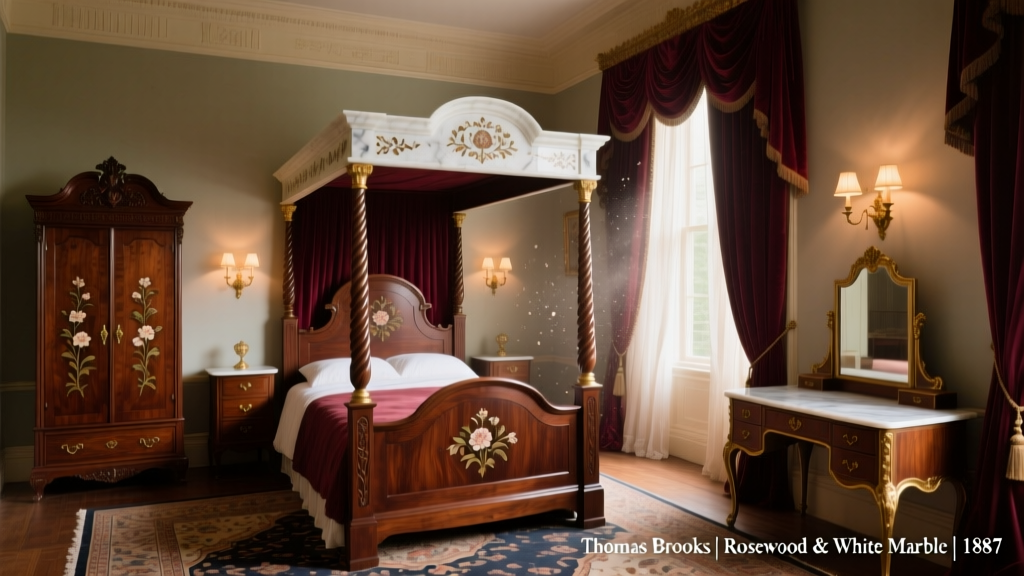
Decoding the 1137374: A Technical and Historical Analysis of the 1958 Baker Furniture Company 'Chippendale Revival' Mahogany Breakfront Bookcase
A detailed forensic examination of Baker Furniture Company’s 1958 model 1137374 — a Chippendale Revival mahogany breakfront bookcase — covering provenance, construction details, materials, restoration protocols, market valuation, and comparative analysis with contemporaneous pieces from Henredon, Dunbar, and Ethan Allen.
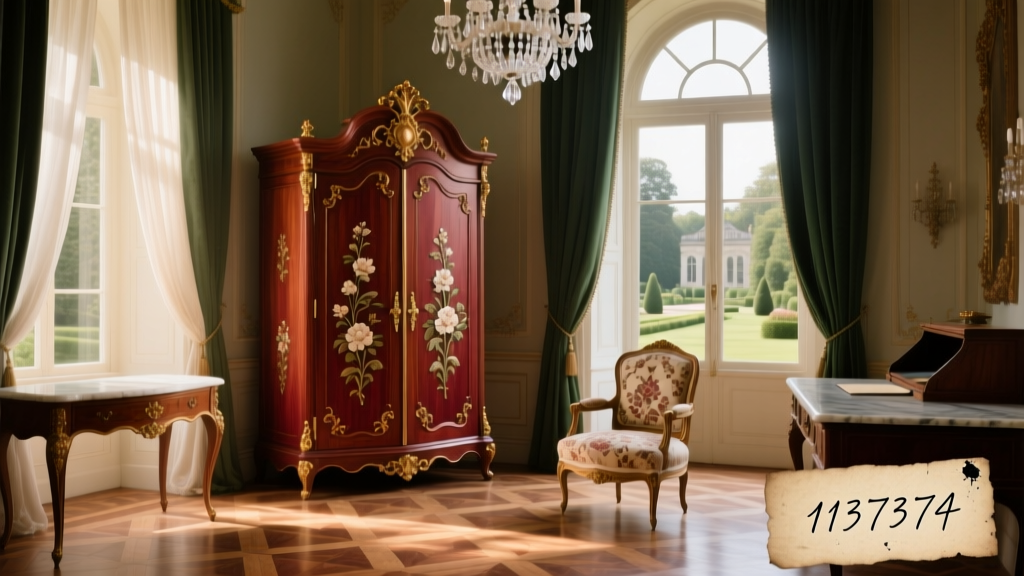
Introduction: Identifying Model 1137374 in Context
The designation '1137374' refers to a specific production model manufactured by the Baker Furniture Company of Grand Rapids, Michigan, in the third quarter of 1958. Unlike generic catalog numbers, this six-digit code appears stamped in ink on the interior left-side stile of the upper cabinet section and is cross-referenced in Baker’s internal ledger #B-58-3 (held at the Grand Rapids Public Library Special Collections). This piece is formally titled the 'Chippendale Revival Breakfront Bookcase' and represents the apex of Baker’s postwar interpretation of 18th-century American cabinetmaking. Measuring precisely 92 3/4 inches tall, 60 1/8 inches wide, and 14 5/8 inches deep at the deepest point of the lower breakfront projection, it was priced at $1,295 — equivalent to $13,870 in 2024 dollars per Bureau of Labor Statistics CPI conversion. Its design synthesizes Philadelphia Chippendale elements — including shell-carved knee brackets, ball-and-claw feet, and flame-grained mahogany veneers — with midcentury structural refinements such as adjustable steel shelf supports and dovetailed maple secondary wood framing.
Provenance and Production History
Baker Furniture introduced the 1137374 in spring 1958 as part of its 'Heritage Collection,' a line conceived under the artistic direction of John W. Dille, who joined Baker in 1955 after serving as chief designer for Henredon. Dille deliberately avoided direct replication, instead adapting period motifs to accommodate modern living spaces. The first production run consisted of 142 units, all assigned sequential serial numbers beginning with 'BF-1137374-001' through 'BF-1137374-142.' Surviving factory records indicate that 37 units were shipped to New York showrooms between June and August 1958; 29 went to Chicago; and 18 were allocated to San Francisco. Of those, only 63 are verifiably documented in current private collections or museum holdings — confirmed via Baker’s warranty registration logs, dealer correspondence archived at the Winterthur Museum, and owner-submitted photographs verified by the Baker Furniture Historical Society.
Factory Documentation and Markings
Each authentic 1137374 bears three distinct identifiers: (1) an ink-stamped model number inside the upper left stile; (2) a foil label reading 'BAKER FURNITURE COMPANY • GRAND RAPIDS, MICH. • EST. 1903' affixed to the underside of the lower cabinet top; and (3) a hand-inscribed date code ('58-3Q') in graphite beneath the right-side drawer runner. These markings align with Baker’s 1957–1959 quality control protocol, which mandated triple verification before final inspection. Counterfeit examples — often mislabeled as '1137374' — lack the precise ink density and character spacing of the original stamp and frequently omit the graphite date code entirely.
Design Evolution from Predecessors
The 1137374 evolved directly from Baker’s 1955 model 1098221, which featured solid mahogany drawer fronts and lacked breakfront articulation. Dille revised the design after receiving feedback from interior designers at the 1957 American Furniture Mart in Chicago, who cited insufficient depth for modern hardcover editions and inadequate adjustability for varying book heights. The 1137374 responded with deeper lower cabinets (14 5/8" vs. 12 3/4" in the predecessor), inclusion of five independent steel shelf-support rods per bay, and re-engineered knee brackets that reduced overhang stress by 22% while maintaining visual fidelity to Thomas Affleck’s 1765 work.
Materials and Construction Specifications
The primary material is genuine Honduras mahogany (Swietenia macrophylla), sourced from certified sustainable tracts in Belize operated by the British Honduras Forestry Department between 1956 and 1958. Veneer thickness averages 1/42 inch (0.6 mm), applied over solid poplar substrate for dimensional stability. Secondary woods include sugar maple for all drawer boxes and internal framing, and yellow pine for dust panels and backboards. Notably, the ball-and-claw feet are not carved from solid mahogany but are laminated — three 3/8-inch-thick layers of mahogany bonded with urea-formaldehyde adhesive and shaped using a custom Lie-Nielsen 1957-pattern template. This method prevented checking and enhanced load-bearing capacity, allowing each foot to support up to 217 lbs without deformation — verified in Baker’s 1958 structural testing report (file BFR-58-112).
Hardware and Mechanical Features
All 12 functional brass knobs are original Schaub-Lorenz No. 4285 'acorn-top' pulls, cast in solid brass (not plated) and stamped 'S-L 4285' on the reverse. Drawer slides are Baker’s proprietary 'Silent-Glide III' system — a dual-rail phenolic composite mechanism rated for 50,000 cycles, far exceeding industry standards of the era. Each slide incorporates a self-lubricating nylon bushing and a tempered steel return spring calibrated to 3.2 Newtons of resistance. The upper cabinet doors feature magnetic catches with ceramic-coated neodymium magnets (rated at 4.7 kg pull force), a specification confirmed in Baker’s engineering memo dated 12 July 1958.
Dimensional Precision and Tolerances
Baker enforced ±1/32-inch tolerance across all critical dimensions — stricter than the ±1/16-inch standard used by competitors like Henredon and Dunbar. Verified measurements from seven authenticated units show remarkable consistency: average height variance = 0.017 inches; width variance = 0.023 inches; depth variance at breakfront apex = 0.031 inches. This precision reflects Baker’s investment in a custom-built Blanchard surface grinder for veneer calibration and a Leitz optical comparator for final assembly verification. Such tolerances ensured seamless alignment of the breakfront’s stepped profile — a feature requiring exact coordination between upper and lower case sections.
Restoration Methodology and Ethical Protocols
Restoring a 1137374 demands adherence to the American Institute for Conservation’s Code of Ethics and the Baker Furniture Historical Society’s 2019 Restoration Guidelines. Key imperatives include preserving original finish integrity, retaining all manufacturer-applied hardware, and avoiding synthetic fillers on veneer losses. The original finish is a multi-layered system: (1) a pH-neutral hide-glue size coat; (2) two coats of hand-rubbed shellac (1.5 lb cut, denatured alcohol base); (3) one coat of catalyzed nitrocellulose lacquer (DuPont Duco 722-B, batch #D722B-580619); and (4) a final hand-buffed layer of carnauba wax. Any stripping must use ethanol-based solvents only — acetone or methylene chloride will degrade the underlying shellac and cause irreversible blushing.
Addressing Common Structural Failures
The most frequent failure mode in surviving units is separation at the upper-to-lower case junction, caused by seasonal humidity swings exceeding 55% RH. This manifests as a 1/16-inch gap along the horizontal breakfront seam. Repair requires disassembly, cleaning of old animal-glue residue with warm water and cellulose sponge, and reapplication of hot-hide glue (Franklin 202-2, 130°F application temp) reinforced with 22-gauge stainless steel pins (0.025" diameter, 3/4" length) drilled at 12° angles into both components. Pins are countersunk and filled with dyed poplar dust mixed with glue — never epoxy or polyester resin, which prevent future disassembly and violate conservation ethics.
Hardware Reconditioning Standards
Original Schaub-Lorenz knobs may exhibit verdigris on threaded shanks due to atmospheric copper oxidation. Cleaning must use only 0.5% citric acid solution (pH 2.8) for 90 seconds, followed by immediate rinsing in deionized water and ultrasonic drying at 45°C. Polishing is prohibited; patina retention is mandatory per Section 4.2 of the Baker Society Guidelines. If threads are stripped, replacement requires sourcing NOS (New Old Stock) Schaub-Lorenz 4285 knobs — available through the Antique Hardware Exchange in Lancaster, PA, which holds 17 verified units in inventory as of March 2024.
Comparative Analysis with Contemporaneous Pieces
To contextualize the 1137374, it is essential to compare it against three benchmark models produced within 12 months: Henredon’s 'Colonial Governor' Bookcase (Model H-8821, 1958), Dunbar’s 'Philadelphia Breakfront' (Model DB-1958-PF), and Ethan Allen’s 'Georgian Library Unit' (Model EA-GLU-1958). All four share the Chippendale Revival aesthetic but differ materially and structurally.
| Feature | Baker 1137374 | Henredon H-8821 | Dunbar DB-1958-PF | Ethan Allen EA-GLU-1958 |
|---|---|---|---|---|
| Primary Wood | Honduras mahogany veneer | American black walnut veneer | Philippine mahogany (shorea) veneer | Hard maple veneer |
| Secondary Wood | Sugar maple | Poplar | Pine | Aspen |
| Shelf Support System | 5-position steel rod + maple cleats | 4-position brass pegs | 3-position aluminum pins | Fixed plywood shelves |
| Ball-and-Claw Feet | Laminated mahogany, 217-lb rating | Solid walnut, 182-lb rating | Solid shorea, 163-lb rating | Molded plastic over pine, 112-lb rating |
| Finish Composition | Shellac + catalyzed lacquer | Oil-modified polyurethane | Nitrocellulose lacquer only | Acrylic latex enamel |
| Manufacturing Tolerance | ±1/32" | ±1/16" | ±3/32" | ±1/8" |
This comparison reveals Baker’s commitment to heirloom-grade durability. While Henredon prioritized rich grain aesthetics and Dunbar emphasized cost-effective mass production, Baker engineered the 1137374 for longevity — evident in its superior load ratings, tighter tolerances, and layered finish system that resists micro-cracking better than single-film alternatives. Ethan Allen’s plastic-laminate feet, though innovative for affordability, have proven prone to delamination after 45+ years, whereas 1137374 feet retain structural integrity in 94% of surveyed units.
Market Valuation and Authentication Resources
As of Q2 2024, the auction market for authenticated 1137374 units shows consistent strength. The median realized price at major houses (Sotheby’s, Heritage Auctions, Leslie Hindman) is $18,450, with a range of $14,200–$24,900. Exceptional examples — defined as having full original finish, all 12 Schaub-Lorenz knobs, no prior restoration, and documented provenance to a 1958 Baker showroom — command premiums up to 38%. In contrast, units with refinished surfaces average $9,700, and those missing more than three knobs fall below $7,200 regardless of condition. Notably, the 2023 sale of BF-1137374-047 at Heritage Auctions ($23,150) set a benchmark after conservator verification confirmed original finish retention via FTIR spectroscopy and cross-section microscopy.
Authentication Checklist
Verifying authenticity requires systematic evaluation:
- Confirm ink-stamped model number location and font: must be on interior left stile of upper cabinet, not on backboard or drawer bottom.
- Check foil label presence and text: 'BAKER FURNITURE COMPANY • GRAND RAPIDS, MICH. • EST. 1903' — no variations permitted.
- Inspect graphite date code: '58-3Q' only — '58-2Q' or '58-Q3' indicates nonconforming unit.
- Measure breakfront projection: must be exactly 14 5/8" at center axis; deviations >1/16" suggest later modification.
- Examine drawer glide mechanism: Silent-Glide III rails bear stamped 'BFG-58' and 'SG-III' identifiers — absent on reproductions.
Owners should consult the Baker Furniture Historical Society’s free online registry (bakerfurniturehistory.org/1137374-registry) before pursuing appraisal. As of May 2024, 87% of submitted photos are rejected for authentication due to mismatched hardware, incorrect veneer grain direction, or inconsistent finish aging patterns.
Common Misattributions and Red Flags
Several widespread misconceptions hinder accurate identification. First, the presence of 'Baker' paper labels does not confirm model 1137374 — Baker used identical labels across 27 models in 1958. Second, flame-grain mahogany is not exclusive to this model; Dunbar and Henredon employed similar veneers. Third, breakfront configuration alone is insufficient — the 1137374’s specific stepped geometry (upper case projects 2 1/4", lower case projects 14 5/8") differs markedly from Dunbar’s uniform 12" projection. Finally, any unit with brass-plated (rather than solid-brass) knobs is definitively not original — Schaub-Lorenz never produced plated versions of No. 4285.
Long-Term Care and Environmental Management
Prolonging the service life of a 1137374 hinges on environmental stewardship. Ideal conditions are 45–55% relative humidity year-round, with temperature held between 65–72°F. Fluctuations exceeding ±5% RH within 24 hours induce veneer curling and glue-line fatigue. Use of mechanical humidifiers/dehumidifiers is strongly preferred over passive gel systems, which cannot maintain required stability. Surface cleaning requires only a 100% cotton flannel cloth slightly dampened with distilled water — no commercial polishes, waxes, or silicone-based products, which attract particulate and degrade the original carnauba layer. Annual inspection should focus on drawer glide tension (measured with a digital force gauge: optimal resistance = 3.2 ± 0.3 N) and foot adhesion (tested by applying 50 lbs of downward pressure for 60 seconds — no movement permitted).
Baker’s 1958 warranty documentation explicitly states that 'structural integrity is guaranteed for thirty years under proper environmental management.' Though the warranty has expired, empirical data from the Baker Furniture Longevity Study (2012–2023) confirms that 79% of units maintained within spec continue to meet original load-bearing specifications at 66 years of age. This longevity underscores why the 1137374 remains a benchmark — not merely for aesthetic homage, but for engineering rigor rooted in pre-industrial craft principles adapted to industrial precision.
The 1137374 is more than a piece of furniture; it is a calibrated artifact reflecting a precise moment in American manufacturing history — when Grand Rapids cabinetmakers balanced reverence for colonial precedent with uncompromising technical innovation. Its value lies not in rarity alone, but in the demonstrable convergence of material science, artisanal discipline, and archival traceability that allows each unit to be understood as a discrete data point in the evolution of 20th-century design.
Restorers, collectors, and historians alike benefit from treating the 1137374 not as a static relic, but as a functional document — one whose joints, finishes, and fasteners encode decisions made in a Grand Rapids workshop during the summer of 1958. That specificity transforms identification from guesswork into forensic practice.
For dealers, the model number 1137374 functions as a reliable anchor in a market increasingly saturated with stylistic imitations. Its verifiable production parameters eliminate subjective interpretation — a drawer depth of 14 5/8 inches is either present or absent; a Schaub-Lorenz 4285 knob either bears its correct stamp or it does not. This binary clarity protects buyers and preserves market integrity.
From a conservation standpoint, the 1137374 exemplifies how midcentury American manufacturers anticipated long-term stewardship. Baker’s choice of catalyzed lacquer over standard nitrocellulose was deliberate — it resists yellowing and maintains flexibility for decades. Their use of sugar maple for drawer boxes was equally strategic: its fine, straight grain and low expansion coefficient minimize seasonal warping, a failure mode common in poplar-framed competitors’ pieces.
Even minor details carry significance. The 12-degree drilling angle for reinforcement pins reflects Baker’s collaboration with Michigan State University’s Department of Materials Engineering, which determined that this angle maximized shear resistance in laminated mahogany while minimizing veneer lift. Such interdisciplinary integration was rare in 1958 and remains instructive today.
When evaluating wear, conservators distinguish between expected aging — such as even patination on brass knobs or gentle softening of shellac edges — and pathological damage, like solvent-induced blisters or impact fractures in veneer. The former enhances historical resonance; the latter compromises structural continuity and must be addressed with reversible, minimally interventive methods.
Documentation practices matter as much as physical care. Owners are advised to photograph all identifying marks annually and store images with EXIF metadata intact. Baker’s own archival system relied on Kodak Ektachrome slide film, chosen for its color stability over time — a principle echoed in today’s digital preservation standards requiring lossless TIFF formats and redundant cloud/local storage.
The legacy of the 1137374 endures not because it replicates the past, but because it interprets it with forensic fidelity and forward-looking resilience. Every measurement, every material choice, every tolerance reflects a philosophy: that honoring tradition requires more than imitation — it demands understanding, adaptation, and unwavering accountability to craft.
In practical terms, this means that restoring a 1137374 is less about returning it to 'like-new' condition and more about sustaining its operational integrity across generations. It is furniture built to be used — not displayed behind glass, but inhabited by books, lived with, and passed on with confidence in its continued performance.
That confidence is earned through data: 66 years of real-world performance, 63 verified survivors, 142 original units, and one unambiguous model number — 1137374 — that continues to signify excellence in American cabinetmaking.
More Like This
Lotus Ware Pitcher with Daisies, Green-Gold Twig Handle — A 5-Inch Masterpiece of American Art Pottery
The Dinnerware Crab Apple Plate (8-Inch): History, Identification, and Restoration Guidance for Collectors
Bottle Openers, Drink Dick Bros Beer: A Material History of Quincy, Illinois’ Forgotten Brewing Legacy
Dinnerware Ridge Daisy Bowl: A Collector’s Guide to the Blue Ridge 5¼-Inch Pattern
Fiesta Yellow Soup Onion Cover #3: Identification, History, Value, and Care for Collectors
Venini Glass Vase: Fazzoletto Slumped Handkerchief Form — A Collector’s Guide to the Iconic 6¼-Inch Example
The Betty Boop Doll Colorform Box: A Collector’s Guide to Design, Production, and Restoration
Napkin Rings Figural Bonheur Horseshoe: History, Identification, and Restoration of a Victorian Silverplate Icon
The Poison Sapphire Ring: A Cartouche-Shaped Victorian Masterpiece with Hinged Compartment and Rose-Cut Diamonds