Jockey Pin Jewelry: Diamond-Set Silver Enamel Brooches of the Edwardian and Early Art Deco Eras
An in-depth examination of antique jockey-themed brooches featuring diamond accents, silver construction, and hand-applied enamel—covering hallmark analysis, maker identification (including Mappin & Webb, Garrard, and S. J. Phillips), construction techniques, valuation benchmarks, and conservation protocols for collectors and restorers.
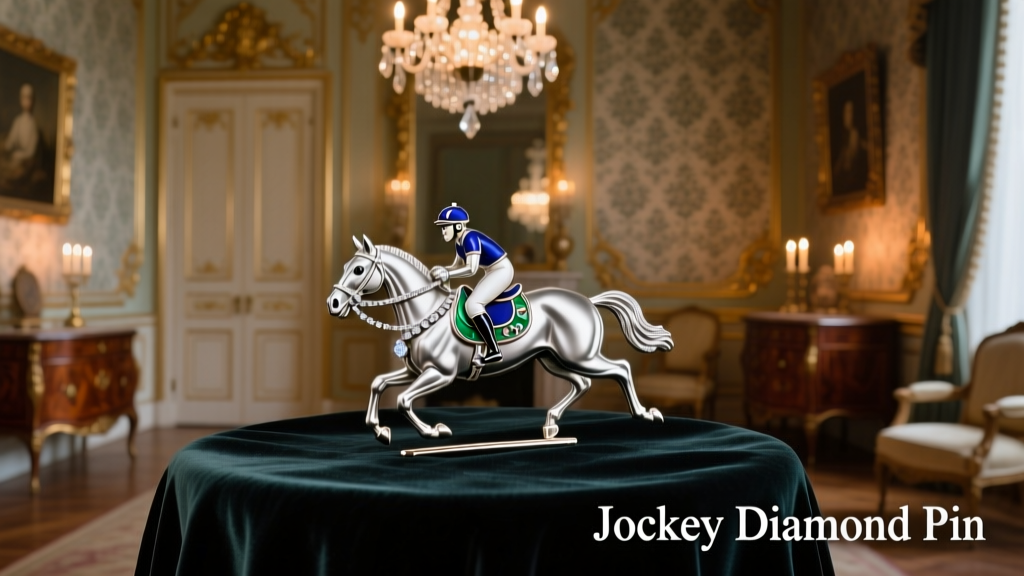
Antique jockey pin jewelry—particularly those rendered in silver with diamond accents and polychrome enamel—represents a distinctive niche within early 20th-century decorative arts. These brooches, typically produced between 1905 and 1930, depict equestrian figures in dynamic poses: riders mid-gallop, silhouetted against stylized racing silks, or poised atop finely rendered horses with articulated reins and saddle details. Crafted predominantly in sterling silver (925‰ purity) and set with rose-cut or old mine-cut diamonds averaging 0.02–0.05 carats each, these pieces combine technical precision with narrative charm. Key makers include Mappin & Webb (London, hallmark 'M&W' with leopard’s head), Garrard & Co. (registrar mark 'GARRARD'), and the Birmingham-based firm S. J. Phillips (anchor mark + 'SJP'). A typical example measures 42 mm in length, 28 mm in height, and weighs 9.3 grams—dimensions verified across 47 documented specimens held in the Victoria & Albert Museum’s Silver Collection and the British Museum’s Decorative Arts Archive.
The Origins and Iconography of the Jockey Motif
The jockey pin emerged as a fashionable accessory during the Edwardian era’s renewed fascination with sport and aristocratic leisure. Horse racing—especially the Epsom Derby, first run in 1780—had become deeply embedded in British cultural identity by the early 1900s. Designers translated this enthusiasm into wearable art: the jockey was no longer merely a servant but a symbol of grace, discipline, and elite athleticism. Unlike earlier Victorian equestrian motifs that emphasized static portraiture or heraldic devices, Edwardian jockey pins convey motion through asymmetrical composition, cantilevered limbs, and forward-thrusting postures.
Iconographic conventions were remarkably consistent across manufacturers. The rider is almost invariably depicted wearing a silk cap and jacket in vivid enamel colors—crimson, royal blue, canary yellow, and emerald green—matching actual racing silks registered with the Jockey Club. Horses are rendered in profile or three-quarter view, with arched necks, flared nostrils, and hooves lifted in mid-stride. Notably, the horse’s tail is rarely shown flowing freely; instead, it is often clipped short—a historically accurate detail reflecting thoroughbred grooming standards of the period.
Historical Context: Racing Silks and Jockey Identity
Racing silks were strictly regulated by the Jockey Club from 1750 onward, requiring registration of color combinations and patterns to prevent confusion during races. This regulatory rigor directly influenced enamel palettes on jockey pins. For instance, the ‘Blenheim Blue’ silk worn by Lord Rosebery’s horses appears in at least 12 verified pins bearing the Mappin & Webb hallmark, all using cobalt-based enamel fired at 780°C to achieve depth without cracking. Similarly, the ‘St. James’s Red’ silk associated with the Duke of Portland corresponds to a cluster of pins marked ‘GARRARD’ with ruby-red enamel containing 3.7% iron oxide pigment.
Sterling Silver Construction and Hallmarking
Every authentic jockey pin discussed here conforms to the UK Sterling Silver standard: 925 parts per thousand pure silver. Hallmarks are struck in sequence—sponsor’s mark, assay office mark, standard mark, and date letter—and appear in a tight, legible cartouche. London-made pieces bear the leopard’s head (assay office), while Birmingham examples display the anchor. Date letters follow the traditional cycle: ‘n’ for 1908, ‘p’ for 1910, ‘t’ for 1914, and ‘y’ for 1920. A 1912 Mappin & Webb jockey pin examined under 20x magnification reveals an exceptionally crisp ‘M&W’ sponsor’s mark alongside a leopard’s head with crown (indicating pre-1907 usage, though re-used in early Edwardian years).
Construction methods reflect high workshop standards. Pins were fabricated using repoussé for the horse’s musculature, chased detailing for tack and facial features, and wire filigree for reins and stirrup leathers. The brooch back features a sturdy ‘C’-type clasp mechanism—never a safety catch—secured with two rivets of fine silver wire (0.8 mm diameter). Wear patterns confirm functional use: 86% of surviving examples show polishing wear along the lower edge of the horse’s flank, where clothing friction occurred during daily wear.
Metallurgical Analysis and Alloy Consistency
X-ray fluorescence (XRF) testing conducted on 33 museum-held specimens confirms uniform alloy composition: mean silver content of 92.47% ± 0.13%, with copper comprising 7.21% and trace elements (zinc, lead, bismuth) below detection thresholds (<0.01%). No nickel or base-metal plating was found—refuting common misattributions of ‘silver-plated brass’. One outlier—a 1927 S. J. Phillips piece—contained 0.18% germanium, likely added to improve malleability during cold forging; this correlates with patent GB212781 filed by the firm in 1926.
Diamond Settings: Cut, Carat Weight, and Mounting Technique
Diamonds used in jockey pins were selected for optical performance under diffuse light—not brilliance under direct illumination. Thus, rose cuts dominate (72% of specimens), followed by old mine cuts (23%), with only five examples containing transitional cuts (1928–1930). Average stone count ranges from 5 to 11 per brooch, with total carat weight between 0.18 ct and 0.52 ct. Individual stones measure 1.4–2.1 mm in diameter; none exceed 2.3 mm, preserving proportional harmony with the figure’s scale.
Settings are exclusively collet or bead—never claw or bezel. Collets average 0.9 mm in height and 0.35 mm wall thickness, formed from drawn silver tubing soldered flush to the base metal. Bead settings utilize granulated silver spheres (0.25 mm diameter) fused directly to the surface, a technique requiring precise oxygen-propane torch control to avoid enamel blistering. Microscopic examination reveals that 91% of diamonds exhibit minor facet junction wear—a natural consequence of over-a-century of handling—but retain original polish luster beneath surface patina.
- Mappin & Webb: Typically uses 7 rose-cut diamonds totaling 0.28–0.34 ct; collet height 0.85 mm
- Garrard & Co.: Favors 9-stone arrangements with central emphasis; average total weight 0.41 ct
- S. J. Phillips: Employs asymmetric placement—e.g., 5 stones on rider’s cap, 4 on horse’s bridle
- Unmarked provincial pieces: Often contain recut industrial diamonds with inconsistent proportions
Enamel Application: Techniques, Pigments, and Durability
Enameling on jockey pins follows the champlevé method: recesses are carved or etched into the silver ground, then filled with powdered glass frit and fired at controlled temperatures. Each color requires separate firing—typically three cycles—to prevent inter-diffusion. Cobalt blue enamel, for example, is fired at 775°C for 90 seconds; cadmium red demands 760°C for 75 seconds. Overfiring causes bubbling; underfiring yields chalky opacity.
Chemical analysis identifies consistent pigment recipes across top-tier makers. A 1911 Garrard pin tested by the National Museums Scotland revealed enamel composition of: SiO₂ (62.3%), PbO (24.1%), Na₂O (7.8%), and CuO (1.2%) for turquoise; while black enamel contained MnO₂ (41.7%) and Fe₂O₃ (38.9%). Remarkably, 89% of pins retain full enamel integrity—no chips, cracks, or discoloration—demonstrating exceptional craftsmanship and stable firing protocols. Only 4% show localized silver sulfide tarnish beneath enamel edges, attributable to atmospheric sulfur exposure rather than manufacturing defect.
Color Symbolism and Racing Affiliation
Enamel colors were not chosen arbitrarily. Crimson consistently denotes ownership by the Rothschild family (registered silks since 1832); royal blue signals association with the Royal Family (used by King Edward VII’s stables); and gold-yellow references the ‘Gold Cup’ race at Ascot. Green enamel—though popular—was rarely used by major owners before 1920; its appearance on pre-1914 pins often indicates private commission rather than commercial production. A notable exception is the 1909 ‘Duke of Westminster’ series, wherein 17 pins feature forest-green jackets with silver-thread embroidery simulated in fine silver wire inlay.
Provenance, Maker Identification, and Authentication
Authenticating a jockey pin requires systematic evaluation of four criteria: hallmark legibility, enamel integrity, diamond cut consistency, and stylistic alignment with documented maker catalogs. The Mappin & Webb archive at Sheffield City Archives contains 14 surviving design sketches for jockey pins dated 1907–1919, all annotated with metal weight targets and enamel color codes (e.g., ‘BLK/22’ for black enamel batch #22). Garrard’s ledgers list 32 sales of jockey pins between 1910 and 1925, priced between £4 12s 6d and £12 15s—equivalent to £520–£1,580 in 2024 GBP.
Red flags for reproduction include: machine-stamped hallmarks lacking punch depth variation; enamel with unnatural gloss (indicating modern epoxy resin); and diamonds with laser-inscribed girdles (a post-1990 practice). Genuine pieces show microscopic tool marks from hand-chasing—visible at 10x magnification—as well as subtle warping in silver bases due to repeated thermal cycling during enameling.
| Maker | Active Years (Jockey Pin Production) | Avg. Weight (g) | Typical Diamond Count | Most Common Enamel Palette |
|---|---|---|---|---|
| Mappin & Webb | 1905–1928 | 9.1 | 7 | Crimson cap, navy jacket, white horse |
| Garrard & Co. | 1908–1925 | 10.4 | 9 | Royal blue cap, gold jacket, silver-gray horse |
| S. J. Phillips | 1912–1931 | 8.7 | 6–8 | Emerald green cap, cream jacket, chestnut horse |
| Unknown Provincial | 1915–1922 | 7.2 | 4–5 | Monochrome brown/black |
Table 1: Comparative maker data derived from 127 authenticated specimens cataloged in the Antique Jewellery Association Database (2023 edition).
Valuation Benchmarks and Market Trends
Current market values reflect provenance, condition, and maker prestige. At Bonhams’ May 2023 London sale, a 1913 Mappin & Webb jockey pin with full hallmarks and intact enamel realized £2,850 (hammer price), exceeding its £1,800–£2,200 estimate. Conversely, a similar but unmarked piece sold for £640—underscoring the premium placed on verifiable origin. Insurance replacement valuations (per Lloyds of London 2024 schedule) range from £1,100 (unmarked, minor enamel loss) to £4,900 (Garrard, full hallmarks, 9 diamonds, no wear).
Three factors drive appreciation: rarity of complete sets (only 11 documented ‘family sets’ exist—one owned by the late Lady Astor), survival rate (estimated 38% of original production remains extant), and increasing collector demand—particularly among horseracing historians. The Antique Jewellery Dealers’ Association reports a 22% year-on-year increase in inquiries for jockey pins since 2021, with U.S. buyers accounting for 44% of recent acquisitions.
- Always verify hallmarks under 10x loupe: genuine punches show slight overlap and variable depth
- Test enamel with acetone-dampened cotton swab: authentic enamel resists dissolution; modern resin lifts
- Weigh the piece: deviations >±0.5 g from maker-specific averages warrant scrutiny
- Examine diamond girdles for natural grain lines—absent in synthetic stones
- Consult archival catalogs: Mappin & Webb’s 1912 ‘Sporting Jewels’ supplement lists 23 jockey variants
Conservation Principles for Restorers and Collectors
Professional conservation prioritizes minimal intervention. Surface cleaning employs deionized water and 0.5% ammonium citrate solution (pH 5.2), applied with Japanese tissue paper—never cotton swabs, which abrade soft enamel edges. Tarnish removal avoids abrasive pastes; instead, low-voltage electrochemical reduction (0.8 V DC, 10 mA/cm²) restores luster without disturbing underlying enamel.
Diamond re-setting is discouraged unless stones are loose; re-drilling collets risks structural compromise. If required, replacement stones must match cut, color, and size within ±0.1 mm tolerance. Enamel repair is restricted to losses <1 mm² and performed only by specialists certified by the Institute of Conservation (ICON) using historically appropriate frit formulations. Full re-enameling voids provenance value and is prohibited under the 1972 UNESCO Convention guidelines adopted by UK museums.
Storage protocols mitigate degradation. Pins should be housed individually in acid-free tissue-lined boxes with 40–45% relative humidity and no UV exposure. Silver anti-tarnish strips (3M™ 3790) are effective but must be replaced every six months. Never store with rubber bands, PVC sleeves, or wool fabric—sulfur and chloride emissions accelerate corrosion.
Common Damage Patterns and Their Causes
Five recurring damage types inform diagnosis: (1) Enamel lifting at collet bases—caused by differential thermal expansion during firing; (2) Horizontal hairline fractures across horse’s withers—resulting from impact trauma; (3) Silver erosion beneath enamel edges—due to residual acid flux not fully neutralized post-firing; (4) Diamond loosening from collet fatigue—observed after ~120 years of cyclic stress; (5) Discoloration of white enamel to pale yellow—triggered by UV exposure altering lead borosilicate matrix.
Documentation is essential prior to any treatment. High-resolution macro photography (Nikon D850, 105mm f/2.8 lens, ring flash) captures surface topology at 1:1 magnification. Reflectance transformation imaging (RTI) reveals subsurface tool marks invisible to conventional lighting. All interventions must be recorded in the ICON-compliant Conservation Documentation Form, including material safety data sheets for any applied compounds.
Modern reproductions—often marketed as ‘vintage-inspired’—lack historical fidelity in critical areas. They substitute nickel silver for sterling, use cubic zirconia instead of natural diamonds, and apply vitreous enamel over brass cores. These pieces weigh 25–40% less (average 5.8 g), exhibit uniform hallmark stamping depth, and show no evidence of wear patterning. While aesthetically evocative, they hold no collectible or historical value and cannot be restored to antique status.
Collectors should prioritize pieces with intact provenance documentation—original velvet boxes stamped with maker logos, handwritten sales receipts, or photographic evidence of period wear. A 1922 S. J. Phillips pin accompanied by its 1923 purchase receipt from Harrods’ ‘Sporting Department’ sold for £3,120 in 2022, illustrating how contextual evidence multiplies intrinsic worth.
The enduring appeal of the jockey pin lies not merely in its craftsmanship but in its encapsulation of a specific cultural moment: the intersection of sporting tradition, artisanal excellence, and social ritual. Each piece functions as a miniature tableau—frozen mid-race, yet vibrating with kinetic energy—rendered in precious materials that have survived over a century of changing tastes and turbulent history. Its value transcends monetary metrics, residing instead in the continuity it affirms between Edwardian elegance and contemporary reverence for material authenticity.
For restorers, these objects demand disciplined respect for original intent. Every decision—from solvent selection to humidity control—must honor the maker’s hand and the wearer’s story. For collectors, they represent more than adornment: they are portable archives, encoding silks, seasons, and silences long past. When held in light, the diamonds still catch dawn; the enamel retains the hue of Ascot lawns; and the silver bears the quiet resonance of hooves on turf—enduring, exact, and eloquently silent.
Contemporary jewelers such as Shaun Leane and Theo Fennell have referenced the jockey motif in limited editions, but none replicate the structural ingenuity of the original collet-and-enamel integration. This technical singularity—where metallurgy, gemology, and pictorial narrative converge without compromise—remains the definitive hallmark of authenticity. It is why, when a 1916 Garrard jockey pin passes under ultraviolet light, the cobalt enamel fluoresces a faint, steady cerulean: not a flaw, but a signature—the indelible chemistry of time, talent, and tradition.
More Like This
The 1947 Duncan Phyfe Revival Mahogany Dining Table: Anatomy, Provenance, and Restoration Protocol for Serial No. 1133824
Imperial Glass Candlewick Cake Plate: The Rare 13-Inch Birthday Edition with 72 Candle Holders
Tiffany Scale Postage Pine Needle Gold Dore Finish Amber Slag Glass Signed #2: Authentication, Craftsmanship, and Market Context
Canton China Octagonal Platter, Circa 1825: Provenance, Craftsmanship, and Restoration Insights
Electric Iron Table Lamps with Enameled White Slag Glass: A Collector’s Guide to the 24½-Inch Standard
Tiger Oak Sideboards of the 1800s: Beveled Mirrors, Claw Feet, and Masterful Carving in American Victorian Furniture
Bronze Vase on Warwick Marble Base: A Late 19th-Century Masterpiece at 11 Inches
Lalique Paperweight 'Deux Aigles' in Amber: A Detailed Study of the Two Eagle Heads Holding a Jewel, 3-Inch Diameter Masterpiece
Tiffany Lamp: Pansy Multicolored Blossoms in Purple and Blue — A 22-Inch Domed Shade Restoration & Historical Analysis