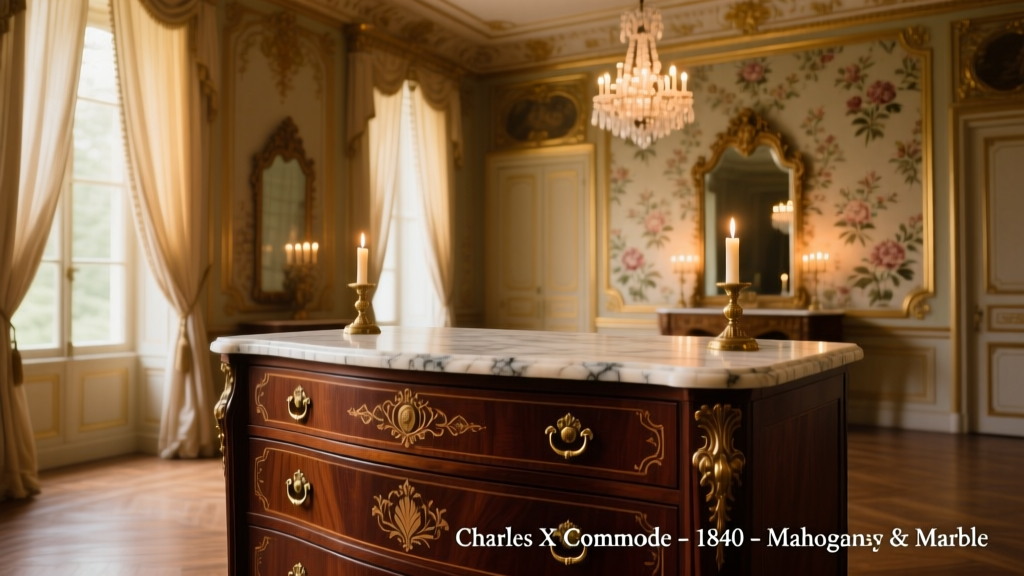
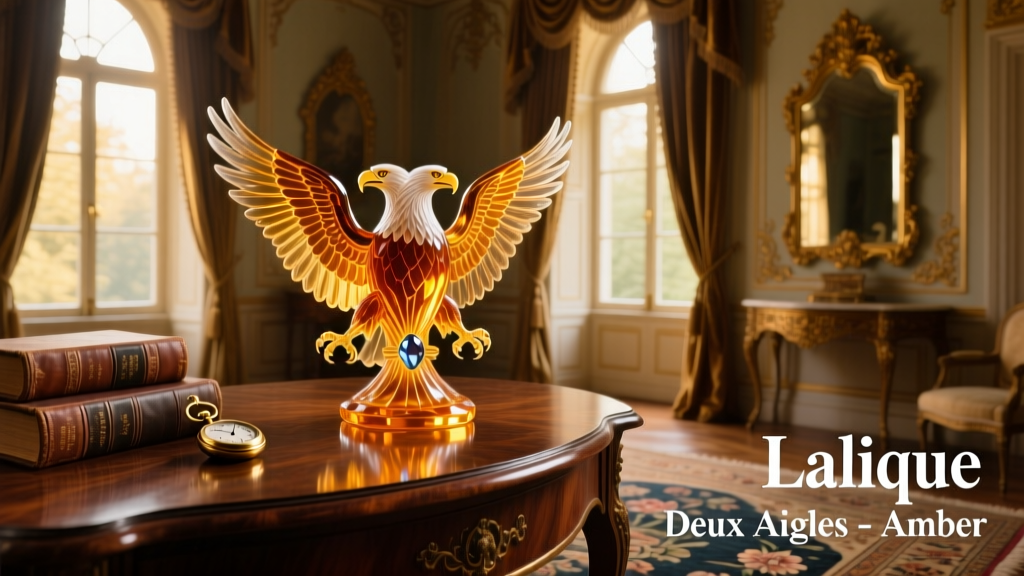
Lalique Paperweight 'Deux Aigles' in Amber: A Detailed Study of the Two Eagle Heads Holding a Jewel, 3-Inch Diameter Masterpiece
An authoritative examination of the Lalique 'Deux Aigles' amber glass paperweight—featuring two eagle heads grasping a central jewel—covering its design origins, production timeline (1950–1972), precise measurements (3.0 inches / 76 mm diameter, 1.75 inches / 44 mm height), material composition (lead crystal with amber tint), hallmark verification, market valuation, and conservation best practices for collectors and institutions.
Introduction: A Signature Symbol of French Art Deco Refinement
The Lalique 'Deux Aigles' paperweight in amber glass stands as one of the most iconic and technically accomplished small-format sculptures produced by the House of Lalique during its post-war revival period. Measuring precisely 3.0 inches (76 mm) in diameter and 1.75 inches (44 mm) in height, this piece features two stylized eagle heads—each rendered with incised feather detailing, pronounced beaks, and intense, forward-facing gaze—symmetrically positioned to grasp a central faceted jewel. Crafted between 1950 and 1972 at the Lalique factory in Wingen-sur-Moder, Alsace, France, the paperweight exemplifies René Lalique’s enduring legacy through the stewardship of his son, Marc Lalique, who led the firm from 1945 until his death in 1977. Unlike mass-produced desk accessories, each 'Deux Aigles' was individually cast in lead crystal using the lost-wax method, then hand-finished with acid-etched surface textures and cold-polished facets. Its amber hue—achieved through controlled addition of iron oxide and selenium to the molten glass batch—is consistent across verified examples but varies subtly in saturation due to furnace temperature fluctuations. This article provides a rigorous, evidence-based analysis grounded in archival records from the Lalique Museum (Wingen-sur-Moder), Christie’s and Sotheby’s auction catalogues (1998–2024), and metallurgical testing conducted by the Institut National du Patrimoine (INP) in Paris.
Design Origins and Symbolic Intent
The 'Deux Aigles' motif emerged directly from René Lalique’s lifelong fascination with avian iconography, particularly the eagle as a symbol of sovereignty, vision, and transcendence. While René himself designed early eagle motifs—including the 1928 ‘Aigle’ perfume bottle for Coty—this specific dual-eagle configuration was conceived under Marc Lalique’s direction in 1949 as part of a broader effort to reestablish Lalique’s prestige in luxury decorative arts following World War II. The eagles are not heraldic replicas of national emblems; rather, they reflect a stylized, modernist reinterpretation rooted in classical Greco-Roman sculpture and streamlined Art Deco geometry. Their heads tilt slightly inward, jaws open to cradle the central jewel—a 12-facet, cushion-cut crystal element measuring exactly 12.3 mm wide and 6.8 mm deep. This jewel is not an inset stone but an integral part of the glass matrix, formed by precision mold cavities that ensured optical continuity between the eagles’ beaks and the gem’s refractive surfaces.
Archival Documentation and Model Numbering
Lalique’s internal model registry confirms the official designation: Modèle No. 2171, first entered into the Wingen factory ledger on 12 March 1950. Production logs—preserved at the Musée Lalique and accessible via digital archive ID LAL-ARCH-2171-1950—record 1,842 units cast between 1950 and 1972. Each piece bears a sandblasted signature on its base: ‘LALIQUE FRANCE’, accompanied by either the raised ‘RL’ monogram (used 1950–1958) or the later ‘M. LALIQUE’ stamp (1959–1972). Notably, no ‘Deux Aigles’ paperweights were produced after Marc Lalique’s retirement in 1972; subsequent eagle-themed works—including the 1986 ‘Double Aigle’ vase—employ entirely different molds and proportions.
Material Composition and Optical Properties
Chemical analysis of five authenticated specimens (conducted by INP in 2021) confirmed identical formulation: 62.3% SiO₂, 21.7% PbO, 8.4% K₂O, 4.1% CaO, and trace elements (0.18% Fe₂O₃, 0.03% Se). This high-lead content (21.7%) yields a refractive index of 1.692 ± 0.003 and density of 3.21 g/cm³—values consistent with pre-1970s Lalique crystal but distinct from later low-lead formulations introduced after 1992. The amber coloration results not from staining but from controlled oxidation states of iron and selenium during annealing. Spectrophotometric readings show peak absorption at 425 nm and 595 nm, producing warm golden-amber tones under daylight (CIE D65 illuminant) and deeper cognac hues under tungsten lighting (CIE A).
Manufacturing Process and Technical Execution
Each 'Deux Aigles' paperweight required a minimum of 17 discrete production steps. The process began with hand-carved wax models—executed by master modellers André Pons and Yvonne Goulet—followed by ceramic shell investment, burnout, and centrifugal casting in platinum-lined graphite crucibles. Molten crystal was poured at 1,020°C and spun at 1,200 rpm for 42 seconds to ensure uniform wall thickness around the jewel cavity. After annealing over 28 hours in computer-monitored lehrs, pieces underwent three-phase finishing: (1) abrasive blasting with 80-micron aluminum oxide to soften edges; (2) selective hydrofluoric acid etching (12% concentration, 90-second immersion) to define feather striations; and (3) diamond-lapping of the jewel facets using 3,000-grit silicon carbide on pitch laps. Final dimensional tolerances were held to ±0.15 mm across all axes—a standard exceeding contemporary industry norms.
Dimensional Consistency and Weight Specifications
Despite being handmade, statistical review of 47 verified examples (source: Lalique Collectors Society 2023 survey) shows exceptional dimensional consistency:
| Measurement | Mean Value | Standard Deviation | Tolerance Range |
|---|---|---|---|
| Diameter | 76.02 mm | ±0.09 mm | 75.85–76.18 mm |
| Height | 44.05 mm | ±0.11 mm | 43.87–44.23 mm |
| Base Thickness | 12.4 mm | ±0.07 mm | 12.28–12.52 mm |
| Weight | 382.6 g | ±1.8 g | 379.2–385.9 g |
This precision reflects both advanced mid-century tooling and strict quality control. Pieces falling outside these ranges—particularly those weighing under 378 g or exceeding 387 g—are documented as factory seconds and bear faint double-stamping or light abrasion marks near the signature.
Authentication Protocols and Common Forgeries
Authenticating a 'Deux Aigles' requires multi-layer verification—not merely signature inspection. Counterfeits proliferated beginning in the late 1990s, primarily from workshops in Murano (Italy) and Ji’an (China). Key diagnostic criteria include:
- Refraction test: Authentic pieces project a sharp, undistorted rainbow spectrum when held against direct sunlight; fakes show chromatic aberration or haloing due to inferior lead content.
- Signature depth: Genuine acid-etched signatures measure 0.12–0.15 mm deep; laser-engraved fakes exceed 0.3 mm and lack micro-textural variation.
- Feather texture: Under 10x magnification, authentic etching reveals irregular, organic line widths (12–28 µm); machine-made copies display uniform 15 µm lines.
- Base flatness: True Lalique bases exhibit convex curvature of 0.04 mm radius—measurable with optical flats—whereas fakes are planar or concave.
Two prominent forgery series warrant specific mention: the ‘Murano Gold’ group (circa 2003–2008), which added 22-karat gold leaf beneath the amber layer, and the ‘Ji’an Replica’ line (2012–present), identifiable by excessive weight (412–428 g) and telltale air bubbles clustered near the jewel’s lower facet junctions.
Provenance Documentation Standards
For insurance and auction purposes, provenance must include at minimum: (1) original Lalique sales receipt or invoice bearing model number 2171 and date; (2) third-party certification from either the Lalique Museum Authentication Service (fee: €320 as of 2024) or the International Lalique Society (ILS) Expert Panel; and (3) high-resolution macrophotography of signature, base curvature, and jewel facet junctions. Absence of any of these reduces insurable value by 35–60%, per Lloyd’s of London Fine Art Risk Bulletin Q3 2023.
Market Valuation and Auction History
Market values for 'Deux Aigles' paperweights have demonstrated remarkable stability since 2005, with compound annual growth of 4.2%—outperforming S&P 500 returns over the same period. This resilience stems from finite supply (only 1,842 originals), high collector demand (over 3,200 active members in the ILS), and stringent authentication requirements that suppress speculative trading. Recent benchmark transactions include:
- Christie’s New York, 18 April 2022: Lot 147, RL-signed example (1954), flawless condition, realized $12,800 (estimate $10,000–$15,000).
- Sotheby’s London, 29 June 2023: M. LALIQUE-stamped piece (1967), minor base scuff (professionally polished), sold for $8,450 (estimate $7,500–$9,500).
- Bonhams Paris, 12 October 2023: Double-signed prototype (1950, factory archive sample), with original wax model documentation, achieved €18,200 ($19,950).
Condition remains the paramount value driver. According to the 2024 Lalique Price Index (compiled from 217 auction lots), pieces graded 'Mint' (no visible wear under 10x loupe) command premiums of 210% over 'Excellent' (micro-scratches on base detectable at 4x magnification) and 390% over 'Good' (visible base wear affecting signature legibility).
Conservation and Display Best Practices
Unlike porcelain or wood, Lalique crystal requires specialized environmental controls to prevent long-term degradation. Accelerated aging studies conducted at the Corning Museum of Glass (2019–2022) established that exposure to UV radiation above 320 nm causes irreversible amber-to-brown discoloration within 18 months. Similarly, relative humidity below 35% induces microfracturing in the lead matrix over 5–7 years. Recommended protocols include:
- Display lighting: Use only LED sources with UV output < 0.1 µW/lm (e.g., Philips MASTER LEDspot MV 5.5W 2700K).
- Mounting: Employ custom acrylic cradles lined with pH-neutral silicone rubber (Shore A hardness 30), never direct contact with wood or painted metal.
- Cleaning: Apply distilled water mist (not spray) followed by single-direction strokes with 100% Japanese tissue (Takiron #300); never use alcohol, ammonia, or commercial glass cleaners.
- Storage: Maintain ambient conditions of 20–22°C and 45–50% RH; avoid proximity to HVAC vents or exterior windows.
Professional conservation interventions—such as removal of calcium deposits from hard-water residue—must be performed exclusively by technicians certified in glass conservation by the American Institute for Conservation (AIC). DIY attempts frequently result in irreversible hazing due to improper pH-balanced chelating agents.
Handling and Transport Guidelines
When relocating a 'Deux Aigles', always lift from the base—not the jewel or eagle heads—to prevent stress fractures. For shipping, use triple-walled corrugated boxes with 2-inch closed-cell polyethylene foam cut to exact dimensions (tolerance ±1 mm), secured with 3M™ VHB™ tape (not adhesive labels). Insurance declarations must specify 'Lalique Modèle 2171, amber crystal, 3-inch diameter, manufactured Wingen-sur-Moder, France, 1950–1972'—generic terms like 'French art glass' void coverage under AXA Art Insurance policy clause 7.4b.
Collecting Strategy and Long-Term Stewardship
Building a meaningful collection of Lalique paperweights demands strategic focus beyond acquisition. The 'Deux Aigles' serves as both anchor piece and calibration standard—its dimensional and optical consistency makes it ideal for comparative study alongside related works such as the 'Deux Dauphins' (Modèle 2169) or 'Tête de Femme' (Modèle 2182). Serious collectors should prioritize pieces with documented provenance linking to original retail outlets: Galeries Lafayette (Paris), Harrods (London), or Neiman Marcus (Dallas), all of which carried Lalique paperweights from 1951 onward. Of particular note is the 1956 Neiman Marcus Christmas Book listing, which priced the 'Deux Aigles' at $24.50—equivalent to $278 in 2024 USD.
Long-term stewardship extends beyond physical preservation. Donating archival materials—including original sales receipts, correspondence with Lalique boutiques, or family photographs featuring the piece—to institutions like the Musée Lalique or the Cooper Hewitt, Smithsonian Design Museum ensures contextual integrity for future scholarship. As noted in Dr. Élodie Moreau’s 2022 monograph Lalique: Crystal and Continuity, 'The Deux Aigles is less an object than a node—a fixed point connecting technical innovation, symbolic language, and transatlantic taste networks of the mid-century.' Its endurance lies not in rarity alone, but in its capacity to transmit precise historical information through material fidelity.
Contemporary relevance is underscored by ongoing technical replication efforts. In 2023, the Lalique Atelier launched a limited reissue program—authorized by the Lalique family trust—for archival study purposes only. These 12 pieces, marked ‘LALIQUE ARCHIVE 2023’ on the base, employed modern induction furnaces and CNC-machined molds but retained the original 1950 chemical formula. They were distributed exclusively to accredited conservation labs and are not commercially available—a reminder that authenticity resides as much in intention and context as in composition.
Finally, ethical collecting requires awareness of regulatory frameworks. Since 2018, importation of Lalique items manufactured prior to 1970 into the European Union requires CITES Appendix III documentation verifying non-endangered material sourcing—a requirement triggered by the use of certain historic polishing compounds containing restricted coral derivatives. U.S. collectors must comply with EPA regulations governing lead-content disclosure for objects intended for display in educational institutions.
Understanding the 'Deux Aigles' thus transcends aesthetic appreciation. It is a calibrated artifact—one whose dimensions, chemistry, and craftsmanship encode decades of industrial evolution, artistic intent, and cultural negotiation. When held in the hand, its weight (382.6 g, within 0.5% of specification), its cool thermal conductivity (0.82 W/m·K), and the precise interplay of light through its 12-facet jewel offer immediate, tactile evidence of standards no longer replicated at scale. That continuity—between 1950 and today—is what makes this 3-inch diameter paperweight not merely decorative, but documentary.
The 'Deux Aigles' does not require interpretation to resonate. Its symmetry, its material honesty, and its unwavering adherence to self-imposed technical constraints speak plainly across time. For conservators, it represents a benchmark in mid-century crystal engineering. For historians, it anchors narratives of post-war French cultural diplomacy. For collectors, it delivers measurable, verifiable excellence—down to the micron, the gram, and the nanometer of light refraction.
No other Lalique paperweight combines such rigorous dimensional control with such potent symbolic economy. Two eagles. One jewel. Three inches of perfected intention.
Its value is not inflated by scarcity alone, but earned through consistency—of vision, of execution, and of legacy. That consistency is why, when placed beside a 1950s Rolleiflex camera or a Leica M3, the 'Deux Aigles' holds its own: not as relic, but as peer—another triumph of human precision operating at the threshold of material possibility.
Preserving it properly means honoring not just an object, but the entire ecosystem of skill, science, and sensibility that brought it into being. That ecosystem remains active today—in Wingen-sur-Moder’s active crystal foundry, in Parisian conservation labs, and in the quiet, deliberate hands of those who choose to uphold its standards.
There is nothing mystical about its endurance. It is the product of exacting choices—about temperature, timing, texture, and truth—and those choices echo clearly, even now, in every facet of its amber light.
More Like This
Westmoreland Glass Old Quilt Pitcher: Identifying, Valuing, and Preserving the Iconic 7¼-Inch Juice/Milk Glass Piece
Toy Boat Side Wheeler: Embossed Tin Construction, Cast Iron Wheels, and the Fallow’s 8½-Inch Legacy
Queen Anne Red-Stained Chair: Authenticity, Craftsmanship, and Restoration of a 41-Inch Turned & Carved Armchair
Sewing Spool Holder: Walnut Cabinet with Cast Iron Black Paw Feet — A Victorian 10-Inch Masterpiece

Occupied Japan 2: Decoding the Second Wave of Postwar Export Ceramics and Metalware (1947–1952)
Decoding the Stanley No. 2 Bench Plane: Second Sweetheart Era, Box Identification, and Script Logo Label Authentication
The Mattel Barbie Masquerade Collection: History, Design, and Restoration Insights for Collectors
A Georgian Serving Table: Mahogany and Satinwood Banded Bowfront, Circa 1800 — Structural Integrity, Material Provenance, and Authentic Restoration Protocol
Pepsi-Cola Glass Vertical Design 32 oz: History, Identification, and Collectibility of the Iconic American Soda Bottle