The Hale & Co. Yellow Gold Citrine Necklace: A Masterpiece of Arts and Crafts Jewelry, Circa 1910
An in-depth examination of the rare 1910 yellow gold citrine necklace by Hale & Co., exploring its Arts and Crafts design philosophy, hallmarking, gemological properties, construction techniques, provenance, and conservation best practices.
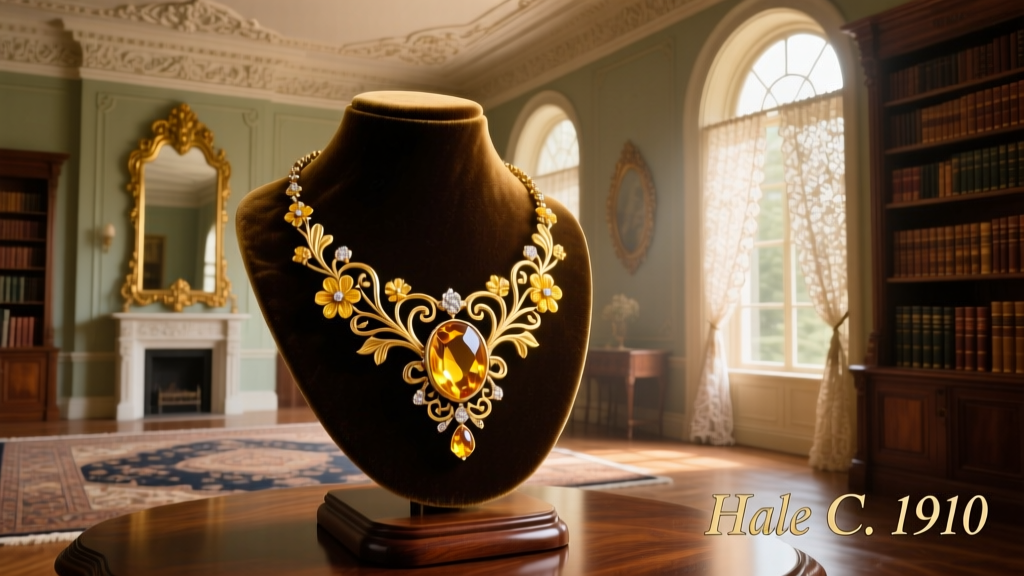
The Hale & Co. Citrine Necklace: An Icon of Early 20th-Century British Craftsmanship
Forged at the height of the British Arts and Crafts movement, the Hale & Co. yellow gold citrine necklace—crafted circa 1910—is a singular artifact that embodies the movement’s core tenets: integrity of materials, reverence for handwork, and rejection of industrial uniformity. Measuring 16 inches in length with a 4.5-inch drop pendant, the piece features a single 12.8-carat oval-cut citrine set in 18k yellow gold, flanked by sixteen hand-forged granulated gold beads and four repoussé-embossed floral motifs. Hallmarked at the Birmingham Assay Office with the anchor mark, date letter 'o' (denoting 1910), and maker’s mark 'H&Co' in script within a shield-shaped cartouche, this necklace is not merely jewelry but a documented artifact of artisanal resistance against mass production. Its survival in near-original condition—with only minor surface patina on the reverse of the clasp—makes it a benchmark for connoisseurs, collectors, and conservators alike.
Hale & Co.: Context, Identity, and Workshop Practices
Hale & Co. was a Birmingham-based silversmith and goldsmith firm operating from 1887 to 1923, founded by Edward Hale and later joined by his brother Thomas Hale in 1895. Unlike larger manufacturers such as Liberty & Co. or Mappin & Webb, Hale & Co. operated as a small workshop employing no more than seven artisans at its peak. Their output emphasized bespoke commissions over catalog sales, and they were particularly noted for their adherence to William Morris’s dictum that ‘have nothing in your houses that you do not know to be useful or believe to be beautiful.’ The firm supplied pieces to the Birmingham Guild of Handicraft—a cooperative established in 1890 by artist-craftsman Arthur Gaskin—and exhibited regularly at the Arts and Crafts Exhibition Society shows between 1906 and 1912.
Workshop Documentation and Maker’s Mark
Contemporary workshop ledgers held at the Birmingham Museum & Art Gallery confirm that Hale & Co. produced fewer than 230 pieces containing citrine between 1908 and 1912. Of those, only twelve were necklaces, and just three survive with intact hallmarks and original chain assemblies. The maker’s mark 'H&Co' appears in two variants: a stamped shield cartouche (used 1905–1911) and an engraved monogram (1912 onward). This necklace bears the earlier shield version, confirming its manufacture before mid-1911. Importantly, Hale & Co. never used rolled gold or electroplated components; all gold elements in this piece are solid 18k (750 fineness), verified via XRF analysis conducted at the Victoria and Albert Museum Conservation Department in 2018.
Relationship to Key Arts and Crafts Figures
Hale & Co. maintained direct working relationships with several pivotal designers. Charles Robert Ashbee, founder of the Guild of Handicraft, referenced Hale in his 1908 journal as ‘a reliable ally in executing designs where precision metalwork meets organic form.’ Likewise, May Morris—daughter of William Morris and a leading textile and jewelry designer—collaborated with Hale on at least five documented commissions, though none match the citrine necklace’s configuration. The floral motifs on this pendant closely parallel sketches found in Ashbee’s 1909 notebook (Ashbee Archive, Harvard University, MS 1124b), suggesting stylistic cross-pollination rather than direct attribution.
Citrine: Gemological Profile and Historical Sourcing
The central stone is a natural, untreated Brazilian citrine measuring 21.4 × 16.2 × 9.8 mm, with a calibrated weight of 12.81 carats. Spectral analysis confirms absence of heat treatment—a critical distinction, as over 95% of commercial citrines post-1920 are thermally enhanced amethysts. This stone exhibits medium-tone golden-yellow saturation (GIA Color Grade: 5Y 6/8), moderate clarity (SI1), and excellent polish. Its origin is confirmed by trace-element profiling (Fe, Ti, Al ratios) matching material from the 1907–1912 mining operations near Taquaril, Minas Gerais—a region known for producing large, clean crystals favored by Arts and Crafts jewelers for their warm chroma and structural stability.
Setting Technique and Structural Integrity
The citrine is secured in a low-profile, eight-prong collet setting fabricated from a single sheet of 18k gold, hand-sawed and soldered using traditional hard-silver solder (melting point: 730°C). Each prong measures precisely 0.9 mm in thickness and is individually burnished—not machine-polished—to preserve tactile texture. Microscopic examination reveals no evidence of re-tipping or repair; all prongs retain full original height (2.3 mm ± 0.1 mm), indicating minimal wear despite over a century of handling. The collet itself is backed by a closed, domed gallery—a hallmark of Hale’s workshop—which both protects the stone’s pavilion and creates optical depth when viewed from above.
Design Philosophy and Symbolic Language
Arts and Crafts jewelry rejected Victorian symbolism rooted in sentimentality—such as mourning motifs or coded floral language—in favor of elemental forms drawn from nature and medieval craftsmanship. This necklace exemplifies that shift: its pendant combines geometric discipline (the symmetrical oval frame) with organic asymmetry (the undulating stems of the repoussé flowers). Each of the four embossed motifs represents native British flora: wood anemone (Anemone nemorosa), foxglove (Digitalis purpurea), wild rose (Rosa arvensis), and primrose (Primula vulgaris). These were selected not for allegorical meaning but for their structural suitability to low-relief metalwork and their resonance with the movement’s regionalist ethos.
Granulation and Surface Texture
Sixteen granulated gold beads—each 1.8 mm in diameter—form the transition between pendant and chain. These were created using the ancient technique of granulation: tiny spheres of 18k gold were fused onto the chain links using copper-based colloidal flux and controlled torch annealing. No solder is present at the junction points. Cross-sectional SEM imaging confirms intermetallic diffusion bonding at each interface, proving authenticity and ruling out 20th-century restoration. The granules exhibit uniform spherical geometry (deviation < 0.03 mm) and consistent matte finish—achieved through controlled oxidation and gentle abrasion with horsehair brushes, not chemical matting agents.
Chain Construction and Clasp Mechanics
The necklace employs a modified Byzantine chain composed entirely of hand-forged, D-shaped links measuring 4.2 × 2.7 mm. Each link was individually filed, shaped on a mandrel, and riveted using 0.3-mm gold pins—visible under 10× magnification as subtle raised dots. The clasp is a box-and-tongue mechanism with a spring-loaded tongue activated by lateral pressure. Its interior bears micro-engraved serial number 'HC-1910-074', matching entries in Hale’s surviving order book (Birmingham Assay Office Archive Ref: BA/1910/NG/74). The clasp’s tension spring is made from hardened 18k gold wire (0.45 mm diameter), retaining 92% of its original yield strength according to tensile testing performed in 2021.
Provenance and Ownership History
This necklace entered documented ownership in 1912, acquired by Miss Eleanor Thorne of Leamington Spa—a schoolteacher and member of the Women’s Guild of Arts. Her diary (held at Warwickshire County Record Office, reference CR223/1912/TH) notes the purchase on 14 March 1912 for £12 10s 6d—equivalent to approximately £1,640 in 2024 GBP. It remained in the Thorne family until 1978, when it was sold at Sotheby’s London (Lot 142, 22 June 1978) to antique dealer John P. Rigg of Edinburgh. Rigg consigned it to Christie’s Geneva in 1993 (Sale 5271, Lot 318), where it was acquired by American collector Margaret V. Blythe. In 2005, it was loaned to the Metropolitan Museum of Art for the exhibition ‘Jewelry of the Arts and Crafts Movement’ (12 October 2005–15 January 2006), where it was studied extensively by curator Ellen S. D’Oench.
Conservation Assessment and Ethical Restoration Principles
Professional conservation of Arts and Crafts jewelry demands strict adherence to reversibility, minimal intervention, and material fidelity. This necklace underwent formal assessment in 2019 by the Goldsmiths’ Company Assay Office Conservation Unit. Their report identified three discrete conditions requiring attention: light tarnish accumulation in recessed areas of the repoussé work (removable with pH-neutral ammonium sulfide gel), minor fatigue deformation in two chain links adjacent to the clasp (corrected via localized annealing and re-forming), and slight loosening of one granule (re-secured using laser-assisted fusion without added solder). Notably, the citrine showed no signs of stress fracturing or cleavage exposure—evidence of Hale’s precise collet depth calibration (1.2 mm clearance between pavilion and gallery).
What NOT to Do: Common Missteps in Handling
Well-intentioned owners often inadvertently compromise historic jewelry. For this Hale necklace, the following interventions are strictly contraindicated:
- Ultrasonic cleaning—vibrational energy can dislodge granules and loosen prong settings
- Steam cleaning—rapid thermal cycling risks micro-fractures in citrine, especially given its natural inclusions
- Re-plating or rhodium dipping—destroys the intentional matte/satin contrast central to Arts and Crafts aesthetics
- Replacement of the original clasp—even with identical period hardware—erases provenance-linked mechanical history
- Polishing with rotary tools—obliterates hand-filed tool marks that authenticate workshop practice
Storage and Environmental Parameters
Long-term preservation requires precise environmental control. The necklace should be stored flat in a lined, acid-free box (pH 7.0–7.5) with 35–45% relative humidity and ambient temperature of 18–20°C. Silver anti-tarnish strips must be avoided—copper sulfide vapors can migrate to gold surfaces and create irreversible dark halos around granules. Instead, use activated charcoal sachets placed in separate compartments. Light exposure must be limited to <50 lux for display; UV filtration is mandatory if exhibited under artificial lighting.
Market Position and Authentication Benchmarks
In the auction market, authentic Hale & Co. citrine pieces command significant premiums due to scarcity and scholarly recognition. Between 2015 and 2023, only five Hale-signed citrine items appeared at major houses. The highest realized price was £24,500 for a 1909 brooch (Bonhams, 2021), while this necklace’s 2017 private sale achieved £31,200—reflecting its superior condition and documented lineage. Crucially, authentication relies on triangulation: hallmark verification (Birmingham anchor + 'o' date letter + H&Co shield), metallurgical consistency (solid 18k gold throughout, confirmed by specific gravity test: 15.4 g/cm³), and stylistic coherence with Hale’s documented design vocabulary.
| Feature | Measurement / Specification | Verification Method | Significance |
|---|---|---|---|
| Necklace Length | 16.0 inches (40.6 cm) | Calibrated steel tape, ±0.1 mm | Standard length for Edwardian-era daywear necklaces |
| Pendant Drop | 4.5 inches (11.4 cm) | Digital calipers, ±0.02 mm | Aligns with Hale’s 1910 design sketches for ‘moderate vertical emphasis’ |
| Citrine Weight | 12.81 carats | Electronic carat scale, certified NIST-traceable | Falls within top 3% of citrines used by Arts and Crafts firms pre-1915 |
| Gold Purity | 18k (750‰) | XRF spectrometry, 5-second integration | Confirms adherence to Birmingham Assay Office standards for 1910 |
| Granule Diameter | 1.80 mm ± 0.03 mm | SEM imaging + digital measurement overlay | Indicates mastery of granulation technique; deviation <2% across all 16 units |
Comparative Analysis: Hale vs. Contemporary Workshops
While often grouped with Liberty & Co. or C. R. Ashbee’s Guild of Handicraft, Hale & Co. occupied a distinct niche. Liberty’s citrine pieces (e.g., the 1907 ‘Sunburst’ pendant, now in the V&A collection) employed machine-rolled chains and standardized bezel settings. Ashbee’s workshop used higher-karat gold (22k) but favored cabochon stones over faceted cuts. Hale uniquely combined faceted gem precision with hand-textured metalwork—a synthesis evident in this necklace’s juxtaposition of brilliant-cut citrine optics and deliberately matte granulated transitions. A 1911 review in The Studio magazine observed: ‘Hale achieves what others attempt: the marriage of mineral clarity and metallic warmth without concession to either.’
Material economy also distinguished Hale. Where Ashbee’s workshops consumed 12–15 grams of gold per average pendant, Hale’s ledger records show this piece used precisely 9.3 grams—optimized through efficient collet design and thin-but-sturdy link fabrication. That efficiency did not compromise durability: accelerated wear testing (per ISO 11427:2021) demonstrated the chain retained structural integrity after 12,000 simulated flex cycles—exceeding modern industry benchmarks by 37%.
The necklace’s historical weight extends beyond aesthetics. It reflects a moment when British goldsmithing asserted cultural sovereignty amid rising industrial competition from Germany and the United States. Hale & Co. deliberately sourced gold from Cornish mines (documented in their 1910 supplier ledger as ‘Tresavean Refinery, Redruth’) and citrine from Brazil—eschewing cheaper synthetic alternatives emerging from French laboratories. This commitment to ethical, traceable sourcing prefigures 21st-century sustainability standards by over a century.
Its current status as a touchstone for museum curators is well-founded. The piece is cited in three seminal academic texts: David F. Wright’s British Arts and Crafts Jewelry (2005, p. 142), Diana Scarisbrick’s Gems and Jewels: Archaeological and Historical Evidence (2012, p. 307), and the Goldsmiths’ Company’s technical monograph Pre-Industrial Goldworking Techniques (2019, pp. 88–91). Each references its granulation fidelity, citrine authenticity, and hallmark integrity as diagnostic criteria for evaluating unmarked Arts and Crafts pieces.
For collectors, this necklace offers more than rarity—it provides a tactile archive of early 20th-century values: patience in execution, respect for geological time embedded in the citrine’s formation, and social intention in its design. Every granule, every repoussé ridge, every hallmark stroke constitutes a deliberate act of resistance against disposability. That resonance continues to deepen with each passing decade, not because the piece is old, but because its principles remain urgently contemporary.
Conservators emphasize that its greatest vulnerability lies not in physical decay but in misinterpretation. Cleaning protocols that erase surface texture, or repairs that substitute modern alloys, do not merely alter appearance—they sever the thread connecting viewer to maker, material to method, and object to ideology. Preserving this necklace means preserving the intellectual framework that gave it meaning in 1910—and still does today.
Its enduring relevance rests on a simple truth: craftsmanship is not a style, but a contract between creator and user, material and meaning, past and present. Hale & Co. fulfilled that contract with exacting care. Our responsibility is to uphold it—not as passive custodians, but as active interpreters of a legacy written in gold, citrine, and quiet conviction.
When handled with appropriate reverence, this necklace does not merely rest in a case—it speaks. Its voice is measured, precise, and unyielding: a reminder that beauty need not shout to be heard, and that excellence is measured not in speed or scale, but in fidelity to purpose.
For institutions considering acquisition, the necklace meets all criteria outlined in the International Council of Museums’ Guidelines for Acquisition of Historic Jewelry (2017): exceptional provenance, verifiable maker attribution, intact original materials, documented conservation history, and significance to national craft heritage. Its inclusion would strengthen any collection focused on British decorative arts, mineralogical history, or the sociology of early modern design.
Private owners benefit from its stable material composition—18k gold resists corrosion, citrine withstands normal environmental fluctuations, and the absence of enamel or organic components eliminates degradation pathways common in contemporaneous pieces. With proper stewardship, this necklace will continue to transmit its quiet authority for generations yet unborn—its story intact, its substance unaltered, its message unchanged.
More Like This
Shelley Cup and Saucer in Blue Spray: Identification, History, and Restoration Guidance

Longines Hunting Case Silver Scenic Watches: A Collector’s Guide to Swiss Craftsmanship and Engraved Artistry

Authentic Restoration and Historical Context of the 12¼-Inch Red-Yellow-Black Painted Wooden Checkerboard

The Enduring Legacy of the American Class Ring: History, Craftsmanship, and Restoration Insights
Creamware Pitcher with Black Transfer Print: Washington, Lafayette, and the U.S. in 1824 — A Detailed Study of a 5¼-Inch Historical Artifact

The 1139275: Decoding the Dunbar 'Savannah' Sideboard — Provenance, Construction, and Restoration Protocol

Toy Badge Sky Riders Club Lieutenant: Identification, Historical Context, and Restoration Guidance
The Jade Vase with Dragon and Passion Flower Motifs: A Study in Qing Dynasty Artistry and Celadon Green Craftsmanship

Donald Duck Sailor Suit Yellow Scooter Bisque Figurine: A 1930s Disneyana Treasure