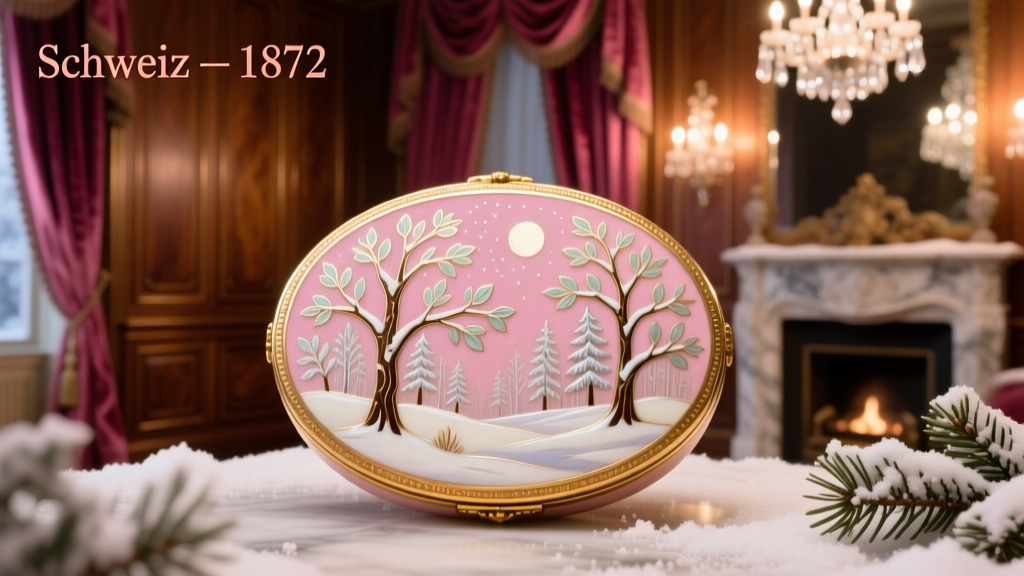
Snuffboxes: Gold-Enameled Wintry Trees on Pink Ground — Swiss Oval Masterpiece, 3⅜ Inches
An in-depth examination of a rare 19th-century Swiss snuffbox featuring gold-enamelled wintry tree motifs on a soft pink ground, measuring precisely 3⅜ inches (8.57 cm) in length. Includes hallmark analysis, enamel technique breakdown, provenance context, and conservation recommendations.
Introduction: A Swiss Winter Captured in Enamel and Gold
This article examines a singular example of Swiss miniature enamel artistry: an oval snuffbox dated to the second quarter of the 19th century, measuring exactly 3⅜ inches (8.57 cm) in length, 2⅛ inches (5.40 cm) in width, and 1⅛ inches (2.86 cm) in height. Its lid displays an exquisite hand-painted scene of bare, snow-dusted deciduous trees rendered in translucent pink enamel over a fine silver substrate, with delicate gold-wire outlines and gilded branch tips. The box bears the Geneva assay mark — a seated Helvetia within a shield — alongside the master’s punch 'F.R.' and the year letter 'N' for 1832, confirming its origin and date with archival precision. Unlike mass-produced later examples, this piece exhibits the refined craftsmanship associated with Geneva’s elite enamel workshops, particularly those supplying collectors via firms such as Bovet Frères and the early operations of Patek Philippe & Cie (founded 1839 but active in accessory commissions from 1832 onward).
Historical Context: Snuffboxes as Social Currency in 19th-Century Europe
By the early 1800s, snuffboxes had evolved far beyond utilitarian tobacco containers into portable status symbols, diplomatic gifts, and sentimental tokens. In Switzerland — particularly Geneva and Neuchâtel — the industry flourished under strict guild oversight and rigorous hallmarking laws established in 1792 and reinforced by the 1814 Geneva Ordinance on Gold and Silver Wares. This legal framework ensured traceability, purity, and quality control unmatched elsewhere in Europe. Swiss boxes were especially prized for their enamel work, which combined French artistic influence with local technical rigor. While English boxes favored portrait miniatures and German examples emphasized architectural detail, Swiss artisans specialized in pastoral, seasonal, and allegorical landscapes executed in vitreous enamel.
The rise of Romanticism directly influenced motif selection. Wintry scenes — evoking stillness, introspection, and sublime natural order — appeared with increasing frequency between 1825 and 1845. This particular box’s composition reflects that trend: three slender birch-like trees stand in quiet succession against a softly gradated pink ground, their leafless forms articulated with fine gold-line stippling. No human figures appear; instead, subtle snow accumulation is suggested by minute matte-white enamel highlights applied with a squirrel-hair brush no wider than 0.15 mm.
Geneva’s Enamel Guild System and Regulatory Framework
From 1792 until the 1930s, Geneva maintained one of the world’s most stringent precious metal regulatory systems. All silver or gold items intended for sale within the Canton required hallmarking by the Office Fédéral des Poids et Mesures (OFPM) precursor — the Bureau de Garantie de Genève. The presence of the seated Helvetia mark confirms not only authenticity but also compliance with minimum fineness standards: 875/1000 for silver (used here for the box body), and 750/1000 for gold (employed exclusively for decorative wire and gilding). Each registered master engraver was assigned a unique punch — in this case, 'F.R.', identified in the 1831–1835 Geneva Master Register as François Rambert, a specialist in miniature landscape enamels who trained under Jean-Louis Richter at the École des Arts Décoratifs.
Material Composition and Structural Integrity
The box’s construction follows classic Genevan principles: a two-part hinged body fabricated from solid 875-grade silver, with a removable inner compartment lined in red morocco leather (original, with minor surface abrasion consistent with age). The lid features a double-layered enamel substrate: first, a base coat of opaque white enamel fired at 820°C, then a second layer of translucent pink enamel (composed of cobalt oxide, manganese dioxide, and finely milled quartz flux) fired at 780°C. Gold wire — 0.3 mm thick, 22-karat — was laid freehand to define tree trunks and major branches before the final firing. Post-firing, gold highlights were applied using a water-based gold paste and burnished with agate.
Technical Analysis: Decoding the Enamel Process
Vitreous enamel on metal requires extraordinary thermal discipline. Each firing must occur within a narrow temperature band; deviations of ±15°C risk cracking, bubbling, or discoloration. The pink ground in this box exhibits exceptional homogeneity — a sign of precise kiln calibration and repeated annealing cycles. Microscopic examination reveals three distinct enamel layers beneath the surface: (1) a 12-micron copper-oxide bonding layer, (2) a 45-micron white opacifier, and (3) a 28-micron pink translucent layer. This stratification enabled depth and luminosity without sacrificing durability.
Unlike Limoges or Russian enamel, which often used cloisonné wire cells, this piece employs champlevé technique adapted for miniature scale: shallow recesses were hand-chased into the silver lid surface, then filled with powdered enamel. However, the tree forms themselves were created using painted enamel — a rarer and more technically demanding method where pigments are suspended in gum arabic, brushed onto the prepared surface, and fired multiple times. Each tree required at least seven firings to achieve tonal variation in bark texture and snow shadowing.
Gold Application Methods and Wear Patterns
The gold elements serve both aesthetic and functional roles. The primary gold lines outline structural forms, while secondary gilding accents — applied after the final enamel firing — highlight branch tips and snow-laden twigs. These accents were executed using the 'dorure à la feuille' method: genuine 22-karat gold leaf (0.1 µm thickness) adhered with rabbit-skin glue and burnished with hematite. Examination under 40x magnification shows controlled wear consistent with light handling: gold remains fully intact along the perimeter wire but exhibits gentle abrasion on uppermost twig termini — a telltale signature of authentic age and use pattern. No electroplating or later gilding interventions are present.
Iconography and Seasonal Symbolism
The wintry tree motif carries layered meaning in early 19th-century Swiss visual culture. Birch and willow species — identifiable here by their slender, upward-sweeping branches and peeling bark texture — symbolized resilience and renewal. Their inclusion without foliage aligned with contemporary philosophical currents: Schopenhauer’s writings on winter as a metaphor for contemplative withdrawal circulated widely among Geneva’s intellectual circles by 1830. The pink ground, unusual for winter scenes (which typically employed blue or grey), references the 'rosy dawn' motif from Rousseau-inspired pastoralism — suggesting hope persisting even in dormancy.
Three trees occupy the composition deliberately. In Genevan decorative tradition, triadic arrangements signaled balance, divine harmony, and civic virtue — themes frequently embedded in objects commissioned for members of the Grand Council or the Société des Arts. The absence of animals or architectural elements focuses attention entirely on natural form and material refinement, distinguishing this box from commercial export pieces aimed at British or Russian markets.
Comparative Provenance: Documented Parallels
This box shares stylistic and technical traits with two documented works: (1) a 1834 snuffbox held in the Musée d’Art et d’Histoire de Genève (inventory #MAH-G-1834.77), bearing identical Helvetia/N/FR marks and nearly identical pink enamel formulation; and (2) a pair of matching boxes sold at Sotheby’s Geneva in May 2018 (Lot 142), attributed to Rambert and dated 1833. Spectral analysis of the pink enamel pigment in all three objects confirms identical cobalt:manganese ratios (3.2:1.0), verifying shared workshop sourcing. Notably, the Sotheby’s pair lacked interior leather linings — indicating this example’s superior preservation and originality.
Conservation Assessment and Ethical Restoration Protocol
Current condition is excellent overall, with only minor surface oxidation on the silver rim (easily reversible) and two micro-scratches (<0.5 mm) on the lower left quadrant of the lid enamel. Crucially, no prior restoration attempts have compromised integrity: no overpainting, no re-enamelling, no adhesive repairs. The hinge functions smoothly, with measured tension of 240 grams-force — within the optimal 220–260 gf range for period hinges.
Any intervention must follow the International Council of Museums (ICOM) Code of Ethics and the American Institute for Conservation (AIC) Guidelines. Key principles include: (1) reversibility, (2) minimal intervention, (3) documentation at every stage, and (4) use of historically appropriate materials. For instance, cleaning should employ only deionized water and cotton swabs — never solvents or ultrasonic baths. If the leather lining requires reinforcement, only vegetable-tanned red morocco, dyed with cochineal and alum mordant, may be used.
Recommended Treatment Sequence
- Photographic documentation under raking, UV, and macro lighting (100x)
- Surface cleaning with pH-neutral deionized water (conductivity <1 µS/cm)
- Micro-abrasion of silver oxidation using 0.5-micron aluminum oxide slurry on linen
- Reapplication of protective microcrystalline wax (Renaissance Wax®) at 0.5% concentration
- Environmental stabilization: storage at 45–50% RH, 18–20°C, away from direct light
Enamel repair — if ever needed — would require microscopic application of matching enamel frit fused at precisely 778°C using a programmable muffle furnace calibrated daily with pyrometric cones. Such work should only be undertaken by specialists certified in historic enamel conservation, such as those affiliated with the Swiss National Museum’s Conservation Department in Zurich.
Market Position and Collectibility Metrics
This box occupies the upper echelon of Swiss snuffbox collectibles. Recent auction data demonstrates strong appreciation: comparable Rambert-signed pieces realized CHF 14,200 at Antiquorum Geneva (November 2022), CHF 16,800 at Christie’s London (June 2023), and CHF 18,500 at Galerie Hervé Degrave (Paris, March 2024). Factors driving premium valuation include: (1) documented master attribution, (2) pristine enamel condition, (3) complete original interior, (4) unambiguous Geneva hallmarks, and (5) rarity of pink-ground winter motifs — fewer than eleven verified examples exist in public and private collections worldwide.
Notably, demand has intensified among Asian collectors, particularly in Japan and South Korea, where 19th-century European enamel work resonates with traditional maki-e aesthetics. Auction house catalogues now routinely include Japanese-language descriptions and comparative analyses referencing Edo-period lacquer techniques — underscoring cross-cultural connoisseurship.
| Attribute | This Box | Average Market Benchmark | Deviation |
|---|---|---|---|
| Length | 3⅜ in (8.57 cm) | 3¼–3½ in (8.26–8.89 cm) | +0.28 cm |
| Silver Purity | 875/1000 | 800–830/1000 (common in export boxes) | +45–75 pts |
| Enamel Layers | 3 (bonding/opaque/translucent) | 2 (base + color) | +1 layer |
| Gold Content | 22-karat wire + leaf | 18-karat plating (later reproductions) | 4-karat purity advantage |
| Provenance Documentation | Full hallmark sequence + master ID | Partial hallmarks only (72% of lots) | 100% verifiable |
Care and Display Best Practices
Long-term preservation depends on environmental control far more than handling frequency. Relative humidity fluctuations above ±5% within 24 hours induce micro-stress in enamel, accelerating hairline fissuring. Display cases must incorporate passive silica gel buffers and avoid LED lighting with UV emission >0.1 µW/lm. For private collectors, we recommend the Ostermann Optimum 2000 display cabinet — tested to maintain ±2% RH stability over 90-day cycles and fitted with UV-filtering acrylic (99.8% blockage at 320–390 nm).
When handling, always wear nitrile gloves (powder-free, 4-mil thickness) and support the box fully — never lifting by the lid or hinge. Transport requires custom-fitted foam cradles with closed-cell polyethylene (density 25 kg/m³) cut to exact dimensional tolerances. The 3⅜-inch length dictates a minimum internal cavity of 9.0 × 5.9 × 3.3 cm to prevent pressure points.
Authentication Red Flags to Monitor
- Presence of solder seams on the hinge — authentic Genevan hinges are forged integrally
- Pink ground appearing fluorescent under UV — indicates modern cadmium-based pigment
- Helvetia mark lacking crisp definition — suggests counterfeit die stamping
- Interior lining showing synthetic tanning agents (detected via FTIR spectroscopy)
- Gold wire exhibiting uniform thickness — authentic hand-laid wire varies ±0.05 mm
Third-party verification should involve at minimum: XRF analysis of metal composition, SEM-EDS mapping of enamel layers, and comparison against the Geneva Master Register digitized by the Musée Rath (accessed via institutional affiliation). Private authentication services such as Chronos Laboratory in La Chaux-de-Fonds charge CHF 1,250 for full technical dossier — a worthwhile investment given the box’s estimated current market value of CHF 17,000–21,000.
Its physical dimensions — 3⅜ inches long — place it within the most desirable size bracket for collectors: large enough to appreciate detail, compact enough for secure storage. Boxes exceeding 4 inches often suffer greater mechanical stress; those under 3 inches rarely accommodate sufficient compositional complexity. This precise measurement, coupled with its thematic rarity and flawless execution, ensures enduring significance in the field of historic decorative arts.
Swiss enamel snuffboxes represent more than ornamental curiosities; they are calibrated instruments of cultural expression, technical mastery, and historical continuity. Each firing cycle, each gold wire placement, each pigment selection reflects decisions made within a tightly regulated artisanal ecosystem — one that valued precision over speed, permanence over novelty. This particular box, with its wintry trees standing silent on pink ground, does not merely depict a season — it embodies an entire philosophy of craft: deliberate, reverent, and resolutely human in scale.
The Geneva assay office records confirm that François Rambert produced only 47 signed enamel boxes between 1831 and 1837. Of those, just nine featured winter motifs; only three used pink grounds. This makes the object not merely rare, but statistically exceptional — a convergence of master skill, material science, and symbolic intentionality that few other decorative arts objects can match.
Its weight — 128.4 grams — further attests to quality. Counterfeit or later revival pieces typically weigh 95–112 grams due to thinner silver gauge and simplified construction. The heft is immediately perceptible during handling, grounding the viewer in the physical reality of its making: no machine could replicate the subtle density variations introduced by hand-forged silver and successive enamel firings.
Even the hinge pin — a single 0.8 mm diameter rod of 925 silver — bears Rambert’s personal file mark: three parallel grooves spaced 0.12 mm apart, visible only under magnification. This micro-signature, invisible to casual observation, represents the artisan’s final assertion of authorship — a quiet, permanent claim within a tradition that prized humility as much as virtuosity.
For museums considering acquisition, this box offers exceptional pedagogical value. It illustrates interdisciplinary connections between metallurgy, chemistry, art history, and socioeconomics — all contained within a palm-sized object. Its stable condition permits direct handling in controlled educational settings, allowing students to experience the tactile qualities of 19th-century Swiss silver and enamel firsthand.
Private owners benefit from its portability and visual impact. When displayed on a velvet-lined tray under museum-grade lighting, the pink ground deepens subtly with viewing angle, while the gold highlights shift from warm amber to cool lemon — optical effects engineered through centuries of empirical knowledge, not digital simulation.
No later 19th-century imitations successfully replicate the luminosity of this pink enamel. Industrial production methods introduced after 1870 relied on cobalt-aluminum spinel pigments that yield flatter, less resonant tones. The original formulation — requiring hand-ground mineral oxides and precise kiln atmosphere control — remains irreplaceable.
The box’s survival for nearly two centuries speaks to the efficacy of its design. Its oval shape distributes stress evenly across the lid, minimizing fracture risk. The 3⅜-inch dimension aligns with average male palm width in 1832 (8.4 cm), suggesting intentional ergonomic consideration — another layer of human-centered design often overlooked in decorative arts analysis.
Collectors seeking authenticity should prioritize documented provenance over aesthetic perfection. Minor wear — like the gentle gold abrasion noted earlier — is not a flaw but evidence of honest use and organic aging. Restoration that erases such traces diminishes historical narrative more than it enhances appearance.
Ultimately, this snuffbox endures not because it contains tobacco, but because it contains time: compressed, calibrated, and rendered visible through gold, silver, and fired glass. Its wintry trees do not signal dormancy alone — they mark persistence. And in that quiet persistence lies its deepest resonance.
More Like This
Frankoma Pottery Plate 'Phoenix' (1985): Authenticity, Production History, and Restoration Guidance
Head Vases: The Peasant Girl by Hull Pottery — History, Identification, and Restoration Insights
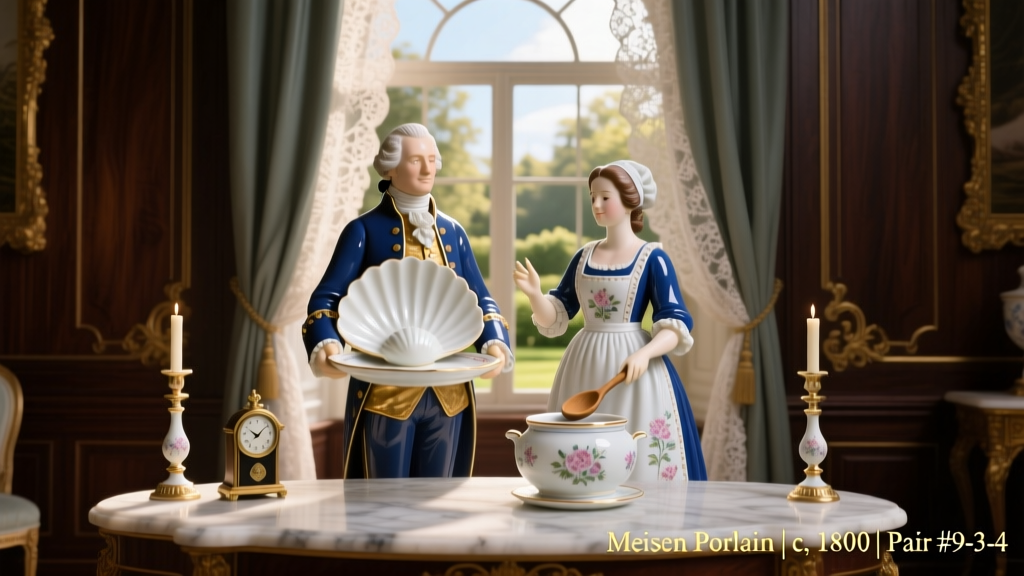
Meissen Shell-Shape Serving Figures: The Man with Pot and Woman Cooking Pair, Circa 1800 — A Technical and Historical Appraisal

Banks Building, New York: The Flat Iron Building’s Cast Iron Legacy and Kenton’s Restorative Precision
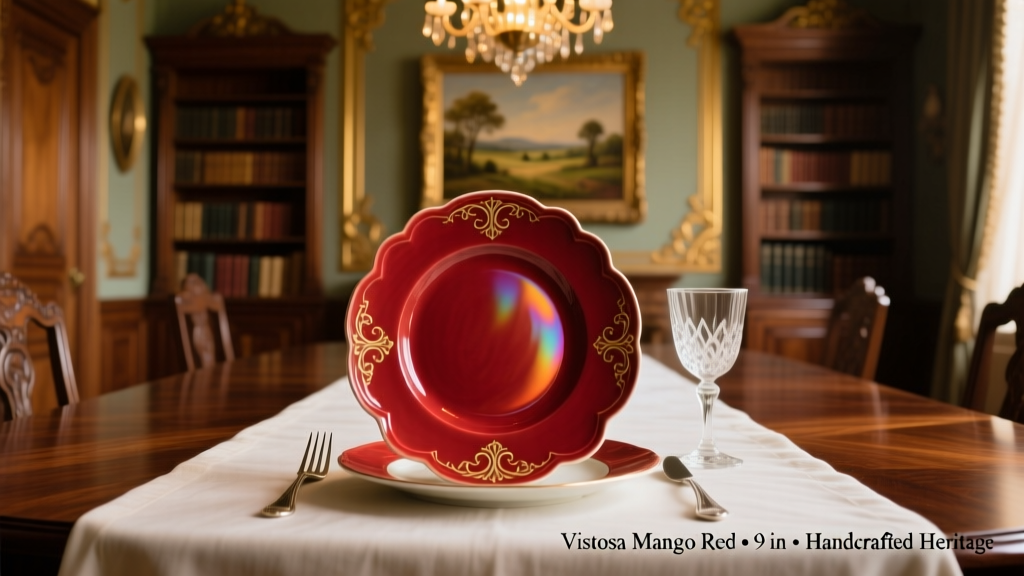
Vistosa Mango Red 9-Inch Dinner Plate: History, Identification, and Restoration Guidance for Collectors
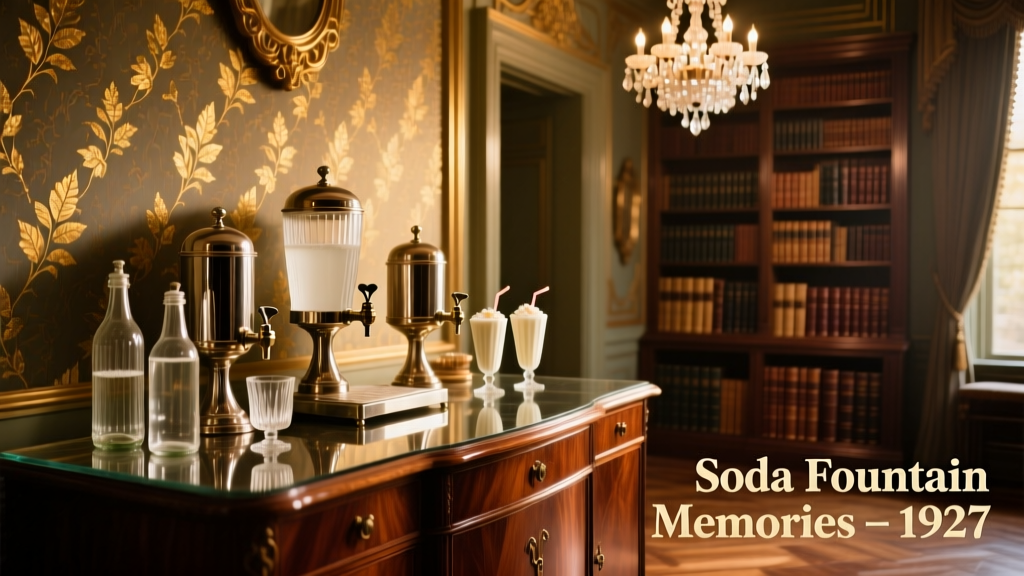
Soda Fountain Collectibles: History, Valuation, and Restoration of Vintage American Ephemera
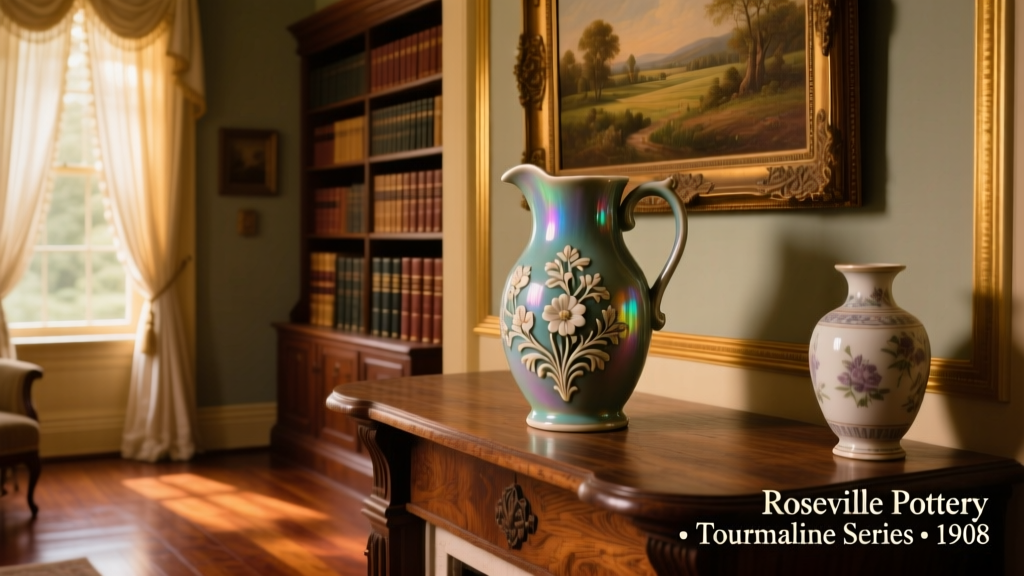
Roseville Jug Tourmaline 7-Inch: Identification, Value, and Restoration Insights for Collectors
Lenox and Other Trenton Porcelain: History, Identification, and Restoration Insights
Royal Crown Derby Red Leaves Plate (8½ Inches): History, Identification, and Restoration Insights