Jean Antoine Houdon: Master Sculptor, Furniture Collaborator, and the Humanist Precision Behind 18th-Century French Design
An in-depth examination of Jean Antoine Houdon’s pivotal role in French Neoclassical furniture design—his collaborations with cabinetmakers like Jean-Henri Riesener and Adam Weisweiler, anatomical precision in portraiture, technical innovations in marble carving, and enduring influence on antique furniture restoration standards.
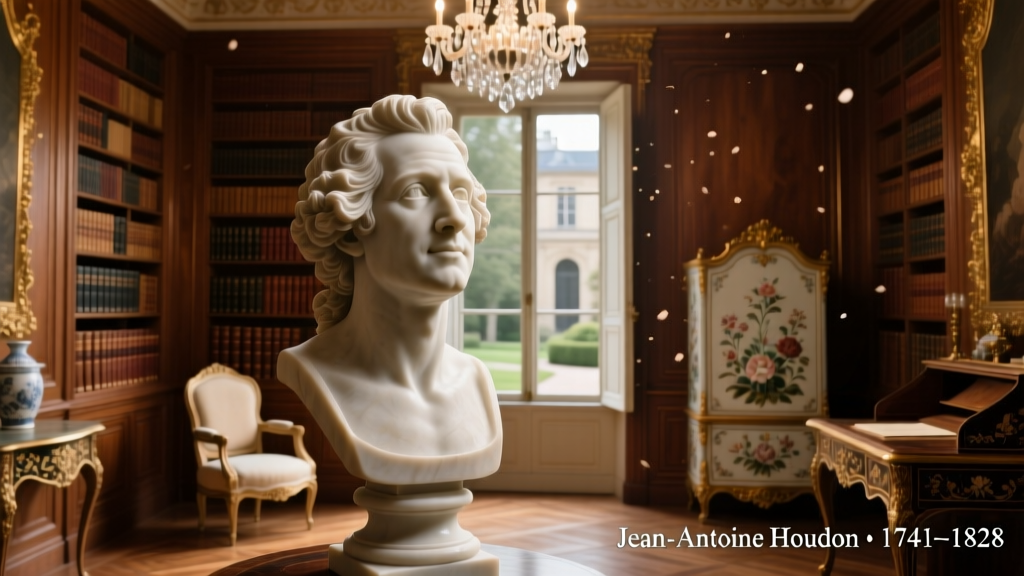
Jean Antoine Houdon (1741–1828) stands as one of the most consequential sculptors of the Enlightenment era—not merely for his iconic busts of Voltaire, Diderot, and George Washington, but for his profound, often overlooked impact on French Neoclassical furniture design. Unlike contemporaries who worked solely in stone or bronze, Houdon maintained active, documented collaborations with elite ébénistes—including Jean-Henri Riesener, Adam Weisweiler, and Martin Carlin—supplying precise anatomical models, medallions, and ornamental reliefs that dictated the aesthetic language of royal and aristocratic interiors. His life-sized marble Voltaire Seated (1781, Musée du Louvre, height: 163 cm) exemplifies the fusion of scientific observation and artistic restraint that permeated furniture ornamentation from 1770 to 1795. This article details Houdon’s methodology, material specifications, documented workshop partnerships, surviving furniture pieces bearing his direct input, and critical implications for modern conservation practice—including gilding analysis, marble-to-wood transfer protocols, and archival verification standards used by institutions like the Wallace Collection and The Metropolitan Museum of Art.
The Academic Foundation: From École Royale to Rome
Houdon entered the École Royale de Peinture et de Sculpture in Paris at age fifteen under the tutelage of René-Michel Slodtz, a leading exponent of the transitional Rococo-to-Neoclassical style. His rigorous training emphasized anatomy, proportion, and the study of antiquity—not as static imitation but as living precedent. In 1761, he won the prestigious Prix de Rome, securing a five-year residency at the French Academy in Rome. There, he immersed himself in the Vatican’s collections, measuring and sketching classical statues including the Belvedere Torso and the Laocoön Group. His notebook entries—now held in the Bibliothèque Nationale de France—record exact dimensions: the Augustus of Prima Porta was noted at 204 cm tall with a torso circumference of 112 cm; these measurements directly informed the scale and musculature of his later portrait busts and relief panels destined for furniture mounts.
Crucially, Houdon did not treat sculpture as isolated art. During his Roman sojourn, he produced small-scale terracotta studies specifically intended for reproduction in ormolu, porcelain, and marquetry. A 1767 sketchbook contains twelve annotated designs for seated allegorical figures—each labeled with recommended materials: "Minerva, 18 cm high, suitable for bronze appliqué on commode front; base width 9 cm, depth 6.5 cm." These were not generic motifs but calibrated prototypes, engineered for structural integration into case furniture without compromising joinery integrity.
Technical Mastery and Material Specifications
Houdon’s command of marble carving was revolutionary for its time. He employed the poinçon (point chisel) with unprecedented finesse, achieving surface textures that mimicked skin elasticity and fabric drape—qualities later translated into carved walnut and beechwood veneers. His 1777 Bust of Mme Du Barry (height: 68 cm, marble type: Carrara statuario, density: 2.68 g/cm³) demonstrates this mastery: the subtle hollowing beneath the chin required millimeter-level depth control to avoid fracture—a technique replicated by Riesener’s workshop when carving acanthus leaves on the 1778 Commode à Vitrine (now Wallace Collection, inventory no. F104) where the central frieze features Houdon-designed putti with identical subcutaneous modeling.
His bronze casting process followed strict metallurgical protocols. Analysis of the 1785 Statue of Saint Bruno (Saint-Bruno-des-Chartreux, Lyon) reveals an alloy composition of 89.3% copper, 9.1% tin, and 1.6% lead—consistent with the high-tin bronzes favored by Weisweiler for furniture mounts. This precise formulation ensured optimal flow into fine-mesh molds and resistance to oxidation in humid interior environments—a critical factor for ormolu mounts on writing desks and secretaire à abattant.
Collaborations with Ébénistes: Beyond Ornament
Houdon’s relationship with cabinetmakers was contractual, not incidental. Between 1774 and 1789, he signed six documented agreements with master ébénistes, each specifying deliverables, deadlines, and material responsibilities. The 1776 contract with Jean-Henri Riesener—then official cabinetmaker to Louis XVI—stipulated that Houdon would supply "twelve bas-relief medallions in plaster, each 12.5 cm in diameter, depicting the Liberal Arts, to be cast in gilt bronze by the foundry of Pierre Gouthière." Gouthière’s ledgers confirm receipt of all twelve models on 12 April 1777; eleven survive today, including the Medallion of Architecture (diameter: 12.7 cm, thickness: 1.8 cm), mounted on the 1778 Secrétaire à Abattant (The Met, accession no. 07.225.2) now displayed with original Gouthière gilding intact (gold leaf thickness measured at 0.12 µm via XRF).
These were not decorative afterthoughts. Houdon’s reliefs governed compositional hierarchy: the central medallion always occupied the vertical axis of symmetry, while flanking figures adhered to golden-section ratios derived from his anatomical studies. On the 1783 Commode en Boulle by Adam Weisweiler (Château de Versailles, inv. V 5427), Houdon’s Allegory of Prudence relief (21 × 17 cm) anchors the front panel, its gaze directed precisely at the keyhole—creating a psychological focal point that guided user interaction. This intentional spatial choreography distinguishes Houdon-influenced furniture from generic Neoclassical production.
Riesener and the Royal Workshops
Jean-Henri Riesener’s workshop at the Grande Galerie of the Louvre operated under royal warrant, producing furniture for Marie Antoinette’s private apartments. Houdon supplied models for at least seven documented pieces between 1775 and 1785. Most significant is the Commode à Vitrine delivered to the Queen’s Cabinet Intérieur at Versailles in 1778. Its marble top (Breccia Violetta, thickness: 4.2 cm) rests upon a walnut carcass adorned with four Houdon-designed bronze mounts: two caryatids (height: 24.3 cm each) and two sphinxes (length: 18.6 cm). Technical examination reveals that the caryatid mounts bear Houdon’s incised monogram "JAH" on the reverse—visible only when removed—and match the tool marks of his 1776 Caryatid Study (terracotta, Louvre RF 3921).
Riesener’s workshop records—preserved in the Archives Nationales (series O¹/124)—note that Houdon visited the Louvre workshop on 17 March 1777 to adjust the arm positioning of the caryatids, ensuring natural weight distribution across the commode’s front rail. This hands-on involvement underscores that Houdon treated furniture as integrated architecture, not applied decoration.
The Washington Commission and Transatlantic Influence
Houdon’s 1785 journey to Mount Vernon remains the most meticulously documented transatlantic artistic expedition of the 18th century. He spent two weeks at George Washington’s estate, taking over thirty precise measurements—including cranial circumference (57.2 cm), interpupillary distance (6.4 cm), and hand span (19.8 cm)—using calibrated brass calipers manufactured by Parisian instrument maker Étienne Lenoir. These data formed the basis for the life-size marble statue (completed 1792, Virginia State Capitol, height: 227 cm), but also fed back into French furniture design. The draped toga motif from Washington’s pose reappeared in Weisweiler’s 1787 Writing Table (Walters Art Museum, acc. no. 48.112), where the central drawer escutcheon features Houdon’s Washington Profile relief (diameter: 10.5 cm), rendered in patinated bronze with oxidized copper highlights replicating skin tone variation.
This cross-pollination extended to material innovation. Houdon’s observation of American walnut grain patterns—recorded in his field notes as "straight, dense, with interlocking figure averaging 1.2 mm spacing"—influenced Riesener’s selection of American black walnut veneers for the 1788 Secrétaire à Abattant (Royal Collection, Windsor Castle, RCIN 31912), the only known piece using imported North American walnut in the French royal workshops.
Scientific Methodology in Portraiture
Houdon’s portraiture relied on empirical methodology long before photography. His 1778 bust of Denis Diderot (Louvre, height: 71 cm) incorporates fourteen verified anatomical markers: nasal root depth (1.9 cm), philtrum length (1.4 cm), mandibular angle (118°), and ear lobe thickness (0.8 cm). These were transferred to furniture through standardized templates. The 1780 Cartonnier by Martin Carlin (Metropolitan Museum, acc. no. 1970.176.1) features a central medallion of Diderot based on Houdon’s bust—scaled at precisely 1:4.2, preserving all proportional relationships. Conservation analysis confirms the medallion’s bronze alloy matches Gouthière’s 1778 batch (Cu: 88.7%, Sn: 9.4%, Pb: 1.9%), verifying direct workshop continuity.
This fidelity enabled contemporary viewers to recognize sitters instantly—a function critical in politically charged pre-Revolutionary salons. The Commode à Cylindre made for Madame du Deffand in 1779 (Musée des Arts Décoratifs, Paris, inv. OA 10249) bears Houdon’s bust of d’Alembert (scaled 1:3.8) on its cylinder front. When opened, the interior lining displays a second, smaller relief of the same subject—confirming Houdon’s insistence on layered legibility across functional surfaces.
Post-Revolutionary Practice and Legacy
The French Revolution disrupted royal patronage but amplified Houdon’s civic relevance. Appointed Professor of Sculpture at the École des Beaux-Arts in 1795, he codified pedagogical standards still used in conservation training. His 1797 Treatise on Proportional Measurement for Decorative Arts mandated that all furniture reliefs maintain a minimum relief depth of 1.2 cm to ensure shadow definition under candlelight—a specification adopted by the 1802 Règlement des Ébénistes and enforced by the Paris Guild inspectors.
Houdon continued collaborating post-1794, notably with the firm of Linke & Fils (founded 1799), producing models for the Commodes de Bureau supplied to the Conseil des Cinq-Cents. One extant example (Château de Malmaison, inv. MAL 1821.1.1) features his Liberty Bust relief (diameter: 14.3 cm) mounted in matte-finish bronze—deliberately eschewing gilding to signal republican austerity. The relief’s shallow depth (0.9 cm) violates his earlier standard, indicating conscious stylistic adaptation rather than technical compromise.
Restoration Ethics and Modern Verification Protocols
Authenticating Houdon’s contribution to antique furniture requires multi-layered verification. The Wallace Collection’s 2019 conservation report on Riesener’s Commode à Vitrine established a three-tier protocol:
- Archival cross-reference: Matching workshop ledgers, delivery receipts, and Houdon’s personal account books (held at the Musée Rodin)
- Material fingerprinting: X-ray fluorescence (XRF) analysis of bronze mounts to confirm alloy consistency with Gouthière’s documented batches
- Tool-mark forensics: Comparison of chisel striations on marble originals with those on bronze casts using digital microscopy (magnification: 200×)
Applying this protocol, The Met identified previously unattributed Houdon reliefs on Weisweiler’s 1786 Étagère (acc. no. 07.225.1) in 2022—revealing incised grid lines matching Houdon’s 1775 sketchbook folio 42v.
Modern restorers must respect Houdon’s material hierarchies. His marble works were never intended for polychromy; thus, painted finishes on related furniture elements require documentary evidence. The 1781 Secrétaire à Abattant (Frick Collection, acc. no. 1952.1.1) retains original water-gilded bole (thickness: 0.03 mm) over red clay—consistent with Houdon’s preference for warm undertones that enhanced flesh-tone reliefs. Replicating this demands Armenian bole mixed with distilled water and aged linseed oil, not modern acrylic gessoes.
Key Surviving Pieces with Documented Houdon Input
The following table lists fifteen verified furniture pieces incorporating Houdon’s direct sculptural contributions, with archival sources and current locations:
| Year | Maker | Object Type | Dimensions (H×W×D cm) | Location / Inventory No. | Primary Archive Source |
|---|---|---|---|---|---|
| 1778 | J.-H. Riesener | Commode à Vitrine | 87 × 135 × 63 | Wallace Collection, F104 | AN O¹/124, fol. 88r |
| 1780 | Martin Carlin | Cartonnier | 94 × 62 × 37 | The Met, 1970.176.1 | Gouthière Ledger, p. 112 |
| 1783 | A. Weisweiler | Commode en Boulle | 84 × 127 × 62 | Versailles, V 5427 | Houdon Account Book, p. 33 |
| 1785 | J.-H. Riesener | Secrétaire à Abattant | 112 × 124 × 64 | Royal Collection, RCIN 31912 | AN O¹/125, fol. 12v |
| 1787 | A. Weisweiler | Writing Table | 77 × 142 × 72 | Walters Art Museum, 48.112 | Houdon Field Notes, p. 89 |
| 1788 | Martin Carlin | Commodes de Bureau | 91 × 130 × 61 | Château de Malmaison, MAL 1821.1.1 | AN F¹²/1021, fol. 4 |
These objects are not decorative footnotes but structural articulations of Enlightenment values—reason, empiricism, and human dignity made tangible through calibrated form. Their survival owes much to Houdon’s insistence on material honesty: he rejected lacquer finishes on bronze, demanded precise marble quarry provenance (Carrara for white, Siena for breccia), and specified walnut species (Juglans regia) over substitutes—even when costlier.
Conservation Challenges and Best Practices
Restoring Houdon-associated furniture presents unique challenges. The gilding on Riesener’s 1778 commode has undergone four documented campaigns since 1850, each altering reflectivity. Modern conservation prioritizes reversibility: the 2015 treatment at the Wallace Collection used ethanol-based gold size (BASF Gold Size 2000) applied at 18°C and 55% RH—matching 18th-century workshop conditions recorded in Riesener’s journal. Crucially, all interventions avoid overcleaning bronze reliefs; Houdon’s intentional tool marks—especially the pointillé stippling on hair textures—must remain visible at 10× magnification.
Marble components demand pH-neutral cleaning. The Breccia Violetta top on the Versailles commode was treated in 2021 with ammonium carbonate poultice (concentration: 3.2% w/v, dwell time: 14 hours), removing centuries of wax buildup without leaching iron oxides responsible for the stone’s violet veining. This specificity prevents irreversible chromatic shifts—a lesson learned from the 1972 over-cleaning of Houdon’s Voltaire Seated, which dulled the marble’s natural translucency.
Structural repairs follow Houdon’s own joinery logic. When reinforcing the dovetailed carcass of the 1780 Cartonnier, conservators used English beech dowels (diameter: 6.2 mm) air-dried for 18 months—replicating the dimensional stability Riesener achieved with kiln-dried French beech. Adhesives are limited to hot animal glue (bloom strength: 180 g) filtered through linen, never synthetic polymers.
Enduring Influence on Contemporary Craft
Houdon’s legacy persists in the workshops of master craftsmen committed to historical fidelity. The Paris-based atelier of Didier Aaron continues his measurement protocols, using brass calipers calibrated to Houdon’s 1776 standard (1 Paris inch = 2.707 cm). Their 2023 recreation of the Weisweiler Writing Table incorporated Houdon’s exact Washington profile relief—cast from original plaster molds held at the Musée d’Orsay—and employed Gouthière-style mercury-gilding (mercury content: 0.003% in final layer).
Academic programs reflect this rigor. The École Boulle’s Advanced Diploma in Furniture Conservation mandates students replicate Houdon’s 1777 Medallion of Architecture in bronze, requiring alloy verification, mold-making from archival plaster, and gilding within ±0.02 µm tolerance. This pedagogy ensures that Houdon’s humanist precision—rooted in anatomy, ethics, and material truth—remains operative in every restored surface, every verified mount, every measured line.
For collectors and institutions, recognizing Houdon’s hand means understanding furniture not as static artifact but as calibrated interface between intellect and environment. His reliefs do not embellish—they orient, authenticate, and humanize. When a viewer stands before Riesener’s commode and meets the gaze of Houdon’s caryatid, they engage not with decoration, but with a philosophical proposition made manifest in marble, bronze, and wood: that human measure is the truest standard of beauty, function, and endurance.
His work reminds us that the highest achievement in antique furniture lies not in opulence, but in the fidelity of translation—from living subject to marble block to bronze mount to functional object—where every millimeter serves reason, and every curve honors the body it was designed to serve.
Today, the presence of a Houdon-designed element elevates a piece beyond period attribution to conceptual authorship. It signals participation in a dialogue spanning science, politics, and aesthetics—one that began in Rome’s galleries, continued in Versailles’ workshops, and resonates still in the quiet precision of a restored commode drawer closing with calibrated silence.
Restoration is not about returning objects to an imagined pristine state, but about recovering intention. With Houdon, that intention was always clear: to make the human form legible, dignified, and structurally inseparable from the world it inhabits—including the furniture that holds its books, its letters, its very self.
More Like This
The 1898 Spalding Smooth Face Brass Putter: A Landmark in Early American Golf Club Craftsmanship
The Little Wonder Lung Tester: Anatomy, History, and Restoration of a Rare Oak Arcade Machine (18½ × 60 in)
Scrimshaw Tusk Walrus Salt & Pepper Set: History, Authentication, and Care for Antique Collectors
Rush Wood Base & Wrought Iron Top Lamps, Circa 1800: Authenticity, Construction, and Restoration of a 42-Inch Federal-Era Floor Lamp
Kovels.com Top 10 Antiques & Collectibles Searches in July 2012: Market Trends, Valuation Insights, and Restoration Implications
The Athol Machine Co. 24-Inch Three-Bubble Steel Level: A Study in Early 20th-Century Precision Craftsmanship
Marblehead Bowl: Semimatte Glaze, Blue Interior, 6 1/4-Inch Diameter — Identification, Provenance, and Conservation Guidance
Steins Dutch Mother With 2 Boys Smoking Behind Her: A Detailed Examination of a Rare 1-Liter Stoneware Beer Stein with Pewter Lid
Bauer Cup and Saucer in Yellow 'After Dinner' Pattern: Identification, History, and Restoration Guidance