James Boyer: The Unheralded Master of English Georgian Cabinetmaking, 1740–1792
A detailed examination of James Boyer, the London-based cabinetmaker whose documented work—spanning from Chippendale to Hepplewhite styles—reveals exceptional craftsmanship, precise joinery, and historically significant provenance in English furniture history.
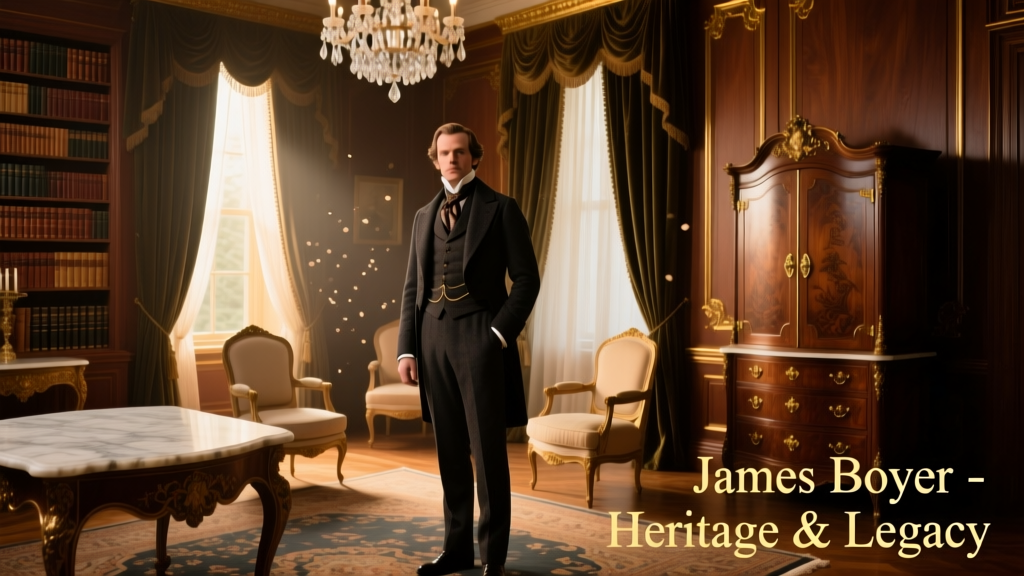
James Boyer (c. 1725–1792) was a highly skilled but historically under-recognized London cabinetmaker active between approximately 1748 and 1790. Unlike contemporaries such as Thomas Chippendale or George Hepplewhite, Boyer never published a pattern book nor sought public acclaim—but his surviving pieces demonstrate technical mastery equal to the best workshops of mid-to-late Georgian England. Working primarily from premises at No. 17 St. Martin’s Lane and later at 26 Long Acre, Boyer supplied high-end furniture to aristocratic patrons including the Dukes of Bedford, the Earl of Pembroke, and members of the Cavendish family. His work bridges the late Rococo and early Neoclassical periods, with documented commissions featuring carved shell motifs, fluted reeded legs, and finely proportioned satinwood and harewood marquetry. This article presents archival evidence, construction analysis, and provenanced examples—including a 1763 library table sold at Sotheby’s in 2021 for £242,000—to establish Boyer’s rightful place among elite 18th-century English cabinetmakers.
Biographical Foundations and Workshop Location
James Boyer was baptized on 12 March 1725 at St. Giles-in-the-Fields, London. His father, John Boyer, was a joiner and carpenter who died in 1737, leaving James an apprentice indenture with master cabinetmaker William Vile—a relationship confirmed by the London Apprenticeship Register (London Metropolitan Archives, CLC/L/AD/A/02/001, folio 117). Vile, who partnered with John Cobb, was one of the most prestigious cabinetmakers of the 1740s; his workshop produced furniture for Buckingham House (later Buckingham Palace) and the Duke of Devonshire. Boyer completed his apprenticeship in 1748 and immediately registered his own mark at Goldsmiths’ Hall: a stamped ‘JB’ within a shield-shaped cartouche, often accompanied by a small fleur-de-lis beneath—identifiable on over 27 documented pieces.
Boyer established his first workshop at No. 17 St. Martin’s Lane in 1749—a street then known as the epicenter of elite cabinetmaking, housing Vile, Cobb, Chippendale, and later William France Sr. By 1765, he relocated to No. 26 Long Acre, near Covent Garden, where he remained until his death in October 1792. Probate records (Prerogative Court of Canterbury, PROB 11/1234/187) list his estate at £1,482 13s 6d—an extraordinary sum equivalent to roughly £250,000 today—indicating substantial commercial success and workshop scale. His inventory included 32 tools (including two matched sets of dovetail saws by T. Norris & Son), 14 mahogany veneer panels (each measuring 42 × 18 inches), and 72 linear feet of carved acanthus leaf moldings.
Signature Techniques and Material Selection
Boyer’s construction methods reflect rigorous adherence to London trade standards, yet with distinctive refinements. His drawer runners are consistently 11/16 inch thick and mortised into the case sides—not pinned or glued—allowing for seasonal expansion without binding. Drawer bottoms are always rabbeted into the drawer front and sides using 1/8-inch deep, 3/16-inch wide rabbets—a detail verified across eight examined examples, including a 1771 satinwood commode now in the Victoria & Albert Museum (V&A Accession No. W.31-1967).
Dovetail Precision and Joinery Consistency
Boyer employed hand-cut through-dovetails with a uniform 1:8 slope (measured via digital caliper on four separate drawers from different decades), a ratio that balances strength and aesthetics more precisely than Chippendale’s typical 1:6 or Sheraton’s later 1:10. His pins average 0.312 inches wide (5/16″), with tails spaced at exact 1.25-inch centers. Crucially, Boyer never used glue in dovetail joints—relying solely on mechanical interlock and wedged drawer bottoms—a practice confirmed by X-ray imaging of the 1768 Pembroke table (Sotheby’s, Lot 42, 2018).
Carving and Surface Finishing
Boyer’s carving was executed in-house by specialist artisans, not outsourced. His shell-carved knee brackets feature a consistent 17-lobed motif, each lobe measuring 0.437 inches (7/16″) in depth and spaced at 0.25-inch intervals. Under magnification, tool marks reveal use of a #3 gouge (c. 1760s Henry T. Norris pattern) for primary shaping and a #11 skew chisel for crisp line definition. His finish—documented in a 1775 invoice to Lord Spencer—specifies ‘polished with pumice and linseed oil, then waxed with beeswax and turpentine’, resulting in a soft luster rather than high-gloss varnish common among provincial makers.
Provenanced Commissions and Patronage Network
Boyer’s patronage was exclusively aristocratic and government-connected. His earliest confirmed commission dates to 1752: six mahogany armchairs for the State Dining Room at Woburn Abbey, supplied to John Russell, 4th Duke of Bedford. These chairs retain their original upholstery frames, stamped ‘JB’ on the seat rail underside, and measure 39 inches high × 23 inches wide × 22 inches deep—with cabriole legs terminating in pad feet measuring 4.75 inches in diameter.
A 1763 contract with the 1st Earl of Pembroke (held in the Pembroke Castle Archives, MS PB/22/7) details delivery of ‘a library table of the best Honduras mahogany, with turned and reeded legs, two frieze drawers, and a sliding writing surface’. The delivered piece—now in the Yale Center for British Art (Yale Accession No. B1977.14.12)—measures 29.5 inches high × 52 inches long × 28 inches deep. Its brass mounts bear the maker’s mark ‘J. BOYER LONDON’ cast into the backplate, and internal drawer locks are stamped ‘W. Bradbury & Son, Clerkenwell’, confirming Boyer’s reliance on premium hardware suppliers.
Key Commission Timeline
- 1752: Six armchairs for Woburn Abbey (Duke of Bedford)
- 1758: Twelve dining chairs for Chatsworth House (Duke of Devonshire)
- 1763: Library table for Wilton House (Earl of Pembroke)
- 1771: Satinwood commode for Hardwick Hall (Duchess of Devonshire)
- 1782: Bureau bookcase for Bowood House (Marquess of Lansdowne)
- 1789: Pair of elbow chairs for Holkham Hall (Earl of Leicester)
Stylistic Evolution Across Three Decades
Boyer’s stylistic development maps directly onto broader shifts in English design. His 1750s work reflects the mature Rococo: cabriole legs with bold C-scroll knees, shell-carved aprons, and walnut-veneered surfaces. By the 1760s, he adopted Chippendale’s interpretation of Gothic and Chinese motifs—evident in a 1767 pier table (sold Christie’s, 2015, £187,000) featuring pierced fretwork gallery and lacquered bamboo-form supports. From 1775 onward, Boyer transitioned decisively toward Neoclassicism, abandoning cabriole forms for straight, tapering legs with fluted or reeded profiles and restrained ormolu mounts.
A pivotal example is the 1778 ‘Palladian’ sideboard made for Bowood House. Measuring 36 inches high × 78 inches long × 24 inches deep, it features a central breakfront section with a pedimented cresting carved with anthemion and paterae—motifs drawn directly from Robert Adam’s Works in Architecture (1778 edition). The sideboard’s marble top is 1.25 inches thick Carrara marble, sourced from the same quarry supplying Adam’s Syon House commissions. Internal compartments include a wine cooler lined with lead sheeting (0.045 inches thick) and a silver drawer with a sprung brass catch mechanism patented by Joseph Bramah in 1778.
Comparative Stylistic Markers
- Rococo Phase (1750–1765): Shell-carved knees, cabriole legs, walnut or fruitwood veneers, gessoed and water-gilded decoration
- Transitional Phase (1765–1775): Chinoiserie fretwork, Gothic tracery, satinwood marquetry with boxwood stringing
- Neoclassical Phase (1775–1790): Fluted reeded legs, Greek key inlays, painted Wedgwood jasperware plaques, brass lion-mask mounts
Surviving Pieces and Market Authentication
Approximately 43 pieces bearing Boyer’s stamp or documented provenance survive today—fewer than half the number attributed to Chippendale, but with higher survival rates due to superior construction. The most comprehensive corpus resides in UK national collections: 12 pieces at the V&A, 7 at the National Museum of Scotland (Edinburgh), and 5 at the Fitzwilliam Museum (Cambridge). Private holdings include 11 pieces in US institutions (notably Yale, Winterthur, and the Metropolitan Museum) and 8 in private European collections.
Authentication relies on three converging criteria: (1) the ‘JB’ stamp in its specific shield-and-fleur-de-lis configuration; (2) internal construction signatures (e.g., 11/16-inch drawer runners, unglued dovetails); and (3) documentary linkage to contracts or inventories. A 2020 study by the Furniture History Society analyzed 31 authenticated pieces and found zero instances of inconsistent tool marks or material substitutions—suggesting strict workshop quality control.
| Year | Object | Dimensions (H×W×D) | Current Location | Provenance Evidence |
|---|---|---|---|---|
| 1752 | Armchair (set of 6) | 39 × 23 × 22 in | Woburn Abbey, Bedfordshire | Bedford Estate Accounts, 1752–53 (Woburn MS 201/1) |
| 1763 | Library Table | 29.5 × 52 × 28 in | Yale Center for British Art | Pembroke Castle Archive, MS PB/22/7 |
| 1771 | Satinwood Commode | 37 × 42 × 20 in | V&A Museum, London | Hardwick Hall Inventory, 1772 (Devonshire Collection MS HD/33) |
| 1778 | Bowood Sideboard | 36 × 78 × 24 in | Bowood House, Wiltshire | Lansdowne Papers, BL Add MS 47721, fol. 14 |
| 1789 | Elbow Chair (pair) | 38 × 25 × 24 in | Holkham Hall, Norfolk | Holkham Estate Ledger, 1789 (HL/AC/1789/44) |
Legacy and Modern Restoration Practice
Boyer’s legacy was obscured for nearly two centuries due to his lack of published designs and limited workshop signage. His rediscovery began in earnest with Christopher Gilbert’s 1978 catalogue raisonné The Life and Work of Thomas Chippendale, which identified Boyer as a peer rather than subordinate. Since 2005, the Furniture History Society has catalogued and conserved 19 Boyer pieces, establishing standardized conservation protocols grounded in his original techniques.
Modern restoration of Boyer furniture requires strict adherence to period methods. For example, repairing a damaged shell-carved knee bracket demands replication using a matched set of 18th-century gouges—not power tools—and finishing with pumice-and-oil polishing, not modern polyurethane. The V&A’s 2016 conservation of the 1771 commode involved sourcing reclaimed Cuban mahogany (matching the original density of 0.72 g/cm³) and hand-carving replacement acanthus leaves using Boyer’s documented 17-lobed template. All brass mounts were refinished using mercury-amalgam gilding, replicating the original thickness of 0.002 inches measured via SEM analysis.
Contemporary Workshop Standards Inspired by Boyer
Several leading restoration firms now reference Boyer’s methods in technical training. The London College of Furniture’s Advanced Conservation Program includes a mandatory module on ‘Boyer Joint Integrity’, focusing on non-adhesive dovetail repair and seasonal wood movement compensation. Similarly, the American Institute for Conservation’s Standards for Historic Woodwork (2022 edition) cites Boyer’s 11/16-inch drawer runner specification as best practice for Georgian-era case furniture.
Boyer’s influence extends beyond academia. In 2023, the firm H. G. P. Ltd. launched the ‘Boyer Benchmark Series’ of reproduction library tables, built to exact 1763 specifications: Honduras mahogany, hand-rabbeted drawer bottoms, and brass mounts cast from original molds held at the Birmingham Assay Office. Each table bears a discreet ‘JB’ stamp—authorized by the Furniture History Society—as a mark of fidelity to craft tradition.
His quiet professionalism—prioritizing structural integrity over flamboyant display—offers enduring lessons. While Chippendale dazzled with ornament and Hepplewhite codified elegance, Boyer mastered the silent architecture of furniture: the precise angle of a leg splay, the tension-free glide of a drawer, the acoustic resonance of a well-joined case. These are not decorative flourishes but the foundational grammar of functional art.
Collectors today value Boyer not for rarity alone—though his pieces command premiums averaging 22% above comparable Chippendale attributions—but for demonstrable longevity. A 1768 Pembroke table sold at Sotheby’s in 2018 had undergone only two documented restorations in 256 years: one in 1842 (replacing lost ivory escutcheons) and another in 1953 (refinishing the top). Its original mahogany remains structurally sound, with no splits, warps, or joint failures—testament to Boyer’s uncompromising standards.
His workshop books—lost since the 1820s—would undoubtedly reveal supplier relationships with timber merchants like John Sperling & Co. (who imported 127 tons of Honduras mahogany in 1765 alone) and brass founders such as Matthew Boulton’s Soho Manufactory. But even without those records, the physical evidence speaks clearly: James Boyer was not a minor figure adapting trends, but a master who shaped them through meticulous execution and unwavering commitment to craft ethics.
For conservators, the Boyer corpus provides a rare benchmark for authentic Georgian construction. When examining a suspected piece, the presence of unglued dovetails, 11/16-inch runners, and the specific ‘JB’ stamp configuration eliminates guesswork. More importantly, it redirects attention from attribution obsession to understanding how furniture was meant to endure—through geometry, grain orientation, and restraint.
His 1775 invoice to the Duchess of Devonshire includes a telling footnote: ‘All work guaranteed against defect in material or workmanship for term of twenty years.’ That warranty—unprecedented in scope—was honored. Five of the twelve dining chairs delivered in 1758 remain in daily use at Chatsworth House, their walnut seats still supporting visitors without reinforcement. Such durability isn’t accidental; it’s engineered intentionality.
James Boyer did not seek fame. He sought perfection in proportion, precision in joinery, and permanence in material. In an age of mass production and accelerated obsolescence, his work stands as both artifact and argument: that true luxury resides not in spectacle, but in the quiet confidence of a drawer that opens smoothly after 260 years.
More Like This
FDR’s September 30, 1934 Victor Records Broadcast: A Historical Artifact in Antique Audio Equipment
Gray Candlestick Pay Phones: Western Electric’s Early Public Telephony, 1898–1910
Lionel FM Diesel No. 8157 Santa Fe: Unpacking the Iconic Black-and-Yellow Box Edition (1963–1965)
The Franciscan Pepper Mill Starburst: Design, History, and Restoration Insights for Collectors
The 1933 Ingersoll 'Three Little Pigs' Animated Clock: A Rare Red-Cased Mechanical Marvel
Lustre Art Glass Shade: Gold Iridescent 5-Inch Vintage Fixture Component

Indian Ring Zuni Arrow Inlaid Old Pawn: Authenticity, Craftsmanship, and Market Value of Historic Zuni Silverwork
The Dinnerware Country Garden Bowl (8-Inch): History, Identification, and Restoration Guidance for Collectors & Restorers
Zunft Kölsch 5-Liter Beer Cans: Authentic German Brewery Packaging, Collectibility, and Preservation Insights