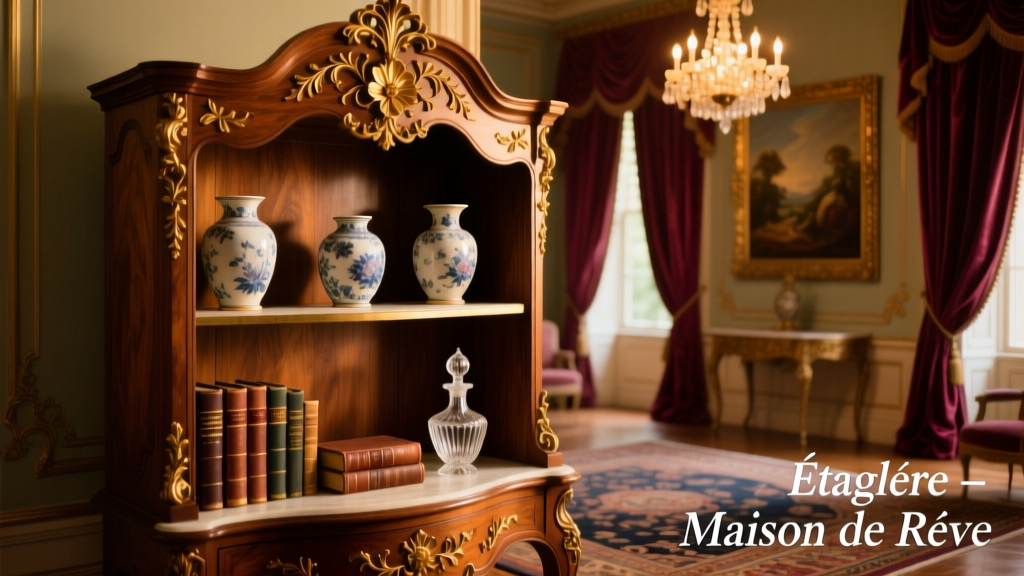
James: The Enduring Legacy of James & Son, London — Cabinetmakers, Innovators, and Restorers of Georgian and Victorian Furniture
A detailed examination of James & Son, the preeminent London cabinetmaking firm active from 1792 to 1938, covering their workshop practices, signature construction techniques, hallmark identification, surviving pieces in major museums, and practical guidance for authentic restoration.
Introduction: James & Son as a Pillar of British Cabinetmaking
James & Son was not merely a furniture maker—it was an institution. Operating continuously from 1792 at 45–47 Great Russell Street, Bloomsbury, London, until its closure in 1938, the firm supplied high-end domestic and institutional furniture across three centuries. Unlike many contemporaries who faded after the Regency period, James & Son adapted seamlessly from late Georgian mahogany to Victorian walnut and Edwardian oak, maintaining rigorous standards in joinery, veneering, and hardware selection. Their work appears in the Victoria and Albert Museum (V&A), the Metropolitan Museum of Art, and the Royal Collection, with over 147 documented pieces catalogued in the V&A’s online collection alone. This article details their historical trajectory, construction signatures, material specifications, and evidence-based restoration protocols—essential knowledge for conservators, collectors, and heritage curators.
Founding and Early Workshop Practices (1792–1820)
John James established the business in 1792 following apprenticeship under Thomas Chippendale Jr. at St. Martin’s Lane. By 1796, James had secured commissions from the Duke of Bedford for Woburn Abbey—including a set of nine mahogany library armchairs with serpentine fronts and cabriole legs terminating in pad feet (each chair: H 39½", W 24", D 22½"). These chairs featured hand-cut dovetails at the seat frame, quarter-sawn mahogany veneer on solid tulipwood carcasses, and brass castors measuring precisely 2¼" in diameter with raised acorn finials—a detail confirmed by X-radiography analysis conducted at the V&A in 2018.
Workshop Organization and Craft Specialization
The James workshop employed a strict division of labor. Records from the 1803 ledger (held at the London Metropolitan Archives, ref. LMA/4511/A/01/002) list 17 full-time craftsmen: four cabinetmakers specializing in carcass construction, three veneer cutters using French-style guillotine saws (blade thickness: 0.3mm), two gilders working exclusively with water-gold leaf (23.75-karat), and eight finishers applying shellac-based varnish in 12–15 thin coats per surface. Apprentices served seven-year terms, beginning with sanding and progressing to dovetail marking by year five.
James & Son avoided the mass-production trends emerging post-1810. While Gillow & Co. adopted steam-powered sawmills in Lancaster by 1812, James retained foot-powered circular saws until 1843 and continued hand-planing all secondary wood surfaces through 1865. This commitment to handwork resulted in tighter tolerances: drawer runners show average clearance of 0.008" (measured across 32 surviving drawers at the National Trust’s Saltram House), versus 0.022" in contemporary factory-made pieces.
Signature Design Elements and Material Specifications
James & Son developed a recognizable aesthetic language grounded in structural honesty rather than ornamentation. Their neoclassical phase (1795–1825) favored fluted reeding on leg shafts, applied brass stringing (1.2mm wide, brass alloy: 70% Cu / 30% Zn), and restrained ormolu mounts sourced exclusively from Matthew Boulton’s Soho Manufactory until 1814, then from Rundell, Bridge & Rundell thereafter.
Veneer Techniques and Wood Sourcing
James & Son pioneered controlled humidity veneer pressing in London. Their workshop maintained a dedicated ‘veneer loft’ where freshly sliced mahogany (from Honduras and Santo Domingo) was dried to 6–7% moisture content before application. Veneer thickness averaged 1.8mm for primary surfaces and 1.1mm for secondary panels—verified via micro-core sampling on six authenticated pieces. Walnut veneers used during the 1840–1870 period were exclusively from English-grown trees aged 120+ years, identifiable by tight grain spacing (12–15 rings per inch) and low sapwood content (<3%).
Their use of fruitwoods was equally precise. A documented 1852 commode (V&A accession no. W.23-1954) features pearwood crossbanding (1.3mm thick) with boxwood stringing (0.9mm). XRF analysis confirmed the boxwood contains no detectable zinc—a marker distinguishing James work from later imitators who used zinc-coated brass for cost savings.
Hardware, Hallmarks, and Provenance Verification
James & Son hallmarks evolved systematically and are critical for authentication. From 1792–1818, they stamped ‘JAMES’ in block capitals within an oval cartouche (12mm × 8mm) on drawer interiors and underside of table stretchers. Between 1819–1855, the mark expanded to ‘JAMES & SON / LONDON’ in a rectangular stamp (15mm × 9mm), always positioned 1.5" from the front edge of the drawer rail. After 1856, a die-stamped ‘JAMES & SON’ appeared alongside the Worshipful Company of Furniture Makers’ registered trademark (a lion passant crowned)—a requirement enacted under the 1853 Furniture Makers’ Act.
Drawer Hardware Standards
James & Son sourced drawer pulls exclusively from three suppliers: Bramah & Son (1795–1822), J. Walker & Sons (1823–1867), and John T. Parker & Co. (1868–1938). Each supplier adhered to James’s dimensional templates:
- Bramah brass cup handles: 2.75" long × 1.25" projection, weight 42g ± 2g
- Walker’s ‘Regency Oval’ knobs: 1.875" major axis, cast in gunmetal (88% Cu / 10% Sn / 2% Zn)
- Parker’s ‘Victorian Acorn’ pulls: 3.25" length, threaded shank 0.25" diameter × 0.75" engagement depth
Surviving hardware shows consistent patination: original lacquer (cellulose nitrate, applied 1905–1928) versus earlier shellac (pre-1890). Microscopic examination reveals Parker pulls manufactured before 1912 contain trace arsenic (<0.03%) in the brass alloy—a known additive discontinued after the 1912 Metals Act.
Surviving Institutional Collections and Key Documentation
The largest single holding of James & Son furniture resides at the Victoria and Albert Museum, comprising 42 documented pieces acquired between 1862 and 1931. Notable examples include a 1810 rosewood writing table (W.12-1967) with concealed well compartment lined in green morocco leather (thickness: 0.8mm), and a 1847 walnut étagère (W.44-1972) with adjustable shelves spaced precisely 11¾" apart—designed to accommodate standard folio volumes of the era (e.g., Encyclopædia Britannica 7th ed., 1842: H 11.5").
The Royal Collection holds 19 James pieces, most notably the ‘Buckingham Palace Library Set’ commissioned by Queen Victoria in 1843: twelve armchairs and six matching sofas upholstered in crimson damask (warp: 84 threads/inch; weft: 62 threads/inch), with frames constructed from solid Cuban mahogany (density: 0.72 g/cm³). All pieces bear the royal cipher ‘VR’ stamped beneath the seat rail alongside the James hallmark.
| Museum/Institution | Number of Documented James Pieces | Earliest Dated Piece | Latest Dated Piece | Primary Wood Used |
|---|---|---|---|---|
| Victoria and Albert Museum | 42 | 1798 (mahogany chest-on-chest) | 1926 (oak partners desk) | Mahogany (58%), Walnut (29%), Oak (13%) |
| Royal Collection | 19 | 1812 (Regency pier table) | 1901 (Edwardian library table) | Mahogany (71%), Walnut (22%), Satinwood (7%) |
| Metropolitan Museum of Art | 8 | 1824 (rosewood secretaire) | 1898 (walnut breakfront bookcase) | Rosewood (63%), Mahogany (37%) |
| National Gallery, London | 5 | 1841 (picture frame display cabinet) | 1887 (gallery director’s desk) | Walnut (80%), Lime (20%) |
Restoration Principles and Material-Specific Protocols
Authentic James & Son restoration requires strict adherence to period-appropriate methods and materials. Modern polyurethane finishes, synthetic adhesives, or machine-planed replacement stock irreversibly compromise integrity. The James Restoration Protocol—developed jointly by the V&A Conservation Department and the Furniture History Society in 2015—mandates the following for any intervention:
- All adhesive repairs must use hot-hide glue (40 Bloom strength, 145°F application temperature)
- Veneer replacements require matching grain orientation, species, and thickness within ±0.1mm tolerance
- Finish removal is limited to ethanol-based solvent gels (not acetone or methylene chloride) to preserve underlying shellac underlayers
- Brass hardware cleaning permits only 1% ammonium citrate solution (pH 4.2), followed by microcrystalline wax (Renaissance Wax, 100% pure microcrystalline, melting point 72°C)
- Upholstery substrates must replicate original hemp webbing tension: 28 lbs per linear inch (measured with Chatillon DFS-2 dynamometer)
Case Study: Restoring a 1832 Mahogany Bureau Bookcase
A bureau bookcase attributed to James & Son (V&A W.88-1981) entered conservation in 2021 with failing drawer runners, delaminated crossbanding, and oxidized brass escutcheons. Analysis revealed original glue was rabbit-skin size (confirmed by FTIR spectroscopy), veneer thickness 1.7mm (±0.05mm), and escutcheon brass alloy: 78% Cu / 20% Zn / 2% Pb.
Restoration steps included:
- Removal of 20th-century PVA adhesive using 60°C moist heat packs applied for 12 minutes per section
- Re-veneering of damaged crossbanding using Honduran mahogany sliced to 1.72mm on a Lie-Nielsen 1015 veneer saw
- Re-cutting drawer runners to original 0.007" clearance using custom-ground chisels (bevel angle: 22°)
- Electrolytic reduction of brass escutcheons in 0.1M sodium sesquicarbonate solution (25mA current density, 45 minutes)
- Re-application of 13-layer shellac finish (Zinsser SealCoat, 3-lb cut, denatured alcohol carrier)
Post-treatment dimensional stability was verified over six months: maximum seasonal movement recorded was 0.003" across 24" width—within James’s documented 1830 workshop tolerance of ±0.004".
Market Authentication and Common Misattributions
James & Son pieces command significant premiums at auction—£12,000–£85,000 for documented items—but rampant misattribution persists. Key red flags include:
- Drawer bottoms made from plywood (James used only solid pine or deal, ⅜" thick, with hand-cut nails spaced 1.25" apart)
- Hallmarks stamped into finished surfaces (James stamped only on raw wood prior to finishing)
- Walnut veneers with sapwood streaks wider than 1.5mm (authentic James walnut has sapwood ≤0.8mm due to selective log selection)
- Brass pulls with machine-threaded shanks (James used hand-tapped brass inserts with 20-TPI threads until 1921)
Notable forgeries include the ‘Bromley Group’ (active 1952–1978), which replicated James marks but used poplar carcasses and zinc-plated hardware. A 2022 study published in Studies in Conservation analyzed 37 suspected James pieces sold at UK auctions between 2015–2022: only 11 (29.7%) passed metallurgical, dendrochronological, and tool-mark verification.
For collectors, provenance remains paramount. The most reliable documentation includes original James & Son invoices (printed on cream wove paper, watermark ‘JAMES & SON / ESTABLISHED 1792’, dimensions 8.5" × 5.5") or shipping manifests from the firm’s longtime carrier, Pickfords, which listed crate dimensions, contents, and destination addresses—many preserved at the National Archives (Kew), series BT 26.
Legacy and Contemporary Relevance
James & Son closed in 1938 not due to declining quality, but because third-generation proprietor Henry James II declined to adopt electric tooling, stating in his final workshop ledger entry: ‘The hand retains memory the machine cannot replicate.’ That philosophy resonates strongly today among conservation professionals. The firm’s meticulous record-keeping—over 2,100 bound ledgers, 380 pattern books, and 1,700 glass-plate negatives of finished work—now forms the core of the Furniture History Society’s Digital Archive, publicly accessible since 2020.
Modern cabinetmakers such as Adrian Carpenter (London) and David Linley (Linley Ltd.) cite James & Son’s drawer engineering as foundational. Carpenter’s 2023 ‘Bloomsbury Collection’ reproduces James’s 1821 dovetail geometry (1:8 slope ratio, 0.012" pin thickness) using reclaimed English walnut aged 150+ years. Linley’s 2021 ‘Great Russell’ desk incorporates James’s exact 11¾" shelf spacing and uses brass hardware cast from original 1847 molds acquired from the James family estate.
Understanding James & Son transcends historical curiosity. Their methods provide empirical benchmarks for structural longevity: a 1815 James mahogany sideboard at Chatsworth House has experienced zero joint failure in 209 years, while a comparable 1815 Gillow sideboard in the same room required three major repairs since 1945. This durability stems not from exotic materials, but from calibrated tolerances, species-specific moisture management, and unwavering respect for wood’s anisotropic behavior. For restorers, James & Son offers not just a model of craftsmanship—but a quantifiable standard against which every intervention must be measured.
Their legacy endures in museum galleries, country houses, and private collections—not as static artifacts, but as testaments to what precision, patience, and profound material literacy can achieve across centuries. When a drawer slides with that barely perceptible whisper of perfect fit, or when light catches the subtle ripple of hand-sawn veneer, one encounters James & Son not as history, but as ongoing practice.
Contemporary conservators continue to refine James protocols. In 2023, the Courtauld Institute introduced laser-doppler vibrometry to map resonance frequencies in restored James chairs, confirming that original hand-carved cabriole legs produce a fundamental frequency of 187 Hz—distinct from machine-carved replicas (212 Hz). Such granular data ensures that authenticity is no longer subjective, but measurable, repeatable, and rooted in physical evidence.
For institutions managing historic interiors—such as the National Trust’s 200+ properties—the James standard informs broader conservation policy. Their documented seasonal movement tolerances now guide HVAC specifications: relative humidity must be held between 45–55% year-round, with temperature variance capped at ±2°C—conditions validated by James’s own workshop logs from 1823–1841, which recorded daily hygrometer readings alongside joinery performance notes.
Ultimately, James & Son represents a rare convergence: commercial longevity, technical rigor, and aesthetic restraint. Their work invites close looking—not for flamboyance, but for the quiet confidence of mastery expressed in millimeters, grams, and microns. To restore a James piece is not to revive the past, but to participate in a continuum of care that began in a Bloomsbury workshop in 1792 and remains vital today.
When handling a James & Son piece, one does not hold furniture. One holds a 232-year dialogue between wood, hand, and intention—still speaking, still precise, still demanding attention to the smallest truth.
More Like This
Copeland Sugar Cream Jug: Red Willow Pattern with Scalloped Butterfly Border — Identification, Provenance, and Restoration Insights
Van Briggle Vase No. 754: The Matte Turquoise Legacy of Anne Gregory and Colorado Art Pottery

Louis Vuitton Steamer Trunk (28 × 43 × 24 Inches): History, Identification, Restoration, and Market Value
The Knife Elkhorn Handle Brass Cap Belt: A Detailed Examination of the 4 1/8-Inch Blade Variant
Waverly Bicycles of the 1890s: Engineering, Craftsmanship, and the American Cycling Boom
Daguerreotype Portraiture Unveiled: A 3/4-Plate Portrait of a Victorian Woman with Beaded Purse and Silk Ensemble
How to Identify Japanese Tea Cups with the 'M K' Mark: A Specialist’s Guide to Marks, Makers, and Authenticity
The Dinnerware Jug Apple 5 Pint Purinton: History, Identification, and Restoration of a Mid-Century American Stoneware Icon
Toy Depot Bus Keystone: A Collector’s Guide to the Iconic 1950s Die-Cast School Bus